Discharge Process 2017 ANCC National Magnet Conference Session - - PDF document

discharge process
SMART_READER_LITE
LIVE PREVIEW

Discharge Process 2017 ANCC National Magnet Conference Session - - PDF document

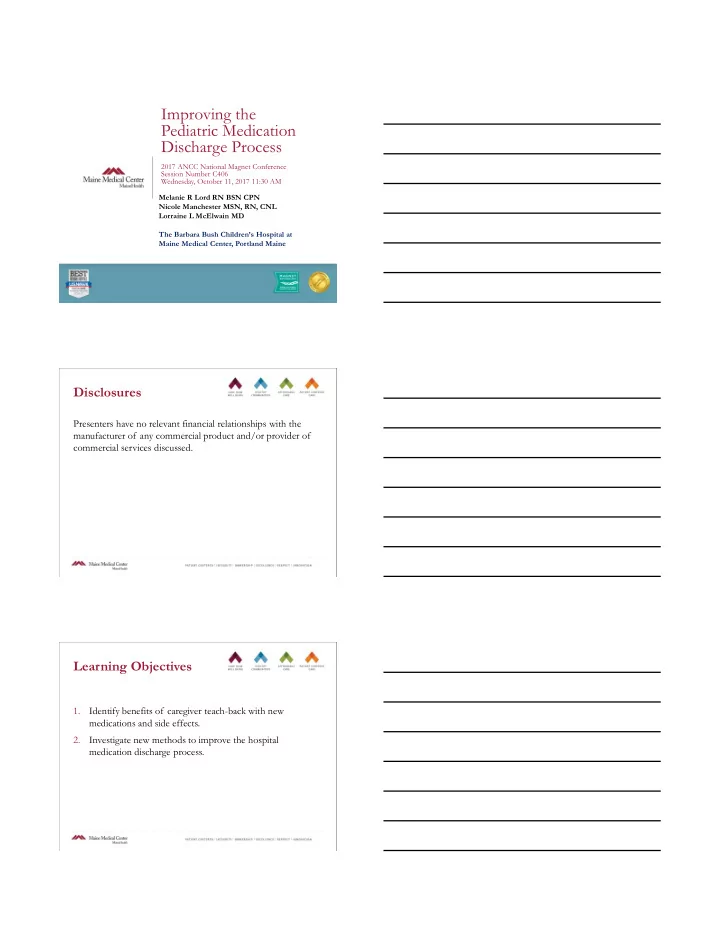
Improving the Pediatric Medication Discharge Process 2017 ANCC National Magnet Conference Session Number C406 Wednesday, October 11, 2017 11:30 AM Melanie R Lord RN BSN CPN Nicole Manchester MSN, RN, CNL Lorraine L McElwain MD The Barbara


slide-1
SLIDE 1

Melanie R Lord RN BSN CPN Nicole Manchester MSN, RN, CNL Lorraine L McElwain MD The Barbara Bush Children’s Hospital at Maine Medical Center, Portland Maine

Improving the Pediatric Medication Discharge Process

2017 ANCC National Magnet Conference Session Number C406 Wednesday, October 11, 2017 11:30 AM

Disclosures

Presenters have no relevant financial relationships with the manufacturer of any commercial product and/or provider of commercial services discussed.

Learning Objectives

1. Identify benefits of caregiver teach-back with new medications and side effects. 2. Investigate new methods to improve the hospital medication discharge process.

slide-2
SLIDE 2

Setting

  • Maine Medical Center is an academic, urban hospital with 600

licensed beds in Portland Maine

  • The Barbara Bush Children’s Hospital is embedded within

Maine Medical Center

  • Maine Medical Center received it’s 3rd Magnet designation in

2017

The Barbara Bush Children’s Hospital

  • 116 licensed beds including the following:
  • 30 inpatient pediatric beds
  • 7 short stay beds
  • 8 PICU beds
  • 51 NICU/CCN beds
  • 20 newborn beds
  • The only children’s hospital in the state of Maine, serving

Maine and eastern New Hampshire

  • Pediatric Hospital Medicine (PHM) joined Project IMPACT (Improving

Pediatric Patient-Centered Care Transitions), a National AAP QI Project in

  • 2013. The project’s aim was to improve the discharge process for patients and

families and to help create a best practice pediatric discharge bundle.

  • Discharge Bundle elements tested by our Discharge Improvement Team :
  • 1. Pre-discharge teach-back education
  • 2. Discharge readiness checklist
  • 3. Inpatient to outpatient provider handoff
  • 4. Follow-up phone call to family caregiver

6

Background

slide-3
SLIDE 3

Our Baseline Data

  • Follow up phone calls revealed opportunities for improvement

with discharge medications

  • Medication errors: 7% of caregivers/family members unable to

teach-back medications correctly

  • HCAHPS responses on questions regarding medication

teaching were below national average

  • Examples of discharge medication errors:
  • Did not pick-up medication on way home (child sick, did not

want to wait at pharmacy, pharmacy was closed, liquid form of medication not available)

  • Did not have the money to pay for the medication
  • Prior Authorization was needed for the medication, medication

not obtained

  • Did not know how or when to give medication
  • Did not realize the medication should be started right away (as
  • pposed to waiting until after the weekend)

8

Goal: Improve the discharge medication process

Interventions

  • Formed an inter-professional team
  • Refresher for staff on Teach-Back technique
  • EHR optimization - created the “Consult to Outpatient

Pharmacy” order to enhance communication with our on-site retail pharmacy

  • Expanded capacity of bedside delivery
  • Pharmacist or Nurse education at bedside with medications

in hand

  • Discuss reason for medicine, potential side effects
  • Employ teach-back method
slide-4
SLIDE 4

Improve access to new medications:

  • Increase % of patients leaving the hospital with new

medications in hand from ~2% to 50% by the end of a 2-year 1st study period (Discharge Improvement Team).

  • Increase the % further in the 2nd study period

(Discharge Medication Process Improvement Work Group).

11

Primary Driver:

Improve understanding of new medication plans:

  • Improve family member understanding of medication

plans as measured by ability to accurately “teach-back” details on a post-discharge phone call.

  • Improve family member experience and satisfaction

with explanation of side effects of new medications and how to take new medications to or above national average as measured by our HCAHPS tool

12

Primary Driver cont.

slide-5
SLIDE 5
  • Improve access to new medications:
  • 1. Access to onsite retail pharmacy
  • 2. Availability of bedside delivery
  • 3. Earlier identification of financial barriers
  • 4. Earlier identification of prescription errors

13

Secondary Drivers:

  • Improve understanding of new medication plans:
  • 1. Teaching with medications in hand
  • 2. Teach-back technique
  • 3. Discharge medication teaching by pharmacists, reinforced by

nursing staff

14

Secondary Drivers: Nursing Teach-Back

  • An evidence-based method to improve understanding and

retention of discharge instructions

  • Chosen as the preferred method of discharge teaching by

Project IMPACT

  • Educated staff nurses on the inpatient pediatric unit utilizing
  • ne on one teaching and computer based education modules
slide-6
SLIDE 6
  • A teaching technique where family members demonstrate

their understanding

  • Prevents incorrect understanding and reinforces retention of

medical information

  • Uses simple language, avoids confusing medical jargon
  • Allows for immediate correction of misunderstandings prior

to discharge

  • Confirms understanding after repeated clarification

16

Teach-Back

  • Patient initially taught discharge information
  • At the end of initial teaching, comprehension is tested
  • “I want to be sure I am explaining this well. Can you repeat

this back to me to be sure it’s clear?”

  • Discharge medications
  • Follow up appointments
  • Contingency Plan
  • Home Care and/or equipment

17

Teach-Back Teach-Back

Perceived nursing concerns:

  • Talked down to/paternalistic
  • Family offended

Actual feedback:

  • Families appreciated the reinforcement
  • Sustained use of the method with ongoing evidence and

education

slide-7
SLIDE 7

Teach-Back

  • Additional

focus/education on medication instructions (dosing, side effects, reason for treatment)

  • Comfort with teach-back

technique strengthened

  • EHR tool developed to

support technique

Interdisciplinary team: resident & attending physicians, nurses, parent representatives, care managers, and pharmacists performed series of planned sequential interventions (PDSA cycles) and plotted/interpreted data on statistical process control charts

  • Observational time series:

Jan 2014 - Dec 2015 (2 yrs, 1st study period) Jan 2016 - Dec 2016 (1 yr, 2nd study period)

  • Population - all patients discharged from our Pediatric Hospital Medicine service

~1100 patients per year

  • EHR review including post-discharge phone call transcripts
  • HCAHPS responses
  • Hospital discharge time data

20

Data Collection Process measures

  • Use of “Consult to Outpatient Pharmacy” order in EHR
  • Bedside medication delivery
  • Discharge with meds in hand
slide-8
SLIDE 8

22

Results-Process Measure

UCL LCL

0% 10% 20% 30% 40% 50% 60% 70% 80% 90% 100% 1/1/15 2/1/15 3/1/15 4/1/15 5/1/15 6/1/15 7/1/15 8/1/15 9/1/15 10/11/15 11/1/15 12/1/15 1/1/16 2/1/16 3/1/16 4/1/16 5/1/16 6/1/16 7/1/16 8/1/16 9/1/16 10/1/16 11/1/16 12/1/16

Utilization of “Consult to Outpatient Pharmacy” order in EHR

Percent of e-prescription to our onsite retail pharmacy with a corresponding “Consult to Outpatient Pharmacy” order First study period Second study period “Discharge Medication Process Improvement Work Group” formed Benefits of enhanced communication with outpatient pharmacists becomes routinely reinforced at unit’s daily Interdisciplinary Care Rounds +3 sigma Rotating providers during the Holidays

  • 3 sigma

mean=8% mean=28% mean=88% “Consult to Outpatient Pharmacy” becomes a selectable order in EHR

23

Results-Process Measure

UCL LCL

0% 10% 20% 30% 40% 50% 60% 70% 80% 90% 1/1/15 2/1/15 3/1/15 4/1/15 5/1/15 6/1/15 7/1/15 8/1/15 9/1/15 10/1/15 11/1/15 12/1/15 1/1/16 2/1/16 3/1/16 4/1/16 5/1/16 6/1/16 7/1/16 8/1/16 9/1/16 10/1/16 11/1/16 12/1/16

Percent of Prescriptions filled by Bedside Delivery

Percent of pediatric patients receiving bedside delivery (as opposed to pharmacy window pick up) of their new medication prescriptions from our onsite retail pharmacy Onsite retail pharmacy opens Bedside delivery available “Discharge Medication Process Improvement Work Group” formed Onsite retail pharmacy hires additional pharmacist for bedside delivery (in response to increase demand for service as Adult Inpatient Service duplicates QI project) +3 sigma

  • 3 sigma

mean=28% mean=66% First study period Second study period “Consult to Outpatient Pharmacy” Order is available in EHR

24

Results-Process Measure

UCL LCL

0% 10% 20% 30% 40% 50% 60% 70% 80% 90% 100% 1/1/14 2/1/14 3/1/14 4/1/14 5/1/14 6/1/14 7/1/14 8/1/14 9/1/14 10/1/14 11/1/14 12/1/14 1/1/15 2/1/15 3/1/15 4/1/15 5/1/15 6/1/15 7/1/15 8/1/15 9/1/15 10/1/15 11/1/15 12/1/15 1/1/16 2/1/16 3/1/16 4/1/16 5/1/16 6/1/16 7/1/16 8/1/16 9/1/16 10/1/16 11/1/16 12/1/16

Percent of Pediatric Hospital Medicine Service Patients Discharged with New Medications in Hand

Percent of PHM patients with new prescriptions filled by our onsite retail pharmacy prior to patient discharge mean=2% mean=9% mean=51% mean=82%

  • 3 sigma

Hospital opens

  • nsite retail

pharmacy Discharge Improvement Team prioritizes filling medications at onsite retail pharmacy prior to patient discharge “Consult to Outpatient Pharmacy” order is available in EHR “Discharge Medication Process Improvement Work Group” formed. Monthly meetings to review and address issues. Second study period +3 sigma Bedside delivery available “Consult to Outpatient Pharmacy” order and bedside Delivery rates both exceed 70% First study period Monthly “Discharge Improvement Team” meetings with focus on

  • ptimizing Transitions

Checklist in EHR

slide-9
SLIDE 9

Outcome measures

  • HCAHPS questions regarding medication administration and

side effects

  • Follow up phone call data

26

Results-Outcome Measure

46% 50.30% 51.20% 43.70% 45.60% 45.10% 47.10% 50.20% 48.90% 50% 50% 44.40% 80.80% 80% 71.40% 70.60% 87.50% 77.80% 20% 30% 40% 50% 60% 70% 80% 90% 100% Qtr 4 2014 Qtr 1 2015 Qtr 2 2015 Qtr 3 2015 Qtr 4 2015 Qtr 1 2016 Qtr 2 2016 Qtr 3 2016 Qtr 4 2016 Percent Responding "Yes, definitely"

HCAHPS: Staff Described Medicine Side Effects

Children's Hospitals MMC Adult Inpatient The Barbara Bush Children's Hospital at MMC

“Before your child left the hospital, did a provider or hospital pharmacist explain in a way that was easy to understand about possible side effects of these new medicines?” Choices: Yes, definitely. Yes, somewhat. No.

27

Results-Outcome Measure

70% 75% 80% 85% 90% 95% 100% Qtr 4 2014 Qtr 1 2015 Qtr 2 2015 Qtr 3 2015 Qtr 4 2015 Qtr 1 2016 Qtr 2 2016 Qtr 3 2016 Qtr 4 2016 Percent Responding "Yes, definitely"

HCAHPS-P: Staff Explained How to Take New Medicine

Children's Hospitals The Barbara Bush Children's Hospital at MMC

“Before your child left the hospital, did a provider or hospital pharmacist explain in a way that was easy to understand how your child should take these new medicines after leaving the hospital?” Choices: Yes, definitely. Yes, somewhat. No.

slide-10
SLIDE 10

Res

n= 1425 Patients discharged to home 873 (61%) Prescribed new medications at discharge 515 (59%) Medications filled prior to discharge 292 (56.7%) Patients contacted by phone after discharge

290 (99.32%) Successfully teach back medication administration instructions on phone call 2 (0.7%)* Cannot successfully teach back medication administration instructions on phone call 358 (41%) Medications not filled prior to discharge 246 (68.7%) Patients contacted by phone after discharge 238 (96.75%) Successfully teach back medication administration instructions on phone call 8 (3%)* Cannot successfully teach back medication administration instructions on phone call

Results-Outcome Measure Results-Balancing Measure

  • Were discharges prior to noon impacted?

30

Results-Balancing Measure

UCL LCL

10% 20% 30% 40% 50% 60% 70% Qtr 1 2013 Qtr 2 2013 Qtr 3 2013 Qtr 4 2013 Qtr 1 2014 Qtr 2 2014 Qtr 3 2014 Qtr 4 2014 Qtr 1 2015 Qtr 2 2015 Qtr 3 2015 Qtr 4 2015 Qtr 1 2016 Qtr 2 2016 Qtr 3 2016 Qtr 4 2016

Percent of Pediatric Pre-Noon Discharges

Percent of pre-noon inpatient pediatric discharges mean=33% mean=49% +3 sigma

  • 3 sigma

Monthly “Discharge Improvement Meetings” with focus on optimizing Transitions Checklist in EHR Hospital opens onsite retail pharmacy “Consult to Outpatient Pharmacy” order is available In EHR “Discharge Medication Process Improvement Work Group” formed New residents on service each of these months First study period Second study period

slide-11
SLIDE 11
  • Increasing the percentage of new medications in hand prior to

discharge was associated with improved family member experience and understanding of medication plans.

  • This process did not lead to a decrease in pre-noon discharges.
  • Keys to success
  • Engaging an inter-professional team
  • Opening on-site retail pharmacy, facilitating enhanced

communication with outpatient pharmacists with EHR order

  • Implementing bedside medication delivery
  • Educating families utilizing an evidenced base method, Teach-

Back, with “medications in hand”

31

Conclusions

  • Expanding hours of bedside delivery and teaching
  • Expansion of service to the newborn population (Vitamin D)

32

Next Steps

  • Transitions Team:

Support: Steve Prato (RedCap, data analysis), Anna Martens (data collection) Nursing: Aggie Bellevue RN (care coordination), Nancy Bouthot RN (follow-up phone calls), Nicole Manchester RN (IPU nurse director), Sarah Thompson RN (IPU nurse manager), Teresa Morgan RN (Outpatient clinic nurse) Pediatric Hospital Medicine (PHM): Leah Mallory MD, Jennifer Hayman MD, Shannon Bennett DO, Jennifer Jewell MD, Logan Murray MD, Jonathan Bausman DO

  • Discharge Medication Process Improvement Work Group:

Pharmacy: Jonathan P Bourque PharmD (inpatient), Jessica L Miller PharmD (inpatient), Nancy M Nystrom PhD (outpatient) Physician: Lorraine L McElwain MD (PHM), Noah P Diminick MD (PHM), Meredith R Bryden MD (resident), Ina St. Onge MD (resident), Leah Mallory MD (PHM) Nursing: Melanie R Lord RN (IPU nurse manager)

33

Acknowledgments

slide-12
SLIDE 12
  • Melanie Lord, RN, BSN, CPN

lordm@mmc.org

  • Nicole Manchester, RN, MSN

manchn@mmc.org

  • Lorraine L. McElwain, MD

mcelwl@mmc.org

34

Contact Information