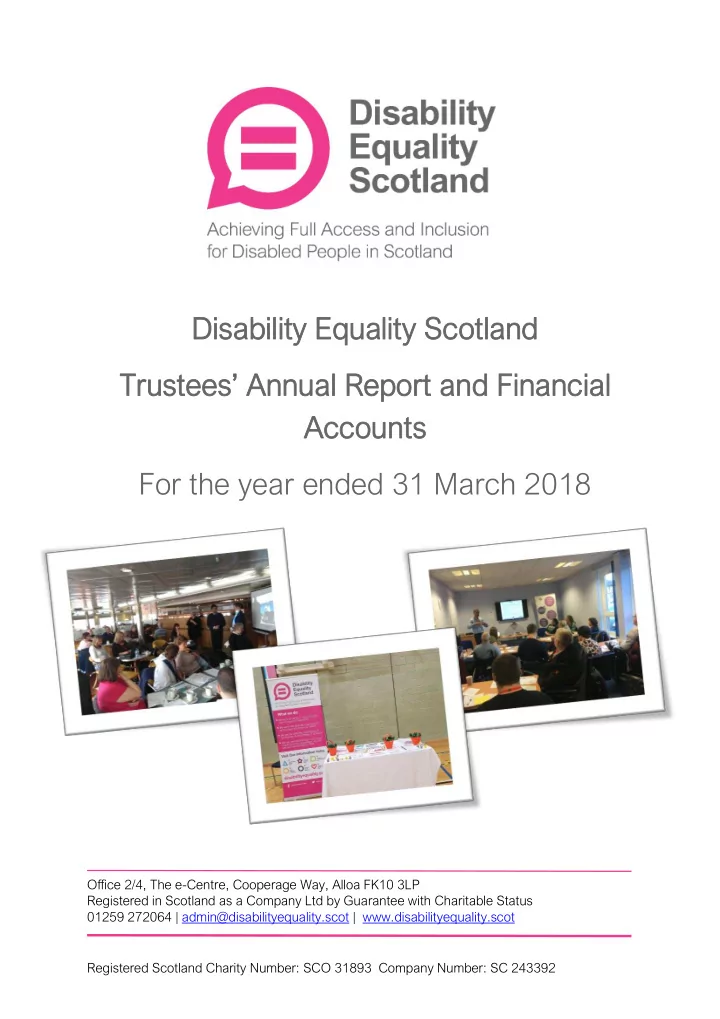
SLIDE 1 Office 2/4, The e-Centre, Cooperage Way, Alloa FK10 3LP Registered in Scotland as a Company Ltd by Guarantee with Charitable Status 01259 272064 | admin@disabilityequality.scot | www.disabilityequality.scot Registered Scotland Charity Number: SCO 31893 Company Number: SC 243392
Disa Disabilit bility Eq y Equality uality Scotla cotland nd Trustees’ Annual Report an and Fi d Financi nancial al Acc ccou
nts For the year ended 31 March 2018
SLIDE 2
2
Co Contents ntents
Page age Report of the trustees 3 to 32 Presentation of Financial Accounts 33 to 34
SLIDE 3 3
Introduct Introductio ion fro from the the Inte Interim rim Co Conven ener er an and Chief d Chief Exe xecutiv cutive
This Annual Report 2017- 2018 highlights how our work
- ver the last year has met our
strategic objectives and how we have managed the risks to achieving our operational
- bjectives identified within our
Strategic Plan 2017-2020. This year we have faced a few challenges and implemented several changes to improve how we do things, including how we work better as a team, with our members, disabled people, Access Panels, stakeholders, funders and other disabled people organisations. It has been a time of great change with many positive achievements and success stories for us to celebrate. We have developed some new relationships and partnerships and our Board concentrated on strengthening our governance framework to ensure we have a solid foundation to move forward from as we enter the growth period of our strategic plan.
Our core aim remains “To achieve full ac acce cess ss and and inclu nclusi sion n for for disabled people in Scotland”
This year saw several Directors leave our Board and we thank them for their service. We would like to welcome our new Directors and thank them for the intense contribution since joining our board at a time of great change, not
- nly in board and staff team dynamics, but when we all decided to “set
up our stall” differently to ensure the voices of our members were heard
SLIDE 4
4 and could influence positive change to advocate for a fair and equal society for us all. We would like to thank the staff team for all their hard work and commitment throughout this year. Thank you to our funders who recognise the value and benefits of listening and responding to the voice and experience of our members and access panels. We hope you enjoy reading about how we are able to improve equality and accessibility in Scotland. The only way we can achieve anything is through the continued support of our members, Access Panels and sponsors. So, thank you for enabling us to achieve as much as we have this year and please join us for the next part of this journey, towards the day when all disabled people can enjoy life with dignity, respect, choice and independence.
Li Linda nda Ba Bamf mford rd Mo Morv rven en Bro Brooks Interim Convener Chief Executive Officer
Trustees’ report for the year ended 31 March 2018
The trustees present their report, incorporating their strategic report and financial accounts for the year ended 31 March 2018. The financial accounts have been prepared in accordance with the accounting policies set out in the notes to the financial statements and comply with the charitable company’s Articles of Association and the Companies Act 2006.
SLIDE 5 5
Ob Obje jecti ctives s and nd activitie activities
We are a national charity working to achieve full access and inclusion for disabled people. We promote access in its widest sense, including access to the built and natural environment and access to the same opportunities that are enjoyed by others in our communities; promoting a life of dignity, respect and independence. Our aim is for every disabled person to have the opportunity to participate in a fulfilling life. We represent the views of individuals with any type of impairment, as well as disability organisations and groups who share our values. This annual report covers progress on Disability Equality Scotland’s
- bjectives and activities between 1 April 2017 to 30 March 2018.
Our M ur Mission ssion
“Achieving full Access and Inclusion for disabled people in Scotland.”
Our ur Vision
A better life for disabled people.
Our Pr ur Princ nciples es
Positi
ve App pproa roach ch: To approach issues in a positive way. Prom romoting Eq
ality: To promote good/best practice Partn artnersh ership ip-fo focu cused ed: Work with partners across all sectors
SLIDE 6 6 Below is a summary of the objectives for Disability Equality Scotland as set out in our governing document:
- to promote the benefit of disabled people in Scotland by encouraging
communication between disabled people and national and local
- rganisations concerned with the inclusion of disabled people in
society;
- to advance the education of the public about disability equality and
accessible environments, and to effect positive change in attitude and awareness of disability.
Main O ain Object jectives f s for r the the Ye Year ar
Disability Equality Scotland has been involved in many projects, all of which focus on the organisation’s principles to:
- 1. Promote and raise awareness of equality and access Scotland-wide.
- 2. Improve access to participation and engagement for disabled people
in issues which affect them on a local and national level.
- 3. Promote action to make Scotland, Scottish institutions and services
more accessible to disabled people.
- 4. Promote accessibility and disability equality amongst employers
across all sectors, encouraging meaningful and long-term employment for disabled people
- 5. Build good relationships with key players in the disability field and
identify opportunities for partnership working. The following pages are the main areas of work delivered through funding from the Equality Unit, Adult Care and Support (Access Panel Project) and Transport Scotland.
SLIDE 7 7
Memb Member ership hip
Over erview ew and and Pro Progr gress ess
As a member-led organisation we work with our members in a mutually beneficial way to promote equality for disabled people in Scotland. All our policies are formulated directly from our member views, experiences and expertise. We regularly ask our members for their views
- n many diverse policy issues which then directly feed into our policy
work and government consultation responses. We make introductions to key decision makers and contacts and make sure members have frequent opportunities to meet and network with relevant audiences. We help members make the right connections through our events and sharing polls with Ministers. During the period from 1 April 2017 to 31 March 2018 we had 83 new members join us. (68 Individual and 15 Corporate), resulting in a 14% 14% increa increase in our overall membership, this brought our membership total to 647 members:
- 498 Individual members
- 110 Corporate members
- 39 Access Panels
We have been able to grow our membership through attending various events and networking opportunities. This includes Independent Living Scotland exhibition and Disability Roadshow events. We also experienced a surge in membership because of the introduction
- f our new name and branding. In line with our new branding, we also
relaunched our website: www.disabilityequality.scot
200 400 600 800 1 April 2015 - 31 March 2016 1 April 2016 - 31 March 2017 1 April 2017 - 31 March 2018
Membe bership rship
Members joined Total Members
SLIDE 8 8 Our new website makes it much clearer to navigate from the homepage to the members section of the website. Here potential members will discover the benefits of joining Disability Equality Scotland. We rely greatly on the support of our members, and our members are the voice of disabled people in Scotland. Here is a selection of comments from our membership on why they enjoy being a member of Disability Equality Scotland:
Dis Disabilit ability y Equ Equali ality Sco ty Scotl tlan and N News ews: e : email n mail newslett ewsletter er
Over erview ew and and Pro Progr gress ess
Disability Equality Scotland News is our members’ email newsletter, which is sent by email and available in alternative formats (Word, PDF, Plain Text and Audio). In January 2018, we surveyed our members asking them for their feedback on Disability Equality Scotland
respondents tell us they read the newsletter regularly and prefer to receive information and news through the newsletter from us. “The information and surveys are good. I also enjoy reading your magazine, Open Door.” “It is an opportunity to make a difference to issues that are affecting those with disabilities and ensure that our voice is heard.” “Your information is up to date and Disability Equality Scotland is good at sign posting if needed.”
SLIDE 9 9
Ope Open n Doo Door ma magazine azine
Over erview ew and and Pro Progr gress ess
Our Open Door Magazine is our members’ magazine. We also use it as a promotional tool at events and meetings, send it to MSPs and key partners, to highlight the work we do and the activities of the Access Panels across Scotland. When we surveyed our members in January 2018, the majority of our members now prefer to receive Open Door by email. We have published four issues during 2017 and 2018 which have promoted the project work we are delivering on – Inclusive Communication, Inclusive Design, Accessible Travel, as well as providing an in-sight into the work of the Access Panels across Scotland.
Co Consult nsultatio ations ns
Over erview ew and and Pro Progr gress ess
From April 2017 to March 2018, we undertook seven large consultations with our members, on issues which matter to them. These issues/barriers range from Equality Human Rights, Accessible Housing, Blue Badge Parking and Disability Hate Crime. We provided our members with an Easy Read version of the consultation, to enable the majority of our membership to respond. We received an average response of 30 respondents per consultation. It is vital our members continue to contribute to Government policy
- consultations. This allows the opinions and lived experiences of disabled
people across Scotland, to effectively influence changes in government policies. “The information and surveys are good. Also, the Open Door.”
SLIDE 10 10
Dis Disabilit ability y Roadsho Roadshows
Over erview ew and and Pro Progr gress ess
During the period 2017 to 2018, we delivered three Disability Roadshows across Scotland:
- Intersectionality Disability and LGBT,
Nairn, 28 October 2017
- Accessible housing, Dundee, 2 November
2017
- Disability in Sport, Edinburgh, 16 Nov
2017 Access Panels were involved in the planning of the events. Each event welcomed an average of 30 delegates (local disabled people, local authority staff, MSPs, local private companies and third sector organisations). We received positive feedback from each roadshow event. All our events were held in local community centres, to attract disabled people who had not heard of their local Access Panel or Disability Equality Scotland.
Key ey me messa sages es fro from t the he event ents: s:
Disab Disabil ility in ity in Sport Ev Sport Even ent “Really useful to have resources as hand-outs to take inclusive communication further, following the event.” ▪ In Involv volve e dis disab able led d pe people ple fr from
the first st st stage of ge of pl plan anning or ing or de decision cision maki aking (ev g (events ts, d des esig ign, comm communicatio ication) ▪ Acc cces ess s Panels els sh should ld have ve Stat Statutory tory Co Consu sulte ltee e Stat tatus, s, to to stren strengt gthen t the e proc proces ess s of
disa isabled bled p peo eople ple being in eing involve volved d fr from
the e fi first p rst point
pla lanning or d g or decision cision maki aking ▪ Li Listen sten to to th the c com
ity
SLIDE 11 11
Inclu Inclusive Comm sive Commun unicati ication
In Inclus clusive Co e Commu municat ation n Hu Hub www.i .inclu nclusive siveco commun unication. ation.sc scot
We have continued to work with our partners at Sense Scotland in developing the Inclusive Communication Hub, which has had an update in line with our new name and branding. The Hub has been updated with new case studies from Sense Scotland and other information and articles for individuals. The Steering Group have met and made constructive comments about the development of the site, which have been taken on board; changing the resources page to align with the six principles of Inclusive Communication, and aiming the content at organisations, while keeping disabled people in mind as the main beneficiaries of this information. We have worked to promote the Inclusive Communication Hub and have given presentations to partners at Scottish Government Communications Team, and to senior managers at Audit Scotland. We have worked with partners at Deafblind Scotland to develop a BSL homepage welcome video for the Hub and for our main website. We have also worked collaboratively with Deafscotand (formally SCoD) and Royal College of Speech and Language Therapists to further promote and develop good practice for decision makers in terms of quality communications. Our CEO has contributed to the wider discussions on developing an Inclusive Communication Strategy and we will be involved in focused discussions around types of inclusive communication.
SLIDE 12 12
Eas asy Re Read ad
Over erview ew and and Pro Progr gress ess
Disability Equality Scotland provide a professional and efficient Easy Read service to all sectors as part of our commitment towards improving access to information for all. Easy Read is an accessible format that makes written information easier to understand. The Easy Read format is easy to understand and uses simple, jargon free language, shorter sentences and supporting images. Easy Read documents make information more accessible to people with learning disabilities. They can also be useful for people with other communication difficulties including:
- acquired brain injury
- dyslexia
- people with hearing impairment whose first language is British Sign
Language (BSL)
- people who do not speak English as their first language
- people who find reading difficult
- people with cognitive impairments such as dementia.
Some of the Easy Read reports we have worked on during 2017-2018:
- The Hate Crime Legislation Review:
http://www.gov.scot/Resource/0052/00524076.pdf
- Mobility and Access Committee for Scotland (MACS) annual report:
http://disabilityequality.scot/macs-easy-read/
- Situations Vacant: Employer-ability and Disabled People’s Right to
Work: http://www.ilis.co.uk/uploads/EASY%20READ%20- %20ILIS%20Employerability%20summary%20Final.docx
SLIDE 13 13
Weekly eekly Polls Polls
Over erview ew and and Pro Progr gress ess
During 2017/2018 we have undertaken 50 weekly poll questions, covering topics such as Universal Credit, PIP, accessible tickets, poverty, mobile banking and
- rgan donation. We worked with our
partners at Deafscotland (formally Scottish Council on Deafness) to produce BSL videos of the previous month’s questions to ensure we reach deaf and hard of hearing respondents. Below is a sample of the results from weekly polls, conducted during the reporting period, 2017/2018. We produced press releases which were distributed to Ministers, media and members.
0% 20% 40% 60% 80% 100% social isolation and loneliness Accessible Housing Mobile Banking
Summary Weekly Polls
Results Yes Results No
SLIDE 14 14 Social I
solation a and d Lone Loneli liness ss Ques estion tion: Have you experienced social isolation and loneliness because of your disability? Answ swer: er: Yes - 82% (46 respondents) No - 18% (10 respondents) Key Key com
ent: t: “I have lost friends and relationships that were important to me as some people don’t want to be involved with someone who is unwell much of the time.” Acc cces essible sible Hou Housi sing Ques estion tion: Have you come across barriers which prevent you from living in a home which could improve your quality of life? Yes/No? Answ swer: er: Yes - 73% (29 respondents) No - 27% (11 respondents) Key Key com
ent: t: “We live upstairs, and my daughter has mobility issues. We are also isolated as had to move away from own neighbourhood after homelessness” Roya Royal B l Ban ank o
Scotland Branch Branch Closu Closure res Ques estion tion: The Royal Bank of Scotland (RBS) is planning to replace many local branches with a mobile banking vehicle that will visit local areas as per a fixed timetable. Is a mobile banking vehicle a suitable option? Answ swer: er: Yes - 19% (15 respondents) No - 81% (64 respondents) Key Key com
ent: t: Physical Access – Access to mobile banking vehicles can be challenging for disabled people due to physical barriers. “If you cannot access the van, the bank teller has to leave the vehicle and attend to the customers’ banking needs, in the supermarket car park, which is humiliating and an unacceptable form of inequality.”
SLIDE 15 15
Rep epre resen enti ting Dis Disabled abled Pe Peopl
Over erview ew and and Pro Progr gress ess
In all our activities and projects, we are representing the views of disabled people in Scotland. By diversifying the methods, we use to engage our members, we can elicit useful information, allowing us to build up a bank of data and views on various topics of interest to disabled
- people. For example, we have introduced our ‘weekly poll’ questions
which allow us to gather statistical information as well as verbatim comments on topical issues. This is useful as a greater number of members participate in this method than via lengthy consultation
- documents. We continue to test consultation questions and contribute
more meaningful responses using the polling method. We have found that promoting our new name and logo has led to new and fruitful partnerships that we hope to build on over time. Our staff have attended meetings with a variety of different organisations, introducing our work and sharing our aims, allowing us to identify ways of working together. Recent examples include Audit Scotland, where we volunteered to present at a World Café event with other equalities
Dis Disabilit ability y Hate Hate Crim Crime
Over erview ew and and Pro Progr gress ess
The Disability Safety Information Hub is in its design and planning phase, and we plan to carry out focus groups early in 2018 to gather feedback from disabled people about the type of information they would like to see on the Hub. We already know from our own research and from data collected by Police Scotland that there is a need for this type of resource, as disability hate crime is one of the most under- reported of all crimes; estimated at 97% under-reported. We anticipate that the information contained on this new Hub will make a positive
SLIDE 16 16 difference to the recognition of hate crime amongst disabled people and the numbers reporting incidents. We want to ensure that disabled people do not accept hate crime as a ‘social norm’ but that they understand the seriousness of their experiences. We have conducted weekly polls on this topic. We found that from our members:
someone who had experienced disability hate crime;
they did not report the crime; and
- 31% said that they would not feel confident to report an incident of
disability hate crime.
Acce Access ssible ible Trav Travel el Hu Hub b www.a
.acce ccessi sibletra etravel.sc scot Over erview ew and and Pro Progr gress ess
Disability Equality Scotland have developed and launched the Accessible Travel Hub, providing an
- nline point of information on
accessibility and inclusion for disabled travelers, transport operators and staff. By developing and promoting the Accessible Travel Hub, we will be contributing towards Ambition Three of ‘A Fairer Scotland for Disabled People’; making places that are accessible to everyone. The Hub is managed by the Equality Projects Manager. The Transport Scotland Accessible Travel Steering Group and Transport Operators have been approached for information on policies, training “I have only reported a hate crime once. I have been the victim of hate crime on several
- ccasions. The time I reported
it the police spoke to the person but that only made the person do it more.”
SLIDE 17 17 and other relevant information. Our Equality Project Assistant will continue to engage with these groups and bodies to grow the depth and breadth of information available on the Hub. Transport Scotland’s accessibility event in October 2017 helped to raise awareness of the Accessible Travel Hub among transport providers as did our Summit event in Aberdeen in March 2018, where we were able to demonstrate the new look hub to providers and disabled people and encourage them to submit ‘good news’ stories as well as case studies of their own experiences using public transport. The Accessible Travel Hub has undergone a rebranding in line with our new name and logo. The Accessible Travel Hub has received positive feedback and constructive comments from members of the National Transport Accessibility Steering Group, Access Panels and other organisations and individuals who have visited the Hub. Statistical data taken from Google Analytics (January 2018 - March 2018) shows that there were 84% new visitors to the site, and 872 page views. There has been a steady increase in the number of users each month. This is a result of the implementation of new branding and related promotional materials. In addition, promotion of the Accessible Travel Hub at events such as the Aberdeen Accessibility Summit has resulted in an increase in the number
There has been a 10% decrease in the bounce rate, which can be attributed to fresh and engaging content being added to the Accessible Travel Hub, including the continued promotion of transport surveys and events.
SLIDE 18 18
Acce Access ssible ible Trav Travel el Fr Fram amew ework
Natio ationa nal Survey Surveys
Over erview ew and and Pro Progr gress ess
Disability Equality Scotland conducted a national survey of disabled people and transport providers in May 2017. This resulted in over 200 responses about experiences of travel on public transport. Key issues were highlighted in this baseline report, and these have been explored in more detail in the funding year 2017/18, with three shorter, more focused surveys on specific travel topics. The national baseline survey indicated some interesting topics which we explored further as shorter, more focused surveys, which we aligned to local events. “Some staff would rather make excuses than help a disabled person.” Conn Connectivity ctivity (issues with timetabling and frequency of services) -ran from 25 September 2017 to 31 October 2017 Findings from our Connectivity survey included:
- 78 people responded
- 64% found it difficult to change from a train to another form of transport.
Issues included not having ramps available, even if booked.
- 50% agreed they could plan a journey by train easily in advance – some
had experience of using online sites, like Traveline – but these remain an issue for visually impaired passengers.
- 72% felt that the scheduling of bus timetables made it difficult to make a
connection.
- 36% said that information at train stations helped to make it easy to
change to the next form of transport.
- Impact on independent travel was that journeys could be stressful for
disabled people, and for many, they choose not to travel alone, but instead take a companion, or drive.
- More assistance at stations, more frequent services and having assistance
available without pre-booking are important to help improve travel for disabled people.
SLIDE 19 19 Tr Tran ansp sport
in R Rural ral Areas reas (cost, frequency of service) – ran from 8 December 2017 to 12 January 2018. Findings from our Transport in Rural areas survey included: 113 people to date have completed this survey.
- Frequency of service is secondary to the accessibility of the service –
many people found they cannot access buses in rural areas.
- Rural services cannot be relied upon for punctuality – often
appointments are missed, as services subject to cancellation.
- Rural services are also infrequent and finish early. Some examples of no
service after 6pm.
- Significant reliance on community transport and on private taxis (which
are expensive).
- Lack of suitable transport provision can lead to loneliness and isolation.
- Changes have been to the detriment of the services, with people seeing
more cancellations and less frequent services in rural areas in the last six months. Acc cces essible sible I Inform formati ation
- n (attitudes from staff, accessible information) – ran
from 16 February to 9 April 2018. 68 people have completed the survey. Findings from our Accessible Information survey included:
- 58% found ticket machines accessible
- 33% found timetables inaccessible
- Respondents said audio announcements (58%) and visual display
boards (82%) were accessible.
- Having step free access (33%) and staff trained in disability awareness
(25%) would make the most positive difference to traveling on public transport. “There are not enough awareness trained staff available at present and we would definitely struggle if this was further reduced.” “I am usually organised, but travel information is not always up to date.”
SLIDE 20 20
Mini Su Mini Summits mmits
Over erview ew and and Pro Progr gress ess
The mini summit events offers disabled people an opportunity to give their detailed views on specific transport related topics. We held a workshop on the topic of ‘connectivity’ in Oban on 31 January 2018, which was an
- pportunity for local disabled
people to come together with transport providers, to discuss local transport issues. This event helped to raise awareness of the Accessible Travel Framework and highlighted areas where local transport providers can work with the Access Panel to bring about change. For example, the local bus company is working with the Panel to pilot audio announcements on their services. A second local event was scheduled for Stirling on 28 February 2018 to discuss transport in rural areas. This event was cancelled because of the adverse weather conditions but was rescheduled in May 2018. A larger event took place in March 2018 in Aberdeen, with 59 delegates taking part in discussions. The delegates included disabled people, equalities organisations such as Inspire and Pamis, and transport providers, including Aberdeen airport, ScotRail, Stagecoach NorthLink ferries and NESTRAN the regional transport partnership, as well as local councillors and access panel members.
Tran anspor sport t Su Summit Aber it Aberdeen deen Ma March 20 2018
SLIDE 21 21 The summit heard from Karl Zaczek at Transport Scotland talking about the Accessible Travel Framework and from Hussein Patwa of MACS, about his experiences of traveling on public transport as a disabled person. Disability Equality Scotland then presented findings from the surveys that have taken place. This was followed by group discussions where delegates were to talk about their own experiences of public transport, how this impacts on their ability to travel independently, and what would make the greatest difference to travel as a disabled person. Some of the key findings from the group discussions included:
- Disability awareness training for staff was very important.
- Having information available in accessible formats, including timetables
and audio announcements was necessary from all providers
- Disabled people should be consulted over the design of different
modes of transport; concerns were raised about wheelchair accessible taxis; as not all disabled people use wheelchairs – a ‘one size fits all’ accessibility policy is not appropriate.
- Passenger assistance offered by ScotRail was praised because of the
different methods by which assistance could be booked, and staff have a good level of disability awareness, attentiveness and ensure a safe traveling environment. Feedback from the local workshop
- n Connectivity in Oban was very
positive and there has been a commitment from local transport providers to work with the access panel to bring about change. “Great event to bring various groups / organisations together and people with varying disabilities a chance to network and speak with others including transport providers.” “The Connectivity Roadshow was excellent, and a wide range of issues were freely and robustly discussed. As a panel we are keen to see all these topics followed up and progressed and look forward to working with you to this end.”
SLIDE 22
22 The number of delegates at the Accessible Transport Summit in Aberdeen indicates a willingness to engage on the topic of accessible travel. Following the Connectivity event, the Equality Projects Manager met with the local councillor for Highland to discuss some of the issues raised. Councillor Brendan O’Hara made a commitment to follow up on some of the issues discussed, including the accessible toilet at Oban Station which has been out of order for six months. Evaluation forms from the Accessible Travel Summit in Aberdeen in March 2018 were positive.
Inclu nclusive De sive Desig sign Hu Hub www.i .inclu nclusivedes sivedesign.scot n.scot
Over erview ew and and Pro Progr gress ess
Launched in July 2016; the Inclusive Design Hub is an online information resource that aims to improve awareness and take-up of best practice in inclusive design for planners, developers, architects, and other building professionals in Scotland. The website includes information, articles, access guides, and case studies of best practice for shared learning and guidance. By providing information and insight, Inclusive Design Hub will help built environment professionals to be better placed to deliver inclusive environments. The website also contains accessible information that will develop the general public’s understanding of inclusive design.
Fe Feedb edbac ack
The Inclusive Design Hub has received positive feedback and constructive comments from Disability Equality Scotland members, Access Panels and other organisations/individuals who have visited the Hub.
SLIDE 23 23 The majority of comments consist of suggestions for additional content and minor tweaks to the design and layout of the Hub:
- Adding additional resources/case studies/news items.
- Suggestions of individuals and organisations to contact for content
and to help promote the Inclusive Design Hub.
Mo Monito torin ring a g and nd Fut Future ure Plan Plans
Conte Content: : The Inclusive Design Hub will be updated and revised on an
- ngoing basis. A feedback form has been created to allow users to
submit any comments and suggestions to help to improve the website. Continue to add fresh content. It is vital to keep users interested so that they are encouraged to come back, as well as recommend the website to others. Acc cces essibil sibility ity: : We will strive to continue to monitor and improve accessibility of the Inclusive Design Hub based on user feedback. Arrange for Access Panels to test accessibility on an ongoing basis. Make use of the wide variety of assistive technology. Develop an accessibility strategy/statement and make it clear that alternative formats can be produced, although this may differ for third party resources. “I just wanted to say well done
- n producing such a great
- resource. This type of
site/database/resource is really needed, and I’m pleased to see
Iain McKinnon, Senior Inclusive Design Manager, Queen Elizabeth Olympic Park
“It's a great idea and will be a great tool for disabled people in Scotland"
Susan Fulton, Inclusive Design Advisor, Easy Ayrshire Council.
SLIDE 24 24 Prom romotion
: Google analytics will identify how users are accessing the website. Based on analytical data we can change
- ur promotional practices and how we target users.
Increase promotion of the website to local authorities. Also target Universities and encourage them to feature the website on their reading lists.
Acce Access P ss Pane nel l Ne Network
Over erview ew and and Pro Progr gress ess
An Access Panel is a group of volunteers, the majority of which are disabled people,
- r are directly affected by disability,
perhaps as a carer or family member. They meet on a regular basis, usually monthly, to discuss issues in their local community which affect disabled people, and work towards removing barriers to independent living in their
- wn locality, to ensure disabled people have access to the same choice,
dignity and control as others in our society. There are currently 38 active Access Panels across Scotland, from Barra and Orkney, to the Scottish Borders and everywhere in between. Panel membership varies between 5 and 150 disabled members, and it is estimated that there are around 1000 Access Panel members in total. Not all members are actively involved volunteers, and many contribute in
- ther ways towards their panel, by sharing information, or participating in
consultations; other members may simply wish to be kept informed of disability work in their area. Access Panels are fully constituted members of Disability Equality
- Scotland. To be a member a Panel must be recognised by their local
authority and be properly constituted. All Panels have access to the Access Panel Grant, provided by the Scottish Government, and administered by Disability Equality Scotland who act at the Umbrella Body for the panels. Access Panels can also access other funding,
SLIDE 25 25 depending on their status, including local councils, the Big Lottery or other funding resources. Some receive benefits in kind, for example office accommodation or other support. The Office Bearers of each Access Panel oversee the strategic development, finances, management of operations and engagement. As Panels have typically grown organically around the needs of their locality, they vary greatly in their focus and remit however, they are primarily committed to improving access and equality in its widest form which means access to the physical environment, Education, Housing, Health, Transport, Leisure & Recreation and Social Justice amongst
Acce ccess P s Panel anel Netw etwork rk acti activity durin uring 20 g 2017/20 /2018
On On-goi going su g supp pport
- rt: The Access Team have made good links with Third
Sector Interfaces (TSIs) around Scotland who can help support Access Panels with governance and record keeping training. The Access team has started rolling out the access auditing training course to Access Panels. We have held training events with West Dunbartonshire Access Panel, Glasgow Access Panel and Dundee Access Panel on Easy Read training, Tweeddale Access Panel and North Ayrshire Access Panel on Access Audits and North Lanarkshire, Badenoch and Strathspey, Central Aberdeen, Nairn, Shetland, and Lochaber Access Panels on governance training. The Access Engagement Officer has attended meetings with several
- rganisations and stakeholders around raising awareness of the Access
Panel Network to promote the services they can offer. These meetings include Pamis in November 2017 and January 2018, NHS 24 in October 2017 to discuss access audits, several TSI’s including Highland TSI, Western Isles TSI, South Ayrshire TSI, and East Ayrshire TSI. Our Access Engagement Officer has also held joint events with the ALLIANCE to consult on disability access for the new social security locations as well as the Cairngorms access forum, Equity Partnership in
SLIDE 26 26 Aberdeen, East Lothian Council to discuss a new Panel for that local authority. New Access Panels are being established in East and South Ayrshire, Uist, Lewis, East Renfrewshire, East Lothian, and Bute. Local Local Auth thori
ty Eng Engagement agement: An engagement pathway has been developed for each individual Access Panel which will form part of the updated information pack for each Panel. Local authority engagement packs went out to Panels to assist them with key contacts within their local authorities and this is updated on an ongoing basis to ensure the information contained within is still relevant Health Health Care are Fa Facil ciliti ities es: A survey surrounding Access Panels has been completed which is being sent out to local health boards asking, amongst other things, whether they have ever considered asking Access Panels to undertake work and provide their advice on planned and existing facilities across the NHS
- estate. The survey will also be made available in Easy Read format.
Badenoch and Strathspey Access Panel and Skye and Lochalsh Access Panel are both working with NHS Highland concerning the new community health centres in Kyle of Lochalsh and Aviemore. They hope to be able to make the buildings as accessible as possible and will update us on their progress once the initial meetings have taken place with NHS Scotland estates.
Acce Access P ss Pane nel G l Gra rant nt
Over erview ew and and Pro Progr gress ess
The Access Panel Grant (APG) is a fund designed to help increase the capacity and outreach of Access Panels right across Scotland. The majority of Access Panels are staffed solely by volunteers who are passionate about increasing access and social inclusion for disabled people in their community. For the period 1 April 2017 to 31 March 2018, £50,000 was received by Disability Equality Scotland from the Equality Unit, The Scottish Government.
SLIDE 27 27 Access Panels face many challenges (ageing volunteers, lack of younger volunteers, difficulties in reporting, geographical spread) the Access Panel Grant has been a lifeline for many Panels who would have otherwise faced a year without funding. Its allowed Panels across Scotland to continue the vital work that they’ve been doing for
- ver 30 years and to build on that success.
Futu uture Pla re Plans ns
Our main objectives for the year continue to be those set out in our Strategic Plan for 2017 to 2020. We have reviewed those objectives and our progress towards them. We review our objectives regular through monitoring reports to the Board of Disability Equality Scotland, focusing on the key projects which are designed to achieve our ambitions.
Lo Looking to ng to t the f he futur uture our e our p plan ans wi s will includ clude: e:
- Retaining current services and grow sustainably
- Continue to increase and promote our membership
- Continue to invest in staff skills and training
- Focus on appropriate cost reduction
- Focus on Services in Easy Read
- Effectively recruit and retain staff
- Continue to meet our funders requirements
- Improve our Stakeholder Engagement
- Improve our links to key political stakeholders nationally and
locally
- Continue to develop our Board
SLIDE 28 28
St Stru ructu cture re, , gove
nanc nce e and nd man anag agemen ment
Disability Equality Scotland was established under a Memorandum
- f Association which established the objects and powers of the charitable
company and is governed by the Articles of Association. Disability Equality Scotland is a charity limited by guarantee and has no share capital. The liability of each member in the event of winding up is limited to £1.
Recr ecrui uitme ment and nt and app appointm ntment o ent of f new t new tru ruste stees es
Although not a public body, our board recruitment is competency based. The skills, knowledge and experience on our board during 2017-2018 range from:
- HR Management
- Strategy Planning
- Business Management (including in the charity sector)
- Change Management
- Risk Management
- Access Panel involvement
- Equalities
- Personal lived experience as a disabled person
Board members serve a term of three years and are voted in at our Annual General Meeting. The role of the Board is to oversee the work of the organisation and to make strategic decisions about its future. The Board meets officially four times a year, with additional meetings for sub-
- groups. We have the following sub-groups which meet quarterly and
report to the quarterly board meetings. Each sub group has a board lead:
- Corporate Sub-committee
- Finance and Risk Management Sub-committee
- Access Sub-committee
- Projects Sub-committee
SLIDE 29 29 Our Convener leads the board and offers support to our Chief Executive Officer. We have an induction policy in place for all new Directors. Each is supplied with a Governance Handbook, which sets out the operating structure of the company, as well as the responsibilities of the Board, including administration, management, and the strategic policy and direction of the company. Clackmannanshire Third Sector Interface have conducted Induction Sessions for the existing Board and new Directors. We have a Board Member’s Code of Conduct that all Directors are
- bligated to sign when they take up their position. The Code of Conduct
is based on the Nolan Principles. It sets out what is expected of them in terms of general conduct, confidentiality, whether there are any conflicts
- f interests, the use of their position on the Board and what results from
any breach of this conduct. Before a decision is taken to appoint a new director, a skills gap analysis is undertaken to highlight any underrepresented areas. Potential candidates who are shortlisted must first attend an interview. This gives us the opportunity to assess skills and knowledge. Training is made available, particularly for any key gaps identified to meet responsibilities, for example, finance, human resources or health and safety. Decision Logs are in place to track decisions that are proposed and approved. We also have a Communication Charter outlining how best to communicate with Directors out with board meetings. We provide directors with a secure and private cloud folder to access relevant documents, to ensure clear and consistent communication. Disability Equality Scotland have introduced a robust process for risk identification and management based on the Scottish Government 5 x 5 Risk Assessment Scale.
SLIDE 30
30
Ou Our r Fun undin ding
Pro Promot moting ng Equa uality ty and C and Cohesion F esion Fund, nd, Th The S e Scot cottis tish h Govern ernment nt
For this project, we are committed to engaging and disseminating information to disabled people through our publications and online newsletters, easy-read briefings and events. We also stated we would improve Access to Social Justice for disabled people, through representation of their views, needs and rights and by supporting the work of those committed to improving equality and inclusion in Scotland. Finally, we would administer the Access Panel Funding Grant to support and protect ongoing volunteer work, to reduce barriers to inclusion and equality at local and national levels.
Ad Adult t Commu muni nity Car y Care e Grant rant Sc Schem eme, e, The The Sc Scott ttish sh Govern ernme ment nt
We are the umbrella organisation for Access Panels across all of Scotland and work with other partners to improve access and inclusion. We work to empower and promote the rights of disabled people. Our role is to influence and effect change, both locally and nationally, through the network of Access Panels and to support them to work in partnership to address local issues.
Acce ccessi sible Tr e Tran anspo sport rt fo for r Di Disa sabled P ed Peop eople G e Grant Fu ant Fundi nding, ng, Tr Tran anspo sport rt Scot Scotland nd
The aim of this project is to work with Transport Scotland and relevant groups to improve the accessibility of transport in Scotland. Our role is to ensure disabled people are informed and included in each stage of the process, including proposing the issues to agreeing actions, to monitoring and feeding back on successes and areas for improvement
SLIDE 31 31
Ref Refere rence nce a and nd Admini Administra strati tive Detail ve Details
Regi Registered stered C Com
pany y numbe ber SC243392 (Scotland) Regi Registered stered C Chari arity ty numbe ber SCO31893 Regi Registered stered offi
ce Office 1/2 The E-Centre Cooperage Way Business Village Alloa, FK10 3LP
SLIDE 32 32 Board Board of
Trust stee ees The following trustees served on the board from 1 April 2017 to 31 March 2018.
- Linda Bamford (Appointed 14 November 2016)
- Dorothy McKinney (Appointed 30 March 2017)
- Janis McDonald (Appointed 5 December 2017)
- Maureen Morrison (Appointed 4 December 2017)
- Louise Orr (Appointed 5 December 2017)
- Scott Stewart (Appointed 5 December 2017)
- Hope Craig (Resigned 24 May 2017)
- Ian Buchanan (Appointed 4 December 2017, Resigned 5 December 2017)
- Emma Scott (Appointed 4 December 2017, Resigned 5 December 2017)
- Sam Hunter (Resigned 3 December 2017)
- Jackie Maceira (Resigned 3 December 2017)
- Peter McDade (Resigned 4 December 2017)
- Patrick McGuigan (Resigned 1 December 2017)
- Gordon Mungall (Resigned 11 December 2017)
- Alex Thorburn (Resigned 4 December 2017)
In Indep ependen ent t exam examin iner er Mark Stewart CA ICAS Stewart Accounting Services Limited Office 90 Alloa Business Centre Whins Road Alloa Clackmannanshire FK10 3SA Approved by order of the board of trustees on ........................................ and signed on its behalf by: ............................................ Trustee
SLIDE 33 33
Presentatio resentation n of
Finan ancial Account cial Accounts s
1 A 1 April pril 201 2017 7 - 31 31 March arch 201 2018 In Income come 2018 2018 2017 2017
Gen Genera eral Fund Fund (Unr Unrestr estricted ed F Fun und) d) £12,3 12,396 96 £510 5103 Rest estrict ricted F ed Fun und £274, 274,440 440 £290, 290,329 329 Scottish Government Equality Unit £93,847 £107,140 Access Panel Grant £53,820 £60,000 Scottish Government Section 10 £80,132 £80,132 Transport Scotland £46,641 £40,057 SCVO – (Equality Internship Programme) £3,000 Tot
Income me £286, 286,836 836 £295, 295,432 432
Exp Expendit diture re 201 2018 201 2017
Ch Charitab ritable e ac activities es Allocated to Access Panel Grant £31,853 £35,844 Salaries £154,836 £151,787 Employers National Insurance contribution £13,238 £12,735 Employers Pension contribution £7,715 £6,355 Hire of plant and machinery £0.00 £2,940 Rent and service charges £14,738 £22,579 Recruitment and training £1,179 £6,159 Telephone £1,277 £1,671 Postage and stationery £11,685 £16,934 Advertising £0.00 £1,885 Travel, subsistence etc £9,805 £13,152 Bank charges £209 £2 Computer expenses £4,475 £6,729 Access Panel Grants £31,853 £35,844 Tot
£251, 251,010 010 £278, 278,772 772
SLIDE 34 34 2018 2018 2017 2017
Sup Suppo port Cos Costs Mana anagem ement ent Insurance £5,464 £980 Other er Accountancy training £1,176 £1,523 Events, room hire & conference £9,605 £11,757 Tot
£10,7 10,781 81 £13,2 13,280 80 Go Governanc rnance C e Costs
Accountancy fees £7.951 £3,000 Legal fees £9,441 £15,663 £17,3 17,392 92 £18,6 18,663 63 Tot
resou esourc rces es spen pent £284, 284,647 647 £311, 311,695 695 Net et i incom come / e / (e (expend xpenditure) ure) £2,18 2,189 (£ (£16, 16,263) 263)
Balan alance ce Shee Sheet t
as at 31 March 2018 Cu Curr rren ent ass asset ets Debtors £9,040 £3,597 Cash at bank and in hand £42,534 £73,001 Tot
cur urren rent ass assets £51,5 51,574 74 £76,5 76,598 98 Credi reditors rs Amounts falling due within one year (£7,620) (£34,833) Tot
asset ets les less c curr rren ent liabi abilities es £43,954 £41,765 Fun unds ds Unrestricted funds £20,772 £30,033 Restricted funds £23,182 £11,732 Tot
funds ds £4 £43,9 3,954 54 £41,7 41,765 65
Full financial statements which have been examined by Stewart Accounting Services Limited are available from the company on request.
SLIDE 35 35
Dis Disabilit ability y Equ Equali ality Sco ty Scotl tlan and
Scottish Charity Number: SC031893
Office 2/4, the e-Centre Cooperage Way Alloa, Clackmannanshire FK10 3LP Tel: 01259 272064 Email: admin@disabilityequality.scot Facebook @DisabilityEqualityScotland Twitter @DEScotTweets Website: www.disabilityequality.scot
Ou Our r Spo Sponsors sors
We are grateful for the generosity of our sponsors:
- Scottish Personal Assistant Employers Network (SPAEN)
- NHS 24
- Humanism in Scotland
- Enable – Falkirk Branch
- Clyde Shopmobility
- Blackwood Housing
- Active4All
- Scottish Council on Deafness (SCoD)
- UKPIPS
- DisabledGo
Funders: The Scottish Government; Transport Scotland