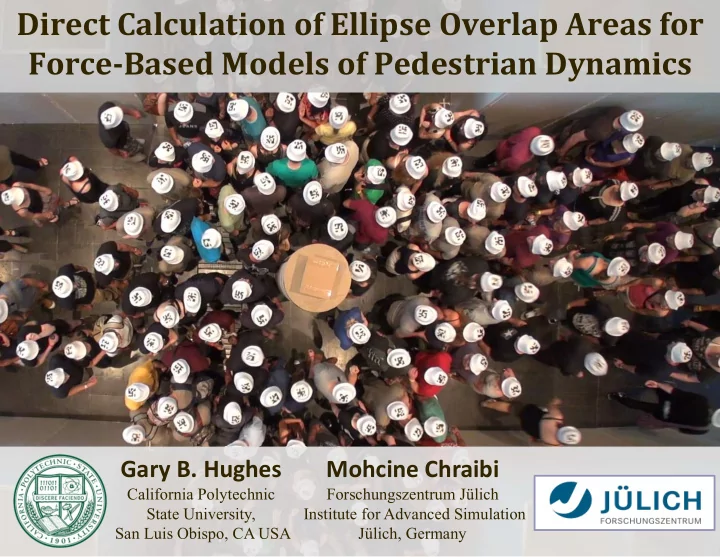
SLIDE 1
Direct Calculation of Ellipse Overlap Areas for Force-Based Models of Pedestrian Dynamics
Gary B. Hughes
California Polytechnic State University, San Luis Obispo, CA USA
Mohcine Chraibi
Forschungszentrum Jülich Institute for Advanced Simulation Jülich, Germany
SLIDE 2 Pedestrian Spatial Aspect
- Radially Asymmetric
- Velocity-Dependent
01
SLIDE 3
Dynamic, Elliptical ‘Sensory Zone’
Semi-Axis Lateral Swaying: Semi-Axis Direction of Movement:
Chraibi, M., Seyfried, A. and Schadschneider, A. (2010), “Generalized centrifugal- force model for pedestrian dynamics,” Physical Review E, 82:4, p. 046111.
i j
02
SLIDE 4
Driving Force
Chraibi, M., Seyfried, A. and Schadschneider, A. (2010), “Generalized centrifugal- force model for pedestrian dynamics,” Physical Review E, 82:4, p. 046111.
Driving Force:
i j
03
SLIDE 5
Repulsive Force
Repulsive Force:
Chraibi, M., Seyfried, A. and Schadschneider, A. (2010), “Generalized centrifugal- force model for pedestrian dynamics,” Physical Review E, 82:4, p. 046111.
ri rj dij i j
04
SLIDE 6
Overlap and Oscillations
ri rj dij i j dij ri i rj j
05
SLIDE 7
Generalized Centrifugal-Force Model
Overlapping Proportion:
Chraibi, M., Seyfried, A. and Schadschneider, A. (2010), “Generalized centrifugal- force model for pedestrian dynamics,” Physical Review E, 82:4, p. 046111.
dij ri i rj j
06
SLIDE 8
1: Transversal at 4 Points 2: Transversal at 2 Points 3: Separated 4, 5: One Ellipse Contained in the Other 6: Transversal at 2 Points and Tangent at 1 Point 7: Externally Tangent 8: Internally Tangent at 1 Point 9: Internally Tangent at 2 Points 10, 11: Osculating and Hyperosculating
Relative Position Classification
1 1 1
07
SLIDE 9
Overlap Area: Inscribed Polygons
i j
08
SLIDE 10
cos sin sin cos sin
Ellipse Area by Gauss-Green Formula
09
SLIDE 11 Ellipse Sector Area
(x1, y1) (x2, y2) θ1 θ2 φ
Sector Area
SLIDE 12
Ellipse Segment Area
Segment Area
(x1, y1) (x2, y2) θ1 θ2 φ
11
SLIDE 13
Ellipse Overlap Area
Relative Position 2 Relative Positions 10, 11
Hughes, G.B., and Chraibi, M. (2014), “Calculating Ellipse Overlap Areas,” Computing and Visualization in Science 15, pp. 291-301.
Relative Position 1 Relative Position 6
12
SLIDE 14
Intersection Points
Hughes, G.B., and Chraibi, M. (2014), “Calculating Ellipse Overlap Areas,” Computing and Visualization in Science 15, pp. 291-301.
General Ellipse (Parametric)
(h, k) φ
(0, 0)
13
SLIDE 15 Intersection Points
Hughes, G.B., and Chraibi, M. (2014), “Calculating Ellipse Overlap Areas,” Computing and Visualization in Science 15, pp. 291-301.
2 2 2 2 2 2 2 2 2 2 2 2
General Ellipse (Implicit Polynomial)
2 2 2 2 2 2
14
SLIDE 16 Intersection Points
Hughes, G.B., and Chraibi, M. (2014), “Calculating Ellipse Overlap Areas,” Computing and Visualization in Science 15, pp. 291-301.
2 1 1 1 1 1 2 1 1 2 2 1 2 2 2 2 2 2
Bézout determinant:
15
SLIDE 17
Run-Time Comparison
Hughes, G.B., and Chraibi, M. (2014), “Calculating Ellipse Overlap Areas,” Computing and Visualization in Science 15, pp. 291-301. 16
SLIDE 18
Random Sample of m ≈ 0.1 n Nearest-Neighbor Distances List of discrete points in a continuous 2D domain: {(x1, y1), (x2, y2), …, (xn, yn)} Each point has a nearest neighbor at a specific distance: {D1, D2, …, Dn} λ = point density within the domain = n / area Test Statistic with Standard Normal Distribution:
Validation: Spatial Randomness
17
SLIDE 19
Deviations from a “2D Poisson Process”: More Regular (Z > 0) More Clustered (Z < 0)
18
n = 100 discrete points within [0, 1]Х[0, 1]
Z = -0.205861 Z = +6.04962 Z = -4.16134
Clark-Evans Test Statistic
SLIDE 20 Spatial Randomness of Pedestrian Flow
- Corridor, bidirectional flow
- http://ped.fz-juelich.de/experiments/2013.06.19_Duesseldorf_Messe_BaSiGo/result/corrected/BI_CORR.zip
- bi_corr_400_b_02.txt
19
SLIDE 21
Questions