DigitalOcean Provider The DigitalOcean (DO) provider is used to - - PDF document

digitalocean provider
SMART_READER_LITE
LIVE PREVIEW

DigitalOcean Provider The DigitalOcean (DO) provider is used to - - PDF document

DigitalOcean Provider The DigitalOcean (DO) provider is used to interact with the resources supported by DigitalOcean. The provider needs to be congured with the proper credentials before it can be used. Use the navigation to the left to read


slide-1
SLIDE 1

DigitalOcean Provider

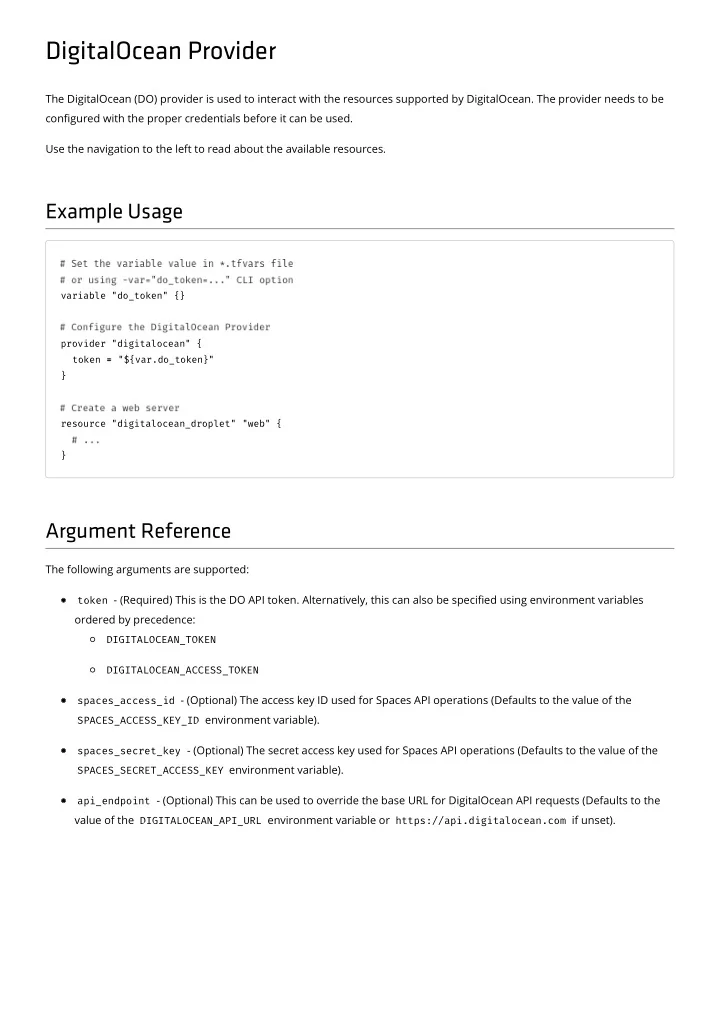
The DigitalOcean (DO) provider is used to interact with the resources supported by DigitalOcean. The provider needs to be congured with the proper credentials before it can be used. Use the navigation to the left to read about the available resources.

Example Usage

variable "do_token" {} provider "digitalocean" { token = = "${var.do_token}" } resource "digitalocean_droplet" "web" { }

Argument Reference

The following arguments are supported:

token - (Required) This is the DO API token. Alternatively, this can also be specied using environment variables

  • rdered by precedence:

DIGITALOCEAN_TOKEN DIGITALOCEAN_ACCESS_TOKEN spaces_access_id - (Optional) The access key ID used for Spaces API operations (Defaults to the value of the SPACES_ACCESS_KEY_ID environment variable). spaces_secret_key - (Optional) The secret access key used for Spaces API operations (Defaults to the value of the SPACES_SECRET_ACCESS_KEY environment variable). api_endpoint - (Optional) This can be used to override the base URL for DigitalOcean API requests (Defaults to the

value of the DIGITALOCEAN_API_URL environment variable or https://api.digitalocean.com if unset).

slide-2
SLIDE 2

digitalocean_certicate

Get information on a certicate. This data source provides the name, type, state, domains, expiry date, and the sha1 ngerprint as congured on your DigitalOcean account. This is useful if the certicate in question is not managed by Terraform or you need to utilize any of the certicates data. An error is triggered if the provided certicate name does not exist.

Example Usage

Get the certicate:

data "digitalocean_certificate" "example" { name = = "example" }

Argument Reference

The following arguments are supported:

name - (Required) The name of certicate.

Attributes Reference

The following attributes are exported:
id : The ID of the certicate. type : The type of the certicate. state : the current state of the certicate. domains : Domains for which the certicate was issued. not_after : The expiration date and time of the certicate. sha1_fingerprint : The SHA1 ngerprint of the certicate.

slide-3
SLIDE 3

digitalocean_database_cluster

Provides information on a DigitalOcean database cluster resource.

Example Usage

data "digitalocean_database_cluster" "example" { name = = "example-cluster" }

Argument Reference

The following arguments are supported:

name - (Required) The name of the database cluster.

Attributes Reference

The following attributes are exported:

id - The ID of the database cluster. urn - The uniform resource name of the database cluster. engine - Database engine used by the cluster (ex. pg for PostreSQL). version - Engine version used by the cluster (ex. 11 for PostgreSQL 11). size - Database droplet size associated with the cluster (ex. db-s-1vcpu-1gb ). region - DigitalOcean region where the cluster will reside. node_count - Number of nodes that will be included in the cluster. maintenance_window - Denes when the automatic maintenance should be performed for the database cluster. host - Database cluster's hostname. private_host - Same as host , but only accessible from resources within the account and in the same region. port - Network port that the database cluster is listening on. uri - The full URI for connecting to the database cluster. private_uri - Same as uri , but only accessible from resources within the account and in the same region. database - Name of the cluster's default database. user - Username for the cluster's default user.

slide-4
SLIDE 4

password - Password for the cluster's default user. maintenance_window supports the following: day - The day of the week on which to apply maintenance updates. hour - The hour in UTC at which maintenance updates will be applied in 24 hour format.

slide-5
SLIDE 5

digitalocean_domain

Get information on a domain. This data source provides the name, TTL, and zone le as congured on your DigitalOcean

  • account. This is useful if the domain name in question is not managed by Terraform or you need to utilize TTL or zone le

data. An error is triggered if the provided domain name is not managed with your DigitalOcean account.

Example Usage

Get the zone le for a domain:

data "digitalocean_domain" "example" { name = = "example.com" }

  • utput "domain_output" {

value = = "${data.digitalocean_domain.example.zone_file}" } $ terraform apply data.digitalocean_domain.example: Refreshing state... Apply complete! Resources: 0 added, 0 changed, 0 destroyed. Outputs: domain_output = $ORIGIN example.com. $TTL 1800 example.com. IN SOA ns1.digitalocean.com. hostmaster.example.com. 1516944700 10800 3600 604800 1800 example.com. 1800 IN NS ns1.digitalocean.com. example.com. 1800 IN NS ns2.digitalocean.com. example.com. 1800 IN NS ns3.digitalocean.com. www.example.com. 3600 IN A 176.107.155.137 db.example.com. 3600 IN A 179.189.166.115 jira.example.com. 3600 IN A 207.189.228.15

Argument Reference

The following arguments are supported:

name - (Required) The name of the domain.

Attributes Reference

The following attributes are exported:

slide-6
SLIDE 6

ttl : The TTL of the domain. urn - The uniform resource name of the domain zone_file : The zone le of the domain.

slide-7
SLIDE 7

digitalocean_droplet

Get information on a Droplet for use in other resources. This data source provides all of the Droplet's properties as congured on your DigitalOcean account. This is useful if the Droplet in question is not managed by Terraform or you need to utilize any of the Droplet's data. Note: This data source returns a single Droplet. When specifying a tag , an error is triggered if more than one Droplet is found.

Example Usage

Get the Droplet by name:

data "digitalocean_droplet" "example" { name = = "web" }

Get the Droplet by tag:

data "digitalocean_droplet" "example" { tag = = "web" }

Argument Reference

One of following the arguments must be provided:

name - (Optional) The name of Droplet. tag - (Optional) A tag applied to the Droplet.

Attributes Reference

The following attributes are exported:

id : The ID of the Droplet. urn - The uniform resource name of the Droplet region - The region the Droplet is running in. image - The Droplet image ID or slug. size - The unique slug that indenties the type of Droplet. disk - The size of the Droplets disk in GB. vcpus - The number of the Droplets virtual CPUs.

slide-8
SLIDE 8

memory - The amount of the Droplets memory in MB. price_hourly - Droplet hourly price. price_monthly - Droplet monthly price. status - The status of the Droplet. locked - Whether the Droplet is locked. ipv6_address - The Droplets public IPv6 address ipv6_address_private - The Droplets private IPv6 address ipv4_address - The Droplets public IPv4 address ipv4_address_private - The Droplets private IPv4 address backups - Whether backups are enabled. ipv6 - Whether IPv6 is enabled. private_networking - Whether private networks are enabled. monitoring - Whether monitoring agent is installed. volume_ids - List of the IDs of each volumes attached to the Droplet. tags - A list of the tags associated to the Droplet.

slide-9
SLIDE 9

digitalocean_droplet_snapshot

Droplet snapshots are saved instances of a Droplet. Use this data source to retrieve the ID of a DigitalOcean Droplet snapshot for use in other resources.

Example Usage

Get the Droplet snapshot:

data "digitalocean_droplet_snapshot" "web-snapshot" { name_regex = = "^web" region = = "nyc3" most_recent = = true true }

Argument Reference

name - (Optional) The name of the Droplet snapshot. name_regex - (Optional) A regex string to apply to the Droplet snapshot list returned by DigitalOcean. This allows

more advanced ltering not supported from the DigitalOcean API. This ltering is done locally on what DigitalOcean returns.

region - (Optional) A "slug" representing a DigitalOcean region (e.g. nyc1 ). If set, only Droplet snapshots available in

the region will be returned.

most_recent - (Optional) If more than one result is returned, use the most recent Droplet snapshot.

NOTE: If more or less than a single match is returned by the search, Terraform will fail. Ensure that your search is specic enough to return a single Droplet snapshot ID only, or use most_recent to choose the most recent one.

Attributes Reference

The following attributes are exported:

id The ID of the Droplet snapshot. created_at - The date and time the Droplet snapshot was created. min_disk_size - The minimum size in gigabytes required for a Droplet to be created based on this Droplet snapshot. regions - A list of DigitalOcean region "slugs" indicating where the Droplet snapshot is available. droplet_id - The ID of the Droplet from which the Droplet snapshot originated. size - The billable size of the Droplet snapshot in gigabytes.

slide-10
SLIDE 10

digitalocean_oating_ip

Get information on a oating ip. This data source provides the region and Droplet id as congured on your DigitalOcean

  • account. This is useful if the oating IP in question is not managed by Terraform or you need to nd the Droplet the IP is

attached to. An error is triggered if the provided oating IP does not exist.

Example Usage

Get the oating IP:

variable "public_ip" {} data "digitalocean_floating_ip" "example" { ip_address = = "${var.public_ip}" }

Argument Reference

The following arguments are supported:

ip_address - (Required) The allocated IP address of the specic oating IP to retrieve.

Attributes Reference

The following attributes are exported:

region : The region that the oating IP is reserved to. urn : The uniform resource name of the oating IP. droplet_id : The Droplet id that the oating IP has been assigned to.

slide-11
SLIDE 11

digitalocean_image

Get information on an images for use in other resources (e.g. creating a Droplet based on snapshot). This data source provides all of the image properties as congured on your DigitalOcean account. This is useful if the image in question is not managed by Terraform or you need to utilize any of the image's data. An error is triggered if zero or more than one result is returned by the query.

Example Usage

Get the data about a snapshot:

data "digitalocean_image" "example1" { name = = "example-1.0.0" }

Reuse the data about a snapshot to create a Droplet:

data "digitalocean_image" "example1" { name = = "example-1.0.0" } resource "digitalocean_droplet" "example1" { image = = "${data.digitalocean_image.example1.image}" name = = "example-1" region = = "nyc2" size = = "s-1vcpu-1gb" }

Get the data about an ocial image:

data "digitalocean_image" "example2" { slug = = "ubuntu-18-04-x64" }

Argument Reference

The following arguments are supported:

name - (Optional) The name of the private image. slug - (Optional) The slug of the ocial image.

Attributes Reference

The following attributes are exported:

slide-12
SLIDE 12

id : The ID of the image. image - The id of the image. distribution - The name of the distribution of the OS of the image. min_disk_size : The minimum 'disk' required for the image. private - Is image a public image or not. Public images represent Linux distributions or One-Click Applications, while

non-public images represent snapshots and backups and are only available within your account.

regions : The regions that the image is available in. type : Type of the image.

slide-13
SLIDE 13

digitalocean_kubernetes_cluster

Retrieves information about a DigitalOcean Kubernetes cluster for use in other resources. This data source provides all of the cluster's properties as congured on your DigitalOcean account. This is useful if the cluster in question is not managed by Terraform.

Example Usage

data "digitalocean_kubernetes_cluster" "example" { name = = "prod-cluster-01" } provider "kubernetes" { host = = data.digitalocean_kubernetes_cluster digitalocean_kubernetes_cluster.example example.endpoint endpoint token = = data.digitalocean_kubernetes_cluster digitalocean_kubernetes_cluster.example example.kube_config kube_config[0].token token cluster_ca_certificate = = base64decode( data.digitalocean_kubernetes_cluster digitalocean_kubernetes_cluster.example example.kube_config kube_config[0].cluster_ca_certificate cluster_ca_certificate ) }

Argument Reference

The following arguments are supported:

name - (Required) The name of Kubernetes cluster.

Attributes Reference

The following attributes are exported:

id - The unique ID that can be used to identify and reference a Kubernetes cluster. region - The slug identier for the region where the Kubernetes cluster is located. version - The slug identier for the version of Kubernetes used for the cluster. tags - A list of tag names to be applied to the Kubernetes cluster. cluster_subnet - The range of IP addresses in the overlay network of the Kubernetes cluster. service_subnet - The range of assignable IP addresses for services running in the Kubernetes cluster. ipv4_address - The public IPv4 address of the Kubernetes master node. endpoint - The base URL of the API server on the Kubernetes master node. status - A string indicating the current status of the cluster. Potential values include running, provisioning, and

errored.

slide-14
SLIDE 14

created_at - The date and time when the Kubernetes cluster was created. updated_at - The date and time when the Kubernetes cluster was last updated. kube_config.0 - A representation of the Kubernetes cluster's kubecong with the following attributes: raw_config - The full contents of the Kubernetes cluster's kubecong le. host - The URL of the API server on the Kubernetes master node. cluster_ca_certificate - The base64 encoded public certicate for the cluster's certicate authority. token - The DigitalOcean API access token used by clients to access the cluster. client_key - The base64 encoded private key used by clients to access the cluster. Only available if token

authentication is not supported on your cluster.

client_certificate - The base64 encoded public certicate used by clients to access the cluster. Only

available if token authentication is not supported on your cluster.

expires_at - The date and time when the credentials will expire and need to be regenerated. node_pool - A list of node pools associated with the cluster. Each node pool exports the following attributes: id - The unique ID that can be used to identify and reference the node pool. name - The name of the node pool. size - The slug identier for the type of Droplet used as workers in the node pool. node_count - The number of Droplet instances in the node pool. tags - A list of tag names applied to the node pool. nodes - A list of nodes in the pool. Each node exports the following attributes: id - A unique ID that can be used to identify and reference the node. name - The auto-generated name for the node. status - A string indicating the current status of the individual node. created_at - The date and time when the node was created. updated_at - The date and time when the node was last updated.

slide-15
SLIDE 15

digitalocean_loadbalancer

Get information on a load balancer for use in other resources. This data source provides all of the load balancers properties as congured on your DigitalOcean account. This is useful if the load balancer in question is not managed by Terraform or you need to utilize any of the load balancers data. An error is triggered if the provided load balancer name does not exist.

Example Usage

Get the load balancer:

data "digitalocean_loadbalancer" "example" { name = = "app" }

Argument Reference

The following arguments are supported:

name - (Required) The name of load balancer. urn - The uniform resource name for the Load Balancer

Attributes Reference

See the Load Balancer Resource (/docs/providers/do/r/loadbalancer.html) for details on the returned attributes - they are identical.

slide-16
SLIDE 16

digitalocean_record

Get information on a DNS record. This data source provides the name, TTL, and zone le as congured on your DigitalOcean

  • account. This is useful if the record in question is not managed by Terraform.

An error is triggered if the provided domain name or record are not managed with your DigitalOcean account.

Example Usage

Get data from a DNS record:

data "digitalocean_record" "example" { domain = = "example.com" name = = "test" }

  • utput "record_type" {

value = = "${data.digitalocean_record.example.type}" }

  • utput "record_ttl" {

value = = "${data.digitalocean_record.example.ttl}" } $ terraform apply data.digitalocean_record.example: Refreshing state... Apply complete! Resources: 0 added, 0 changed, 0 destroyed. Outputs: record_ttl = 3600 record_type = A

Argument Reference

The following arguments are supported:

name - (Required) The name of the record. domain - (Required) The domain name of the record.

Attributes Reference

The following attributes are exported:

slide-17
SLIDE 17

id : The ID of the record. type : The type of the DNS record. data : Variable data depending on record type. For example, the "data" value for an A record would be the IPv4

address to which the domain will be mapped. For a CAA record, it would contain the domain name of the CA being granted permission to issue certicates.

priority : The priority for SRV and MX records. port : The port for SRV records. ttl : This value is the time to live for the record, in seconds. This denes the time frame that clients can cache queried

information before a refresh should be requested.

weight : The weight for SRV records. flags : An unsigned integer between 0-255 used for CAA records. tag : The parameter tag for CAA records.

slide-18
SLIDE 18

digitalocean_ssh_key

Get information on a ssh key. This data source provides the name, public key, and ngerprint as congured on your DigitalOcean account. This is useful if the ssh key in question is not managed by Terraform or you need to utilize any of the keys data. An error is triggered if the provided ssh key name does not exist.

Example Usage

Get the ssh key:

data "digitalocean_ssh_key" "example" { name = = "example" }

Argument Reference

The following arguments are supported:

name - (Required) The name of the ssh key.

Attributes Reference

The following attributes are exported:

id : The ID of the ssh key. public_key : The public key of the ssh key. fingerprint : The ngerprint of the public key of the ssh key.

slide-19
SLIDE 19

digitalocean_tag

Get information on a tag. This data source provides the name as congured on your DigitalOcean account. This is useful if the tag name in question is not managed by Terraform or you need validate if the tag exists in the account. An error is triggered if the provided tag name does not exist.

Example Usage

Get the tag:

data "digitalocean_tag" "example" { name = = "example" }

Argument Reference

The following arguments are supported:

name - (Required) The name of the tag.

Attributes Reference

The following attributes are exported:

id : The ID of the tag.

slide-20
SLIDE 20

digitalocean_volume

Get information on a volume for use in other resources. This data source provides all of the volumes properties as congured on your DigitalOcean account. This is useful if the volume in question is not managed by Terraform or you need to utilize any of the volumes data. An error is triggered if the provided volume name does not exist.

Example Usage

Get the volume:

data "digitalocean_volume" "example" { name = = "app-data" region = = "nyc3" }

Reuse the data about a volume to attach it to a Droplet:

data "digitalocean_volume" "example" { name = = "app-data" region = = "nyc3" } resource "digitalocean_droplet" "example" { name = = "foo" size = = "s-1vcpu-1gb" image = = "ubuntu-18-04-x64" region = = "nyc3" } resource "digitalocean_volume_attachment" "foobar" { droplet_id = = "${digitalocean_droplet.example.id}" volume_id = = "${data.digitalocean_volume.example.id}" }

Argument Reference

The following arguments are supported:

name - (Required) The name of block storage volume. region - (Optional) The region the block storage volume is provisioned in.

Attributes Reference

The following attributes are exported:

slide-21
SLIDE 21

id : The ID of the block storage volume. urn : The uniform resource name for the storage volume. size - The size of the block storage volume in GiB. description - Text describing a block storage volume. filesystem_type - Filesystem type currently in-use on the block storage volume. filesystem_label - Filesystem label currently in-use on the block storage volume. droplet_ids - A list of associated Droplet ids.

slide-22
SLIDE 22

digitalocean_volume_snapshot

Volume snapshots are saved instances of a block storage volume. Use this data source to retrieve the ID of a DigitalOcean volume snapshot for use in other resources.

Example Usage

Get the volume snapshot:

data "digitalocean_volume_snapshot" "snapshot" { name_regex = = "^web" region = = "nyc3" most_recent = = true true }

Reuse the data about a volume snapshot to create a new volume based on it:

data "digitalocean_volume_snapshot" "snapshot" { name_regex = = "^web" region = = "nyc3" most_recent = = true true } resource "digitalocean_volume" "foobar" { region = = "nyc3" name = = "baz" size = = 100 snapshot_id = = "${data.digitalocean_volume_snapshot.snapshot.id}" }

Argument Reference

name - (Optional) The name of the volume snapshot. name_regex - (Optional) A regex string to apply to the volume snapshot list returned by DigitalOcean. This allows

more advanced ltering not supported from the DigitalOcean API. This ltering is done locally on what DigitalOcean returns.

region - (Optional) A "slug" representing a DigitalOcean region (e.g. nyc1 ). If set, only volume snapshots available in

the region will be returned.

most_recent - (Optional) If more than one result is returned, use the most recent volume snapshot.

NOTE: If more or less than a single match is returned by the search, Terraform will fail. Ensure that your search is specic enough to return a single volume snapshot ID only, or use most_recent to choose the most recent one.

slide-23
SLIDE 23

Attributes Reference

The following attributes are exported:

id The ID of the volume snapshot. created_at - The date and time the volume snapshot was created. min_disk_size - The minimum size in gigabytes required for a volume to be created based on this volume snapshot. regions - A list of DigitalOcean region "slugs" indicating where the volume snapshot is available. volume_id - The ID of the volume from which the volume snapshot originated. size - The billable size of the volume snapshot in gigabytes.

slide-24
SLIDE 24

digitalocean_cdn

Provides a DigitalOcean CDN Endpoint resource for use with Spaces.

Example Usage

Basic Example

resource "digitalocean_spaces_bucket" "mybucket" { name = = "example" region = = "sfo2" acl = = "public-read" } resource "digitalocean_cdn" "mycdn" {

  • rigin =

= "${digitalocean_spaces_bucket.mybucket.bucket_domain_name}" }

  • utput "fqdn" {

value = = "${digitalocean_cdn.mycdn.endpoint}" }

Custom Sub-Domain Example

resource "digitalocean_spaces_bucket" "mybucket" { name = = "example" region = = "sfo2" acl = = "public-read" } resource "digitalocean_certificate" "cert" { name = = "cdn-cert" type = = "lets_encrypt" domains = = ["static.example.com"] } resource "digitalocean_cdn" "mycdn" {

  • rigin =

= "${digitalocean_spaces_bucket.mybucket.bucket_domain_name}" custom_domain = = "static.example.com" certificate_id = = "${digitalocean_certificate.cert.id}" }

slide-25
SLIDE 25

Argument Reference

The following arguments are supported:

  • rigin - (Required) The fully qualied domain name, (FQDN) for a Space.

ttl - (Optional) The time to live for the CDN Endpoint, in seconds. Default is 3600 seconds. certificate_id - (Optional) The ID of a DigitalOcean managed TLS certicate used for SSL when a custom

subdomain is provided.

custom_domain - (Optional) The fully qualied domain name (FQDN) of the custom subdomain used with the CDN

Endpoint.

Attributes Reference

The following attributes are exported:

id - A unique ID that can be used to identify and reference a CDN Endpoint.

  • rigin - The fully qualied domain name, (FQDN) of a space referenced by the CDN Endpoint.

endpoint - The fully qualied domain name (FQDN) from which the CDN-backed content is served. created_at - The date and time when the CDN Endpoint was created. ttl - The time to live for the CDN Endpoint, in seconds. certificate_id - The ID of a DigitalOcean managed TLS certicate used for SSL when a custom subdomain is

provided.

custom_domain - The fully qualied domain name (FQDN) of the custom subdomain used with the CDN Endpoint.

Import

CDN Endpoints can be imported using the CDN id , e.g.

terraform import digitalocean_cdn.mycdn fb06ad00-351f-45c8-b5eb-13523c438661

slide-26
SLIDE 26

digitalocean_certicate

Provides a DigitalOcean Certicate resource that allows you to manage certicates for conguring TLS termination in Load

  • Balancers. Certicates created with this resource can be referenced in your Load Balancer conguration via their ID. The

certicate can either be a custom one provided by you or automatically generated one with Let's Encrypt.

Example Usage

Custom Certicate

resource "digitalocean_certificate" "cert" { name = = "custom-terraform-example" type = = "custom" private_key = = "${file("/ /Users/ /terraform/ /certs/ /privkey.pem pem")}" leaf_certificate = = "${file("/ /Users/ /terraform/ /certs/ /cert.pem pem")}" certificate_chain = = "${file("/ /Users/ /terraform/ /certs/ /fullchain.pem pem")}" }

Let's Encrypt Certicate

resource "digitalocean_certificate" "cert" { name = = "le-terraform-example" type = = "lets_encrypt" domains = = ["example.com"] }

Use with Other Resources

Both custom and Let's Encrypt certicates can be used with other resources including the digitalocean_loadbalancer and digitalocean_cdn resources.

slide-27
SLIDE 27

resource "digitalocean_certificate" "cert" { name = = "le-terraform-example" type = = "lets_encrypt" domains = = ["example.com"] } resource "digitalocean_loadbalancer" "public" { name = = "secure-loadbalancer-1" region = = "nyc3" droplet_tag = = "backend" forwarding_rule { entry_port = = 443 entry_protocol = = "https" target_port = = 80 target_protocol = = "http" certificate_id = = "${digitalocean_certificate.cert.id}" } }

Argument Reference

The following arguments are supported:

name - (Required) The name of the certicate for identication. type - (Optional) The type of certicate to provision. Can be either custom or lets_encrypt . Defaults to custom . private_key - (Optional) The contents of a PEM-formatted private-key corresponding to the SSL certicate. Only valid

when type is custom .

leaf_certificate - (Optional) The contents of a PEM-formatted public TLS certicate. Only valid when type is custom . certificate_chain - (Optional) The full PEM-formatted trust chain between the certicate authority's certicate and

your domain's TLS certicate. Only valid when type is custom .

domains - (Optional) List of fully qualied domain names (FQDNs) for which the certicate will be issued. The domains

must be managed using DigitalOcean's DNS. Only valid when type is lets_encrypt .

Attributes Reference

The following attributes are exported:

id - The unique ID of the certicate name - The name of the certicate not_after - The expiration date of the certicate

slide-28
SLIDE 28

sha1_fingerprint - The SHA-1 ngerprint of the certicate

Import

Certicates can be imported using the certicate id , e.g.

terraform import digitalocean_certificate.mycertificate 892071a0-bb95-49bc-8021-3afd67a210bf

slide-29
SLIDE 29

digitalocean_database_cluster

Provides a DigitalOcean database cluster resource.

Example Usage

Create a new PostgreSQL database cluster

resource "digitalocean_database_cluster" "postgres-example" { name = = "example-postgres-cluster" engine = = "pg" version = = "11" size = = "db-s-1vcpu-1gb" region = = "nyc1" node_count = = 1 }

Create a new MySQL database cluster

resource "digitalocean_database_cluster" "mysql-example" { name = = "example-mysql-cluster" engine = = "mysql" size = = "db-s-1vcpu-1gb" region = = "nyc1" node_count = = 1 }

Create a new Redis database cluster

resource "digitalocean_database_cluster" "redis-example" { name = = "example-redis-cluster" engine = = "redis" size = = "db-s-1vcpu-1gb" region = = "nyc1" node_count = = 1 }

Argument Reference

The following arguments are supported:

name - (Required) The name of the database cluster.

slide-30
SLIDE 30

engine - (Required) Database engine used by the cluster (ex. pg for PostreSQL, mysql for MySQL, or redis for

Redis).

size - (Required) Database droplet size associated with the cluster (ex. db-s-1vcpu-1gb ). region - (Required) DigitalOcean region where the cluster will reside. node_count - (Required) Number of nodes that will be included in the cluster. version - (Optional) Engine version used by the cluster (ex. 11 for PostgreSQL 11). tags - (Optional) A list of tag names to be applied to the database cluster. maintenance_window - (Optional) Denes when the automatic maintenance should be performed for the database

cluster.

maintenance_window supports the following: day - (Required) The day of the week on which to apply maintenance updates. hour - (Required) The hour in UTC at which maintenance updates will be applied in 24 hour format.

Attributes Reference

In addition to the above arguments, the following attributes are exported:

id - The ID of the database cluster. urn - The uniform resource name of the database cluster. host - Database cluster's hostname. private_host - Same as host , but only accessible from resources within the account and in the same region. port - Network port that the database cluster is listening on. uri - The full URI for connecting to the database cluster. private_uri - Same as uri , but only accessible from resources within the account and in the same region. database - Name of the cluster's default database. user - Username for the cluster's default user. password - Password for the cluster's default user.

Import

Database clusters can be imported using the id returned from DigitalOcean, e.g.

terraform import digitalocean_database_cluster.mycluster 245bcfd0-7f31-4ce6-a2bc-475a116cca97

slide-31
SLIDE 31

digitalocean_database_replica

Provides a DigitalOcean database replica resource.

Example Usage

Create a new PostgreSQL database replica

resource "digitalocean_database_replica" "read-replica" { cluster_id = = "${digitalocean_database_cluster.postgres-example.id}" name = = "read-replica" size = = "db-s-1vcpu-1gb" region = = "nyc1" } resource "digitalocean_database_cluster" "postgres-example" { name = = "example-postgres-cluster" engine = = "pg" version = = "11" size = = "db-s-1vcpu-1gb" region = = "nyc1" node_count = = 1 }

Argument Reference

The following arguments are supported:

cluster_id - (Required) The ID of the original source database cluster. name - (Required) The name for the database replica. size - (Required) Database Droplet size associated with the replica (ex. db-s-1vcpu-1gb ). region - (Required) DigitalOcean region where the replica will reside.

Attributes Reference

In addition to the above arguments, the following attributes are exported:

id - The ID of the database replica. host - Database replica's hostname. private_host - Same as host , but only accessible from resources within the account and in the same region. port - Network port that the database replica is listening on.

slide-32
SLIDE 32

uri - The full URI for connecting to the database replica. private_uri - Same as uri , but only accessible from resources within the account and in the same region. database - Name of the replica's default database. user - Username for the replica's default user. password - Password for the replica's default user.

Import

Database replicas can be imported using the id of the source database cluster and the name of the replica joined with a

  • comma. For example:

terraform import digitalocean_database_replica.read-replica 245bcfd0-7f31-4ce6-a2bc-475a116cca97,read-rep lica

slide-33
SLIDE 33

digitalocean_domain

Provides a DigitalOcean domain resource.

Example Usage

resource "digitalocean_domain" "default" { name = = "example.com" ip_address = = "${digitalocean_droplet.foo.ipv4_address}" }

Argument Reference

The following arguments are supported:

name - (Required) The name of the domain ip_address - (Optional) The IP address of the domain. If specied, this IP is used to created an initial A record for the

domain.

Attributes Reference

The following attributes are exported:

id - The name of the domain urn - The uniform resource name of the domain

Import

Domains can be imported using the domain name , e.g.

terraform import digitalocean_domain.mydomain mytestdomain.com

slide-34
SLIDE 34

digitalocean_droplet

Provides a DigitalOcean Droplet resource. This can be used to create, modify, and delete Droplets. Droplets also support provisioning (/docs/provisioners/index.html).

Example Usage

resource "digitalocean_droplet" "web" { image = = "ubuntu-18-04-x64" name = = "web-1" region = = "nyc2" size = = "s-1vcpu-1gb" }

Argument Reference

The following arguments are supported:

image - (Required) The Droplet image ID or slug. name - (Required) The Droplet name. region - (Required) The region to start in. size - (Required) The unique slug that indenties the type of Droplet. You can nd a list of available slugs on

DigitalOcean API documentation (https://developers.digitalocean.com/documentation/v2/#list-all-sizes).

backups - (Optional) Boolean controlling if backups are made. Defaults to false. monitoring - (Optional) Boolean controlling whether monitoring agent is installed. Defaults to false. ipv6 - (Optional) Boolean controlling if IPv6 is enabled. Defaults to false. private_networking - (Optional) Boolean controlling if private networks are enabled. Defaults to false. ssh_keys - (Optional) A list of SSH IDs or ngerprints to enable in the format [12345, 123456] . To retrieve this info,

use a tool such as curl with the DigitalOcean API (https://developers.digitalocean.com/documentation/v2/#ssh-keys), to retrieve them.

resize_disk - (Optional) Boolean controlling whether to increase the disk size when resizing a Droplet. It defaults to true . When set to false , only the Droplet's RAM and CPU will be resized. Increasing a Droplet's disk size is a

permanent change. Increasing only RAM and CPU is reversible.

tags - (Optional) A list of the tags to be applied to this Droplet. user_data (Optional) - A string of the desired User Data for the Droplet. volume_ids (Optional) - A list of the IDs of each block storage volume (/docs/providers/do/r/volume.html) to be

attached to the Droplet.

slide-35
SLIDE 35

NOTE: If you use volume_ids on a Droplet, Terraform will assume management over the full set volumes for the instance, and treat additional volumes as a drift. For this reason, volume_ids must not be mixed with external

digitalocean_volume_attachment resources for a given instance.

Attributes Reference

The following attributes are exported:

id - The ID of the Droplet urn - The uniform resource name of the Droplet name - The name of the Droplet region - The region of the Droplet image - The image of the Droplet ipv6 - Is IPv6 enabled ipv6_address - The IPv6 address ipv4_address - The IPv4 address ipv4_address_private - The private networking IPv4 address locked - Is the Droplet locked private_networking - Is private networking enabled price_hourly - Droplet hourly price price_monthly - Droplet monthly price size - The instance size disk - The size of the instance's disk in GB vcpus - The number of the instance's virtual CPUs status - The status of the Droplet tags - The tags associated with the Droplet volume_ids - A list of the attached block storage volumes

Import

Droplets can be imported using the Droplet id , e.g.

terraform import digitalocean_droplet.mydroplet 100823

slide-36
SLIDE 36

digitalocean_droplet_snapshot

Provides a resource which can be used to create a snapshot from an existing DigitalOcean Droplet.

Example Usage

resource "digitalocean_droplet" "web" { name = = "web-01" size = = "s-1vcpu-1gb" image = = "centos-7-x64" region = = "nyc3" } resource "digitalocean_droplet_snapshot" "web-snapshot" { droplet_id = = "${digitalocean_droplet.web.id}" name = = "web-snapshot-01" }

Argument Reference

The following arguments are supported:

name - (Required) A name for the Droplet snapshot. droplet_id - (Required) The ID of the Droplet from which the snapshot will be taken.

Attributes Reference

The following attributes are exported:

id The ID of the Droplet snapshot. created_at - The date and time the Droplet snapshot was created. min_disk_size - The minimum size in gigabytes required for a Droplet to be created based on this snapshot. regions - A list of DigitalOcean region "slugs" indicating where the droplet snapshot is available. size - The billable size of the Droplet snapshot in gigabytes.

Import

Droplet Snapshots can be imported using the snapshot id , e.g.

slide-37
SLIDE 37

terraform import digitalocean_droplet_snapshot.mysnapshot 123456

slide-38
SLIDE 38

digitalocean_rewall

Provides a DigitalOcean Cloud Firewall resource. This can be used to create, modify, and delete Firewalls.

Example Usage

slide-39
SLIDE 39

resource "digitalocean_droplet" "web" { name = = "web-1" size = = "s-1vcpu-1gb" image = = "ubuntu-18-04-x64" region = = "nyc3" } resource "digitalocean_firewall" "web" { name = = "only-22-80-and-443" droplet_ids = = ["${digitalocean_droplet.web.id}"] inbound_rule { protocol = = "tcp" port_range = = "22" source_addresses = = ["192.168.1.0/24", "2002:1:2::/48"] } inbound_rule { protocol = = "tcp" port_range = = "80" source_addresses = = ["0.0.0.0/0", "::/0"] } inbound_rule { protocol = = "tcp" port_range = = "443" source_addresses = = ["0.0.0.0/0", "::/0"] } inbound_rule { protocol = = "icmp" source_addresses = = ["0.0.0.0/0", "::/0"] }

  • utbound_rule {

protocol = = "tcp" port_range = = "53" destination_addresses = = ["0.0.0.0/0", "::/0"] }

  • utbound_rule {

protocol = = "udp" port_range = = "53" destination_addresses = = ["0.0.0.0/0", "::/0"] }

  • utbound_rule {

protocol = = "icmp" destination_addresses = = ["0.0.0.0/0", "::/0"] } }

Argument Reference

slide-40
SLIDE 40

The following arguments are supported:

name - (Required) The Firewall name droplet_ids (Optional) - The list of the IDs of the Droplets assigned to the Firewall. tags (Optional) - The names of the Tags assigned to the Firewall. inbound_rule - (Optional) The inbound access rule block for the Firewall. The inbound_rule block is documented

below.

  • utbound_rule - (Optional) The outbound access rule block for the Firewall. The outbound_rule block is

documented below.

inbound_rule supports the following: protocol - (Required) The type of trac to be allowed. This may be one of "tcp", "udp", or "icmp". port_range - (Optional) The ports on which trac will be allowed specied as a string containing a single port, a

range (e.g. "8000-9000"), or "1-65535" to open all ports for a protocol. Required for when protocol is tcp or udp .

source_addresses - (Optional) An array of strings containing the IPv4 addresses, IPv6 addresses, IPv4 CIDRs, and/or

IPv6 CIDRs from which the inbound trac will be accepted.

source_droplet_ids - (Optional) An array containing the IDs of the Droplets from which the inbound trac will be

accepted.

source_tags - (Optional) An array containing the names of Tags corresponding to groups of Droplets from which the

inbound trac will be accepted.

source_load_balancer_uids - (Optional) An array containing the IDs of the Load Balancers from which the inbound

trac will be accepted.

  • utbound_rule supports the following:

protocol - (Required) The type of trac to be allowed. This may be one of "tcp", "udp", or "icmp". port_range - (Optional) The ports on which trac will be allowed specied as a string containing a single port, a

range (e.g. "8000-9000"), or "1-65535" to open all ports for a protocol. Required for when protocol is tcp or udp .

destination_addresses - (Optional) An array of strings containing the IPv4 addresses, IPv6 addresses, IPv4 CIDRs,

and/or IPv6 CIDRs to which the outbound trac will be allowed.

destination_droplet_ids - (Optional) An array containing the IDs of the Droplets to which the outbound trac will

be allowed.

destination_tags - (Optional) An array containing the names of Tags corresponding to groups of Droplets to which

the outbound trac will be allowed. trac.

destination_load_balancer_uids - (Optional) An array containing the IDs of the Load Balancers to which the

  • utbound trac will be allowed.

Attributes Reference

The following attributes are exported:

slide-41
SLIDE 41

id - A unique ID that can be used to identify and reference a Firewall. status - A status string indicating the current state of the Firewall. This can be "waiting", "succeeded", or "failed". created_at - A time value given in ISO8601 combined date and time format that represents when the Firewall was

created.

pending_changes - An list of object containing the elds, "droplet_id", "removing", and "status". It is provided to

detail exactly which Droplets are having their security policies updated. When empty, all changes have been successfully applied.

name - The name of the Firewall. droplet_ids - The list of the IDs of the Droplets assigned to the Firewall. tags - The names of the Tags assigned to the Firewall. inbound_rules - The inbound access rule block for the Firewall.

  • utbound_rules - The outbound access rule block for the Firewall.

Import

Firewalls can be imported using the rewall id , e.g.

terraform import digitalocean_firewall.myfirewall b8ecd2ab-2267-4a5e-8692-cbf1d32583e3

slide-42
SLIDE 42

digitalocean_oating_ip_assignment

Provides a resource for assigning an existing DigitalOcean Floating IP to a Droplet. This makes it easy to provision oating IP addresses that are not tied to the lifecycle of your Droplet.

Example Usage

resource "digitalocean_floating_ip" "foobar" { region = = "sgp1" } resource "digitalocean_droplet" "foobar" { name = = "baz" size = = "s-1vcpu-1gb" image = = "ubuntu-18-04-x64" region = = "sgp1" ipv6 = = true true private_networking = = true true } resource "digitalocean_floating_ip_assignment" "foobar" { ip_address = = "${digitalocean_floating_ip.foobar.ip_address}" droplet_id = = "${digitalocean_droplet.foobar.id}" }

Argument Reference

The following arguments are supported:

ip_address - (Required) The Floating IP to assign to the Droplet. droplet_id - (Optional) The ID of Droplet that the Floating IP will be assigned to.

slide-43
SLIDE 43

digitalocean_oating_ip

Provides a DigitalOcean Floating IP to represent a publicly-accessible static IP addresses that can be mapped to one of your Droplets. NOTE: Floating IPs can be assigned to a Droplet either directly on the digitalocean_floating_ip resource by setting a droplet_id or using the digitalocean_floating_ip_assignment resource, but the two cannot be used together.

Example Usage

resource "digitalocean_droplet" "foobar" { name = = "baz" size = = "s-1vcpu-1gb" image = = "ubuntu-18-04-x64" region = = "sgp1" ipv6 = = true true private_networking = = true true } resource "digitalocean_floating_ip" "foobar" { droplet_id = = "${digitalocean_droplet.foobar.id}" region = = "${digitalocean_droplet.foobar.region}" }

Argument Reference

The following arguments are supported:

region - (Required) The region that the Floating IP is reserved to. droplet_id - (Optional) The ID of Droplet that the Floating IP will be assigned to.

Attributes Reference

The following attributes are exported:

ip_address - The IP Address of the resource urn - The uniform resource name of the oating ip

Import

Floating IPs can be imported using the ip , e.g.

slide-44
SLIDE 44

terraform import digitalocean_floating_ip.myip 192.168.0.1

slide-45
SLIDE 45

digitalocean_kubernetes_cluster

Provides a DigitalOcean Kubernetes cluster resource. This can be used to create, delete, and modify clusters. For more information see the ocial documentation (https://www.digitalocean.com/docs/kubernetes/).

Example Usage

resource "digitalocean_kubernetes_cluster" "foo" { name = = "foo" region = = "nyc1" // Grab the latest version slug from `doctl kubernetes options versions` version = = "1.15.4-do.0" node_pool { name = = "worker-pool" size = = "s-2vcpu-2gb" node_count = = 3 } }

The cluster's kubecong is exported as an attribute allowing you to use it with the Kubernetes Terraform provider (https://www.terraform.io/docs/providers/kubernetes/index.html). For example:

resource "digitalocean_kubernetes_cluster" "foo" { name = = "foo" region = = "nyc1" // Grab the latest version slug from `doctl kubernetes options versions` version = = "1.15.4-do.0" tags = = ["staging"] node_pool { name = = "worker-pool" size = = "s-2vcpu-2gb" node_count = = 3 } } provider "kubernetes" { host = = digitalocean_kubernetes_cluster.foo foo.endpoint endpoint token = = digitalocean_kubernetes_cluster.foo foo.kube_config kube_config[0].token token cluster_ca_certificate = = base64decode( digitalocean_kubernetes_cluster.foo foo.kube_config kube_config[0].cluster_ca_certificate cluster_ca_certificate ) }

Argument Reference

The following arguments are supported:

slide-46
SLIDE 46

name - (Required) A name for the Kubernetes cluster. region - (Required) The slug identier for the region where the Kubernetes cluster will be created. version - (Required) The slug identier for the version of Kubernetes used for the cluster. Use doctl

(https://github.com/digitalocean/doctl) to nd the available versions doctl kubernetes options versions .

node_pool - (Required) A block representing the cluster's default node pool. Additional node pools may be added to

the cluster using the digitalocean_kubernetes_node_pool resource. The following arguments may be specied:

name - (Required) A name for the node pool. size - (Required) The slug identier for the type of Droplet to be used as workers in the node pool. node_count - (Required) The number of Droplet instances in the node pool. tags - (Optional) A list of tag names to be applied to the Kubernetes cluster. tags - (Optional) A list of tag names to be applied to the Kubernetes cluster.

Attributes Reference

In addition to the arguments listed above, the following additional attributes are exported:

id - A unique ID that can be used to identify and reference a Kubernetes cluster. cluster_subnet - The range of IP addresses in the overlay network of the Kubernetes cluster. service_subnet - The range of assignable IP addresses for services running in the Kubernetes cluster. ipv4_address - The public IPv4 address of the Kubernetes master node. endpoint - The base URL of the API server on the Kubernetes master node. status - A string indicating the current status of the cluster. Potential values include running, provisioning, and

errored.

created_at - The date and time when the Kubernetes cluster was created. updated_at - The date and time when the Kubernetes cluster was last updated. kube_config.0 - A representation of the Kubernetes cluster's kubecong with the following attributes: raw_config - The full contents of the Kubernetes cluster's kubecong le. host - The URL of the API server on the Kubernetes master node. cluster_ca_certificate - The base64 encoded public certicate for the cluster's certicate authority. token - The DigitalOcean API access token used by clients to access the cluster. client_key - The base64 encoded private key used by clients to access the cluster. Only available if token

authentication is not supported on your cluster.

client_certificate - The base64 encoded public certicate used by clients to access the cluster. Only

available if token authentication is not supported on your cluster.

expires_at - The date and time when the credentials will expire and need to be regenerated.

slide-47
SLIDE 47

node_pool - In addition to the arguments provided, these additional attributes about the cluster's default node pool

are exported:

id - A unique ID that can be used to identify and reference the node pool. nodes - A list of nodes in the pool. Each node exports the following attributes: id - A unique ID that can be used to identify and reference the node. name - The auto-generated name for the node. status - A string indicating the current status of the individual node. created_at - The date and time when the node was created. updated_at - The date and time when the node was last updated.

Import

Kubernetes clusters can not be imported at this time.

slide-48
SLIDE 48

digitalocean_kubernetes_node_pool

Provides a DigitalOcean Kubernetes node pool resource. While the default node pool must be dened in the

digitalocean_kubernetes_cluster resource, this resource can be used to add additional ones to a cluster.

Example Usage

resource "digitalocean_kubernetes_cluster" "foo" { name = = "foo" region = = "nyc1" version = = "1.12.1-do.2" node_pool { name = = "front-end-pool" size = = "s-2vcpu-2gb" node_count = = 3 } } resource "digitalocean_kubernetes_node_pool" "bar" { cluster_id = = "${digitalocean_kubernetes_cluster.foo.id}" name = = "backend-pool" size = = "c-2" node_count = = 2 tags = = ["backend"] }

Argument Reference

The following arguments are supported:

cluster_id - (Required) The ID of the Kubernetes cluster to which the node pool is associated. name - (Required) A name for the node pool. size - (Required) The slug identier for the type of Droplet to be used as workers in the node pool. node_count - (Required) The number of Droplet instances in the node pool. tags - (Optional) A list of tag names to be applied to the Kubernetes cluster.

Attributes Reference

In addition to the arguments listed above, the following additional attributes are exported:

id - A unique ID that can be used to identify and reference the node pool. nodes - A list of nodes in the pool. Each node exports the following attributes:

slide-49
SLIDE 49

id - A unique ID that can be used to identify and reference the node. name - The auto-generated name for the node. status - A string indicating the current status of the individual node. created_at - The date and time when the node was created. updated_at - The date and time when the node was last updated.

Import

Kubernetes node pools can not be imported at this time.

slide-50
SLIDE 50

digitalocean_loadbalancer

Provides a DigitalOcean Load Balancer resource. This can be used to create, modify, and delete Load Balancers.

Example Usage

resource "digitalocean_droplet" "web" { name = = "web-1" size = = "s-1vcpu-1gb" image = = "ubuntu-18-04-x64" region = = "nyc3" } resource "digitalocean_loadbalancer" "public" { name = = "loadbalancer-1" region = = "nyc3" forwarding_rule { entry_port = = 80 entry_protocol = = "http" target_port = = 80 target_protocol = = "http" } healthcheck { port = = 22 protocol = = "tcp" } droplet_ids = = ["${digitalocean_droplet.web.id}"] }

When managing certicates attached to the load balancer, make sure to add the create_before_destroy lifecycle property in order to ensure the certicate is correctly updated when changed. The order of operations will then be: Create

new certificate -> Update loadbalancer with new certificate -> Delete old certificate . When doing so, you

must also change the name of the certicate, as there cannot be multiple certicates with the same name in an account.

slide-51
SLIDE 51

resource "digitalocean_certificate" "cert" { name = = "cert" private_key = = "${file("key.pem pem")}" leaf_certificate = = "${file("cert.pem pem")}" lifecycle { create_before_destroy = = true true } } resource "digitalocean_droplet" "web" { name = = "web-1" size = = "s-1vcpu-1gb" image = = "ubuntu-18-04-x64" region = = "nyc3" } resource "digitalocean_loadbalancer" "public" { name = = "loadbalancer-1" region = = "nyc3" forwarding_rule { entry_port = = 443 entry_protocol = = "https" target_port = = 80 target_protocol = = "http" certificate_id = = "${digitalocean_certificate.cert.id}" } healthcheck { port = = 22 protocol = = "tcp" } droplet_ids = = ["${digitalocean_droplet.web.id}"] }

Argument Reference

The following arguments are supported:

name - (Required) The Load Balancer name region - (Required) The region to start in algorithm - (Optional) The load balancing algorithm used to determine which backend Droplet will be selected by a

  • client. It must be either round_robin or least_connections . The default value is round_robin .

forwarding_rule - (Required) A list of forwarding_rule to be assigned to the Load Balancer. The forwarding_rule block is documented below. healthcheck - (Optional) A healthcheck block to be assigned to the Load Balancer. The healthcheck block is

documented below. Only 1 healthcheck is allowed.

slide-52
SLIDE 52

sticky_sessions - (Optional) A sticky_sessions block to be assigned to the Load Balancer. The sticky_sessions block is documented below. Only 1 sticky_sessions block is allowed. redirect_http_to_https - (Optional) A boolean value indicating whether HTTP requests to the Load Balancer on

port 80 will be redirected to HTTPS on port 443. Default value is false .

enable_proxy_protocol - (Optional) A boolean value indicating whether PROXY Protocol should be used to pass

information from connecting client requests to the backend service. Default value is false .

droplet_ids (Optional) - A list of the IDs of each droplet to be attached to the Load Balancer. droplet_tag (Optional) - The name of a Droplet tag corresponding to Droplets to be assigned to the Load Balancer. forwarding_rule supports the following: entry_protocol - (Required) The protocol used for trac to the Load Balancer. The possible values are: http , https , http2 or tcp . entry_port - (Required) An integer representing the port on which the Load Balancer instance will listen. target_protocol - (Required) The protocol used for trac from the Load Balancer to the backend Droplets. The

possible values are: http , https , http2 or tcp .

target_port - (Required) An integer representing the port on the backend Droplets to which the Load Balancer will

send trac.

certificate_id - (Optional) The ID of the TLS certicate to be used for SSL termination. tls_passthrough - (Optional) A boolean value indicating whether SSL encrypted trac will be passed through to the

backend Droplets. The default value is false .

sticky_sessions supports the following: type - (Required) An attribute indicating how and if requests from a client will be persistently served by the same

backend Droplet. The possible values are cookies or none . If not specied, the default value is none .

cookie_name - (Optional) The name to be used for the cookie sent to the client. This attribute is required when using cookies for the sticky sessions type. cookie_ttl_seconds - (Optional) The number of seconds until the cookie set by the Load Balancer expires. This

attribute is required when using cookies for the sticky sessions type.

healthcheck supports the following: protocol - (Required) The protocol used for health checks sent to the backend Droplets. The possible values are http or tcp . port - (Optional) An integer representing the port on the backend Droplets on which the health check will attempt a

connection.

path - (Optional) The path on the backend Droplets to which the Load Balancer instance will send a request. check_interval_seconds - (Optional) The number of seconds between between two consecutive health checks. If

not specied, the default value is 10 .

response_timeout_seconds - (Optional) The number of seconds the Load Balancer instance will wait for a response

until marking a health check as failed. If not specied, the default value is 5 .

slide-53
SLIDE 53

unhealthy_threshold - (Optional) The number of times a health check must fail for a backend Droplet to be marked

"unhealthy" and be removed from the pool. If not specied, the default value is 3 .

healthy_threshold - (Optional) The number of times a health check must pass for a backend Droplet to be marked

"healthy" and be re-added to the pool. If not specied, the default value is 5 .

Attributes Reference

The following attributes are exported:

id - The ID of the Load Balancer ip - The ip of the Load Balancer urn - The uniform resource name for the Load Balancer

Import

Load Balancers can be imported using the id , e.g.

terraform import digitalocean_loadbalancer.myloadbalancer 4de7ac8b-495b-4884-9a69-1050c6793cd6

slide-54
SLIDE 54

digitalocean_project

Provides a DigitalOcean Project resource. Projects allow you to organize your resources into groups that t the way you work. You can group resources (like Droplets, Spaces, Load Balancers, domains, and Floating IPs) in ways that align with the applications you host on DigitalOcean. The following resources can be associated with a project: Droplet Load Balancer Domain Volume Floating IP Spaces Bucket Note: A Terrafrom managed project cannot be set as a default project.

Example Usage

The following example demonstrates the creation of an empty project:

resource "digitalocean_project" "playground" { name = = "playground" description = = "A project to represent development resources." purpose = = "Web Application" environment = = "Development" }

The following example demonstrates the creation of a project with a Droplet resource:

resource "digitalocean_droplet" "foobar" { name = = "example" size = = "512mb" image = = "centos-7-x64" region = = "nyc3" } resource "digitalocean_project" "playground" { name = = "playground" description = = "A project to represent development resources." purpose = = "Web Application" environment = = "Development" resources = = ["${digitalocean_droplet.foobar.urn}"] }

slide-55
SLIDE 55

Argument Reference

The following arguments are supported:

name - (Required) The name of the Project description - (Optional) the description of the project purpose - (Optional) the purpose of the project, (Default: "Web Application") environment - (Optional) the environment of the project's resources. The possible values are: Development , Staging , Production ) resources - a list of uniform resource names (URNs) for the resources associated with the project

Attributes Reference

The following attributes are exported:

id - The id of the project

  • wner_uuid - the unique universal identier of the project owner.
  • wner_id - the id of the project owner.

created_at - the date and time when the project was created, (ISO8601) updated_at - the date and time when the project was last updated, (ISO8601)

slide-56
SLIDE 56

digitalocean_record

Provides a DigitalOcean DNS record resource.

Example Usage

resource "digitalocean_domain" "default" { name = = "example.com" } resource "digitalocean_record" "www" { domain = = "${digitalocean_domain.default.name}" type = = "A" name = = "www" value = = "192.168.0.11" }

  • utput "fqdn" {

value = = "${digitalocean_record.www.fqdn}" }

Argument Reference

The following arguments are supported:

type - (Required) The type of record. Must be one of A , AAAA , CAA , CNAME , MX , NS , TXT , or SRV . domain - (Required) The domain to add the record to. value - (Required) The value of the record. name - (Required) The name of the record. port - (Optional) The port of the record. Only valid when type is SRV . Must be between 1 and 65535. priority - (Optional) The priority of the record. Only valid when type is MX or SRV . Must be between 0 and 65535. weight - (Optional) The weight of the record. Only valid when type is SRV . Must be between 0 and 65535. ttl - (Optional) The time to live for the record, in seconds. Must be at least 0. flags - (Optional) The ags of the record. Only valid when type is CAA . Must be between 0 and 255. tag - (Optional) The tag of the record. Only valid when type is CAA . Must be one of issue , issuewild , or iodef .

Attributes Reference

slide-57
SLIDE 57

The following attributes are exported:

id - The record ID fqdn - The FQDN of the record

Import

Records can be imported using the domain name and record id when joined with a comma. See the following example:

terraform import digitalocean_record.example_record example.com,12345678

slide-58
SLIDE 58

digitalocean_spaces_bucket

Provides a bucket resource for Spaces, DigitalOcean's object storage product. The Spaces API (https://developers.digitalocean.com/documentation/spaces/) was designed to be interoperable with Amazon's AWS S3 API. This allows users to interact with the service while using the tools they already know. Spaces mirrors S3's authentication framework and requests to Spaces require a key pair similar to Amazon's Access ID and Secret Key. The authentication requirement can be met by either setting the SPACES_ACCESS_KEY_ID and

SPACES_SECRET_ACCESS_KEY environment variables or the provider's spaces_access_id and spaces_secret_key

arguments to the access ID and secret you generate via the DigitalOcean control panel. For example:

provider "digitalocean" { token = "${var.digitalocean_token}" spaces_access_id = "${var.access_id}" spaces_secret_key = "${var.secret_key}" } resource "digitalocean_spaces_bucket" "static-assets" { # ... }

For more information, See An Introduction to DigitalOcean Spaces (https://www.digitalocean.com/community/tutorials/an- introduction-to-digitalocean-spaces)

Example Usage

resource "digitalocean_spaces_bucket" "foobar" { name = = "foobar" region = = "nyc3" }

Argument Reference

The following arguments are supported:

name - (Required) The name of the bucket region - The region where the bucket resides (Defaults to nyc3 ) acl - Canned ACL applied on bucket creation ( private or public-read ) force_destroy - Unless true , the bucket will only be destroyed if empty (Defaults to false )

Attributes Reference

slide-59
SLIDE 59

The following attributes are exported:

name - The name of the bucket urn - The uniform resource name for the bucket region - The name of the region bucket_domain_name - The FQDN of the bucket (e.g. bucket-name.nyc3.digitaloceanspaces.com)

Import

Buckets can be imported using the region and name attributes (delimited by a comma):

terraform import digitalocean_spaces_bucket.foobar `region`,`name`

slide-60
SLIDE 60

digitalocean_ssh_key

Provides a DigitalOcean SSH key resource to allow you to manage SSH keys for Droplet access. Keys created with this resource can be referenced in your Droplet conguration via their ID or ngerprint.

Example Usage

resource "digitalocean_ssh_key" "default" { name = = "Terraform Example" public_key = = "${file("/ /Users/ /terraform/ /.ssh ssh/ /id_rsa.pub pub")}" } resource "digitalocean_droplet" "web" { image = = "ubuntu-18-04-x64" name = = "web-1" region = = "nyc3" size = = "s-1vcpu-1gb" ssh_keys = = ["${digitalocean_ssh_key.default.fingerprint}"] }

Argument Reference

The following arguments are supported:

name - (Required) The name of the SSH key for identication public_key - (Required) The public key. If this is a le, it can be read using the le interpolation function

Attributes Reference

The following attributes are exported:

id - The unique ID of the key name - The name of the SSH key public_key - The text of the public key fingerprint - The ngerprint of the SSH key

Import

SSH Keys can be imported using the ssh key id , e.g.

slide-61
SLIDE 61

terraform import digitalocean_ssh_key.mykey 263654

slide-62
SLIDE 62

digitalocean_tag

Provides a DigitalOcean Tag resource. A Tag is a label that can be applied to a Droplet resource in order to better organize or facilitate the lookups and actions on it. Tags created with this resource can be referenced in your Droplet conguration via their ID or name.

Example Usage

resource "digitalocean_tag" "foobar" { name = = "foobar" } resource "digitalocean_droplet" "web" { image = = "ubuntu-18-04-x64" name = = "web-1" region = = "nyc3" size = = "s-1vcpu-1gb" tags = = ["${digitalocean_tag.foobar.id}"] }

Argument Reference

The following arguments are supported:

name - (Required) The name of the tag

Attributes Reference

The following attributes are exported:

id - The id of the tag name - The name of the tag

Import

Tags can be imported using the name , e.g.

terraform import digitalocean_tag.mytag tagname

slide-63
SLIDE 63

digitalocean_volume_attachment

Manages attaching a Volume to a Droplet. NOTE: Volumes can be attached either directly on the digitalocean_droplet resource, or using the

digitalocean_volume_attachment resource - but the two cannot be used together. If both are used against the

same Droplet, the volume attachments will constantly drift.

Example Usage

resource "digitalocean_volume" "foobar" { region = = "nyc1" name = = "baz" size = = 100 initial_filesystem_type = = "ext4" description = = "an example volume" } resource "digitalocean_droplet" "foobar" { name = = "baz" size = = "s-1vcpu-1gb" image = = "ubuntu-18-04-x64" region = = "nyc1" } resource "digitalocean_volume_attachment" "foobar" { droplet_id = = "${digitalocean_droplet.foobar.id}" volume_id = = "${digitalocean_volume.foobar.id}" }

Argument Reference

The following arguments are supported:

droplet_id - (Required) ID of the Droplet to attach the volume to. volume_id - (Required) ID of the Volume to be attached to the Droplet.

Attributes Reference

The following attributes are exported:

id - The unique identier for the volume attachment.

slide-64
SLIDE 64

digitalocean_volume

Provides a DigitalOcean Block Storage volume which can be attached to a Droplet in order to provide expanded storage.

Example Usage

resource "digitalocean_volume" "foobar" { region = = "nyc1" name = = "baz" size = = 100 initial_filesystem_type = = "ext4" description = = "an example volume" } resource "digitalocean_droplet" "foobar" { name = = "baz" size = = "s-1vcpu-1gb" image = = "ubuntu-18-04-x64" region = = "nyc1" } resource "digitalocean_volume_attachment" "foobar" { droplet_id = = "${digitalocean_droplet.foobar.id}" volume_id = = "${digitalocean_volume.foobar.id}" }

You can also create a volume from an existing snapshot.

data "digitalocean_volume_snapshot" "foobar" { name = = "baz" } resource "digitalocean_volume" "foobar" { region = = "lon1" name = = "foo" size = = "${data.digitalocean_volume_snapshot.foobar.min_disk_size}" snapshot_id = = "${data.digitalocean_volume_snapshot.foobar.id}" }

Argument Reference

The following arguments are supported:

region - (Required) The region that the block storage volume will be created in. name - (Required) A name for the block storage volume. Must be lowercase and be composed only of numbers, letters

and "-", up to a limit of 64 characters.

size - (Required) The size of the block storage volume in GiB. If updated, can only be expanded.

slide-65
SLIDE 65

description - (Optional) A free-form text eld up to a limit of 1024 bytes to describe a block storage volume. snapshot_id - (Optional) The ID of an existing volume snapshot from which the new volume will be created. If

supplied, the region and size will be limitied on creation to that of the referenced snapshot

initial_filesystem_type - (Optional) Initial lesystem type ( xfs or ext4 ) for the block storage volume. initial_filesystem_label - (Optional) Initial lesystem label for the block storage volume.

Attributes Reference

The following attributes are exported:

id - The unique identier for the block storage volume. urn : The uniform resource name for the storage volume. filesystem_type - Filesystem type ( xfs or ext4 ) for the block storage volume. filesystem_label - Filesystem label for the block storage volume. droplet_ids - A list of associated droplet ids.

Import

Volumes can be imported using the volume id , e.g.

terraform import digitalocean_volume.volume 506f78a4-e098-11e5-ad9f-000f53306ae1

slide-66
SLIDE 66

digitalocean_volume_snapshot

Provides a DigitalOcean Volume Snapshot which can be used to create a snapshot from an existing volume.

Example Usage

resource "digitalocean_volume" "foobar" { region = = "nyc1" name = = "baz" size = = 100 description = = "an example volume" } resource "digitalocean_volume_snapshot" "foobar" { name = = "foo" volume_id = = "${digitalocean_volume.foobar.id}" }

Argument Reference

The following arguments are supported:

name - (Required) A name for the volume snapshot. volume_id - (Required) The ID of the volume from which the volume snapshot originated.

Attributes Reference

The following attributes are exported:

id The ID of the volume snapshot. created_at - The date and time the volume snapshot was created. min_disk_size - The minimum size in gigabytes required for a volume to be created based on this volume snapshot. regions - A list of DigitalOcean region "slugs" indicating where the volume snapshot is available. size - The billable size of the volume snapshot in gigabytes.

Import

Volume Snapshots can be imported using the snapshot id , e.g.

terraform import digitalocean_volume_snapshot.snapshot 506f78a4-e098-11e5-ad9f-000f53306ae1