FortiOS Provider The FortiOS provider is used to interact with the - - PDF document

fortios provider
SMART_READER_LITE
LIVE PREVIEW

FortiOS Provider The FortiOS provider is used to interact with the - - PDF document

FortiOS Provider The FortiOS provider is used to interact with the resources supported by FortiOS. We need to congure the provider with with the proper credentials before it can be used. Example Usage provider "fortios" { hostname


slide-1
SLIDE 1

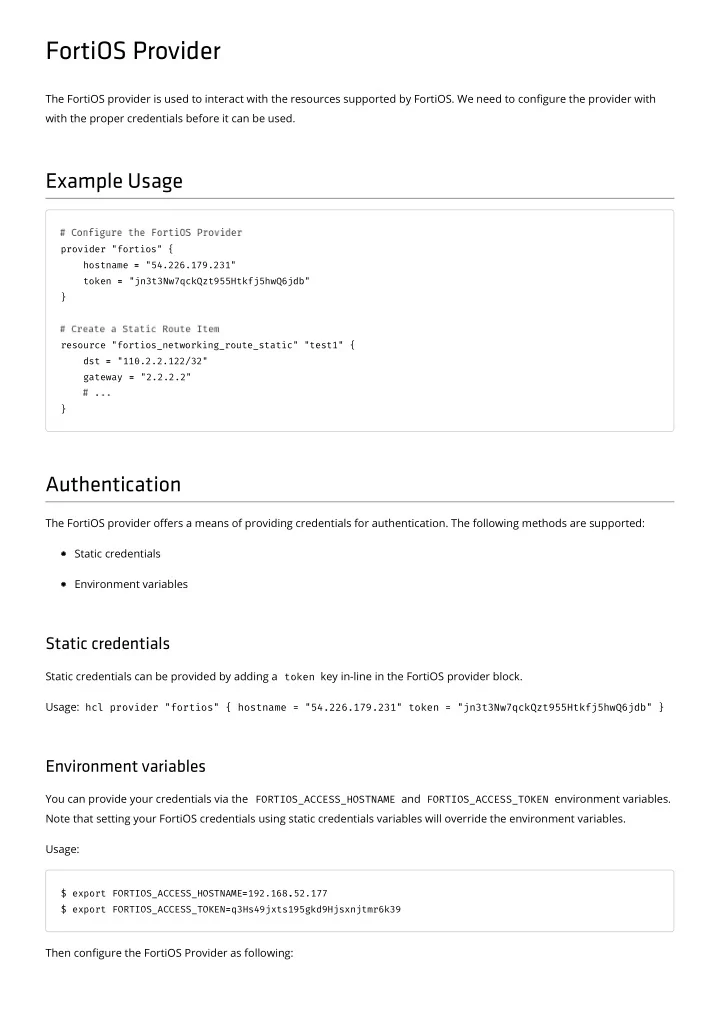
FortiOS Provider

The FortiOS provider is used to interact with the resources supported by FortiOS. We need to congure the provider with with the proper credentials before it can be used.

Example Usage

provider "fortios" { hostname = = "54.226.179.231" token = = "jn3t3Nw7qckQzt955Htkfj5hwQ6jdb" } resource "fortios_networking_route_static" "test1" { dst = = "110.2.2.122/32" gateway = = "2.2.2.2" }

Authentication

The FortiOS provider oers a means of providing credentials for authentication. The following methods are supported: Static credentials Environment variables

Static credentials

Static credentials can be provided by adding a token key in-line in the FortiOS provider block. Usage: hcl provider "fortios" { hostname = "54.226.179.231" token = "jn3t3Nw7qckQzt955Htkfj5hwQ6jdb" }

Environment variables

You can provide your credentials via the FORTIOS_ACCESS_HOSTNAME and FORTIOS_ACCESS_TOKEN environment variables. Note that setting your FortiOS credentials using static credentials variables will override the environment variables. Usage:

$ export FORTIOS_ACCESS_HOSTNAME= =192.168. .52.177 $ export FORTIOS_ACCESS_TOKEN= =q3Hs49jxts195gkd9Hjsxnjtmr6k39

Then congure the FortiOS Provider as following:

slide-2
SLIDE 2

provider "fortios" { } resource "fortios_networking_route_static" "test1" { dst = = "110.2.2.122/32" gateway = = "2.2.2.2" blackhole = = "disable" distance = = "22" weight = = "3" }

VDOM

If the FortiGate unit is running in VDOM mode, the vdom conguration needs to be added. Usage:

provider "fortios" { hostname = = "192.168.52.177" token = = "q3Hs49jxts195gkd9Hjsxnjtmr6k39" vdom = = "vdomtest" } resource "fortios_networking_route_static" "test1" { dst = = "120.2.2.122/32" gateway = = "2.2.2.2" blackhole = = "disable" distance = = "22" weight = = "3" priority = = "3" device = = "lbforvdomtest" comment = = "Terraform test" }

Argument Reference

The following arguments are supported:

hostname - (Optional) This is the hostname or IP address of FortiOS unit. It must be provided, but it can also be

sourced from the FORTIOS_ACCESS_HOSTNAME environment variable.

token - (Optional) This is the token of FortiOS unit. It must be provided, but it can also be sourced from the FORTIOS_ACCESS_TOKEN environment variable. insecure - (Optional) This is used to control whether the Provider to perform insecure SSL requests. If omitted, the FORTIOS_INSECURE environment variable is used. If neither is set, default value is false . cabundlefile - (Optional) The path of a custom CA bundle le. You can specify a path to the le, or you can specify it

by the FORTIOS_CA_CABUNDLE environment variable.

slide-3
SLIDE 3

vdom - (Optional) If the FortiGate unit is running in VDOM mode, you can use this argument to specify the name of the

vdom to be set .

Versioning

The provider can cover both FortiOS 6.0 and 6.2 versions.

slide-4
SLIDE 4

fortios_rewall_object_addressgroup

Provides a resource to congure rewall address group used in rewall policies of FortiOS.

Example Usage

provider "fortios" { hostname = = "54.226.179.231" token = = "jn3t3Nw7qckQzt955Htkfj5hwQ6jdb" } resource "fortios_firewall_object_addressgroup" "s1" { name = = "s1" member = = ["google-play","swscan.apple.com"] comment = = "dfdsad" }

Argument Reference

The following arguments are supported:

name - (Required) Address group name. member - (Required) Address objects contained within the group. comment - Comment.

Attributes Reference

The following attributes are exported:

id - The ID of the rewall address group item. name - Address group name. member - Address objects contained within the group. comment - Comment.

slide-5
SLIDE 5

fortios_rewall_object_address

Provides a resource to congure rewall addresses used in rewall policies of FortiOS.

Example Usage for Iprange Address

provider "fortios" { hostname = = "54.226.179.231" token = = "jn3t3Nw7qckQzt955Htkfj5hwQ6jdb" } resource "fortios_firewall_object_address" "s1" { name = = "s1" type = = "iprange" start_ip = = "1.0.0.0" end_ip = = "2.0.0.0" comment = = "dd" }

Example Usage for Geography Address

provider "fortios" { hostname = = "54.226.179.231" token = = "jn3t3Nw7qckQzt955Htkfj5hwQ6jdb" } resource "fortios_firewall_object_address" "s2" { name = = "s2" type = = "geography" country = = "AO" comment = = "dd" }

Example Usage for Fqdn Address

slide-6
SLIDE 6

provider "fortios" { hostname = = "54.226.179.231" token = = "jn3t3Nw7qckQzt955Htkfj5hwQ6jdb" } resource "fortios_firewall_object_address" "s3" { name = = "s3" type = = "fqdn" fqdn = = "baid.com" comment = = "dd" }

Example Usage for Ipmask Address

provider "fortios" { hostname = = "54.226.179.231" token = = "jn3t3Nw7qckQzt955Htkfj5hwQ6jdb" } resource "fortios_firewall_object_address" "s4" { name = = "s4" type = = "ipmask" subnet = = "0.0.0.0 0.0.0.0" comment = = "dd" }

Argument Reference

The following arguments are supported:

name - (Required) Address name. type - (Required) Type of address(Support ipmask, iprange, fqdn and geography). subnet - IP address and subnet mask of address. start_ip - First IP address (inclusive) in the range for the address. end_ip - Final IP address (inclusive) in the range for the address. fqdn - Fully Qualied Domain Name address. country - IP addresses associated to a specic country. comment - Comment.

Attributes Reference

The following attributes are exported:

slide-7
SLIDE 7

id - The ID of the address item. name - Address name. type - Type of address(Support ipmask, iprange, fqdn and geography). subnet - IP address and subnet mask of address. start_ip - First IP address (inclusive) in the range for the address. end_ip - Final IP address (inclusive) in the range for the address. fqdn - Fully Qualied Domain Name address. country - IP addresses associated to a specic country. comment - Comment.

slide-8
SLIDE 8

fortios_rewall_object_ippool

Provides a resource to congure IPv4 IP address pools of FortiOS.

Example Usage for Overload Ippool

provider "fortios" { hostname = = "54.226.179.231" token = = "jn3t3Nw7qckQzt955Htkfj5hwQ6jdb" } resource "fortios_firewall_object_ippool" "s1" { name = = "ddd" type = = "overload" startip = = "11.0.0.0" endip = = "22.0.0.0" arp_reply = = "enable" comments = = "fdsaf" }

Example Usage for One-to-one Ippool

provider "fortios" { hostname = = "54.226.179.231" token = = "jn3t3Nw7qckQzt955Htkfj5hwQ6jdb" } resource "fortios_firewall_object_ippool" "s2" { name = = "dd22d" type = = "one-to-one" startip = = "121.0.0.0" endip = = "222.0.0.0" arp_reply = = "enable" comments = = "fdsaf" }

Argument Reference

The following arguments are supported:

name - (Required) IP pool name. type - (Required) IP pool type(Support overload and one-to-one). startip - (Required) First IPv4 address (inclusive) in the range for the address pool (format xxx.xxx.xxx.xxx). endip - (Required) Final IPv4 address (inclusive) in the range for the address pool (format xxx.xxx.xxx.xxx).

slide-9
SLIDE 9

arp_reply - Enable/disable replying to ARP requests when an IP Pool is added to a policy. comments - Comment.

Attributes Reference

The following attributes are exported:

id - The ID of the IP pool item. name - IP pool name. type - IP pool type(Support overload and one-to-one). startip - First IPv4 address (inclusive) in the range for the address pool (format xxx.xxx.xxx.xxx). endip - Final IPv4 address (inclusive) in the range for the address pool (format xxx.xxx.xxx.xxx). arp_reply - Enable/disable replying to ARP requests when an IP Pool is added to a policy. comments - Comment.

slide-10
SLIDE 10

fortios_rewall_object_servicegroup

Provides a resource to congure rewall service group of FortiOS.

Example Usage

provider "fortios" { hostname = = "54.226.179.231" token = = "jn3t3Nw7qckQzt955Htkfj5hwQ6jdb" } resource "fortios_firewall_object_servicegroup" "v11" { name = = "1fdsafd11a" comment = = "fdsafdsa" member = = ["DCE-RPC", "DNS", "HTTPS"] }

Argument Reference

The following arguments are supported:

name - (Required) Service group name. member - (Required) Service objects contained within the group. comment - Comment.

Attributes Reference

The following attributes are exported:

id - The ID of the rewall service group item. name - Service group name. member - Service objects contained within the group. comment - Comment.

slide-11
SLIDE 11

fortios_rewall_object_service

Provides a resource to congure rewall service of FortiOS.

Example Usage for Fqdn Service

provider "fortios" { hostname = = "54.226.179.231" token = = "jn3t3Nw7qckQzt955Htkfj5hwQ6jdb" } resource "fortios_firewall_object_service" "v11" { name = = "servicetest1" category = = "General" protocol = = "TCP/UDP/SCTP" fqdn = = "abc.com" comment = = "comment" }

Example Usage for Iprange Service

provider "fortios" { hostname = = "54.226.179.231" token = = "jn3t3Nw7qckQzt955Htkfj5hwQ6jdb" } resource "fortios_firewall_object_service" "v13" { name = = "servicetest2" category = = "General" protocol = = "TCP/UDP/SCTP" iprange = = "1.1.1.1-2.2.2.2" tcp_portrange = = "22-33" udp_portrange = = "44-55" sctp_portrange = = "66-88" comment = = "comment" }

Example Usage for ICMP Service

slide-12
SLIDE 12

resource "fortios_firewall_object_service" "ICMP" { name = = "ICMPService" category = = "General" protocol = = "ICMP" icmptype = = "2" icmpcode = = "3" protocol_number = = "1" comment = = "comment" }

Argument Reference

The following arguments are supported:

name - (Required) Number of minutes before an idle administrator session time out. category - (Required) Service category. protocol - Protocol type based on IANA numbers. fqdn - Fully qualied domain name. iprange - Start and end of the IP range associated with service. tcp_portrange - Multiple TCP port ranges. udp_portrange - Multiple UDP port ranges. sctp_portrange - Multiple SCTP port ranges. icmptype - ICMP type. icmpcode - ICMP code. protocol_number - IP protocol number. comment - Comment.

Attributes Reference

The following attributes are exported:

id - The ID of the rewall service item. name - Number of minutes before an idle administrator session time out. category - Service category. protocol - Protocol type based on IANA numbers. fqdn - Fully qualied domain name. iprange - Start and end of the IP range associated with service.

slide-13
SLIDE 13

tcp_portrange - Multiple TCP port ranges. udp_portrange - Multiple UDP port ranges. sctp_portrange - Multiple SCTP port ranges. icmptype - ICMP type. icmpcode - ICMP code. protocol_number - IP protocol number. comment - Comment.

slide-14
SLIDE 14

fortios_rewall_object_vipgroup

Provides a resource to congure virtual IP groups of FortiOS.

Example Usage

provider "fortios" { hostname = = "54.226.179.231" token = = "jn3t3Nw7qckQzt955Htkfj5hwQ6jdb" } resource "fortios_firewall_object_vipgroup" "v11" { name = = "1fdsafd11a" interface = = "port3" comments = = "comments" member = = ["vip1", "vip3"] }

Argument Reference

The following arguments are supported:

name - (Required) VIP group name. interface - Interface name. member - (Required) Member VIP objects of the group. comments - Comment.

Attributes Reference

The following attributes are exported:

id - The ID of the virtual IP groups item. name - VIP group name. interface - Interface name. member - Member VIP objects of the group. comments - Comment.

slide-15
SLIDE 15

fortios_rewall_object_vip

Provides a resource to congure rewall virtual IPs (VIPs) of FortiOS.

Example Usage

provider "fortios" { hostname = = "54.226.179.231" token = = "jn3t3Nw7qckQzt955Htkfj5hwQ6jdb" } resource "fortios_firewall_object_vip" "v11" { name = = "dfa" comment = = "fdsafdsafds" extip = = "11.1.1.1-21.1.1.1" mappedip = = ["22.2.2.2-32.2.2.2"] extintf = = "port3" portforward = = "enable" protocol = = "tcp" extport = = "2-3" mappedport = = "4-5" }

Argument Reference

The following arguments are supported:

name - (Required) Virtual IP name. extip - (Required) IP address or address range on the external interface that you want to map to an address or

address range on the destination network.

mappedip - (Required) IP address or address range on the destination network to which the external IP address is

mapped.

extintf - Interface connected to the source network that receives the packets that will be forwarded to the

destination network.

portforward - Enable/disable port forwarding. protocol - Protocol to use when forwarding packets. extport - Incoming port number range that you want to map to a port number range on the destination network. mappedport - Port number range on the destination network to which the external port number range is mapped. comment - Comment.

Attributes Reference

slide-16
SLIDE 16

The following attributes are exported:

id - The ID of the rewall virtual IPs item. name - Virtual IP name. extip - IP address or address range on the external interface that you want to map to an address or address range

  • n the destination network.

mappedip - IP address or address range on the destination network to which the external IP address is mapped. extintf - Interface connected to the source network that receives the packets that will be forwarded to the

destination network.

portforward - Enable/disable port forwarding. protocol - Protocol to use when forwarding packets. extport - Incoming port number range that you want to map to a port number range on the destination network. mappedport - Port number range on the destination network to which the external port number range is mapped. comment - Comment.

slide-17
SLIDE 17

fortios_rewall_security_policy

Provides a resource to congure rewall policies of FortiOS.

Example Usage 1

provider "fortios" { hostname = = "54.226.179.231" token = = "jn3t3Nw7qckQzt955Htkfj5hwQ6jdb" } resource "fortios_firewall_security_policy" "test1" { name = = "ap11" srcintf = = ["port2"] dstintf = = ["port1"] srcaddr = = ["swscan.apple.com", "google-play"] dstaddr = = ["swscan.apple.com", "update.microsoft.com"] internet_service = = "disable" internet_service_id = = [] schedule = = "always" service = = ["ALL_ICMP", "FTP"] action = = "accept" utm_status = = "enable" logtraffic = = "all" logtraffic_start = = "enable" capture_packet = = "enable" ippool = = "enable" poolname = = ["rewq", "rbb"] groups = = ["Guest-group", "SSO_Guest_Users"] devices = = ["android-phone", "android-tablet"] comments = = "security policy" av_profile = = "wifi-default" webfilter_profile = = "monitor-all" dnsfilter_profile = = "default" ips_sensor = = "protect_client" application_list = = "block-high-risk" ssl_ssh_profile = = "certificate-inspection" nat = = "enable" }

Example Usage 2

slide-18
SLIDE 18

provider "fortios" { hostname = = "54.226.179.231" token = = "jn3t3Nw7qckQzt955Htkfj5hwQ6jdb" } resource "fortios_firewall_security_policy" "test2" { name = = "ap21" srcintf = = ["port2"] dstintf = = ["port1"] srcaddr = = ["swscan.apple.com", "google-play"] dstaddr = = ["swscan.apple.com", "update.microsoft.com"] internet_service = = "enable" internet_service_id = = [917520, 6881402, 393219] schedule = = "always" service = = [] action = = "accept" utm_status = = "enable" logtraffic = = "all" logtraffic_start = = "enable" capture_packet = = "enable" ippool = = "enable" poolname = = ["rewq", "rbb"] groups = = ["Guest-group", "SSO_Guest_Users"] devices = = ["android-phone", "android-tablet"] comments = = "security policy" av_profile = = "wifi-default" webfilter_profile = = "monitor-all" dnsfilter_profile = = "default" ips_sensor = = "protect_client" application_list = = "block-high-risk" ssl_ssh_profile = = "certificate-inspection" nat = = "enable" }

Example Usage 3

slide-19
SLIDE 19

resource "fortios_firewall_security_policy" "test1" { name = = "ap12221" srcintf = = ["port3"] dstintf = = ["port4"] srcaddr = = [] dstaddr = = [] internet_service = = "enable" internet_service_id = = [5242880] internet_service_src = = "enable" internet_service_src_id = = [65643] users = = ["guest"] status = = "enable" schedule = = "always" service = = [] action = = "accept" utm_status = = "enable" logtraffic = = "all" logtraffic_start = = "enable" capture_packet = = "enable" ippool = = "disable" poolname = = [] groups = = ["Guest-group", "SSO_Guest_Users"] devices = = [] comments = = "security policy" av_profile = = "wifi-default" webfilter_profile = = "monitor-all" dnsfilter_profile = = "default" ips_sensor = = "protect_client" application_list = = "block-high-risk" ssl_ssh_profile = = "certificate-inspection" nat = = "enable" profile_protocol_options = = "default" }

Argument Reference

The following arguments are supported:

name - (Required) Policy name. srcintf - (Required) Incoming (ingress) interface. dstintf - (Required) Outgoing (egress) interface. srcaddr - (Required) Source address and address group names. dstaddr - (Required) Destination address and address group names. internet_service - Enable/disable use of Internet Services for this policy. If enabled, destination address and service

are not used.

internet_service_id - Internet Service ID. action - (Required) Policy action.

slide-20
SLIDE 20

schedule - (Required) Schedule name. service - (Required) Service and service group names.. utm_status - Enable to add one or more security proles (AV, IPS, etc.) to the rewall policy. logtraffic - Enable or disable logging. Log all sessions or security prole sessions. logtraffic_start - Record logs when a session starts and ends. capture_packet - Enable/disable capture packets. ippool - Enable to use IP Pools for source NAT. poolname - IP Pool names. groups - Names of user groups that can authenticate with this policy. devices - Device type category. comments - Comment. av_profile - Name of an existing Antivirus prole. webfilter_profile - Name of an existing Web lter prole. dnsfilter_profile - Name of an existing DNS lter prole. ips_sensor - Name of an existing IPS sensor. application_list - Name of an existing Application list. ssl_ssh_profile - Name of an existing SSL SSH prole. nat - Enable/disable source NAT. internet_service_src - Enable/disable use of Internet Services in source for this policy. If enabled, source address

is not used.

internet_service_src_id - Internet Service source ID. users - Names of individual users that can authenticate with this policy. status - Enable or disable this policy. profile_protocol_options - Name of an existing Protocol options prole.

Attributes Reference

The following attributes are exported:

id - The ID of the rewall policy item. name - Policy name. srcintf - Incoming (ingress) interface. dstintf - Outgoing (egress) interface.

slide-21
SLIDE 21

srcaddr - Source address and address group names. dstaddr - Destination address and address group names. internet_service - Enable/disable use of Internet Services for this policy. If enabled, destination address and service

are not used.

internet_service_id - Internet Service ID. action - Policy action. schedule - Schedule name. service - Service and service group names.. utm_status - Enable to add one or more security proles (AV, IPS, etc.) to the rewall policy. logtraffic - Enable or disable logging. Log all sessions or security prole sessions. logtraffic_start - Record logs when a session starts and ends. capture_packet - Enable/disable capture packets. ippool - Enable to use IP Pools for source NAT. poolname - IP Pool names. groups - Names of user groups that can authenticate with this policy. devices - Device type category. comments - Comment. av_profile - Name of an existing Antivirus prole. webfilter_profile - Name of an existing Web lter prole. dnsfilter_profile - Name of an existing DNS lter prole. ips_sensor - Name of an existing IPS sensor. application_list - Name of an existing Application list. ssl_ssh_profile - Name of an existing SSL SSH prole. nat - Enable/disable source NAT. internet_service_src - Enable/disable use of Internet Services in source for this policy. If enabled, source address

is not used.

internet_service_src_id - Internet Service source ID. users - Names of individual users that can authenticate with this policy. status - Enable or disable this policy. profile_protocol_options - Name of an existing Protocol options prole.

slide-22
SLIDE 22

fortios_log_fortianalyzer_setting

Provides a resource to congure congure logging to FortiAnalyzer log management devices.

Example Usage

provider "fortios" { hostname = = "54.226.179.231" token = = "jn3t3Nw7qckQzt955Htkfj5hwQ6jdb" } resource "fortios_log_fortianalyzer_setting" "test1" { status = = "enable" server = = "10.2.2.99" source_ip = = "10.2.2.99" upload_option = = "realtime" reliable = = "enable" hmac_algorithm = = "sha256" enc_algorithm = = "high-medium" }

Argument Reference

The following arguments are supported:

status - (Required) Enable/disable logging to FortiAnalyzer. server - The remote FortiAnalyzer. source_ip - Source IPv4 or IPv6 address used to communicate with FortiAnalyzer. upload_option - Enable/disable logging to hard disk and then uploading to FortiAnalyzer. reliable - Enable/disable reliable logging to FortiAnalyzer. hmac_algorithm - FortiAnalyzer IPsec tunnel HMAC algorithm. enc_algorithm - Enable/disable sending FortiAnalyzer log data with SSL encryption.

Attributes Reference

The following attributes are exported:

status - Enable/disable logging to FortiAnalyzer. server - The remote FortiAnalyzer. source_ip - Source IPv4 or IPv6 address used to communicate with FortiAnalyzer. upload_option - Enable/disable logging to hard disk and then uploading to FortiAnalyzer.

slide-23
SLIDE 23

reliable - Enable/disable reliable logging to FortiAnalyzer. hmac_algorithm - FortiAnalyzer IPsec tunnel HMAC algorithm. enc_algorithm - Enable/disable sending FortiAnalyzer log data with SSL encryption.

slide-24
SLIDE 24

fortios_log_syslog_setting

Provides a resource to congure logging to remote Syslog logging servers.

Example Usage

provider "fortios" { hostname = = "54.226.179.231" token = = "jn3t3Nw7qckQzt955Htkfj5hwQ6jdb" } resource "fortios_log_syslog_setting" "test2" { status = = "enable" server = = "2.2.2.2" mode = = "udp" port = = "514" facility = = "local7" source_ip = = "10.2.2.199" format = = "csv" }

Argument Reference

The following arguments are supported:

status - (Required) Enable/disable remote syslog logging. server - Address of remote syslog server. mode - Remote syslog logging over UDP/Reliable TCP. port - Server listen port. facility - Remote syslog facility. source_ip - Source IP address of syslog. format - Log format.

Attributes Reference

The following attributes are exported:

status - Enable/disable remote syslog logging. server - Address of remote syslog server. mode - Remote syslog logging over UDP/Reliable TCP. port - Server listen port.

slide-25
SLIDE 25

facility - Remote syslog facility. source_ip - Source IP address of syslog. format - Log format.

slide-26
SLIDE 26

fortios_networking_interface_port

Provides a resource to congure interface settings of FortiOS.

Example Usage for Loopback Interface

provider "fortios" { hostname = = "54.226.179.231" token = = "jn3t3Nw7qckQzt955Htkfj5hwQ6jdb" } resource "fortios_networking_interface_port" "loopback1" { ip = = "23.123.33.10/24" allowaccess = = "ping http" alias alias = = "cc1" description = = "description" status = = "up" role = = "lan" name = = "myinterface1" vdom = = "root" type = = "loopback" mode = = "static" }

Example Usage for VLAN Interface

provider "fortios" { hostname = = "54.226.179.231" token = = "jn3t3Nw7qckQzt955Htkfj5hwQ6jdb" } resource "fortios_networking_interface_port" "vlan1" { role = = "lan" mode = = "static" defaultgw = = "enable" distance = = "33" type = = "vlan" vlanid = = "3" name = = "myinterface2" vdom = = "root" ip = = "3.123.33.10/24" interface = = "port2" allowaccess = = "ping" }

Example Usage for Physical Interface

slide-27
SLIDE 27

provider "fortios" { hostname = = "54.226.179.231" token = = "jn3t3Nw7qckQzt955Htkfj5hwQ6jdb" } resource "fortios_networking_interface_port" "test1" { name = = "port2" ip = = "93.133.133.110/24" alias alias = = "dkeeew" description = = "description" status = = "up" device_identification = = "enable" tcp_mss = = "3232" speed = = "auto" mtu_override = = "enable" mtu = = "2933" role = = "lan" allowaccess = = "ping https" mode = = "static" dns_server_override = = "enable" defaultgw = = "enable" distance = = "33" type = = "physical" }

Argument Reference

The following arguments are supported:

name - (Required) If the interface is physical, the argument is the name of the interface. type - (Required) Interface type (support physical, vlan, loopback). ip - Interface IPv4 address and subnet mask, syntax` - X.X.X.X/24. alias - Alias will be displayed with the interface name to make it easier to distinguish. status - Bring the interface up or shut the interface down. device_identification - Enable/disable passively gathering of device identity information about the devices on the

network connected to this interface.

tcp_mss - TCP maximum segment size. 0 means do not change segment size. speed - Interface speed. The default setting and the options available depend on the interface hardware. mtu_override - Enable to set a custom MTU for this interface. mtu - MTU value for this interface. role - Interface role. allowaccess - Permitted types of management access to this interface. mode - (Required) Addressing mode.

slide-28
SLIDE 28

dns_server_override - Enable/disable use DNS acquired by DHCP or PPPoE. defaultgw - Enable to get the gateway IP from the DHCP or PPPoE server. distance - Distance for routes learned through PPPoE or DHCP, lower distance indicates preferred route. description - Description. interface - Interface name. name - Name. vdom - Interface is in this virtual domain (VDOM). vlanid - VLAN ID.

Attributes Reference

The following attributes are exported:

id - The Name of the interface. ip - Interface IPv4 address and subnet mask, syntax` - X.X.X.X/24. alias - Alias will be displayed with the interface name to make it easier to distinguish. status - Bring the interface up or shut the interface down. device_identification - Enable/disable passively gathering of device identity information about the devices on the

network connected to this interface.

tcp_mss - TCP maximum segment size. 0 means do not change segment size. speed - Interface speed. The default setting and the options available depend on the interface hardware. mtu_override - Enable to set a custom MTU for this interface. mtu - MTU value for this interface. role - Interface role. allowaccess - Permitted types of management access to this interface. mode - Addressing mode. dns_server_override - Enable/disable use DNS acquired by DHCP or PPPoE. defaultgw - Enable to get the gateway IP from the DHCP or PPPoE server. distance - Distance for routes learned through PPPoE or DHCP, lower distance indicates preferred route. description - Description. type - Interface type (support physical, vlan, loopback). interface - Interface name. name - Name.

slide-29
SLIDE 29

vdom - Interface is in this virtual domain (VDOM). vlanid - VLAN ID.

slide-30
SLIDE 30

fortios_networking_route_static

Provides a resource to congure static route of FortiOS.

Example Usage

provider "fortios" { hostname = = "54.226.179.231" token = = "jn3t3Nw7qckQzt955Htkfj5hwQ6jdb" } resource "fortios_networking_route_static" "test1" { dst = = "110.2.2.122/32" gateway = = "2.2.2.2" blackhole = = "disable" distance = = "22" weight = = "3" priority = = "3" device = = "port2" comment = = "Terraform test" }

Argument Reference

The following arguments are supported:

dst - (Required) Destination IP and mask for this route. gateway - (Required) Gateway IP for this route. blackhole - Enable/disable black hole. distance - Administrative distance. weight - Administrative weight. priority - Administrative priority. device - (Required) Gateway out interface or tunnel. comment - Optional comments.

Attributes Reference

The following attributes are exported:

id - The ID of the static route item. dst - Destination IP and mask for this route.

slide-31
SLIDE 31

gateway - Gateway IP for this route. blackhole - Enable/disable black hole. distance - Administrative distance. weight - Administrative weight. priority - Administrative priority. device - Gateway out interface or tunnel. comment - Optional comments.

slide-32
SLIDE 32

fortios_system_admin_administrator

Provides a resource to congure administrator accounts of FortiOS.

Example Usage

provider "fortios" { hostname = = "54.226.179.231" token = = "jn3t3Nw7qckQzt955Htkfj5hwQ6jdb" } resource "fortios_system_admin_administrator" "admintest" { name = = "testadminacc" password = = "cc37331AC1" trusthost1 = = "1.1.1.0 255.255.255.0" trusthost2 = = "2.2.2.0 255.255.255.0" accprofile = = "3d3" vdom = = ["root"] comments = = "comments" }

Argument Reference

The following arguments are supported:

name - (Required) User name. password - (Required) Admin user password. trusthostN - Any IPv4 address or subnet address and netmask from which the administrator can connect to the

FortiGate unit.

vdom - Virtual domain(s) that the administrator can access. accprofile - Access prole for this administrator. Access proles control administrator access to FortiGate features. comments - Comment.

Attributes Reference

The following attributes are exported:

id - The ID of the administrator account item. name - User name. password - Admin user password. trusthostN - Any IPv4 address or subnet address and netmask from which the administrator can connect to the

slide-33
SLIDE 33

FortiGate unit.

vdom - Virtual domain(s) that the administrator can access. accprofile - Access prole for this administrator. Access proles control administrator access to FortiGate features. comments - Comment.

slide-34
SLIDE 34

fortios_system_admin_proles

Provides a resource to congure access proles of FortiOS.

Example Usage

provider "fortios" { hostname = = "54.226.179.231" token = = "jn3t3Nw7qckQzt955Htkfj5hwQ6jdb" } resource "fortios_system_admin_profiles" "test1" { name = = "223d3" scope = = "vdom" comments = = "test" secfabgrp = = "read-write" ftviewgrp = = "read" authgrp = = "none" sysgrp = = "read" netgrp = = "none" loggrp = = "none" fwgrp = = "none" vpngrp = = "none" utmgrp = = "none" wanoptgrp = = "none" wifi = = "none" admintimeout_override = = "disable" }

Argument Reference

The following arguments are supported:

name - (Required) Prole name. scope - Scope of admin access. secfabgrp - Security Fabric. ftviewgrp - FortiView. authgrp - Administrator access to Users and Devices. sysgrp - System Conguration. netgrp - Network Conguration. loggrp - Administrator access to Logging and Reporting including viewing log messages. fwgrp - Administrator access to the Firewall conguration. vpngrp - Administrator access to IPsec, SSL, PPTP, and L2TP VPN.

slide-35
SLIDE 35

utmgrp - Administrator access to Security Proles. wanoptgrp - Administrator access to WAN Opt & Cache. wifi - Administrator access to the WiFi controller and Switch controller. admintimeout_override - Enable/disable overriding the global administrator idle timeout. comments - Comment.

Attributes Reference

The following attributes are exported:

id - The ID of the access prole item. name - Prole name. scope - Scope of admin access. secfabgrp - Security Fabric. ftviewgrp - FortiView. authgrp - Administrator access to Users and Devices. sysgrp - System Conguration. netgrp - Network Conguration. loggrp - Administrator access to Logging and Reporting including viewing log messages. fwgrp - Administrator access to the Firewall conguration. vpngrp - Administrator access to IPsec, SSL, PPTP, and L2TP VPN. utmgrp - Administrator access to Security Proles. wanoptgrp - Administrator access to WAN Opt & Cache. wifi - Administrator access to the WiFi controller and Switch controller. admintimeout_override - Enable/disable overriding the global administrator idle timeout. comments - Comment.

slide-36
SLIDE 36

fortios_system_apiuser_setting

Provides a resource to congure API users of FortiOS. The API user of the token for this feature should have a super admin prole, It can be set in CLI while GUI does not allow.

Example Usage

provider "fortios" { hostname = = "54.226.179.231" token = = "jn3t3Nw7qckQzt955Htkfj5hwQ6jdb" } resource "fortios_system_apiuser_setting" "test2" { name = = "testapiuser" accprofile = = "restAPIprofile" vdom = = ["root"] trusthost { type = = "ipv4-trusthost" ipv4_trusthost = = "61.149.0.0 255.255.0.0" } trusthost { type = = "ipv4-trusthost" ipv4_trusthost = = "22.22.0.0 255.255.0.0" } }

Argument Reference

The following arguments are supported:

name - (Required) User name. accprofile - (Required) Admin user access prole. vdom - (Required) Virtual domains. trusthost-Type - (Required) Trusthost type. trusthost-ipv4_trusthost - (Required) IPv4 trusted host address. comments - Comment.

Attributes Reference

The following attributes are exported:

id - The ID of the API user.

slide-37
SLIDE 37

name - User name. accprofile - Admin user access prole. vdom - Virtual domains. trusthost-Type - Trusthost type. trusthost-ipv4_trusthost - IPv4 trusted host address. comments - Comment.

slide-38
SLIDE 38

fortios_system_license_forticare

Provides a resource to add a FortiCare license for FortiOS.

Example Usage

provider "fortios" { hostname = = "54.226.179.231" token = = "jn3t3Nw7qckQzt955Htkfj5hwQ6jdb" } resource "fortios_system_license_forticare" "test2" { registration_code = = "license" }

Argument Reference

The following arguments are supported:

registration_code - (Required) Registration code.

slide-39
SLIDE 39

fortios_system_license_vdom

Provides a resource to add a VDOM license for FortiOS.

Example Usage

provider "fortios" { hostname = = "54.226.179.231" token = = "jn3t3Nw7qckQzt955Htkfj5hwQ6jdb" } resource "fortios_system_license_vdom" "test2" { license = = "license" }

Argument Reference

The following arguments are supported:

license - (Required) Registration code.

slide-40
SLIDE 40

fortios_system_license_vm

Provides a resource to update VM license using uploaded le for FortiOS. Reboots immediately if successful.

Example Usage

provider "fortios" { hostname = = "54.226.179.231" token = = "jn3t3Nw7qckQzt955Htkfj5hwQ6jdb" } resource "fortios_system_license_vm" "test2" { file_content = = "LS0tLS1CRUdJTiBGR1QgVk0gTElDRU5TRS0tLS0tDQpRQUFBQUxXaTdCVnVkV2x3QXJZcC92S2J2Yk5zME5YN WluUW9sVldmcFoxWldJQi9pL2g4c01oR0psWWc5Vkl1DQorSlBJRis1aFphMWwyNm9yNHdiEQE3RnJDeVZnQUFBQWhxWjliWHFLK1hGN2

  • 3dnB3WTB6QXRTaTdOMVM1ZWNxDQpWYmRRREZyYklUdnRvUWNyRU1jV0ltQzFqWWs5dmVoeGlYTG1OV0MwN25BSitYTTJFNmh2b29DMjE

1YUwxK2wrDQovUHl5M0VLVnNTNjJDT2hMZHc3UndXajB3V3RqMmZiWg0KLS0tLS1FTkQgRkdUIFZNIExJQ0VOU0UtLS0tLQ0K" }

Argument Reference

The following arguments are supported:

file_content - (Required) The license le, it needs to be base64 encoded, must not contain whitespace or other

invalid base64 characters, and must be included in HTTP body.

slide-41
SLIDE 41

fortios_system_setting_dns

Provides a resource to congure DNS of FortiOS.

Example Usage

provider "fortios" { hostname = = "54.226.179.231" token = = "jn3t3Nw7qckQzt955Htkfj5hwQ6jdb" } resource "fortios_system_setting_dns" "test1" { primary = = "208.91.112.53" secondary = = "208.91.112.22" }

Argument Reference

The following arguments are supported:

primary - Primary DNS server IP address. secondary - Secondary DNS server IP address.

Attributes Reference

The following attributes are exported:

primary - Primary DNS server IP address. secondary - Secondary DNS server IP address.

slide-42
SLIDE 42

fortios_system_setting_global

Provides a resource to congure options related to the overall operation of FortiOS.

Example Usage

provider "fortios" { hostname = = "54.226.179.231" token = = "jn3t3Nw7qckQzt955Htkfj5hwQ6jdb" } resource "fortios_system_setting_global" "test1" { admintimeout = = 65 timezone = = "04" hostname = = "mytestFortiGate" admin_sport = = 443 admin_ssh_port = = 22 }

Argument Reference

The following arguments are supported:

hostname - (Required) FortiGate unit's hostname. admintimeout - Number of minutes before an idle administrator session time out. timezone - Number corresponding to your time zone from 00 to 86. admin_sport - Administrative access port for HTTPS. admin_ssh_port - Administrative access port for SSH.

Attributes Reference

The following attributes are exported:

admintimeout - Number of minutes before an idle administrator session time out. timezone - Number corresponding to your time zone from 00 to 86. hostname - FortiGate unit's hostname. admin_sport - Administrative access port for HTTPS. admin_ssh_port - Administrative access port for SSH.

slide-43
SLIDE 43

fortios_system_setting_ntp

Provides a resource to congure Network Time Protocol (NTP) servers of FortiOS.

Example Usage

provider "fortios" { hostname = = "54.226.179.231" token = = "jn3t3Nw7qckQzt955Htkfj5hwQ6jdb" } resource "fortios_system_setting_ntp" "test2" { type = = "custom" ntpserver = = ["1.1.1.1", "3.3.3.3"] ntpsync = = "disable" }

Argument Reference

The following arguments are supported:

type - (Required) Use the FortiGuard NTP server or any other available NTP Server. ntpserver - Congure the FortiGate to connect to any available third-party NTP server. ntpsync - Enable/disable setting the FortiGate system time by synchronizing with an NTP Server.

Attributes Reference

The following attributes are exported:

type - Use the FortiGuard NTP server or any other available NTP Server. ntpserver - Congure the FortiGate to connect to any available third-party NTP server. ntpsync - Enable/disable setting the FortiGate system time by synchronizing with an NTP Server.

slide-44
SLIDE 44

fortios_system_vdom_setting

Provides a resource to congure VDOM of FortiOS. The API user of the token for this feature should have a super admin prole, It can be set in CLI while GUI does not allow.

Example Usage

provider "fortios" { hostname = = "54.226.179.231" token = = "jn3t3Nw7qckQzt955Htkfj5hwQ6jdb" } resource "fortios_system_vdom_setting" "test2" { name = = "aa1122" short_name = = "aa1122" temporary = = 0 }

Argument Reference

The following arguments are supported:

name - (Required) VDOM name. short_name - VDOM short name. temporary - Temporary.

Attributes Reference

The following attributes are exported:

id - The ID of the VDOM. name - VDOM name. short_name - VDOM short name. temporary - Temporary.

slide-45
SLIDE 45

fortios_vpn_ipsec_phase1interface

Provides a resource to use phase1-interface to dene a phase 1 denition for a route-based (interface mode) IPsec VPN tunnel that generates authentication and encryption keys automatically.

Example Usage

fortios_vpn_ipsec_phase1interface needs to be set with fortios_vpn_ipsec_phase2interface. See section fortios_vpn_ipsec_phase2interface.

Argument Reference

The following arguments are supported:

name - (Required) IPsec remote gateway name. type - (Required) Remote gateway type. interface - (Required) Local physical, aggregate, or VLAN outgoing interface. peertype - Accept this peer type. proposal - Phase1 proposal. comments - Comment. wizard_type - GUI VPN Wizard Type. remote_gw - (Required) IPv4 address of the remote gateway's external interface. psksecret - (Required) Pre-shared secret for PSK authentication. certificate - Names of signed personal certicates. peerid - Accept this peer identity. peer - Accept this peer certicate. peergrp - Accept this peer certicate group. ipv4_split_include - IPv4 split-include subnets. split_include_service - Split-include services. ipv4_split_exclude - IPv4 subnets that should not be sent over the IPsec tunnel. authmethod - Authentication method. authmethod_remote - Authentication method (remote side). mode_cfg - Enable/disable conguration method.

slide-46
SLIDE 46

Attributes Reference

The following attributes are exported:

id - The ID of the phase1-interface item. name - IPsec remote gateway name. type - Remote gateway type. interface - Local physical, aggregate, or VLAN outgoing interface. peertype - Accept this peer type. proposal - Phase1 proposal. comments - Comment. wizard_type - GUI VPN Wizard Type. remote_gw - IPv4 address of the remote gateway's external interface. psksecret - Pre-shared secret for PSK authentication. certificate - Names of signed personal certicates. peerid - Accept this peer identity. peer - Accept this peer certicate. peergrp - Accept this peer certicate group. ipv4_split_include - IPv4 split-include subnets. split_include_service - Split-include services. ipv4_split_exclude - IPv4 subnets that should not be sent over the IPsec tunnel. authmethod - Authentication method. authmethod_remote - Authentication method (remote side). mode_cfg - Enable/disable conguration method.

slide-47
SLIDE 47

fortios_vpn_ipsec_phase2interface

Provides a resource to use phase2-interface to add or edit a phase 2 conguration on a route-based (interface mode) IPsec tunnel.

Example Usage for Site to Site/Pre-shared Key

provider "fortios" { hostname = = "54.226.179.231" token = = "jn3t3Nw7qckQzt955Htkfj5hwQ6jdb" } resource "fortios_vpn_ipsec_phase1interface" "test1" { name = = "001Test" type = = "static" interface = = "port2" peertype = = "any" proposal = = "aes128-sha256 aes256-sha256 aes128-sha1 aes256-sha1" comments = = "VPN 001Test P1" wizard_type = = "static-fortigate" remote_gw = = "1.2.2.2" psksecret = = "testscecret112233445566778899" authmethod = = "psk" authmethod_remote = = "" mode_cfg = = "disable" } provider "fortios" { hostname = = "54.226.179.231" token = = "jn3t3Nw7qckQzt955Htkfj5hwQ6jdb" } resource "fortios_vpn_ipsec_phase2interface" "test2" { name = = "001Test" phase1name = = "001Test" proposal = = "aes128-sha1 aes256-sha1 aes128-sha256 aes256-sha256 aes128gcm aes256gcm chacha20poly1305" comments = = "VPN 001Test P2" src_addr_type = = "name" dst_addr_type = = "name" src_name = = "HQ-toBranch_local" dst_name = = "HQ-toBranch_remote" }

Example Usage for Site to Site/Signature

slide-48
SLIDE 48

provider "fortios" { hostname = = "54.226.179.231" token = = "jn3t3Nw7qckQzt955Htkfj5hwQ6jdb" } resource "fortios_vpn_ipsec_phase1interface" "test1" { name = = "001Test" type = = "static" interface = = "port2" proposal = = "aes128-sha256 aes256-sha256 aes128-sha1 aes256-sha1" comments = = "VPN 001Test P1" wizard_type = = "static-fortigate" remote_gw = = "1.2.2.2" psksecret = = "testscecret112233445566778899" certificate = = ["Fortinet_SSL_ECDSA384"] peertype = = "peer" peerid = = "" peer = = "2b_peer" peergrp = = "" } provider "fortios" { hostname = = "54.226.179.231" token = = "jn3t3Nw7qckQzt955Htkfj5hwQ6jdb" } resource "fortios_vpn_ipsec_phase2interface" "test2" { name = = "001Test" phase1name = = "001Test" proposal = = "aes128-sha1 aes256-sha1 aes128-sha256 aes256-sha256 aes128gcm aes256gcm chacha20poly1305" comments = = "VPN 001Test P2" src_addr_type = = "range" dst_addr_type = = "subnet" src_start_ip = = "1.1.1.0" src_end_ip = = "1.1.1.1" dst_subnet = = "2.2.2.2/24" }

Example Usage for Remote Access/Pre-shared Key

slide-49
SLIDE 49

provider "fortios" { hostname = = "54.226.179.231" token = = "jn3t3Nw7qckQzt955Htkfj5hwQ6jdb" } resource "fortios_vpn_ipsec_phase1interface" "test1" { name = = "001Test" type = = "dynamic" interface = = "port2" peertype = = "any" proposal = = "aes128-sha256 aes256-sha256 aes128-sha1 aes256-sha1" comments = = "VPN 001Test P1" wizard_type = = "dialup-forticlient" remote_gw = = "0.0.0.0" psksecret = = "testscecret112233445566778899" ipv4_split_include = = "d_split" split_include_service = = "" ipv4_split_exclude = = "" } provider "fortios" { hostname = = "54.226.179.231" token = = "jn3t3Nw7qckQzt955Htkfj5hwQ6jdb" } resource "fortios_vpn_ipsec_phase2interface" "test2" { name = = "001Test" phase1name = = "001Test" proposal = = "aes128-sha1 aes256-sha1 aes128-sha256 aes256-sha256 aes128gcm aes256gcm chacha20poly1305" comments = = "VPN 001Test P2" src_addr_type = = "subnet" src_start_ip = = "0.0.0.0" src_end_ip = = "0.0.0.0" src_subnet = = "0.0.0.0 0.0.0.0" dst_addr_type = = "subnet" dst_start_ip = = "0.0.0.0" dst_end_ip = = "0.0.0.0" dst_subnet = = "0.0.0.0 0.0.0.0" }

Example Usage for Remote Access/Signature

slide-50
SLIDE 50

provider "fortios" { hostname = = "54.226.179.231" token = = "jn3t3Nw7qckQzt955Htkfj5hwQ6jdb" } resource "fortios_vpn_ipsec_phase1interface" "test1" { name = = "001Test" type = = "dynamic" interface = = "port2" peertype = = "any" proposal = = "aes128-sha256 aes256-sha256 aes128-sha1 aes256-sha1" comments = = "VPN 001Test P1" wizard_type = = "dialup-forticlient" remote_gw = = "1.2.2.2" psksecret = = "testscecret112233445566778899" certificate = = ["Fortinet_SSL_ECDSA384"] peertype = = "peer" peerid = = "" peer = = "2b_peer" peergrp = = "", ipv4_split_include = = "d_split" split_include_service = = "" ipv4_split_exclude = = "" } provider "fortios" { hostname = = "54.226.179.231" token = = "jn3t3Nw7qckQzt955Htkfj5hwQ6jdb" } resource "fortios_vpn_ipsec_phase2interface" "test2" { name = = "001Test" phase1name = = "001Test" proposal = = "aes128-sha1 aes256-sha1 aes128-sha256 aes256-sha256 aes128gcm aes256gcm chacha20poly1305" comments = = "VPN 001Test P2" src_addr_type = = "subnet" src_start_ip = = "0.0.0.0" src_end_ip = = "0.0.0.0" src_subnet = = "0.0.0.0 0.0.0.0" dst_addr_type = = "subnet" dst_start_ip = = "0.0.0.0" dst_end_ip = = "0.0.0.0" dst_subnet = = "0.0.0.0 0.0.0.0" }

Argument Reference

The following arguments are supported:

name - (Required) IPsec tunnel name. phase1name - (Required) Phase 1 determines the options required for phase 2. proposal - Phase2 proposal.

slide-51
SLIDE 51

src_addr_type - Local proxy ID type. src_start_ip - Local proxy ID start. src_end_ip - Local proxy ID end. src_subnet - Local proxy ID subnet. dst_addr_type - Local proxy ID type. src_name - Local proxy ID name. dst_name - Remote proxy ID name. dst_start_ip - Remote proxy ID IPv4 start. dst_end_ip - Remote proxy ID IPv4 end. dst_subnet - Remote proxy ID IPv4 subnet. comments - Comment.

Attributes Reference

The following attributes are exported:

id - The ID of the phase2-interface. name - IPsec tunnel name. phase1name - Phase 1 determines the options required for phase 2. proposal - Phase2 proposal. src_addr_type - Local proxy ID type. src_start_ip - Local proxy ID start. src_end_ip - Local proxy ID end. src_subnet - Local proxy ID subnet. dst_addr_type - Local proxy ID type. src_name - Local proxy ID name. dst_name - Remote proxy ID name. dst_start_ip - Remote proxy ID IPv4 start. dst_end_ip - Remote proxy ID IPv4 end. dst_subnet - Remote proxy ID IPv4 subnet. comments - Comment.