Todays Objectives Check InHow are we doing? Team guidelines and - - PDF document
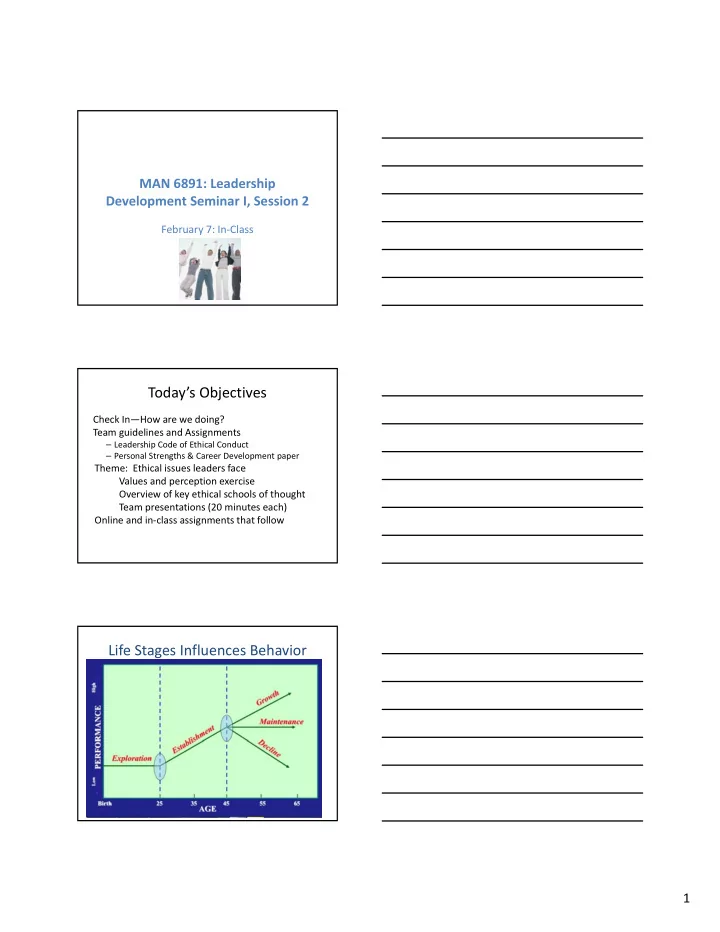
MAN 6891: Leadership Development Seminar I, Session 2 February 7: In Class Todays Objectives Check InHow are we doing? Team guidelines and Assignments Leadership Code of Ethical Conduct Personal Strengths & Career Development
2
The Alligator River Story
Ron Gilbert
Alligator River Story
- Bill
- Cindy
- Sinbad
- Ivana
- Slug
Rank These Five Characters In Terms Of Their Being Offensive To You
Offensive Bill Cindy Sinbad Ivana Slug 1 (most) 2 3 4 5 (least) Example: 1=Bill; 2=Sinbad; 3=Ivana; 4=Cindy; 5=Slug (there is no right or wrong answer—this is not a test)
3 What Are Some Lessons Learned From The Alligator River Story Activity
- Who acted unethically?
- What was the ethical violation?
- Implications regarding assumptions we make
that others know what we know
- Others do not see what we see
- We need to take time and care to manage
individuals’ perceptions and judgments when working with others.
Our Modified Johari Window And Perceptions
Other knows Other Does Not Know I know My hair is grey I dye my hair grey! (Tsk, Tsk) I do not know Stexe has put two fingers above my head when I am lecturing! The grading policy of the new Dean (i.e., the percent
- f A’s a professor can give
to one class)
The challenge is to enlarge what the other knows and what I (you) know so we can gain a shared understanding about our perceptions when problem solving together.
Executive Decision Making
Does it meet the test for being: Prudent? Legal? Ethical?
4
Why Seek Virtue?
“Man has a natural aptitude for virtue; but the perfection of virtue must be acquired by man by means of some kind of training” — Saint Thomas Aquinas
What Does Ethical Behavior Mean?
What do you think is and is not ethical behavior?
Three Basics
- Religious Dictums to “Do The Right Thing”
– Judeo‐Christian Ten Commandments, Parables, Love God, Love your neighbor – Hinduism restraints (non Injury, truthfulness, non stealing) – Islam similar ethical messages in the Qur’an, fleshed out in the sacred Sunna – Buddhism‐‐Avoid being harmful to one’s self or
- thers
5
In A Nutshell
Unethical behavior is about:
– Lying/dishonesty – Cheating/deception – Harming another – Unfairness Laughing to be “in” with others making jokes of
- thers
To Not Lie—It Is Not Easy!
- Telling lies to save someone’s feelings
- Telling lies to avoid embarrassment
- Telling lies to avoid punishment
- Telling lies in negotiation
- Telling lies to children
When would I not tell the whole truth?
Howard, Ronald A.; Korver, Clinton D.; Birchard, Bill (2008‐06‐24). Ethics for the Real World: Creating a Personal Code to Guide Decisions in Work and Life (p. 75). Harvard Business Review Press. Kindle Edition.
Ethical Behavior & Moral Reasoning
- Increases with education and age.
- Is influenced by supervisors and leaders who
model ethical behavior.
- Improves by drawing on ethical guidelines:
– Utilitarianism – Kant’s Categorical Imperative – Altruism – Communitarianism – (rights vs obligation) – Justice‐as‐fairness theory
6
Leadership Code of Conduct
Should answer the question:
What does rightful behavior require of me and those I lead and the institution in which I am obligated to develop good
- rganizational citizenship?
Focus on lying, cheating, harming, unfairness as touchstone guides from which you will use to influence your behavior and that of others you lead. What are the dilemmas and tough spots in living your code? Chapter 9 in Johnson text should be a helpful guide for you as the “Leader as Ethics Officer.”
Ethical Blind Spots
Johnson, Chapter 9
- 1. Overestimating our own ethicality—what we say
is not what we may do
- 2. Forgiving our own unethical conduct—our want
self vs. our should self
- 3. “In‐group” favoritism—we treat others like us
better than others not like us
- 4. Implicit prejudices
- 5. Judging good based on ends as opposed to
means—i.e., the Death By Peanuts case.
Our Modified Johari Window To Create Shared Ethical Action
Other knows Other Does Not Know I know Shared Ethical understanding I think X is ethical and you do not know about it or accept it I do not know You hold an ethical standard and I do not hold it
The challenge is to enlarge what the ethical expectations of one another are so we can gain a shared understanding about acceptable behavior of
- ne another in the organizations we lead.
7 Team Presentations On Ethical Cases
- Team 1, Case study 2.1, “A modern day
libertine.”
- Team 2, Case study 2.3, “Death by Peanuts.”
- Team 3, Case Study 3.1, “Virtue In Extremes
Leadership.”
- Team 4, Case study 3.2, “The Spectacular Rise
and Fall of a Humanitarian Hero.”
- Team 5: Case study 5.3, “Drone Wars.”
How Does Ethical Leadership Fit In With The Other Courses You Are Taking?
Things To Do By April 18
Prepare and share your personal strengths papers with a minimum of two others on your team for them to review Prepare and share your Leadership Ethical Code of Conduct paper. Be sure to take the StrengthsFinders and any other psychological assessments you deem relevant for your Strengths paper. Read: Rath & Conchie, Strengths Based Leadership: Great Leaders, Teams, and Why People Follow
8
Special Leadership Topics
- Characteristics of a CEO (Life Coach)
- Head Hunter—how to market one’s skill set to
make a career change
- Strategic growth (Ron needs more info)
- Executive Time Management
- Negotiating Packages (before accepting a job?)
- Health and Wellness for executives/staff
- Cross cultural leadership (issues & practices)
How Did We Do Today?
- What did you like?
- What do we need to do better next time?
- How can Ron serve you more effectively as we