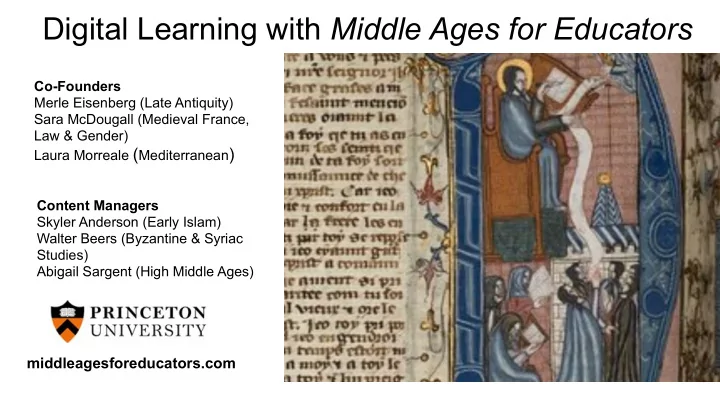
SLIDE 1 Digital Learning with Middle Ages for Educators
Co-Founders Merle Eisenberg (Late Antiquity) Sara McDougall (Medieval France, Law & Gender) Laura Morreale (Mediterranean) Content Managers Skyler Anderson (Early Islam) Walter Beers (Byzantine & Syriac Studies) Abigail Sargent (High Middle Ages)
middleagesforeducators.com
SLIDE 2 Outline for Today’s Talk
- Goal of the Site
- Short Walkthrough of the Site (Merle)
○ Teaching Resources ○ Tool Talks ○ Translated Primary Sources ○ Online Resource Portal
- Digital Pedagogical Interaction (Laura)
○ 4 Levels of Instruction ○ Digital Projects
- Adaptation to User Needs Moving Forward (Sara)
○ What you need ○ What we can and cannot do
SLIDE 3 Outline for Today’s Talk
- Goal of the Site
- Short Walkthrough of the Site (Merle)
○ Teaching Resources ○ Tool Talks ○ Translated Primary Sources ○ Online Resource Portal
- Digital Pedagogical Interaction (Laura)
○ 4 Levels of Instruction ○ Digital Projects
- Adaptation to User Needs Moving Forward (Sara)
○ What you need ○ What we cannot and can do
SLIDE 4
What is the Point of MAFE?
·
SLIDE 5 Outline for Today’s Talk
- Goal of the Site
- Short Walkthrough of the Site (Merle)
○ Teaching Resources ○ Tool Talks ○ Translated Primary Sources ○ Online Resource Portal
- Digital Pedagogical Interaction (Laura)
○ 4 Levels of Instruction ○ Digital Projects
- Adaptation to User Needs Moving Forward (Sara)
○ What you need ○ What we cannot and can do
SLIDE 6
Teaching Resources
·
SLIDE 7
Teaching Resources
·
SLIDE 8
Tool Talks
·
SLIDE 9
Translated Primary Sources
·
SLIDE 10
Online Resources Portal
·
SLIDE 11 Outline for Today’s Talk
- Goal of the Site
- Short Walkthrough of the Site (Merle)
○ Teaching Resources ○ Tool Talks ○ Translated Primary Sources ○ Online Resource Portal
- Digital Pedagogical Interaction (Laura)
○ 4 Levels of Instruction ○ Digital Projects
- Adaptation to User Needs Moving Forward (Sara)
○ What you need ○ What we cannot and can do
SLIDE 12 Digital Learning in Pre-modern Studies
- Medievalists have used the digital
medium to examine their sources for decades.
- We now live in a knowledge economy
based largely on digital dissemination.
- Using digital tools to study the
pre-modern means you are both learning the material and using the most up-to-date methodologies in the field to do so. This is both a challenge and an opportunity. We hope MAFE can help with this.
SLIDE 13
How to use MAFE: 4 levels of Engagement
Level 1: Find information about pre-modern history (Online Resource Portal). Level 2: Deliver Content; eg.teach students something about the 100 years war or the plague (Tag: Meet a Medieval Source, Short Video Lectures) Level 3: Interact with other medieval digital projects (Short Video Lectures, Virtual Project Tours) Level 4: Learn about tools for students to express themselves digitally (Tool Talks)
SLIDE 14
Digital Projects 1: Website, Women of 1000 AD
SLIDE 15
Digital Projects 2: Website, People of 1381
SLIDE 16
Digital Projects 3: Online Interface, Digital Grave
SLIDE 17
Digital Projects 4: Mapping, Primary Sources Independent Crusaders Project
SLIDE 18
Tool Talks
SLIDE 19 Outline for Today’s Talk
- Goal of the Site
- Short Walkthrough of the Site (Merle)
○ Teaching Resources ○ Tool Talks ○ Translated Primary Sources ○ Online Resource Portal
- Digital Pedagogical Interaction (Laura)
○ 4 Levels of Instruction ○ Digital Projects
- Adaptation to User Needs Moving Forward (Sara)
○ What you asked for ○ What we cannot and can do.
SLIDE 20
We Asked You
1. What barriers do you encounter in teaching pre-modern topics and sources? 2. How might MAFE add features that help overcome these problems? 3. What specific materials on MAFE would be helpful to you for teaching Late Antiquity and the Middle Ages? 4. Are there other features you would like us to add to MAFE?
SLIDE 21 What You Need from MAFE
- Students’ (and some non-specialist teachers) lack of
knowledge about the Middle Ages
- Language Skills: some need only English, some need
Spanish (for Sp. Open Iberia/América ) *but all can transcribe!
- Pre-Modern materials can be difficult for students
- Overwhelming number of materials or not enough
- Myths about the Middle Ages
- Specific topics - art & architecture, gender, global, literary
- K-12 friendly recommendations
SLIDE 22 What We Cannot Do
We wish we had K-12 expertise. Sites run by people who can help
- K-12 Resources Medieval World (via the Medieval Academy of
America)
- Sites of Encounter in the Medieval World
- Exploring and Teaching Medieval History in Schools UK
- Asia For Educators from Columbia University
SLIDE 23 Myths about the Middle Ages
- Good point. We’re on it...
In the meantime... there’s lots out there: Gabriele & Rambaran-Olm on Misuse of the Middle Ages Race Racism and Teaching the Middle Ages History Extra: Skoda on medieval myths
SLIDE 24 What We Have Done (and Please Ask for More)
- 1. Art and Architecture:
- Tool talks: (Digital Exhibitions on Artsteps, by Elizabeth Lastra)
- Medieval Academy Webinar presentation by Pamela Patton and Elina
Gertsman "Curating in the Art History Classroom: Objects, Images, and Innovation from Afar" (Forthcoming)
- Resources for Online Teaching of Medieval Art Int’l Center of Medieval Art
- Medieval Art Online Resources from the University of Kent
- Church Crawls and more -Courtauld Institute
SLIDE 25 What We Have Done
- 2. Global:
- Medieval Academy & National Humanities collaborative mythbusting
- nline course: “Medieval Africa and Africans.” (Forthcoming September).
- Stanford Global Medieval Sourcebook
- Teaching Medieval Slavery
- Silk Road: Yale Silk Road,
- International Dunhuang Project
- & Digital Dunhuang-Buddhist caves
SLIDE 26 What We Have Done
- 3. Gender (& Literary)
- The “Lais” of Marie de France, by Kathy Krause & María de Zayas,
Magic, and #MeToo, by Veronica Menaldi
- The People of 1381 Lacey on Margery Tany
- Epistolae: Medieval Women’s Latin Letters
https://epistolae.ctl.columbia.edu/
- Shannon McSheffrey’s Consistory Court database
- Sara Butler and Krista Kesselring’s Legal History Miscellany
SLIDE 27
Questions please!