EUROPE- EUROPE- DESCENT into th ESCENT into the DARK AGES e - - PowerPoint PPT Presentation

europe europe descent into th escent into the dark ages e
SMART_READER_LITE
LIVE PREVIEW

EUROPE- EUROPE- DESCENT into th ESCENT into the DARK AGES e - - PowerPoint PPT Presentation

PCES 2.1 EUROPE- EUROPE- DESCENT into th ESCENT into the DARK AGES e DARK AGES A. Falcone Battle of the Romans & Barbarians The Roman Empire came, & it went- with essentially no contribution to learning in its wake. A great


slide-1
SLIDE 1

PCES 2.1

EUROPE- EUROPE- DESCENT into th ESCENT into the DARK AGES e DARK AGES

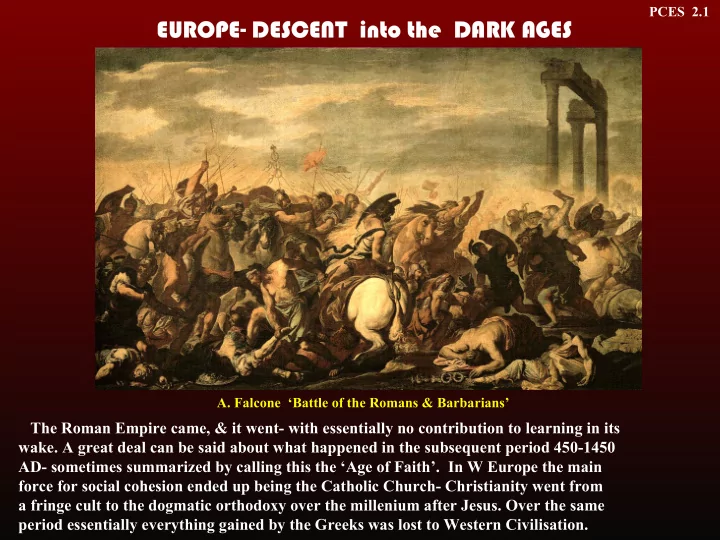
  • A. Falcone ‘Battle of the Romans & Barbarians’

The Roman Empire came, & it went- with essentially no contribution to learning in its

  • wake. A great deal can be said about what happened in the subsequent period 450-1450

AD- sometimes summarized by calling this the ‘Age of Faith’. In W Europe the main force for social cohesion ended up being the Catholic Church- Christianity went from a fringe cult to the dogmatic orthodoxy over the millenium after Jesus. Over the same period essentially everything gained by the Greeks was lost to Western Civilisation.

slide-2
SLIDE 2

Influences from the East- the Silk Road

PCES 2.2

For 1000 years after Rome fell, Europe was a backwater- the great centres of civilisation lay East. Chief amongst these were China, India, & various kingdoms ranging from Asia Minor to

  • Bactria. Despite the enormous distance, a crucial trade

route slowly developed between them- the Silk Road. Transporting silk, spice, metals, fur, etc, it provided crucial support to the Byzantine economy- & later to Mediterranean trading cities. It also brought artistic & architectural influences- & crucially, it brought fundamental work from Indian mathematics.

LEFT: Mandala (Nepal, c. 1100) BELOW: Han ‘flying horse’ (bronze, 150 AD)

slide-3
SLIDE 3

RISE of ISLAM

The other great civilisation of the Middle Ages was Islamic. Starting in 610 AD with a handful of followers in the depths of the Arabian desert, and an idea, in 20 years Mohammad had converted all

  • f Arabia to his ideas, embodied in his teachings

(written down later as the Koran). Within 100 yrs Islamic ideas spreqd east as far as India, & across Africa to Spain. At its height the Islamic empire was

  • ne of the most brilliant

civilisations in history, with dazzling innovations in art, architecture, literature, philosophy, & also science & mathematics. Then, quite suddenly, around 1200 AD, this innovative spirit was

  • extinguished. Soon after

Islam was decimated in the East by the Mongols (to remerge later in a different form).

Gurgan arm bracelet (Iran, 1030 AD) Koran- ink & Gold on vellum (Spain, 1300) King Yunan of Persia (from ‘Arabian Nights) PCES 2.3

slide-4
SLIDE 4

The Lifeline from Islamic Civilisation

PCES 2.4 Maimonides (1135-1204 AD)

Islamic philosophy was a curious fusion of ideas from Greek philosophy, Indian & Greek mathematics, & Islam dogma. A tradition of encycopedic compilation of knowledge developed. The best-known writers (in the east, Ibn-Sina [Avicenna, 980-1037] & in the west Ibn- Rushd [Averroes, 1126-98], & the Jewish Maimonides- who wrote in Arabic) all tried to reconcile Aristotle with faith, & had huge influence in mediaeval Christian Europe.

Lindaraja garden (Alhambra)

In spite of the turbulent history of the Arab world, they preserved Greek & Indian ideas (and even extended mathematics). This was transmitted to Europe later on, & was crucial in stimulating the Renaissance.

Above: the Alhambra in Granada (this is a Christian corruption of ‘Al-Qala Al- Hamra’). Construction of modern Alhambra: 1238 AD et seq).

slide-5
SLIDE 5

Science & Mathematics in India & Islam

PCES 2.5

The Indians were great innovators in mathematics (& to a lesser extent in astronomy). Our debt to them includes the modern number system, & the use of algebra, series expansions, & continued fractions in astronomy, going well beyond any Greek

  • work. Indian astronomical works date back to 425 BC (the

‘Siddhantas’). 2 great figures from Gupta times are AryaBhata I (476-550 AD) and Brahmagupta (598-660 AD). They arrived at startling ideas- Aryabhata believed the earth was round, spun on its axis, & revolved around the sun- and that planetary orbits were ellipses (ideas later suppressed, which never reached Europe!). The fundamental invention of the place system of numbering, with the zero, was imported into the Islamic world in 662 AD, along with the use of mathematics in physics & astronomy. In the eastern flowering

  • f Islam (starting in the reign of Harun

al-Rashid, 786-809 AD), great libraries, hospitals, and observatories were built from Syria to Samarkand- & in Baghdad the “Bayt al-Hikmah” (house of wisdom), the world’s first scientific academy.

Al-Khwarizmi (780-850 AD) Al-Haytham (’Alhazen’), 965-1040 AD

A great project of translation of ancient Indian & Greek works gave Islamic science a springboard- with greatly superior instruments & new ideas in ‘al-jabr’ (algebra) & geometry, Al-Khwarizmi, Alhazen, & others developed ideas in optics & geography, & compiled celestial tables still used 600 yrs later.

The incredible polymath Al-

Biruni, from Khiva (in modern Uzbekhistan) wrote 146 works covering all of science, history (including a massive history of India), geography, & grammar- & translated Euclid & Ptolemy into Sanskrit.

Al-Biruni (973-1048 AD)

slide-6
SLIDE 6

PCES 2.6

TIDES of WAR

ABOVE: Mongol empire, c.1280 BELOW: Krak des Chevaliers (Syria)

Huge changes occured in the 12th-13th century; the Mongols drove as far as Europe, crushing Abbusid Islam & leaving in their wake the muslim Seljuk empire, which captured Constantinople (1453), defeated the Crusaders, & eradicated Christian influence in the East However the story in the West finished differently, with the expulsion of the Moors & the Jews from Spain by the Catholic powers. The stage was set for modern Europe.

Ferdinand & Isabella (c. 1470)