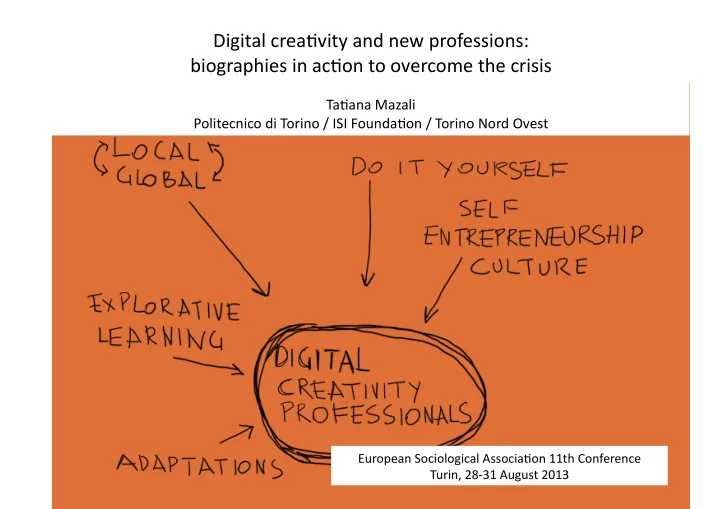
SLIDE 1
Digital
crea+vity
and
new
professions:
biographies
in
ac+on
to
overcome
the
crisis
Ta+ana
Mazali
Politecnico
di
Torino
/
ISI
Founda+on
/
Torino
Nord
Ovest
European
Sociological
Associa+on
11th
Conference
Turin,
28‐31
August
2013
SLIDE 2 Media-oriented digital professions
Videomaking Animation Web/mobile apps Visual and Graphic Design
Field research over a sample group
- f young-adult professionals
- f digital creativity
SLIDE 3
Knowledge workers in Italy 40% of the workforce. But, in Italy only 12% of the workers hold a degree!
Source: Butera, Bagnara, Cesaria, Di Guardo, Knowledge working. 2008
1995
2005
Italy
29%
41%
UK
34%
52%
France
38%
43%
USA
34%
38%
Spain
23%
33%
Germany
48%
SLIDE 4
source: UNCTAD, Creative Economy Report 2010
SLIDE 5
Comparison of four european countries: definitions of the creative/cultural industries
(source: British Council’s Creative And Cultural Economy Series/2, Mapping the Creative Industries: A Toolkit. 2010)
SLIDE 6
THE ITALIAN MODEL: MiBAC (Italian Ministry of National Heritage and Cultural Activities), Libro Bianco sulla Creatività (White Paper on Creativity) (2007). This model focuses on quality of life and well-being, include among the cultural and creative industries also “Industria del gusto” (wine and fine food industry).
Italian classification of Creative and Cultural Industries Material
culture
(as
defined
by
the
rela+onship
between
ar+facts
and
social
rela+ons)
Fashion
Industrial
design
and
craX
Industria
del
gusto
(wine
and
fine
food
industries)
Contents,
informa7on
and
communica7on
produc7on
SoXware
Publishing
TV
–
Radio
Adver+sing
Cinema
Cultural
Heritage
Cultural
Heritage
Music
and
Performing
Arts
Contemporary
Art
Architecture
SLIDE 7 METHODOLOGY FIELD RESEARCH PHASE 1: test questionnaire basic sample of Italian key informants
(June 2013)
PHASE 2: in-depth one-on-one interviews to the first sample
- f key informants (starting
September ending November 2013)
PHASE 3: national web based survey
(starting September ending December 2013)
SLIDE 8
n.
of
professionals
Employed
6
Entrepreneur
3
Free
lance
12
Atypical
contracts
7
Without
pay
4
does
not
answer
1
total
33
Income
(2012).
euros
n.
of
professionals
Under
5000
8
between
5.000
and
10.000
8
between
10.000
and
20.000
11
between
20.000
and
30.000
2
between
30.000
and
50.000
1
between
50.000
and
100.000
0
SLIDE 9 Four-fold model
- 1. self learning + high education
- 2. Teamwork prevails
- 3. The fundamental
dimension of concrete praxis (and authorship) is a specific hallmark of digital creativity professionals
- 4. All creatives adopt and
maintain self-marketing strategies on the web, BUT contrary to what could be expected, and in contrast with the general mainstream trends, the outcome of such strategies is declared as not satisfactory by many
SLIDE 10 Follow up – TEAMWORK
Since digital media projects are complex, they demand a high amount of interdisciplinary work, usually delivered through the cooperation of highly specialized
- experts. Also, a confluence and friendly
confrontation of different know-hows and work experiences is needed for higher results.
Follow up – FABLAB CULTURE
"Individuate in your activity the amount of time dedicated to the phase of designing/developing of a work/project and to the subsequent phase of realization” n.
of
professionals
30%
design
70%
realiza+on
15
50%
design
50%
realiza+on
10
70%
design
30%
realiza+on
6
The
two
phases
are
indis+nguishable
2
total
33
SLIDE 11
n.
of
professionals
social
networks
crea%ve‐targeted
behance
4
dribbble
1
Soundcloud
1
social
networks
person‐centered
facebook
12
twiber
5
linkedin
9
tumblr
1
social
networks
media‐centered
youtube
4
vimeo
8
pinterest
1
Total
Personal
web
sites
6
Follow up – CRITICAL ONLINE SELF- MARKETING Various Social Networks are being used in order to “self-promote”, with recourse to the whole range from person-centered to media-centered. Interestingly, the use of Vimeo prevails with regards to Youtube. Effectiveness of the use of the web in the search for jobs
n.
of
professionals
Very
much
10
Enough
8
A
lible
12
Not
usefull
at
all
0
I
don’t
know
3
Total
33
SLIDE 12
NEEDS AND EXPECTATIONS / Lights and Shadows
"What do you like about your profession? Which aspects of your work do you treasure most, and would rather not give up?” . The emotional approach . The social-relational approach . The explorative approach . The free style approach . The expressive and creative approach
SLIDE 13 I wish to underline the fact that while creatives mostly belong within two
- f these five semantic areas, the
explorative approach is an exception since it almost always represents an exclusive choice.
Seman7c
Areas
Number
of
professionals
Of
which
exclusively
Love
5
0
Relan+onship
9
2
Explora+on
12
10
Freedom
10
3
Expression‐ Crea+on
12
5
SLIDE 14
SHADOWS economical crisis, market crisis lack of available job & currency +
"a chronical lack of acknowledgement from the surrounding world" = discrepancy between the "enacted role" (that is, the way a professional works, maintains social relationships, pursues and achieves results) and the "profession" (the social acknowledgement of an individual's "enacted role”) (Federico Butera, 2009)
SLIDE 15
ACTIONS TO OVERCOME THE CRISIS
Professionals + Institutions
protectionist measures
versus
provocative statements
SLIDE 16
ANY
SUGGESTIONS?
ta+ana.mazali@polito.it
ta+ana.mazali@gmail.com
SLIDE 17 ACKNOWLEDGEMENT
The research is funded by a research grant from Fondazione CRT, co-funded by Torino Nord Ovest, supported by DIST – Interuniversity Department of Regional and Urban Studies and Planning (Politecnico di Torino – Università degli Studi di Torino)
SOME
REFERENCES
- DCMS (1998), Creative Industries Mapping Document 1998, DCMS, London
- DCMS (2001), Creative Industries Mapping Document 2001, DCMS, London
- KEA European Affairs (2006), The Economy of Culture in Europe, European Commission
- UNCTAD (2008, 2010), Creative Economy Report
- MiBAC (2007), Libro Bianco sulla creatività
- Unioncamere, Fondazione Symbola (2012), L’Italia che verrà
- Butera F., Di Guardo S. (2009), Il modello di analisi e progettazione del lavoro della
conoscenza, WP Fondazione Irso
- Florida, R. (2002), The Rise of the Creative Class, Basic Books, New York
- Howkins, J. (2001-2007-2013 forthcoming), The Creative Economy, Penguin, London
- …