Crea%ng and Accessing Arrays Crea%ng and Accessing Arrays - - PDF document

crea ng and accessing arrays crea ng and accessing arrays
SMART_READER_LITE
LIVE PREVIEW

Crea%ng and Accessing Arrays Crea%ng and Accessing Arrays - - PDF document

Array Basics: Outline Crea%ng and Accessing Arrays More Arrays Array Details (Savitch, Chapter 7) The Instance Variable length TOPICS More About Array Indices


slide-1
SLIDE 1

1

More Arrays (Savitch, Chapter 7)

TOPICS

  • Array Basics
  • Arrays in Classes and Methods
  • Programming with Arrays
  • Searching and Sorting Arrays
  • Multi-Dimensional Arrays
  • Static Variables and Constants
  • Crea%ng ¡and ¡Accessing ¡Arrays ¡
  • Array ¡Details ¡
  • The ¡Instance ¡Variable ¡length ¡
  • More ¡About ¡Array ¡Indices ¡
  • Analyzing ¡Arrays ¡

Array ¡Basics: ¡Outline ¡

CS160 - Spring Semester 2016 2

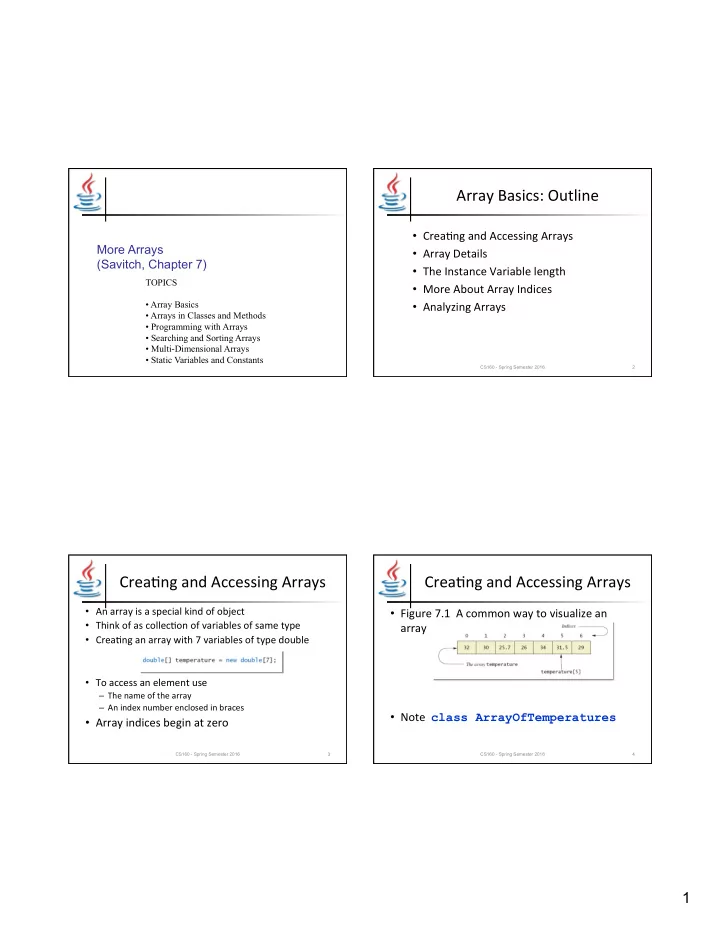
  • An ¡array ¡is ¡a ¡special ¡kind ¡of ¡object ¡
  • Think ¡of ¡as ¡collec%on ¡of ¡variables ¡of ¡same ¡type ¡
  • Crea%ng ¡an ¡array ¡with ¡7 ¡variables ¡of ¡type ¡double ¡
  • To ¡access ¡an ¡element ¡use ¡

– The ¡name ¡of ¡the ¡array ¡ – An ¡index ¡number ¡enclosed ¡in ¡braces ¡

  • Array ¡indices ¡begin ¡at ¡zero ¡

Crea%ng ¡and ¡Accessing ¡Arrays ¡

CS160 - Spring Semester 2016 3

  • Figure ¡7.1 ¡ ¡A ¡common ¡way ¡to ¡visualize ¡an ¡

array ¡

  • Note ¡ ¡class ArrayOfTemperatures

Crea%ng ¡and ¡Accessing ¡Arrays ¡

CS160 - Spring Semester 2016 4

slide-2
SLIDE 2

2

Crea%ng ¡and ¡Accessing ¡Arrays ¡

Sample screen

  • utput

CS160 - Spring Semester 2016 5

  • Syntax ¡for ¡declaring ¡an ¡array ¡with ¡new
  • The ¡number ¡of ¡elements ¡in ¡an ¡array ¡is ¡its ¡

length ¡

  • The ¡type ¡of ¡the ¡array ¡elements ¡is ¡the ¡array's ¡

base ¡type ¡

Array ¡Details ¡

CS160 - Spring Semester 2016 6

  • With ¡a ¡data ¡type ¡when ¡declaring ¡an ¡array: ¡

¡int []pressure;

int pressure[];

  • To ¡enclose ¡an ¡integer ¡expression ¡to ¡declare ¡

the ¡length ¡of ¡the ¡array: ¡ ¡pressure = new int[100];

  • To ¡access ¡the ¡array ¡with ¡an ¡index ¡value: ¡

¡pressure[3] = keyboard.nextInt();

Square ¡Brackets ¡with ¡Arrays ¡

CS160 - Spring Semester 2016 7

  • Figure ¡7.2 ¡Array ¡terminology ¡

Array ¡Details ¡

CS160 - Spring Semester 2016 8

slide-3
SLIDE 3

3

  • As ¡an ¡object ¡an ¡array ¡has ¡only ¡one ¡public ¡

instance ¡variable: ¡

– Variable ¡length – Contains ¡number ¡of ¡elements ¡in ¡the ¡array ¡ – It ¡is ¡final, ¡value ¡cannot ¡be ¡changed ¡

  • Note ¡ ¡class ArrayOfTemperatures2

The ¡Instance ¡Variable ¡length

CS160 - Spring Semester 2016 9

The ¡Instance ¡Variable ¡length ¡

Sample screen

  • utput

CS160 - Spring Semester 2016 10

  • Index ¡of ¡first ¡array ¡element ¡is ¡0 ¡
  • Last ¡valid ¡Index ¡is ¡arrayName.length – 1
  • Array ¡indices ¡must ¡be ¡within ¡bounds ¡to ¡be ¡

valid: ¡

– When ¡program ¡tries ¡to ¡access ¡outside ¡bounds, ¡run ¡ %me ¡excep%on ¡occurs ¡

  • Get ¡used ¡to ¡using ¡index ¡0 ¡

More ¡About ¡Array ¡Indices ¡

CS160 - Spring Semester 2016 11

  • Possible ¡to ¡ini%alize ¡at ¡declara%on ¡%me ¡
  • Also ¡may ¡use ¡normal ¡assignment ¡statements ¡

– One ¡at ¡a ¡%me ¡ – In ¡a ¡loop ¡

Ini%alizing ¡Arrays ¡

CS160 - Spring Semester 2016 12

slide-4
SLIDE 4

4

  • Indexed ¡Variables ¡as ¡Method ¡Arguments ¡
  • En%re ¡Arrays ¡as ¡Arguments ¡to ¡a ¡Method ¡
  • Arguments ¡for ¡the ¡Method ¡main ¡
  • Array ¡Assignment ¡and ¡Equality ¡
  • Methods ¡that ¡Return ¡Arrays ¡

Arrays ¡in ¡Classes ¡and ¡Methods: ¡ Outline ¡

CS160 - Spring Semester 2016 13

  • Indexed ¡variable ¡of ¡an ¡array ¡

– Example ¡… ¡a[i] – Can ¡be ¡used ¡anywhere ¡variable ¡of ¡array ¡base ¡type ¡ can ¡be ¡used ¡

  • View ¡class ¡ArgumentDemo ¡using ¡indexed ¡

variable ¡as ¡an ¡argument ¡

Indexed ¡Variables ¡as ¡Method ¡ Arguments ¡

CS160 - Spring Semester 2016 14

  • Declara%on ¡of ¡array ¡parameter ¡similar ¡to ¡how ¡

an ¡array ¡is ¡declared ¡

  • Example: ¡

En%re ¡Arrays ¡as ¡Arguments ¡

CS160 - Spring Semester 2016 15

  • Array ¡parameter ¡in ¡a ¡method ¡heading ¡does ¡

not ¡specify ¡the ¡length ¡

– An ¡array ¡of ¡any ¡length ¡can ¡be ¡passed ¡to ¡the ¡ method ¡ – Inside ¡the ¡method, ¡elements ¡of ¡the ¡array ¡can ¡be ¡ changed ¡

  • When ¡you ¡pass ¡the ¡en%re ¡array, ¡do ¡not ¡use ¡

square ¡brackets ¡in ¡the ¡actual ¡parameter ¡

En%re ¡Arrays ¡as ¡Arguments ¡

CS160 - Spring Semester 2016 16

slide-5
SLIDE 5

5

  • Recall ¡heading ¡of ¡method ¡main ¡

public static void main (String[] args)

  • This ¡declares ¡an ¡array ¡ ¡

– Formal ¡parameter ¡named ¡args – Its ¡base ¡type ¡is ¡String

  • Thus ¡possible ¡to ¡pass ¡to ¡the ¡run ¡of ¡a ¡program ¡

mul%ple ¡strings ¡

– These ¡can ¡then ¡be ¡used ¡by ¡the ¡program ¡

Arguments ¡for ¡Method ¡main ¡

CS160 - Spring Semester 2016 17

  • Arrays ¡are ¡objects ¡

– Assignment ¡and ¡equality ¡operators ¡behave ¡ (misbehave) ¡as ¡specified ¡in ¡previous ¡chapter ¡

  • Variable ¡for ¡the ¡array ¡object ¡contains ¡memory ¡

address ¡of ¡the ¡object ¡

– Assignment ¡operator ¡= copies ¡this ¡address ¡ – Equality ¡operator ¡== ¡ ¡tests ¡whether ¡two ¡arrays ¡ are ¡stored ¡in ¡same ¡place ¡in ¡memory ¡

Array ¡Assignment ¡and ¡Equality ¡

CS160 - Spring Semester 2016 18

  • Two ¡kinds ¡of ¡equality ¡
  • View ¡ ¡class TestEquals

Array ¡Assignment ¡and ¡Equality ¡

Sample screen

  • utput

CS160 - Spring Semester 2016 19

  • Note ¡results ¡of ¡==
  • Note ¡defini%on ¡and ¡use ¡of ¡method ¡equals

– Receives ¡two ¡array ¡parameters ¡ – Checks ¡length ¡and ¡each ¡individual ¡pair ¡of ¡array ¡ elements ¡

  • Remember ¡array ¡types ¡are ¡reference ¡types ¡

Array ¡Assignment ¡and ¡Equality ¡

CS160 - Spring Semester 2016 20

slide-6
SLIDE 6

6

  • A ¡Java ¡method ¡may ¡return ¡an ¡array ¡
  • View ¡class ReturnArrayDemo
  • Note ¡defini%on ¡of ¡return ¡type ¡as ¡an ¡array ¡
  • To ¡return ¡the ¡array ¡value ¡

– Declare ¡a ¡local ¡array ¡ – Use ¡that ¡iden%fier ¡in ¡the ¡return ¡statement ¡

Methods ¡that ¡Return ¡Arrays ¡

CS160 - Spring Semester 2016 21

  • Programming ¡Example: ¡A ¡Specialized ¡List ¡Class ¡
  • Par%ally ¡Filled ¡Arrays ¡

Programming ¡with ¡Arrays ¡ and ¡Classes: ¡Outline ¡

CS160 - Spring Semester 2016 22

  • A ¡specialized ¡List ¡class ¡

– Objects ¡can ¡be ¡used ¡for ¡keeping ¡lists ¡of ¡items ¡

  • Methods ¡include ¡

– Capability ¡to ¡add ¡items ¡to ¡the ¡list ¡ – Also ¡delete ¡en%re ¡list, ¡start ¡with ¡blank ¡list ¡ – But ¡no ¡method ¡to ¡modify ¡or ¡delete ¡list ¡item ¡

  • Maximum ¡number ¡of ¡items ¡can ¡be ¡specified ¡

Programming ¡Example ¡

CS160 - Spring Semester 2016 23

  • ¡View ¡class ListDemo
  • Note ¡declara%on ¡of ¡the ¡list ¡object ¡
  • Note ¡method ¡calls ¡

Programming ¡Example ¡

CS160 - Spring Semester 2016 24

slide-7
SLIDE 7

7

Programming ¡Example ¡

Sample screen

  • utput

CS160 - Spring Semester 2016 25

  • Now ¡view ¡array ¡wrapped ¡in ¡a ¡class ¡to ¡

represent ¡a ¡list, ¡ class OneWayNoRepeatsList

  • Notable ¡code ¡elements ¡

– Declara%on ¡of ¡private ¡array ¡ – Method ¡to ¡find ¡nth ¡list ¡item ¡ – Method ¡to ¡check ¡if ¡item ¡is ¡on ¡the ¡list ¡or ¡not ¡

Programming ¡Example ¡

CS160 - Spring Semester 2016 26

  • Array ¡size ¡specified ¡at ¡defini%on ¡
  • Not ¡all ¡elements ¡of ¡the ¡array ¡might ¡receive ¡

values ¡

– This ¡is ¡termed ¡a ¡par$ally ¡filled ¡array ¡

  • Programmer ¡must ¡keep ¡track ¡of ¡how ¡much ¡of ¡

array ¡is ¡used ¡

Par%ally ¡Filled ¡Arrays ¡

CS160 - Spring Semester 2016 27

  • Figure ¡7.4 ¡ ¡A ¡par%ally ¡filled ¡array ¡

Par%ally ¡Filled ¡Arrays ¡

CS160 - Spring Semester 2016 28

slide-8
SLIDE 8

8

  • Consider ¡Figure ¡7.6, ¡a ¡table ¡of ¡values ¡

Mul%dimensional-­‑Array ¡Basics ¡

CS160 - Spring Semester 2016 29

  • Figure ¡7.7 ¡Row ¡and ¡column ¡indices ¡for ¡an ¡

array ¡named ¡table

Mul%dimensional-­‑Array ¡Basics ¡

table[3][2]

has a value of 1262

CS160 - Spring Semester 2016 30

  • We ¡can ¡access ¡elements ¡of ¡the ¡table ¡with ¡a ¡

nested ¡for ¡loop ¡

  • Example: ¡
  • View ¡ ¡class ¡InterestTable

Mul%dimensional-­‑Array ¡Basics ¡

CS160 - Spring Semester 2016 31

Mul%dimensional-­‑Array ¡Basics ¡

Sample screen

  • utput

CS160 - Spring Semester 2016 32

slide-9
SLIDE 9

9

  • Mul%dimensional ¡array ¡represented ¡as ¡several ¡one-­‑

dimensional ¡arrays ¡

  • Given ¡ ¡ ¡

int [][] table = new int [10][6];

  • Array ¡table ¡is ¡actually ¡1 ¡dimensional ¡of ¡type ¡int[]

– It ¡is ¡an ¡array ¡of ¡arrays ¡

  • Important ¡when ¡sequencing ¡through ¡

mul%dimensional ¡array ¡

Java's ¡Representa%on ¡of ¡ Mul%dimensional ¡Arrays ¡

CS160 - Spring Semester 2016 33

  • An ¡array ¡is ¡a ¡collec%on ¡of ¡variables ¡all ¡of ¡the ¡

same ¡type ¡

  • Arrays ¡are ¡objects, ¡created ¡with ¡operator ¡new ¡
  • Elements ¡numbered ¡star%ng ¡with ¡0, ¡ending ¡

with ¡1 ¡less ¡than ¡length ¡

  • Indexed ¡variable ¡can ¡be ¡used ¡as ¡a ¡parameter ¡– ¡

treated ¡like ¡variable ¡of ¡base ¡type ¡

Summary ¡

CS160 - Spring Semester 2016 34

  • En%re ¡array ¡can ¡be ¡passed ¡as ¡parameter ¡to ¡a ¡

method ¡

  • Method ¡return ¡value ¡can ¡be ¡an ¡array ¡
  • Par%ally ¡filled ¡array ¡usually ¡stores ¡values ¡in ¡

ini%al ¡segment, ¡use ¡an ¡int ¡to ¡track ¡how ¡many ¡ are ¡used ¡

Summary ¡

CS160 - Spring Semester 2016 35

  • Mul%dimensional ¡arrays ¡are ¡implemented ¡as ¡

an ¡array ¡of ¡arrays ¡

  • Treat ¡two-­‑dimensional ¡array ¡as ¡a ¡table ¡with ¡

rows ¡and ¡columns ¡

Summary ¡ ¡

CS160 - Spring Semester 2016 36