Diagnostics Internally studentized residuals, PRESS residuals or - - PowerPoint PPT Presentation

diagnostics
SMART_READER_LITE
LIVE PREVIEW

Diagnostics Internally studentized residuals, PRESS residuals or - - PowerPoint PPT Presentation

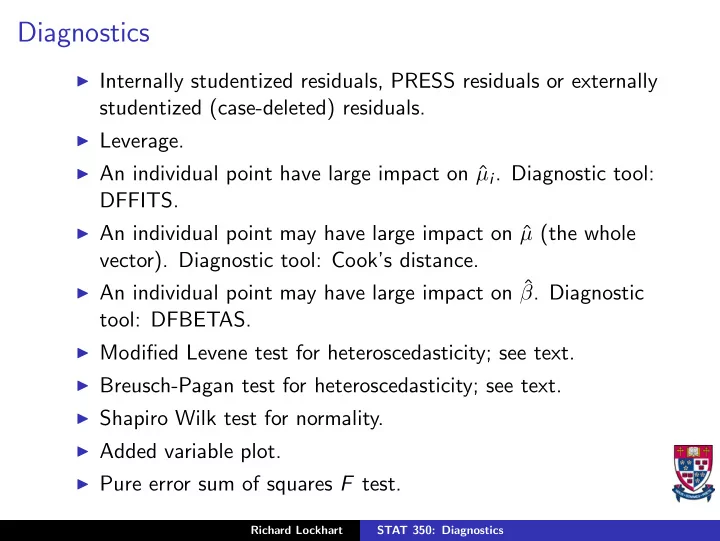
Diagnostics Internally studentized residuals, PRESS residuals or externally studentized (case-deleted) residuals. Leverage. An individual point have large impact on i . Diagnostic tool: DFFITS. An individual point may have


slide-1
SLIDE 1

Diagnostics

◮ Internally studentized residuals, PRESS residuals or externally

studentized (case-deleted) residuals.

◮ Leverage. ◮ An individual point have large impact on ˆ

µi. Diagnostic tool: DFFITS.

◮ An individual point may have large impact on ˆ

µ (the whole vector). Diagnostic tool: Cook’s distance.

◮ An individual point may have large impact on ˆ

β. Diagnostic tool: DFBETAS.

◮ Modified Levene test for heteroscedasticity; see text. ◮ Breusch-Pagan test for heteroscedasticity; see text. ◮ Shapiro Wilk test for normality. ◮ Added variable plot. ◮ Pure error sum of squares F test.

Richard Lockhart STAT 350: Diagnostics

slide-2
SLIDE 2

Leverage

◮ Leverage i is hii — diagonal entry in hat matrix, H. ◮ Var(ˆ

µi) = hii and Var(ˆ ǫi) = 1 − hii so 0 ≤ hii ≤ 1.

◮ trace(H) = p so the hii average to p/n. ◮ Rule of thumb. hii > 2p/n is “large” leverage. ◮ Rule of thumb. hii > 0.5 is large, hii > 0.2 is moderately large.

Richard Lockhart STAT 350: Diagnostics

slide-3
SLIDE 3

DFFITS

Measure change in fitted value for case i after deleting case i: (DFFITS)i = ˆ Yi − ˆ Yi(i) MSE(i)hii

◮ Any subscript (i) refers to a computation with case i deleted. ◮ Can be computed from externally deleted residual by

multiplying by

  • hii/(1 − hii). Thus can be computed without

actually deleting case i and rerunning.

◮ Rule of thumb from text: look out for |DFFITS| > 1 in small

to medium data sets or for |DFFITS| > 2

  • p/n in large data

sets.

◮ But I just examine the few largest values.

Richard Lockhart STAT 350: Diagnostics

slide-4
SLIDE 4

Cook’s Distance

An individual point may have large impact on ˆ µ (the whole vector): Di = n

j=1( ˆ

Yj − ˆ Yj(i))2 pMSE

◮ Can be computed without deleting case from

Di = ˆ ǫ2

i

pMSE

  • hii

(1 − hii)2

  • ◮ To judge size compare to Fp,n−p,0.90 (lower tail area is 10%,

usually found as 1 over upper 10% point of Fn−p,p) and to median(Fp,n−p).

◮ Bigger than latter is quite serious. ◮ Smaller than former is good. ◮ Between is gray zone.

Richard Lockhart STAT 350: Diagnostics

slide-5
SLIDE 5

DFBETAS

◮ Intended to measure impact of deleting case i on ˆ

βk.

◮ Defined by:

DFBETASk(i) = ˆ βk − ˆ βk(i)

  • MSE(i) [(X TX)−1]kk

◮ Same guidelines as DFFITS. ◮ Software not always set up to compute DFBETAS.

Richard Lockhart STAT 350: Diagnostics

slide-6
SLIDE 6

Tests for Homoscedasticity

◮ Modified Levene test:

◮ Split data set into 2 parts on basis of covariates ◮ Fit regressions in each part separately. ◮ Do 2 sample t-test on mean absolute size of residuals.

◮ Breusch-Pagan test:

◮ Regress squared fitted residual on covariate or covariates ◮ Test for non-zero slope. Richard Lockhart STAT 350: Diagnostics

slide-7
SLIDE 7

Tests of Distributional Assumptions

◮ Check assumption of Normality. ◮ Examine Q − Q plot for straightness. ◮ Shapiro-Wilk test applied to residuals ◮ Or correlation test in Q-Q plot.

Richard Lockhart STAT 350: Diagnostics

slide-8
SLIDE 8

Pure Error Sum of Squares

◮ Sometimes for each (or at least sufficiently many) combination

  • f covariates in a data set, there are several observations.

◮ Can do extra sum of squares F-test to see if our regression

model is adequate.

◮ Suppose that x1, . . . , xK are the distinct rows of the design

matrix

◮ Suppose we have n1 observations for which the covariate

values are those in x1, n2 observations with covariate pattern x2 and so on. Of course n1 + · · · + nK = n.

◮ We compare our final fitted model with a so-called saturated

model by an extra sum of squares F-test.

◮ To be precise let α1 be the mean value of Y when the

covariate pattern is x1, α2 the mean corresponding to x2 and so on.

◮ Relabel the n data points as Yi,j; j =, . . . , ni; i = 1, . . . , K ◮ Fit a one way ANOVA model to the Yi,j.

Richard Lockhart STAT 350: Diagnostics

slide-9
SLIDE 9

Pure Error Sum of Squares

◮ Error sum of squares for this FULL model is

ESSFULL =

K

  • i=1

ni

  • j=1

(Yi,j − ¯ Yi,·)2

◮ This ESS is called the pure error sum of squares because we

have not assumed any particular relation between the mean of Y and the covariate vector x.

◮ We form the F statistic for testing the overall quality of our

model by computing the “lack of fit SS” as ESSRestricted − ESSFULL where the restricted model is the final model whose fit we are checking.

Richard Lockhart STAT 350: Diagnostics

slide-10
SLIDE 10

Example: plaster hardness

◮ 9 different covariate patterns: 3 levels of SAND and 3 levels

  • f FIBRE.

◮ Two ways to compute pure error sum of squares:

◮ Create new variable with 9 levels. ◮ Fit a two way ANOVA with interactions.

DATA 1 61 34 1 63 16 15 2 67 36 15 2 69 19 . . . 30 50 9 74 48

Richard Lockhart STAT 350: Diagnostics

slide-11
SLIDE 11

SAS CODE

data plaster; infile ’plaster1.dat’; input sand fibre combin hardness strength; proc glm data=plaster; model hardness = sand fibre; run; proc glm data=plaster; class sand fibre; model hardness = sand | fibre ; run; proc glm data=plaster; class combin; model hardness = combin; run;

Richard Lockhart STAT 350: Diagnostics

slide-12
SLIDE 12

EDITED OUTPUT

Complete output Sum of Mean Source DF Squares Square F Pr > F Model 2 167.41666667 83.70833333 11.53 0.0009 Error 15 108.86111111 7.25740741 Total 17 276.27777778 Sum of Mean Source DF Squares Square F Pr > F Model 8 202.77777778 25.34722222 3.10 0.0557 Error 9 73.50000000 8.16666667 Total 17 276.27777777 Sum of Mean Source DF Squares Square F Pr > F Model 8 202.77777778 25.34722222 3.10 0.0557 Error 9 73.50000000 8.16666667 Total 17 276.27777778

Richard Lockhart STAT 350: Diagnostics

slide-13
SLIDE 13

From the output we can put together a summary ANOVA table Source df SS MS F P Model 2 167.417 83.708 Lack of Fit 6 35.361 5.894 0.722 0.64 Pure Error 9 73.500 8.167 Total (Corrected) 17 276.278

◮ F statistic is

[(108.86111111 − 73.50000000)/6]/[8.16666667].

◮ P-value comes from the F6,9 distribution. ◮ P-value not significant: no reason to reject final fitted model

which was additive and linear in each of SAND and FIBRE.

◮ Notice that the Error SS are the same for the two-way

ANOVA with interactions, which is the second model, and for the 1 way ANOVA.

Richard Lockhart STAT 350: Diagnostics

slide-14
SLIDE 14

◮ This test is not very powerful in general. ◮ More sensitive tests are available if you know how the model

might break down.

◮ For instance, most realistic alternatives will be picked up more

easily by checking for quadratic terms in a bivariate polynomial model; see earlier lectures.

◮ Notice that test for any effect of SAND and FIBRE carried

  • ut in the one way analysis of variance is not significant.

◮ This is an example of the lack of power found in many F-tests

with large numbers of degrees of freedom in the numerator.

◮ If you can guess a reasonable functional form for the effect of

the factors (either the additive two way model with no interactions or the even simpler multiple regression model which is the first model above) you will get a more sensitive test usually.

Richard Lockhart STAT 350: Diagnostics

slide-15
SLIDE 15

Added Variable Plots or partial regression plots

◮ Regress Y on some covariates X1. ◮ Get Residuals. ◮ Regress other covariate X2 on X1. ◮ Get Residuals. ◮ Plot two sets of residuals against each other.

Richard Lockhart STAT 350: Diagnostics

slide-16
SLIDE 16

SENIC data example

Fit final selected model: covariates used are STAY, CULTURE, NURSES, NURSE.RATIO.

  • ptions pagesize=60 linesize=80;

data scenic; infile ’scenic.dat’ firstobs=2; input Stay Age Risk Culture Chest Beds School Region Census Nurses Facil; Nratio = Nurses / Census ; proc glm data=scenic; model Risk = Culture Stay Nurses Nratio ;

  • utput out=scout P=Fitted PRESS=PRESS H=HAT

RSTUDENT=EXTST R=RESID DFFITS=DFFITS COOKD=COOKD; run ; proc print data=scout; Complete SAS Output is here.

Richard Lockhart STAT 350: Diagnostics

slide-17
SLIDE 17

Index plot of leverages

Outlying X Values

Observation Number Leverage 20 40 60 80 100 0.0 0.05 0.10 0.15 0.20 0.25 0.30

  • 4

8 47 54 112

Richard Lockhart STAT 350: Diagnostics

slide-18
SLIDE 18

Index plot of leverages: discussion

◮ Observations 4, 8, 47, 54 and 112 have leverages over 0.15 ◮ Many more are over 10/113 — the suggested cut off. ◮ I prefer to plot the leverages and look at the largest few. ◮ Observations 4 and 47, in particular, have leverages over 0.3

and should be looked at.

◮ That means scientist thinks about those hospitals!

Richard Lockhart STAT 350: Diagnostics

slide-19
SLIDE 19

Influence measures: Cook’s Distance

Influence on entire fitted vector

Observation Number Cook’s Distance 20 40 60 80 100 0.0 0.05 0.10 0.15 0.20

  • 8

11 54 112

Richard Lockhart STAT 350: Diagnostics

slide-20
SLIDE 20

Cook’s distance: discussion

◮ Observations 8, 11, 54 and 112 have values of Di larger than

0.05.

◮ Of these, only observation 11 is new. ◮ Text recommends worrying only about observations for which

Di is larger than the tenth to twentieth percentile of the Fp,n−p distribution.

◮ In this case those critical points are 0.3? and 0.46. ◮ None of the observations exceeds even the lowest of these

numbers.

Richard Lockhart STAT 350: Diagnostics

slide-21
SLIDE 21

Influence measures: DFFITS

Influence on fitted values

Observation Number DFFITS 20 40 60 80 100

  • 1.0
  • 0.5

0.0 0.5

  • 8

11 54 112

Richard Lockhart STAT 350: Diagnostics

slide-22
SLIDE 22

Case deleted residuals

Externally Studentized Residuals

Observation Number Residual 20 40 60 80 100

  • 2
  • 1

1 2 3

  • 53

Richard Lockhart STAT 350: Diagnostics

slide-23
SLIDE 23

Case deleted residuals: discussion

◮ Only observation 53 is added for our consideration, ◮ But with 113 residuals a value of 2.9 is not terribly unusual.

Richard Lockhart STAT 350: Diagnostics

slide-24
SLIDE 24

Examine observations highlighted by diagnostics

Here are the covariate values for observations 4, 8, 11, 47, 53, 54 and 112: Observation Culture Stay Nurses Nratio Risk 4 18.9 8.95 148 2.79 5.6 8 60.5 11.18 360 0.90 5.4 11 28.5 11.07 656 1.11 4.9 47 17.2 19.56 172 0.63 6.5 53 16.6 11.41 273 0.83 7.6 54 52.4 12.07 76 0.66 7.8 112 26.4 17.94 407 0.51 5.9 Mean 15.8 9.65 173 0.95 SD 10.2 1.91 139 0.11

Richard Lockhart STAT 350: Diagnostics

slide-25
SLIDE 25

◮ Observation 4 has a quite unusual value of Nurse.Ratio – a lot

  • f nurses

◮ Observation 47 has quite a high average Stay for patients. ◮ The others are harder to interpret but 4 and 47 are the most

leveraged observations.

◮ In summary it appears that several observations exert excess

influence on the fitting process.

◮ As a final method of judging whether or not our fit was

unduly influenced by these observations I fit the model again in SAS but removing observations number 4, 8, and 47.

Richard Lockhart STAT 350: Diagnostics

slide-26
SLIDE 26

Sum of Mean Source DF Squares Square F Pr > F Model 4 100.4617 25.1154 28.21 0.0001 Error 105 93.4950 0.8904 Total 109 193.9567 R-Square C.V. Root MSE RISK Mean 0.517959 21.87080 0.9436255 4.3145455 T for H0: Pr > |T| SE Parameter Est Par=0 Est INTERCEPT -.15118

  • 0.21

0.8349 0.7237 CULTURE 0.05686 5.28 0.0001 0.0108 STAY 0.27735 4.18 0.0001 0.0663 NURSES 0.00167 2.30 0.0232 0.0007 NRATIO 0.70245 1.92 0.0578 0.3661 Compare these results to the corresponding parts of the same code applied to the full data set.

Richard Lockhart STAT 350: Diagnostics

slide-27
SLIDE 27

Dependent Variable: RISK Sum of Mean Source DF Squares Square F Pr > F Model 4 103.6905 25.9226 28.66 0.0001 Error 108 97.6893 0.9045 Total 112 201.3798 R-Square C.V. Root MSE RISK Mean 0.514900 21.83920 0.9510681 4.3548673 T for H0: Pr > |T| SE Parameter Estimate Par=0

  • f Est

INTERCEPT

  • .083138 -0.14

0.8917 0.6092 CULTURE 0.048249 5.03 0.0001 0.0096 STAY 0.276744 5.04 0.0001 0.0549 NURSES 0.001587 2.26 0.0258 0.0007 NRATIO 0.769487 2.57 0.0115 0.2994 Summary: differences seem minor; little harm in sticking to model fitted earlier.

Richard Lockhart STAT 350: Diagnostics

slide-28
SLIDE 28

Making an Added variable plot: example

◮ For SENIC data to assess influence of facilities. ◮ Regress RISK on STAY, CULTURE, NURSES,

NURSE.RATIO. Get residuals.

◮ Regress FACILITIES on STAY, CULTURE, NURSES,

NURSE.RATIO. Get residuals.

◮ Plot residuals against each other. Look for patterns.

Richard Lockhart STAT 350: Diagnostics

slide-29
SLIDE 29
  • Added Variable Plot for FACILITIES

Residuals from Facilities Residuals from Risk

  • 2
  • 1

1 2

  • 20
  • 10

10 20

Richard Lockhart STAT 350: Diagnostics