MA162: Finite mathematics . Jack Schmidt University of Kentucky - - PowerPoint PPT Presentation

ma162 finite mathematics
SMART_READER_LITE
LIVE PREVIEW

MA162: Finite mathematics . Jack Schmidt University of Kentucky - - PowerPoint PPT Presentation

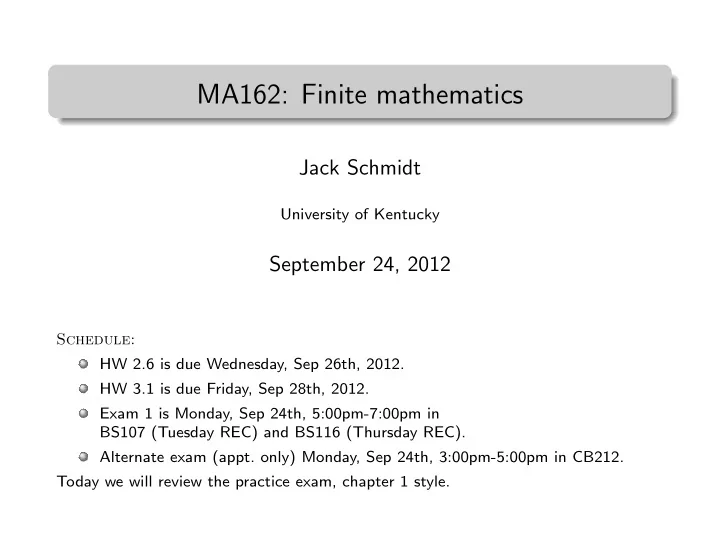
. MA162: Finite mathematics . Jack Schmidt University of Kentucky September 24, 2012 Schedule: HW 2.6 is due Wednesday, Sep 26th, 2012. HW 3.1 is due Friday, Sep 28th, 2012. Exam 1 is Monday, Sep 24th, 5:00pm-7:00pm in BS107 (Tuesday REC)


slide-1
SLIDE 1

. .

MA162: Finite mathematics

Jack Schmidt

University of Kentucky

September 24, 2012

Schedule: HW 2.6 is due Wednesday, Sep 26th, 2012. HW 3.1 is due Friday, Sep 28th, 2012. Exam 1 is Monday, Sep 24th, 5:00pm-7:00pm in BS107 (Tuesday REC) and BS116 (Thursday REC). Alternate exam (appt. only) Monday, Sep 24th, 3:00pm-5:00pm in CB212. Today we will review the practice exam, chapter 1 style.

slide-2
SLIDE 2

Practice exam: chapter 1.3

  • 1. Producing 15 items costs $300, but producing 20 items costs $320.

Assuming a linear model of production costs, how much would producing 16 items cost?

slide-3
SLIDE 3

Practice exam: chapter 1.3

  • 1. Producing 15 items costs $300, but producing 20 items costs $320.

Assuming a linear model of production costs, how much would producing 16 items cost? Answer: How much more did we produce? How much more did it cost? Now use proportion. 20 − 15 is 5 more items, $320 − $300 is $20 more dollars That is $20 extra for 5 extra items That is $4 extra for 1 extra item 16 is “1 extra“ so we need “$4 extra”, that is, $304

slide-4
SLIDE 4

Practice exam: chapter 1.4

  • 2. Where do the lines given by the following equations intersect?

x + y = 12 and 2x + 3y = 31

slide-5
SLIDE 5

Practice exam: chapter 1.4

  • 2. Where do the lines given by the following equations intersect?

x + y = 12 and 2x + 3y = 31 You can solve this many ways (be sure to show your work) Balancing is easy:

x + y = 12 2x + 3y = 31

2R1

− − → 2x + 2y = 24 2x + 3y = 31

R2−R1

− − − − → 2x + 2y = 24 0x + 1y = 7

R1−2R2

− − − − − → 2x + 0y = 10 0x + 1y = 7

1 2 R1

− − → 1x + 0y = 5 0x + 1y = 7

(x = 5, y = 7)

slide-6
SLIDE 6

Practice exam: Chapter 1.3 (Cost,Revenue,Profit)

  • 7. A company produces calculators. The fixed costs of production

total to $1000, while the marginal costs are only $10 per

  • calculator. If the calculators sell for $50 each, what is the

break-even production and the break-even cost?

slide-7
SLIDE 7

Practice exam: Chapter 1.3 (Cost,Revenue,Profit)

  • 7. A company produces calculators. The fixed costs of production

total to $1000, while the marginal costs are only $10 per

  • calculator. If the calculators sell for $50 each, what is the

break-even production and the break-even cost? Be sure to write out the cost function and revenue function and describe what “break-even” means C(X) = $10X + $1000 is the cost R(X) = $50X is the revenue “Break-even” means R = C $50X = $10X + $1000 $40X = $1000 Product X = $1000/$40 = 25 calculators to break-even Cost is $1000 + (25)(10) = $1250

slide-8
SLIDE 8

Practice exam: 1.4 (Supply-demand)

  • 9. Supply X is given by X = 45P + 100 when the price P remains

between $5 and $10 per unit. You know that at $5 per unit, 500 will be demanded, and at $10 per unit only 100 will be demanded. What is the equilibrium price? What is the equilibrium quantity?

slide-9
SLIDE 9

Practice exam: 1.4 (Supply-demand)

  • 9. Supply X is given by X = 45P + 100 when the price P remains

between $5 and $10 per unit. You know that at $5 per unit, 500 will be demanded, and at $10 per unit only 100 will be demanded. What is the equilibrium price? What is the equilibrium quantity? First find the demand equation: X = AP + B solve for A and B using the known values of (X, P). 500 = A($5) + B, 100 = A($10) + B, so subtract to get $400 = (−$5)(A) and A = −80 so B = 900 X = 900 − 80P is the demand equation Equilibrium has both Xs equal: 45P + 100 = 900 − 80P 125P = 800, Equilibrium price is P = $6.40, Equilibrium quantity is X = 388