Diablo Canyon Decommissioning Engagement Panel Meeting Date/Time: - - PDF document

diablo canyon decommissioning engagement panel meeting
SMART_READER_LITE
LIVE PREVIEW

Diablo Canyon Decommissioning Engagement Panel Meeting Date/Time: - - PDF document

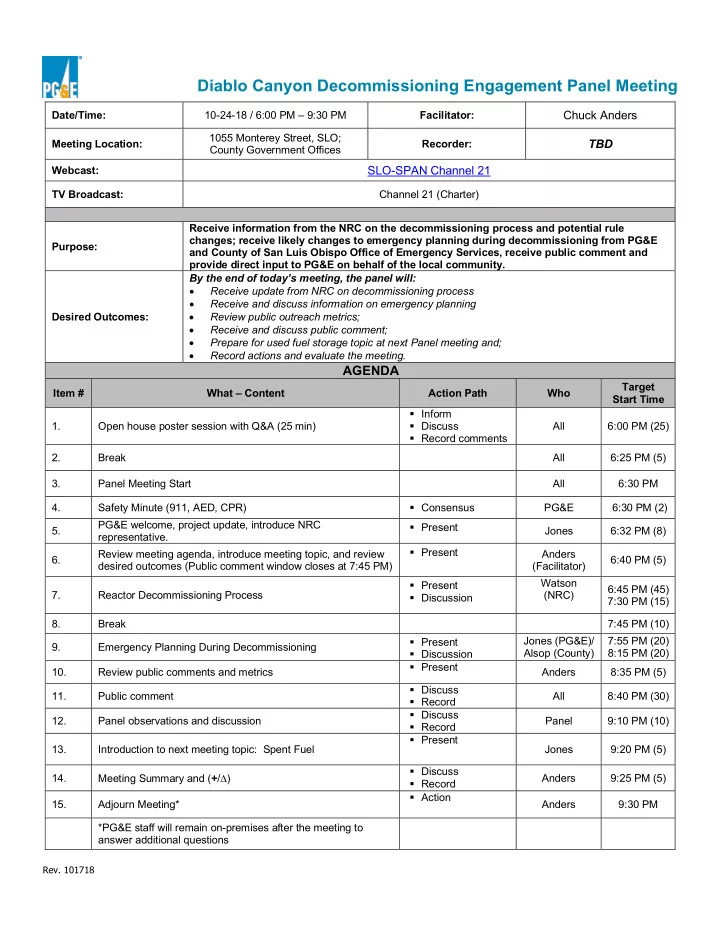
Diablo Canyon Decommissioning Engagement Panel Meeting Date/Time: 10-24-18 / 6:00 PM 9:30 PM Facilitator: Chuck Anders 1055 Monterey Street, SLO; TBD Meeting Location: Recorder: County Government Offices Webcast: SLO-SPAN Channel 21


slide-1
SLIDE 1

Diablo Canyon Decommissioning Engagement Panel Meeting

Date/Time: 10-24-18 / 6:00 PM – 9:30 PM Facilitator:

Chuck Anders

Meeting Location: 1055 Monterey Street, SLO; County Government Offices Recorder:

TBD

Webcast:

SLO-SPAN Channel 21

TV Broadcast: Purpose: Channel 21 (Charter) Receive information from the NRC on the decommissioning process and potential rule changes; receive likely changes to emergency planning during decommissioning from PG&E and County of San Luis Obispo Office of Emergency Services, receive public comment and provide direct input to PG&E on behalf of the local community. Desired Outcomes: By the end of today’s meeting, the panel will:

  • Receive update from NRC on decommissioning process
  • Receive and discuss information on emergency planning
  • Review public outreach metrics;
  • Receive and discuss public comment;
  • Prepare for used fuel storage topic at next Panel meeting and;
  • Record actions and evaluate the meeting.

AGENDA

Item # What – Content Action Path Who Target Start Time 1. Open house poster session with Q&A (25 min) § Inform § Discuss § Record comments All 6:00 PM (25) 2. Break All 6:25 PM (5) 3. Panel Meeting Start All 6:30 PM 4. Safety Minute (911, AED, CPR) § Consensus PG&E 6:30 PM (2) 5. PG&E welcome, project update, introduce NRC representative. § Present Jones 6:32 PM (8) 6. Review meeting agenda, introduce meeting topic, and review desired outcomes (Public comment window closes at 7:45 PM) § Present Anders (Facilitator) 6:40 PM (5) 7. Reactor Decommissioning Process § Present § Discussion Watson (NRC) 6:45 PM (45) 7:30 PM (15) 8. Break 7:45 PM (10) 9. Emergency Planning During Decommissioning § Present § Discussion Jones (PG&E)/ Alsop (County) 7:55 PM (20) 8:15 PM (20) 10. Review public comments and metrics § Present Anders 8:35 PM (5) 11. Public comment § Discuss § Record All 8:40 PM (30) 12. Panel observations and discussion § Discuss § Record Panel 9:10 PM (10) 13. Introduction to next meeting topic: Spent Fuel § Present Jones 9:20 PM (5) 14. Meeting Summary and (+/D) § Discuss § Record Anders 9:25 PM (5) 15. Adjourn Meeting* § Action Anders 9:30 PM *PG&E staff will remain on-premises after the meeting to answer additional questions

  • Rev. 101718
slide-2
SLIDE 2

Meeting Evaluation Plus + Delta D

1. 1. 2. 2. 3. 3.

Action Items Description Owner Due Date

  • Rev. 101718
slide-3
SLIDE 3

Decommissioning Regulatory Process

Deanna Toy June 27, 2018 Diablo Canyon Decommissioning Engagement Panel

1055 Monterey St. San Luis Obispo County Government Building October 24, 2018

slide-4
SLIDE 4

Safety Moment

AED CPR Call 911 Meet and Guide (DCPP FIRE) (DCPP FIRE) (PASION)

  • Emerg. Personnel

(PASION) Evacuation Earthquake Active Shooter Plan (JONES) ‘Duck, Cover, Hold’ (JONES) ‘Get Out, Hide Out, Take Out, Call Out’ (JONES)

2

slide-5
SLIDE 5

Welcome from Tom Jones

PG&E Director, Strategic Initiatives

October 24, 2018

3

slide-6
SLIDE 6

Agenda Overview

Wednesday, October 24

Reactor Decommissioning Process Watson (NRC) 10 minute break (7:45 p.m.) All Emergency Planning During Decommissioning Jones (PG&E) / Alsop (County) Review public comments and metrics Anders (Facilitator) Public comment (window closes at 7:55 p.m.) All Panel observations and discussion Panel Introduction to next meeting topic Jones Meeting summary Anders Adjourn meeting Anders

4

slide-7
SLIDE 7

Protecting People and the Environment

SAFEGUARDS

REACTOR DECOMMISSIONING PROCESS

DIABLO CANYON DECOMMISSIONING ENGAGEMENT PANEL OCTOBER 24, 2018

BRUCE WATSON, CHP

CHIEF, REACTOR DECOMMISSIONING BRANCH - OFFICE OF NUCLEAR MATERIAL SAFETY AND

5

slide-8
SLIDE 8

Safe Decommissioning Leads to License Terminations

12 10 8 6 4 2

Draft Guidance

Materials Sites Research Reactors Power Reactors

6

slide-9
SLIDE 9

Guiding Principles of Decommissioning

 Protection of plant &

workers

 Protection of the public  Communications &

  • utreach with external

stakeholders

7

slide-10
SLIDE 10

Reactor Decommissioning

The process of removing a reactor facility safely from the operating mode to a permanent shutdown condition and reducing the residual radioactivity to a level that permits the release of the property for unrestricted use and termination of the license.

BEFORE AFTER

Maine Yankee

8

slide-11
SLIDE 11

Initial Licensee Steps

 Certification of

permanent cessation of

 Submittal of the

  • perations

Post-Shutdown Decommissioning

 Certification of

Activities Report permanent (PSDAR) removal of fuel from reactor

9

slide-12
SLIDE 12

Post-Shutdown Decommissioning Activities Report (PSDAR)

It contains:

 Description of planned

decommissioning activities

 High-level schedule of planned

decommissioning activities

 Site-specific cost estimate for

the decommissioning

 Environmental impacts of

decommissioning

10

slide-13
SLIDE 13

PSDAR Review Process

 NRC notices receipt of the

PSDAR in the Federal Register and requests public comments

 NRC schedules a public

meeting to discuss PSDAR & solicit public comments

 NRC considers public

comments

 Plant owner may begin

decommissioning work 90 days after NRC receives the PSDAR

11

slide-14
SLIDE 14

Decommissioning Options

 DECON – Licensee

immediately begins removal

  • f equipment, structures, etc.,

and decontamination to a level that permits unrestricted release

 SAFSTOR – Plant is placed in

a safe, stable condition and maintained in this state until it is subsequently decontaminated to levels that permit unrestricted release

12

slide-15
SLIDE 15

How Long to Complete Decommissioning?

 Under NRC

regulations, the process must be completed within 60 years

 Site Restoration is

determined by the

  • wner and State

 Decommissioning

typically takes 7-10 years.

13

slide-16
SLIDE 16

Decommissioning Process - Phases

 Before Cleanup  During Cleanup  After Cleanup

14

slide-17
SLIDE 17

 Ready the plant for decommissioning  Move spent nuclear fuel to dry cask

storage

 Submit & update PSDAR

15

slide-18
SLIDE 18

 Removal of structures & components  Soil remediation  Radioactive waste shipments

16

slide-19
SLIDE 19

 NRC license termination  Spent fuel management  Site restoration

17

slide-20
SLIDE 20

Power Reactors in Decommissioning

 6 units in active

decommissioning

 15 units in SAFSTOR  12 plants have

announced they will be permanently ceasing operations by 2025

 New Business Models

18

slide-21
SLIDE 21

Oversight Program After Shutdown

 Oversight and

monitoring conducted over the entire period of decommissioning process

 Oversight program

is described in Inspection Manual Chapter (IMC) 2561 & 2690

19

slide-22
SLIDE 22

Oversight Program After Shutdown

 Decommissioning inspection

program includes both core and discretionary inspections

 Implementation depends on activities

being planned or performed.

  • Post-Operation Transition Phase
  • Actively Decommissioning – Fuel in Spent

Fuel Pool

  • Actively Decommissioning – No Fuel in

Spent Fuel Pool

  • SAFSTOR – Fuel in Spent Fuel Pool
  • SAFSTOR – No Fuel in Spent Fuel Pool
  • Final Surveys Under way

20

slide-23
SLIDE 23

What Happens to the Spent Fuel?

 Removed from

spent fuel pool

 Stored on-site in dry

cask storage systems

 Safety and security

programs remain until fuel removed from site

21

slide-24
SLIDE 24

Is the Spent Fuel Pool Safe?

 Robust structures  Designed to

withstand severe natural events

 Regulated design

features &

  • perational practices

implemented to maintain fuel in safe condition

22

slide-25
SLIDE 25

How Does Emergency Planning Change?

 Emergency

preparedness remains

 ‘All hazards’ approach

utilized vs. formal pre- planned off-site radiological response plans

 Decommissioning Rule

Making to be completed by 2019 to make the transition more efficient

23

slide-26
SLIDE 26

Emergency Plan Graded Approach

Level 1 — Permanent cessation of operations and

all fuel in spent fuel pool

Level 2 — Spent fuel has sufficiently decayed

(10 hour adiabatic heatup time)

Level 3 — All fuel is in dry cask storage Level 4 — All fuel removed from site

24

slide-27
SLIDE 27

Post-Shutdown Emergency Plan (PSEP)

  • PSEP may start after NRC dockets licensee’s

certifications of certifications of permanent cessation

  • f operations and permanent removal of all fuel from

the reactor vessel.

  • PSEP is a transition period

May only last 10 months (BWR) to 16 months (PWR)

Significant changes to plan not anticipated

No changes to regulations for offsite emergency plan

25

slide-28
SLIDE 28

Post-Shutdown Emergency Plan (PSEP)

  • 10 CFR 50.200(a)
  • Proposed Rule provides for:

– Reduced ERO staffing – Revisions to EALs – ETE updates no longer required – Annual dissemination of information to the public – future plant status – Revised exercise schedule (drill cycle maintained) 26

slide-29
SLIDE 29

Permanently Defueled Emergency Plan (PDEP)

  • 10 CFR 50.200(b) and (c)
  • Proposed Rule provides for:

Reduced Emergency Response Organization staffing

Classification and Notification timeliness commensurate to risk and accident timing

Events classified as Notification of an Unusual Event or Alert

No offsite (Radiological Emergency Plan) planning requirements

  • No defined Emergency Planning Zones beyond the site

boundary

  • No demonstration of capability for prompt public alerting
  • No pre-determined ProtectiveActions

27

slide-30
SLIDE 30

Permanently Defueled Emergency Plan (PDEP)

  • Proposed Rule provides for:

Revisions to Emergency Action Levels (EALs)

Emergency response facilities (Technical Support Center, Operations Support Center, Emergency Operations Facility) may be combined

Biennial exercise within 2 years of entering into decommissioning (drill cycle maintained)

No hostile action requirements (security EALs maintained)

28

slide-31
SLIDE 31

Permanently Defueled Emergency Plan (PDEP)

  • 10 CFR 50.47(f) — Planning standards do not apply to
  • ffsite EP if Emergency Planning Zone does not extend

beyond the site boundary.

 10 CFR 50.54(s)(3) — Clarifies how NRC will make findings

and determinations of reasonable assurance when planning standards do not apply to offsite.

○ (s)(3)“If the planning standards for radiological emergency

preparedness apply to offsite radiological emergency response plans, the NRC will base its finding on a review of the FEMA findings and determinations as to whether State and local emergency plans are adequate and capable of being implemented, and on the NRC assessment as to whether the licensee's emergency plans are adequate and capable of being implemented.”

 10 CFR 50.54(t) — EP program element review at 2 year

intervals until all fuel in dry cask storage.

29

slide-32
SLIDE 32

Independent Spent Fuel Storage Installation (ISFSI) Only Emergency Plan (IOEP)

  • IOEP may start after all spent fuel is in dry cask

storage

  • IOEP utilizes established EP planning standards for

ISFSIs contained in 10 CFR 72.32(a)

  • Part 50 and Part 52 licensees are granted a general

Part 72 license

  • Application for a specific Part 72 license would require

NRC approval of emergency plan

30

slide-33
SLIDE 33

Decommissioning Rulemaking by 2019

  • Emergency Plan Change Process

Transition to Levels

Changes within Levels

Changes in Final Safety Analysis Report (FSAR)

Changes in Emergency Action Levels (EALs) Classifications and Scheme(s)

10 CFR 50.54(q)(7) — Licensee may elect to follow and maintain a Level standard when conditions are met.

10 CFR 50.54(q)(8) — Clarifies need for Reduction in Effectiveness (RIE)

Transition between levels is not an RIE if changes comply with standards.

Changes to e-plan are not RIEs if supported by Final Safety Analysis Report (FSAR) for Safety Systems and Components (SSCs) out of service.

Changes to EAL not RIE if physically unattainable.

  • Draft EP Regulatory Guide to accompany proposed rule

 DG-1346, “Emergency Planning for Decommissioning Nuclear Power

Reactors” (Agencywide Documents Access and Management System

(ADAMS) Accession No. ML17311B018),

31

slide-34
SLIDE 34

Decommissioning EP Levels

Power Level 4 Operations Post Shutdown Emergency Plan (PSEP) Permanently Defueled Emergency Plan (PDEP) ISFSI Only Emergency Plan (IOEP) Level 1 Level 2 Level 3 No Spent Fuel Onsite

Cessation of Power 10 months (BWR) > 5 Operations and Defueled 16 months (PWR) years

32

slide-35
SLIDE 35

How will plant security change?

 Security controls

remain in place

 Some key features

include: intrusion detection and response, assessment of alarms, and off-site assistance, when necessary

33

slide-36
SLIDE 36

Public Involvement on Decommissioning

 Public meeting to discuss the

decommissioning process and the plant’s PSDAR

 NRC staff typically provide briefings at

meetings of state/citizen decommissioning advisory panels

 An opportunity for a hearing  Public meeting on License Termination Plan

34

slide-37
SLIDE 37

2009 Rancho Seco

35

slide-38
SLIDE 38

San Onofre 1, 2, 3

36

slide-39
SLIDE 39

Vallecitos Nuclear Center

37

slide-40
SLIDE 40

Humboldt Bay

38

slide-41
SLIDE 41

Humboldt Bay - October 2018

39

slide-42
SLIDE 42

NRC References

40

slide-43
SLIDE 43

Links for NRC References

 IMC 2561: Decommissioning Power Reactor Inspection Program  RG 1. 184: Decommissioning of Nuclear Power Reactors  RG 1.185: Post Shutdown Decommissioning Activities Report  NUREG 1628: Staff Responses to FAQs Concerning

Decommissioning of Nuclear Power Reactors

 NRC Backgrounder: Decommissioning of Nuclear Power Plants  NRC YouTube Video on Decommissioning

Questions???? Bruce.Watson@nrc.gov

  • r 301-415-6221

41

slide-44
SLIDE 44

42

Questions/ Discussion

slide-45
SLIDE 45

43

Break

10 minutes

slide-46
SLIDE 46

Emergency Planning During Decommissioning

44

Tom Jones PG&E Director, Strategic Initiatives October 24, 2018

slide-47
SLIDE 47

Emergency Planning

45

Emergency Response Facilities

  • Control Room
  • Technical Support Center
  • Operational Support Center
  • Emergency Operations

Facility

  • Joint Information Center
  • Unified Dose Assessment

Center

  • Energy Education Center
  • Emergency Operations

Center - San Francisco, CA

  • State Operations Center -

Sacramento, CA

slide-48
SLIDE 48

Emergency Planning

46

On-site Facilities

  • Control Room, Technical Support Center and

Operational Support Center

slide-49
SLIDE 49

Emergency Planning

47

Local Facilities

Alternate Technical Support Center

(Kendall Rd. SLO)

Emergency Ops Facility

(Kansas Ave. SLO)

Control Room & Technical Support Center (DCPP) Backup Emergency Ops Facility

(S. Higuera. SLO)

Joint Information Center

(Kansas Ave. SLO)

Energy Education Center

(Ontario Rd. SLO)

slide-50
SLIDE 50

Emergency Planning

48

Early Warning System Siren Locations

  • 131 locations

stretching from Whale Rock Reservoir in Cayucos to Black Lake Golf Course in Arroyo Grande, and from DCPP to School Rd in eastern SLO County

slide-51
SLIDE 51

Emergency Planning

49

Beyond Design Basis (BDB) Equipment

  • Designated BDB equipment

storage facilities

  • Mobile communication

centers

  • Additional back-up and

portable diesel generators

  • Additional emergency

cooling pumps

  • Additional instrumentation

to monitor spent fuel pool levels

slide-52
SLIDE 52

Emergency Planning

50

BDB Equipment

  • Secondary Storage Facility houses BDB

equipment including a front end loader and emergency cooling pumps

slide-53
SLIDE 53

Emergency Planning

51

Emergency Response

  • The Diablo Canyon Fire Department uses state-
  • f-the-art equipment and conducts rigorous

training exercises in preparation for extreme events

slide-54
SLIDE 54

Emergency Planning

52

Off-Site Monitoring Equipment

  • Geophysical Monitors
  • Meteorological Towers
  • Environmental Direct Radiation Monitors and Air

Sampling Devices

  • Radiation Monitoring System
  • Laboratories
slide-55
SLIDE 55

How Emergency Planning is Funded for Nuclear

53

Current Emergency Planning Funding is established by Assembly Bill 361

  • Requires CPUC to reimburse agencies for support of

nuclear-related emergency planning activities

  • Sunsets with Unit 2 license expiration date
  • Only applies to operating nuclear plants

CPUC Decision and Senate Bill 1090

  • PG&E shall file for funding to continue local off-site

emergency planning services:

  • Maintenance of public warning sirens
  • Funding of local government emergency planning

functions until Part 50 license termination

slide-56
SLIDE 56

Emergency Planning

54

slide-57
SLIDE 57

READ AND DELETE

For best results with this template, use PowerPoint 2003

Thank you

Tom Jones Tom.Jones@pge.com

55

slide-58
SLIDE 58

56

Questions/ Discussion

slide-59
SLIDE 59

San Luis Obispo County Office of Emergency Services

Overview of Diablo Canyon Related Emergency Planning and Preparedness

57

slide-60
SLIDE 60

Federal Oversight

  • FEMA Radiological

Emergency Preparedness (REP) Program

  • Program created to

address communities with commercial nuclear power plants.

  • FEMA reviews and

approves planning and preparedness activities, evaluates exercises and issues findings if issues are identified.

58

slide-61
SLIDE 61

FEMA Requirements

 FEMA term: “Offsite Response

Organization” is a term used to refer to state, tribal, and/or local government

  • rganizations acting to protect the public

health and safety offsite.

 Thus, the County, cities, special districts,

the State and related agencies are the OROs related to Diablo Canyon.

59

slide-62
SLIDE 62

Offsite Response Organization

 Our ORO make up is unique in that we

have one common emergency plan for all the ORO jurisdictions related to Diablo Canyon - the San Luis Obispo County- Cities Nuclear Power Plant Emergency Response Plan.

 OES coordinates NPP emergency planning

with and between the OROs, the state, and FEMA.

60

slide-63
SLIDE 63

Emergency Planning

1 NPP Admin Plan (Overview) Over 50 agency and function based SOPs

SOPs include:

 Checklists for each emergency position  Preplanned actions based on emergency classification level  Evacuation Time Estimates  Special Needs considerations  Public School Relocation  Carless Collection  Public Notification Methods  Protective Action Guidelines  Exposure Control Guidelines  Reentry, Return, and Recovery  Ingestion Pathway issues

61

slide-64
SLIDE 64

Exercises and Drills

 NPP exercises are required and evaluated by

FEMA; however, we also go beyond what is required … we also request FEMA provide evaluators at times for exercises that are not required to be evaluated but we want their input.

 Required exercises include plume, ingestion

pathway zone, monitoring and decontamination, medical and hostile action based scenarios.

 Full scale exercise participation may range from

200-1000 players.

62

slide-65
SLIDE 65

Exercises and Drills

 NPP exercises also benefit preparedness for other

types of potential emergencies.

63

slide-66
SLIDE 66

Exercises and Drills

 NPP preparedness also benefits response to actual

emergencies.

64

slide-67
SLIDE 67
  • .
  • "slocountyoes"

Questions?

County of San Luis Obispo Office of Emergency Services

  • oes@co.slo.ca.us or (805) 781-5011 -

Follow us on Twitter and Facebook, both are

Questions?

San Luis Obispo County Office of Emergency Services

Overview of Diablo Canyon Related Emergency Planning and Preparedness

65

slide-68
SLIDE 68

66

Panel Discussion and Observations

slide-69
SLIDE 69

67

63 335 10 14 5 5

2018 TOTAL: 449 (393 total last month)

4

REPURPOSING

ENVIRONMENTAL

LANDS

ECONOMIC IMPACTS

SAFETY

TRANSPORTATION

6 7

FUNDING OTHER OUTREACH PROCESS SECURITY

Public Comments & Questions

slide-70
SLIDE 70

68

Public Comment Session

Left Podium Right Podium

slide-71
SLIDE 71

69

Panel Observations and Discussion

slide-72
SLIDE 72

70

Nov 14 Topic: Spent Fuel Storage

slide-73
SLIDE 73

71

Meeting Evaluation

slide-74
SLIDE 74

72

Thank you

We’re available now to answer additional questions

slide-75
SLIDE 75

73

Appendix

  • On-Site Assessment Systems & Equipment
  • Industry Emergency Planning: SAFER
slide-76
SLIDE 76

Emergency Planning

74

On-Site Assessment Systems & Equipment

  • Seismic Monitoring System
  • Meteorological Systems
  • Area Radiation Monitoring System
  • Process Radiological Monitoring System
  • Radiological Counting Room
  • Analytical Facilities (assoc. with TSC)
  • Portable Survey and Dose Rate Instruments
  • Field Monitoring and Evacuation Kits
  • Fire Detection and Trouble Alarm System
  • Sampling and Analysis Capability
  • Post Accident Assessment Instruments
slide-77
SLIDE 77

Emergency Planning

75

Industry: SAFER

  • SAFER: Strategic Alliance

for FLEX Emergency Response

  • Two National Response Centers in Memphis, TN. and

Phoenix, AZ., can respond to any US nuclear power plant within 24 hours with portable emergency backup equipment

  • Portable equipment would maintain plant safety functions

for an indefinite period if an event disabled Diablo Canyon’s safety systems