Device Code E C requirements Conveyance Electrical Code Replace - - PDF document

device code e c
SMART_READER_LITE
LIVE PREVIEW

Device Code E C requirements Conveyance Electrical Code Replace - - PDF document

Stakeholder Oversight Group Meeting 12/3/2018 Modernizing Chicagos Modernizing Chicagos Construction Codes Construction Codes Phase 2 Overview Why modernize the code? What is planned? What has happened before? How will


slide-1
SLIDE 1

Stakeholder Oversight Group Meeting 12/3/2018 1

Modernizing Chicago’s Construction Codes

Phase 2

1

Overview

  • Why modernize the code?
  • What is planned?
  • What has happened before?
  • How will Phase 2a work?
  • How might the code change?

Modernizing Chicago’s Construction Codes

2

Goal To better align the City of Chicago’s construction requirements with up-to-date model codes and standards used in other major US jurisdictions while maintaining longstanding local requirements that are adapted to unique conditions in Chicago.

Modernizing Chicago’s Construction Codes

3

Outcomes

  • streamline permitting process
  • reduce barriers to cost-effective construction
  • enhance public safety
  • promote energy efficiency and sustainability
  • facilitate innovative design and construction
  • benefit from national code development efforts

Modernizing Chicago’s Construction Codes

4

Modernizing Chicago’s Construction Codes

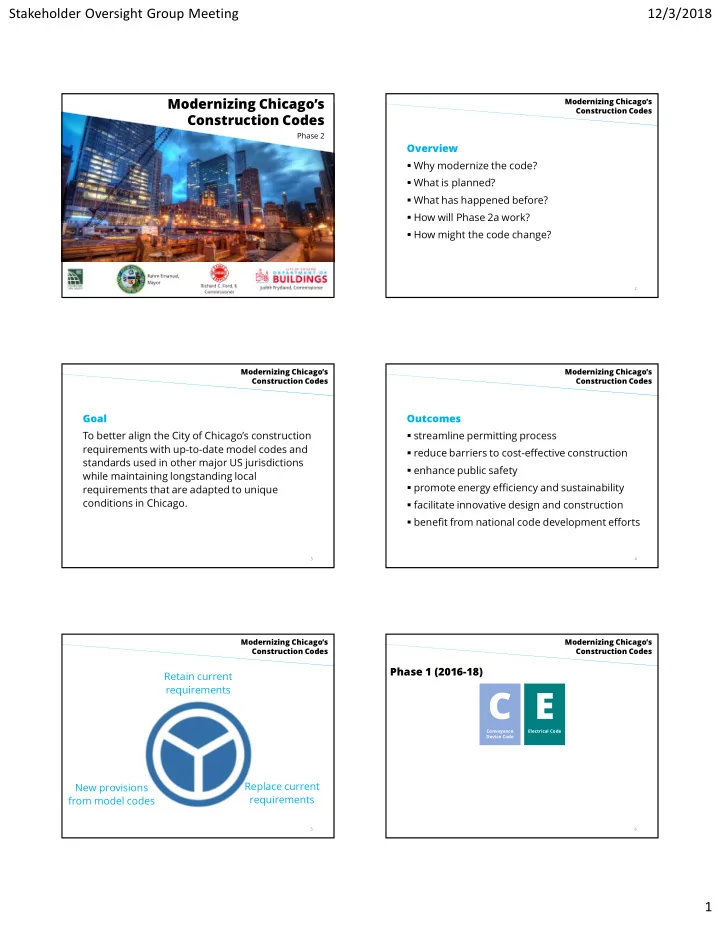
Retain current requirements Replace current requirements New provisions from model codes

5

Modernizing Chicago’s Construction Codes

C

Conveyance Device Code E Electrical Code

Phase 1 (2016-18)

6

slide-2
SLIDE 2

Stakeholder Oversight Group Meeting 12/3/2018 2

Modernizing Chicago’s Construction Codes

A

Administrative Provisions B Building Code C Conveyance Device Code E Electrical Code

N

Energy Conservation Code

R

Rehabilitation Code

X

Existing Building Code

Phase 2a (2016-2020)

P P

7

Modernizing Chicago’s Construction Codes

A

Administrative Provisions B Building Code C Conveyance Device Code E Electrical Code F Fire Prevention Code

N

Energy Conservation Code

R

Rehabilitation Code

X

Existing Building Code

Phase 2b (2018-2020)

P P P P P P

8

Modernizing Chicago’s Construction Codes

A

Administrative Provisions B Building Code C Conveyance Device Code E Electrical Code F Fire Prevention Code G Fuel Gas Code

M

Mechanical Code N Energy Conservation Code P Plumbing Code R Rehabilitation Code S Sign Code X Existing Building Code

Phase 3 (2019-2021)

P P P P P P P

… and trade licensing.

9

Modernizing Chicago’s Construction Codes

A

Administrative Provisions B Building Code C Conveyance Device Code E Electrical Code F Fire Prevention Code G Fuel Gas Code

M

Mechanical Code N Energy Conservation Code P Plumbing Code R Rehabilitation Code S Sign Code X Existing Building Code

Full Project (2016-2021) … and trade licensing.

10

Rinse and Repeat The new construction codes will not be static requirements but a regulatory foundation that will make it easier for the City of Chicago to remain current with the latest building technologies and benefit from national code development efforts.

Modernizing Chicago’s Construction Codes

11

History Understanding where the current code comes from is critical to understanding how we can and should reshape it going forward.

Modernizing Chicago’s Construction Codes

12

slide-3
SLIDE 3

Stakeholder Oversight Group Meeting 12/3/2018 3

Modernizing Chicago’s Construction Codes

1837

“The common council, for the purpose of guarding against the calamities of fire, shall have power to prescribe the limits in said city, within which wooden buildings shall not be erected or placed without the permission of the said common council…”

13

Modernizing Chicago’s Construction Codes

Between 1837 and 1871, the population of Chicago grew from 4,000 to 334,000. In the downtown district, many buildings were built with brick, stone, and iron. But in the city as a whole, more than 90% of buildings were frame construction. Between 1837 and 1871, the population of Chicago grew from 4,000 to 334,000. In the downtown district, many buildings were built with brick, stone, and iron. But in the city as a whole, more than 90% of buildings were frame construction. LaSalle & Washington, 1858 LaSalle & Washington, 1858

14

Modernizing Chicago’s Construction Codes

1871

The Great Fire destroyed more than 15,000 buildings, killed more than 300, and left more than 100,000 homeless.

1871

The Great Fire destroyed more than 15,000 buildings, killed more than 300, and left more than 100,000 homeless.

15

Modernizing Chicago’s Construction Codes

State & Madison State & Madison

1871 1871

16

The City rebuilt rapidly. The council adopted a building code in 1875. The 1875 ordinance was reportedly “the subject of much careful consideration by the leading architects, builders and insurance agents of the city.” It was 5.5 pages. The Tribune thought it was too long. The City rebuilt rapidly. The council adopted a building code in 1875. The 1875 ordinance was reportedly “the subject of much careful consideration by the leading architects, builders and insurance agents of the city.” It was 5.5 pages. The Tribune thought it was too long.

State & Madison, 1878 State & Madison, 1878

Modernizing Chicago’s Construction Codes

17

In 1893, the council adopted a new building code and created the Department of Buildings. The 1893 code also imposed strict height restrictions that would not be fully lifted until the 1920s. In 1893, the council adopted a new building code and created the Department of Buildings. The 1893 code also imposed strict height restrictions that would not be fully lifted until the 1920s.

Modernizing Chicago’s Construction Codes

Masonic Temple, State & Randolph, 21 stories (1892) Masonic Temple, State & Randolph, 21 stories (1892)

18

slide-4
SLIDE 4

Stakeholder Oversight Group Meeting 12/3/2018 4

Modernizing Chicago’s Construction Codes

1903

The Iroquois Theater fire resulted in 602 deaths. All Chicago theaters remained closed for more than a month after the fire. The fire led to adoption of the first comprehensive building code in 1905.

1903

The Iroquois Theater fire resulted in 602 deaths. All Chicago theaters remained closed for more than a month after the fire. The fire led to adoption of the first comprehensive building code in 1905.

19

Modernizing Chicago’s Construction Codes

1946

After the end of WWII, the City allowed many forms of temporary housing on an emergency basis.

1946

After the end of WWII, the City allowed many forms of temporary housing on an emergency basis.

Midway Plaisance housing Midway Plaisance housing

20

Modernizing Chicago’s Construction Codes

1946-49

From 1946-49, John O. Merrill, founding partner of SOM, oversaw the last comprehensive revision of the Chicago Building Code. One of the most controversial issues was whether to allow wallboard instead of plaster-and-lath.

1946-49

From 1946-49, John O. Merrill, founding partner of SOM, oversaw the last comprehensive revision of the Chicago Building Code. One of the most controversial issues was whether to allow wallboard instead of plaster-and-lath.

21

Modernizing Chicago’s Construction Codes

Over time, new requirements have been added in response to tragedies. Over time, new requirements have been added in response to tragedies.

Our Lady of the Angels fire, 1958 Our Lady of the Angels fire, 1958

22

Modernizing Chicago’s Construction Codes

Over time, new requirements have been added in response to tragedies. Over time, new requirements have been added in response to tragedies.

McCormick Place Fire, 1967 McCormick Place Fire, 1967

23

Modernizing Chicago’s Construction Codes

In the early 1970s, there were several high-rise fires in Chicago. The 1974 film, The Towering Inferno, helped to build popular support for enhanced high-rise safety requirements, which were adopted in 1975. In the early 1970s, there were several high-rise fires in Chicago. The 1974 film, The Towering Inferno, helped to build popular support for enhanced high-rise safety requirements, which were adopted in 1975.

24

slide-5
SLIDE 5

Stakeholder Oversight Group Meeting 12/3/2018 5

Modernizing Chicago’s Construction Codes

In the 1980s, the code was amended to make it easier to rehab and reuse existing buildings. In the 1980s, the code was amended to make it easier to rehab and reuse existing buildings.

25

Modernizing Chicago’s Construction Codes

From the late 1990s until 2004, Chicago studied adopting the new International Codes. Ultimately, this effort did not have popular support. From the late 1990s until 2004, Chicago studied adopting the new International Codes. Ultimately, this effort did not have popular support.

26

Modernizing Chicago’s Construction Codes

After the 2003 Cook County Administration Building Fire, Chicago committed to upgrading all pre-1975 high- rise buildings. That effort took more than 15 years and involved more than 1,000 buildings. After the 2003 Cook County Administration Building Fire, Chicago committed to upgrading all pre-1975 high- rise buildings. That effort took more than 15 years and involved more than 1,000 buildings.

27

Modernizing Chicago’s Construction Codes

In 2011, Mayor Emanuel made electronic plan review the Department of Buildings’ top priority. In 2011, Mayor Emanuel made electronic plan review the Department of Buildings’ top priority.

28

Modernizing Chicago’s Construction Codes

29

Phase 2a Process

  • internal drafts
  • review with experts and stakeholders
  • ordinance introduction
  • training and implementation

Modernizing Chicago’s Construction Codes

30

slide-6
SLIDE 6

Stakeholder Oversight Group Meeting 12/3/2018 6

Internal Drafts (January - now)

Modernizing Chicago’s Construction Codes

2009-11 Working Group Drafts

31

Review with Experts and Stakeholders (December - February)

Modernizing Chicago’s Construction Codes

Fire Protection Building Planning Structural Enclosure & Materials Small Residential Existing Buildings Stakeholders Oversight

32

City Council (March - )

  • DOB and Law Department prepare ordinance
  • ordinance is introduced at full council meeting
  • referred to committee for hearing(s)
  • if committee recommends favorable action,

returns to full council for vote

Modernizing Chicago’s Construction Codes

33

Training and Implementation (6 months)

  • Working with ICC to publish code books
  • Training staff, consultants, and certified

professionals

  • Updating forms and IT systems
  • Applicants will be allowed to choose

new or old code for 6-9 month transition

Modernizing Chicago’s Construction Codes

34

Anticipated Changes

  • Adopt national standard system of
  • ccupancy/risk classification
  • Adopt national standards for special features

such as atriums and underground buildings

  • Update requirements for high-rise buildings,

consistent with post-9/11 NIST recommendations

Modernizing Chicago’s Construction Codes

35

Anticipated Changes

  • Adopt national standard classification system

for types of construction (but less recognition for fire retardant treated wood in non- combustible construction types).

  • Allow increased heights and areas of ordinary

and protected frame construction in new buildings with fire protection systems.

Modernizing Chicago’s Construction Codes

36

slide-7
SLIDE 7

Stakeholder Oversight Group Meeting 12/3/2018 7

Anticipated Changes

  • Increase requirements for sprinkler and alarm

systems in new buildings

  • Increase requirements for alarm systems (but

not sprinklers) in rehab work

  • Align with national standards for exiting

requirements (retain Chicago exit signage)

  • Recognize newer construction materials

without specialized approval required

Modernizing Chicago’s Construction Codes

37

Anticipated Changes

  • Align more closely with national standards for

exterior wall and roofing materials

  • Align with national standards for structural

design

  • Expand requirements for use of third-party

inspections during construction

  • Adopt clearer requirements for construction

site safety

Modernizing Chicago’s Construction Codes

38

Anticipated Changes

  • Provide greater flexibility for rehab work,

consistent with International Existing Building Code

  • Provide greater clarity on requirements which

apply to change-of-use projects (warehouse to apartments)

  • Restate property maintenance requirements

in clearer language, consistent with new code

Modernizing Chicago’s Construction Codes

39

Anticipated Similarities

  • Wood-based construction will still be more

limited than under pure model code

  • Some stricter passive fire-resistance

requirements will remain (4-hr fire walls)

  • Chicago-specific requirements for Wrigleyville

rooftops and shooting ranges, etc. are likely to remain

  • Chicago will not require third exits in high-rise

buildings or dedicated fire command rooms

Modernizing Chicago’s Construction Codes

40

Anticipated Similarities

  • In smaller residential buildings, 2 exits will still

be required, and “egress windows” will not be

  • Chicago requirements for exit signs will remain

Modernizing Chicago’s Construction Codes

41

Next Stakeholder Oversight Meetings

  • Wednesday, January 9, 2019

9:30 a.m.

  • Wednesday, February 6, 2019

9:30 a.m.

  • Wednesday, March 6, 2019

9:30 a.m. (locations TBD)

Modernizing Chicago’s Construction Codes

42