Development and testing of a dust indicator for climate assessment - - PowerPoint PPT Presentation

development and testing of a dust indicator for climate
SMART_READER_LITE
LIVE PREVIEW

Development and testing of a dust indicator for climate assessment - - PowerPoint PPT Presentation

Development and testing of a dust indicator for climate assessment in the western United States (PI: Daniel Tong, George Mason University) The 1930s Dust Bowl -- the largest natural catastrophe in the North America history; -- caused by


slide-1
SLIDE 1

Development and testing of a dust indicator for climate assessment in the western United States

(PI: Daniel Tong, George Mason University)

  • The 1930s Dust Bowl
  • - the largest natural catastrophe in the North America history;
  • - caused by extended drought and poor land management.
  • Reconstructed paleo-climatic records (Woodhouse and Overpeck, 1998):
  • - severe droughts about once or twice a century over the past 400 years.
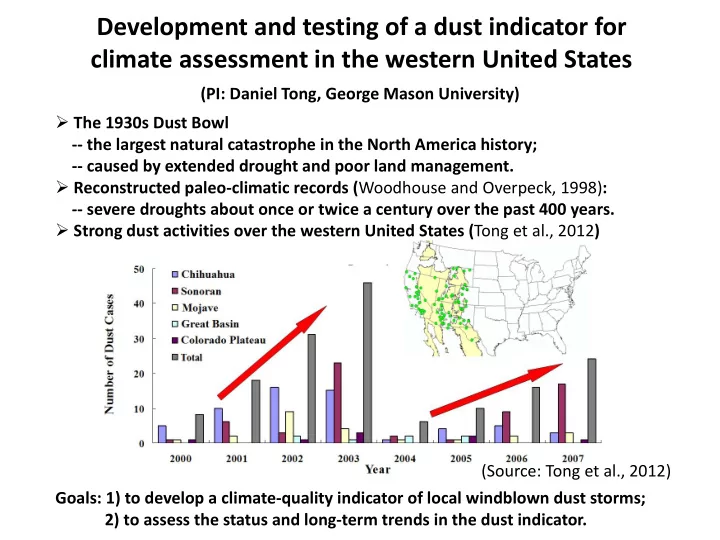
  • Strong dust activities over the western United States (Tong et al., 2012)

Goals: 1) to develop a climate-quality indicator of local windblown dust storms; 2) to assess the status and long-term trends in the dust indicator. (Source: Tong et al., 2012)

slide-2
SLIDE 2

NCA Dust Indicator: The Approach

slide-3
SLIDE 3

NCA Dust Indicator: Expected Results and The Team

University of Texas at El Paso Thomas Gill, Co-I, tegill@utep.edu Huiyan Yang, Co-I, hyang4@utep.edu NASA GSFC Dongchul Kim (USRA), Co-I, dongchul.kim@nasa.gov

  • N. Christina Hsu, Collaborator, christina.hsu@nasa.gov

NOAA Air Resources Laboratory Julian Wang, Co-I, julian.wang@noaa.gov Dust Data Users Clark County Department of Air Quality, Los Vegas, NV (Great Basin Desert) Maricopa Association of Governments, Phoenix, AZ (Sonoran Desert) Bay Area Air Quality Management District, CA, (California Desert) Texas Commission of Environmental Quality, Austin, TX (Chihuahua Desert) Mini-workshop: Dust Indicator developers and data users will meet in Spring 2015. Develop a practical dust indicator that can

  • 1. inform local decision-makers of current status and trends of dust.

2.provide validated local dust dataset for evaluating model prediction and validating satellite aerosol products. 3.advance our knowledge of changes in an important climate variable.

  • Expected Results
  • The Team