Developing Startle and Surprise Training Interventions for Airline - - PowerPoint PPT Presentation

developing startle and surprise training interventions
SMART_READER_LITE
LIVE PREVIEW

Developing Startle and Surprise Training Interventions for Airline - - PowerPoint PPT Presentation

Developing Startle and Surprise Training Interventions for Airline Training Programs Dr Wayne Martin BAvMan, MAvMgmt, MBus, PhD, FRAeS CRICOS QLD00244B NSW 02225M TEQSA:PRF12081 The Problem with Startle and Surprise Surprise An unexpected


slide-1
SLIDE 1

CRICOS QLD00244B NSW 02225M TEQSA:PRF12081
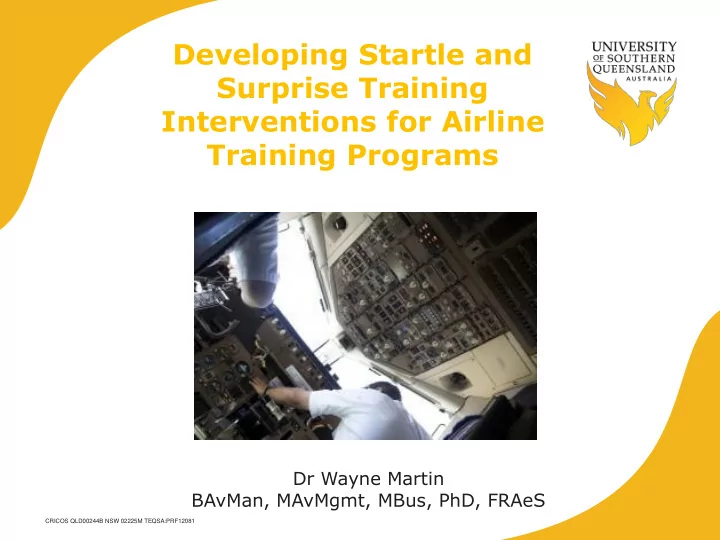
Developing Startle and Surprise Training Interventions for Airline Training Programs

Dr Wayne Martin BAvMan, MAvMgmt, MBus, PhD, FRAeS

slide-2
SLIDE 2

CRICOS QLD00244B NSW 02225M TEQSA:PRF12081

The Problem with Startle and Surprise

Surprise An unexpected event that violates a pilot’s expectations and can affect the mental processes used to respond to the event

(FAA, 2015)

slide-3
SLIDE 3

CRICOS QLD00244B NSW 02225M TEQSA:PRF12081

The Problem with Startle and Surprise

Two Types of Surprise

  • Fundamental Surprise
  • Situational Surprise
slide-4
SLIDE 4

CRICOS QLD00244B NSW 02225M TEQSA:PRF12081

The Problem with Startle and Surprise

Startle An uncontrollable, automatic muscle reflex, raised heart rate, blood pressure, etc., elicited by exposure to a sudden, intense event that violates a pilot’s expectations.

(FAA, 2015)

slide-5
SLIDE 5

CRICOS QLD00244B NSW 02225M TEQSA:PRF12081

Colgan Air – Buffalo 2009

The Problem with Startle and Surprise

slide-6
SLIDE 6

CRICOS QLD00244B NSW 02225M TEQSA:PRF12081

Turkish Airlines – Amsterdam 2009

The Problem with Startle and Surprise

slide-7
SLIDE 7

CRICOS QLD00244B NSW 02225M TEQSA:PRF12081

Air France – Atlantic Ocean 2009

The Problem with Startle and Surprise

slide-8
SLIDE 8

CRICOS QLD00244B NSW 02225M TEQSA:PRF12081

Pinnacle Airlines – Jefferson City 2004

The Problem with Startle and Surprise

slide-9
SLIDE 9

CRICOS QLD00244B NSW 02225M TEQSA:PRF12081

West Caribbean Airlines – Venezuela 2005

The Problem with Startle and Surprise

slide-10
SLIDE 10

CRICOS QLD00244B NSW 02225M TEQSA:PRF12081

Air Asia – Indonesia 2014

The Problem with Startle and Surprise

slide-11
SLIDE 11

CRICOS QLD00244B NSW 02225M TEQSA:PRF12081

While Pilots may practise emergencies in the sim for perhaps four days a year, the remainder of the 360+ days are often routine and emergency-free. On those rare occasions when things do go wrong, then a lack of expectation can produce some heightened surprise and stress reactions, with negative effects on situation

  • utcome.

A Conditioned Expectation of Normalcy

slide-12
SLIDE 12

CRICOS QLD00244B NSW 02225M TEQSA:PRF12081

The Problem with Startle and Surprise

The FAA Experiments – A powerful example

slide-13
SLIDE 13

CRICOS QLD00244B NSW 02225M TEQSA:PRF12081

Training Interventions

slide-14
SLIDE 14

CRICOS QLD00244B NSW 02225M TEQSA:PRF12081

Training Interventions

Simulator experiments are being conducted to expose pilots to ‘controlled’ interventions.

slide-15
SLIDE 15

CRICOS QLD00244B NSW 02225M TEQSA:PRF12081

Training Interventions

Pilot Briefing Package

slide-16
SLIDE 16

CRICOS QLD00244B NSW 02225M TEQSA:PRF12081

Training Interventions

slide-17
SLIDE 17

CRICOS QLD00244B NSW 02225M TEQSA:PRF12081

Training Interventions

Immediate Action Events

EGPWS Terrain Warning Rejected Takeoff Reactive Windshear (Impending) Stall Warning Aircraft Upset Cabin Altitude TCAS RA

Recognition Primed Reactions (Overlearned)

slide-18
SLIDE 18

CRICOS QLD00244B NSW 02225M TEQSA:PRF12081

Training Interventions

Non-immediate Action Events

  • 1. Take a few seconds to recover if possible
  • 2. Check and call the aircraft state

– Speed, Alt, Pitch, EICAS/ECAM

  • 3. Decide on the best course of action

B

  • Breathe (Pause)

A

  • Analyse

D

  • Decide

A 3 step process:

slide-19
SLIDE 19

CRICOS QLD00244B NSW 02225M TEQSA:PRF12081

Training Interventions

Simulator exercises which incorporate startle/surprise event training must be very carefully managed to avoid negative training. It is quite possible that poorly conducted training could actually have negative consequences during future unexpected critical events. It is critical that pilots leave the sim with a sense

  • f self-efficacy for managing such events.

Simulator Exercises

slide-20
SLIDE 20

CRICOS QLD00244B NSW 02225M TEQSA:PRF12081

Training Interventions

The utility of startle/surprise exercises will vary between simulators. The use of distraction immediately prior to an event is recommended to add to the surprise effect.

Simulator Exercises

slide-21
SLIDE 21

CRICOS QLD00244B NSW 02225M TEQSA:PRF12081

Training Interventions

  • Forward Cargo Door Blowout with Associated Engine Failure
  • Unexpected Stick Shaker Stall warning
  • Unexpected EGPWS Terrain warning (Glass Mountain)
  • Autothrottle Failure during Level Off in Climb or Descent (with

distraction)

  • Failure of PF Autopilot Disconnect on RNAV GNSS Approach
  • Subtle Autopilot Failure during Level Off in descent (with

distraction)

  • Altitude Capture Failure
  • Dual AC Bus Failure at 500 feet on Approach
  • Compressor Stall during Go Around

Simulator Exercises - Examples

slide-22
SLIDE 22

CRICOS QLD00244B NSW 02225M TEQSA:PRF12081

Training Interventions

slide-23
SLIDE 23

CRICOS QLD00244B NSW 02225M TEQSA:PRF12081

Training Interventions

Behavioural Marker Assessment

slide-24
SLIDE 24

CRICOS QLD00244B NSW 02225M TEQSA:PRF12081

Training Interventions

Behavioural Marker Assessment

slide-25
SLIDE 25

CRICOS QLD00244B NSW 02225M TEQSA:PRF12081

Training Interventions

Behavioural Marker Assessment

slide-26
SLIDE 26

CRICOS QLD00244B NSW 02225M TEQSA:PRF12081

Training Interventions

Behavioural Marker Assessment

slide-27
SLIDE 27

CRICOS QLD00244B NSW 02225M TEQSA:PRF12081

Training Interventions

Behavioural Marker Assessment

slide-28
SLIDE 28

CRICOS QLD00244B NSW 02225M TEQSA:PRF12081

Training Interventions

Summary

While uncommon, the negative effects of startle and surprise have the potential to adversely affect safety, particularly during unexpected critical events UPRT training, which is being rolled out around the world may incorporate startle and surprise exercises, however the potential for negative training is significant. Conduct of such exercises is critical and needs to be carefully considered, constructively run, and leave pilots with a greater sense of self-efficacy.

slide-29
SLIDE 29

CRICOS QLD00244B NSW 02225M TEQSA:PRF12081

Questions?