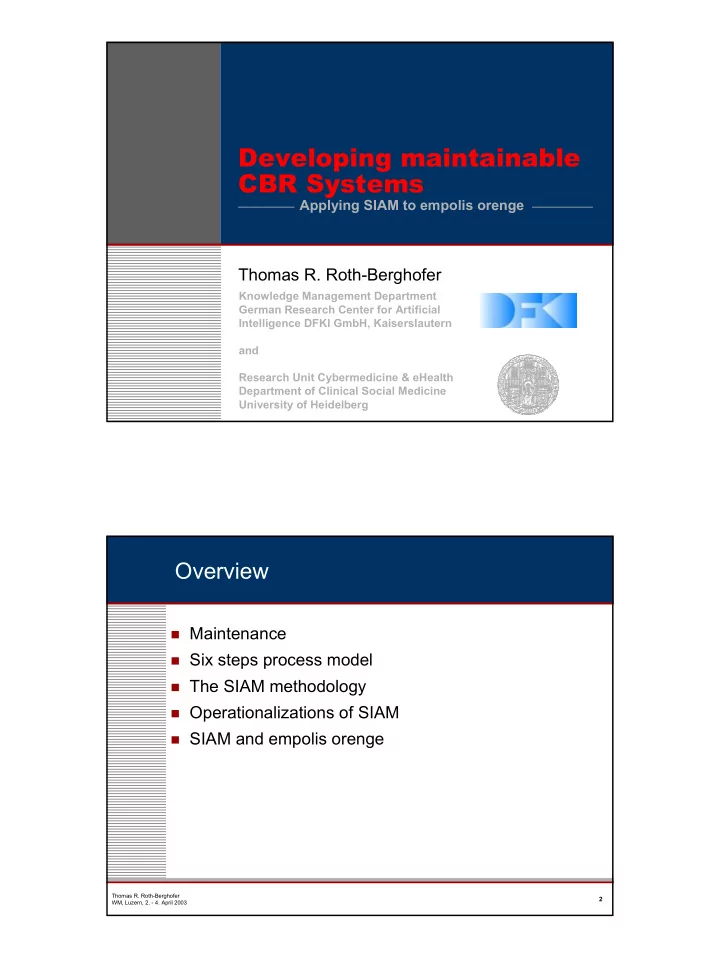
Developing maintainable CBR Systems ___________ Applying SIAM to - - PDF document

developing maintainable cbr systems
SMART_READER_LITE
LIVE PREVIEW

Developing maintainable CBR Systems ___________ Applying SIAM to - - PDF document

Developing maintainable CBR Systems ___________ Applying SIAM to empolis orenge ____________ Thomas R. Roth-Berghofer Knowledge Management Department German Research Center for Artificial Intelligence DFKI GmbH, Kaiserslautern and Research


slide-1
SLIDE 1

Developing maintainable CBR Systems

___________ Applying SIAM to empolis orenge ____________

Thomas R. Roth-Berghofer

Knowledge Management Department German Research Center for Artificial Intelligence DFKI GmbH, Kaiserslautern and Research Unit Cybermedicine & eHealth Department of Clinical Social Medicine University of Heidelberg

2 Thomas R. Roth-Berghofer WM, Luzern, 2. - 4. April 2003

Overview

Maintenance Six steps process model The SIAM methodology Operationalizations of SIAM SIAM and empolis orenge

slide-2
SLIDE 2

3 Thomas R. Roth-Berghofer WM, Luzern, 2. - 4. April 2003

Main idea

Perfect system Imperfect system

Defects Repairs

Control loop

4 Thomas R. Roth-Berghofer WM, Luzern, 2. - 4. April 2003

Knowledge structure

(Richter 1995)

Vocabulary V

  • c

a b u l a r y V

  • c

a b u l a r y Case base Similarity measures Adaptation knowledge

Richter, 1995

slide-3
SLIDE 3

5 Thomas R. Roth-Berghofer WM, Luzern, 2. - 4. April 2003

The six steps process model

(Reinartz, Iglezakis, Roth-Berghofer 2001)

Reuse Revise Retrieve Application Phase Problem Knowledge containers Review Restore Retain Maintenance Phase Knowledge knowledge containers' Knowledge containers' Reuse Revise Retrieve Application Phase Problem Knowledge containers

6 Thomas R. Roth-Berghofer WM, Luzern, 2. - 4. April 2003

The control loop revisited

CBR system at time t Retain Reuse Revise Retrieve Knowledge containers

defect(s)

CBR system at time t´ Retain Reuse Revise Retrieve Knowledge containers

repair

Review Restore

=

CBR system at time t´´ Retain Reuse Revise Retrieve Knowledge containers

slide-4
SLIDE 4

7 Thomas R. Roth-Berghofer WM, Luzern, 2. - 4. April 2003

INITIALIZATION

2

The four phases of SIAM

SETUP

1

APPLICATION

3

SETUP

1

INITIALIZATION

2

APPLICATION

3

MAINTENANCE

4

SETUP

1

INITIALIZATION

2

INRECA

8 Thomas R. Roth-Berghofer WM, Luzern, 2. - 4. April 2003

Possible Operationalizations

Maintenance manual

  • Planning and Scheduling of maintenance tasks
  • Supporting the execution of maintenance tasks by giving

concrete advice

Maintenance Management System

  • Implementation of the maintenance phase
  • Workflow support
slide-5
SLIDE 5

9 Thomas R. Roth-Berghofer WM, Luzern, 2. - 4. April 2003

Maintenance rules

Event Action Condition

knowledge or information item timer event solution quality event Review Restore

Timer New item Feedback 10 Thomas R. Roth-Berghofer WM, Luzern, 2. - 4. April 2003

Maintenance manual: Overview

Review Restore 5.1 Compute usage of cases 5.3 Compute usage of concepts 5.5 Compute rarely and frequently asked queries 5.7 Compute retrieval accuracy for all cases

  • f the case base

5.9 Compile a list of retrieval results 5.11 Compute filling level of valuation model 5.13 Compute frequency distribution

  • f concepts

5.15 Compile a list of new concepts 5.17 Compile a list of deleted concepts 5.19 Check user feedback 5.2 Monitor rarely accessed cases 5.4 Monitor rarely used concepts 5.6 Monitor rarely and frequently asked queries 5.8 Monitor retrieval accuracy 5.10 Monitor retrieval results 5.12 Monitor filling level of valuation model 5.14 Monitor the frequency distribution

  • f concepts

5.16 Monitor new concepts 5.18 Monitor deleted concepts 5.22 Monitor user feedback (erring user) 5.20 Monitor user feedback (wrong retrieval results) 5.21 Monitor user feedback (missing cases) 6.1 Remove documents 6.3 Modify valuation model 6.2 Add new case 6.4 Modify completion rule model 6.5 Modify data model 6.6 Modify analysis model 6.7 'Teach' users Review Restore 5.35 Check retrieval time 5.26 Compute redundancy of cases 5.28 Compute consistency of cases 5.30 Compute minimality of cases 5.32 Compute incoherence of cases 5.23 Compile a list of unknown words contained in queries 5.24 Compile a list of unknown words contained in documents 5.37 Check case base building time 5.25 Monitor unknown words 5.34 Compile a list of expired documents 5.36 Monitor retrieval time 5.27 Monitor redundant cases 5.29 Monitor inconsistent cases 5.31 Monitor not minimal cases 5.33 Monitor not incoherent cases 5.38 Monitor case base building time 6.16 Shorten retrieval time 6.8 Add unknown words 6.9 Modify valuation model (suggested similarities) 6.10 Handle redundant cases 6.11 Handle inconsistent cases 6.12 Handle not minimal cases 6.13 Handle not incoherent cases 6.15 Set new expiration date 6.14 Remove expired documents 6.17 Shorten case base building time

5.1 Compute usage of cases 5.2 Monitor rarely accessed cases 6.1 Remove documents 6.3 Modify valuation model 5.3 Compute usage of concepts 5.4 Monitor rarely used concepts 6.2 Add new case 5.5 Compute rarely and frequently asked queries 5.6 Monitor rarely and frequently asked queries 5.7 Compute retrieval accuracy for all cases

  • f the case base

5.8 Monitor retrieval accuracy 5.9 Compile a list of retrieval results 5.10 Monitor retrieval results 5.11 Compute filling level of valuation model 5.12 Monitor filling level of valuation model 5.13 Compute frequency distribution

  • f concepts

5.14 Monitor the frequency distribution

  • f concepts

5.15 Compile a list of new concepts 5.16 Monitor new concepts 6.4 Modify completion rule model
slide-6
SLIDE 6

11 Thomas R. Roth-Berghofer WM, Luzern, 2. - 4. April 2003

  • renge:ProcessManager

“Pipelets” provide existing

  • renge:Services such as
  • Textminer
  • Completion
  • Retrieval
  • Adaptation

Customizable pipelets

  • Review
  • Restore

12 Thomas R. Roth-Berghofer WM, Luzern, 2. - 4. April 2003

Knowledge structure of empolis orenge

Vocabulary V

  • c

a b u l a r y V

  • c

a b u l a r y Case base Similarity measures Adaptation knowledge

Richter, 1995

Classes and concepts (OMML), Keys (OAML) Orderings, similarity tables, and taxonomies (OVML), Completion rules (ORML)

Adaptation rules (ORML) OOML case base, Index, SQL database

slide-7
SLIDE 7

13 Thomas R. Roth-Berghofer WM, Luzern, 2. - 4. April 2003

Thank you!