Motivation for Simulations NS-2 Tutorial Cheap -- does not require - - PowerPoint PPT Presentation

motivation for simulations ns 2 tutorial
SMART_READER_LITE
LIVE PREVIEW

Motivation for Simulations NS-2 Tutorial Cheap -- does not require - - PowerPoint PPT Presentation

Motivation for Simulations NS-2 Tutorial Cheap -- does not require costly equipment Complex scenarios can be easily tested Results can be quickly obtained more ideas can be tested in a smaller timeframe The real thing isn't


slide-1
SLIDE 1

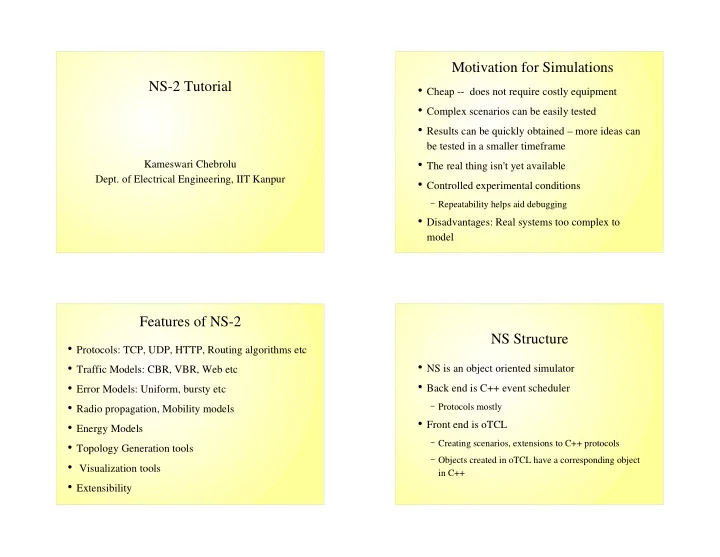
NS-2 Tutorial

Kameswari Chebrolu

  • Dept. of Electrical Engineering, IIT Kanpur

Motivation for Simulations

Cheap -- does not require costly equipment Complex scenarios can be easily tested Results can be quickly obtained – more ideas can

be tested in a smaller timeframe

The real thing isn't yet available Controlled experimental conditions

Repeatability helps aid debugging

Disadvantages: Real systems too complex to

model

Features of NS-2

Protocols: TCP, UDP, HTTP, Routing algorithms etc Traffic Models: CBR, VBR, Web etc Error Models: Uniform, bursty etc Radio propagation, Mobility models Energy Models Topology Generation tools Visualization tools Extensibility

NS Structure

NS is an object oriented simulator Back end is C++ event scheduler

Protocols mostly

Front end is oTCL

Creating scenarios, extensions to C++ protocols Objects created in oTCL have a corresponding object

in C++

slide-2
SLIDE 2

TCL tutorial

Variables: Arrays: Printing: Arithmetic Expression: Control Structures: Procedures:

set x 1 set y $x set a(0) 1 puts “$a(0) \n” set z = [expr $y + 5] if {$z == 6} then { puts “Correct!”} for {set i =0} {$i < 5} {incr i }{ puts “$i * $i equals [expr $i * $i]” } proc sum {a b} { return [expr $a + $b] }

How to Start?

Create simulator object: set ns [new simulator] Open a file for writing data for input to nam

(network animator)

Finish procedure:

set nf [open out.nam w] $ns namtrace-all $nf proc finish {} { global ns nf close $nf exec nam out.nam & exit 0 }

How to Start?

Tell simulator object when to finish Start the simulation

$ns at 5.0 “finish” $ns run

Creating topology

Two nodes connected by a link Creating nodes Creating link between nodes

set n0 [$ns node] set n1 [$ns node] $ns duplex-link $n0 $n1 1Mb 10ms DropTail

slide-3
SLIDE 3

Sending data

Create UDP agent Create CBR traffic source for feeding into UDP agent Create traffic sink

set udp0 [new Agent/UDP] $ns attach-agent $n0 $udp0 set cbr0 [new Application/Traffic/CBR] $cbr0 set packetSize_ 500 $cbr0 set interval_ 0.005 $cbr0 attach-agent $udp0 set null0 [new Agent/Null] $ns attach-agent $n1 $null0

Sending data

Connect two agents Start and stop of data

$ns connect $udp0 $null0 $ns at 0.5 “$cbr0 start” $ns at 4.5 “$cbr0 stop”

Creating TCP Connections

Create TCP agent and attach it to the node Create a Null Agent and attach it to the node Connect the agents

set tcp0 [new Agent/TCP] $ns attach-agent $n0 $tcp0 set null0 [new Agent/TCPSink] $ns attach-agent $n1 $null0 $ns connect $tcp0 $null0

Traffic on top of TCP

FTP Telnet

set ftp [new Application/FTP] $ftp attach-agent $tcp0 set telnet [new Application/Telnet] $telnet attach-agent $tcp0

slide-4
SLIDE 4

Introducing Errors

Creating Error Module Inserting Error Module

set err [new ErrorModel] $err unit pkt_ $err set rate_ 0.01 $err ranvar [new RandomVariable/Uniform] $err drop-target [new Agent/Null] $ns lossmodel $err $n0 $n1

Tracing

All packet trace Variable trace

$ns trace-all [open out.tr w]

<event> <time> <from> <to> <pkt> <size>

  • <flowid> <src> <dst> <seqno> <aseqno>

+ 0.51 0 1 cbr 500 ------- 0 0.0 1.0 0 2

  • 0.51 0 1 cbr 500 ------- 0 0.0 1.0 0 2

r 0.514 0 1 cbr 500 ------- 0 0.0 1.0 0 0 set par [open output/param.tr w] $tcp attach $par $tcp trace cwnd_ $tcp trace maxseq_ $tcp trace rtt_

Summary

Simulators help in easy verification of protocols

in less time, money

NS offers support for simulating a variety of

protocol suites and scenarios

Front end is oTCL, back end is C++ NS is an on-going effort of research and

development