Detection vs. tracking Lecture 21: Motion and tracking Thursday, - - PDF document

detection vs tracking lecture 21 motion and tracking
SMART_READER_LITE
LIVE PREVIEW

Detection vs. tracking Lecture 21: Motion and tracking Thursday, - - PDF document

11/30/2007 Detection vs. tracking Lecture 21: Motion and tracking Thursday, Nov 29 Prof. Kristen Grauman Tracking with dynamics : We use image measurements to estimate position of object, but also incorporate position predicted by


slide-1
SLIDE 1

11/30/2007 1

Lecture 21: Motion and tracking

Thursday, Nov 29

  • Prof. Kristen Grauman

Detection vs. tracking

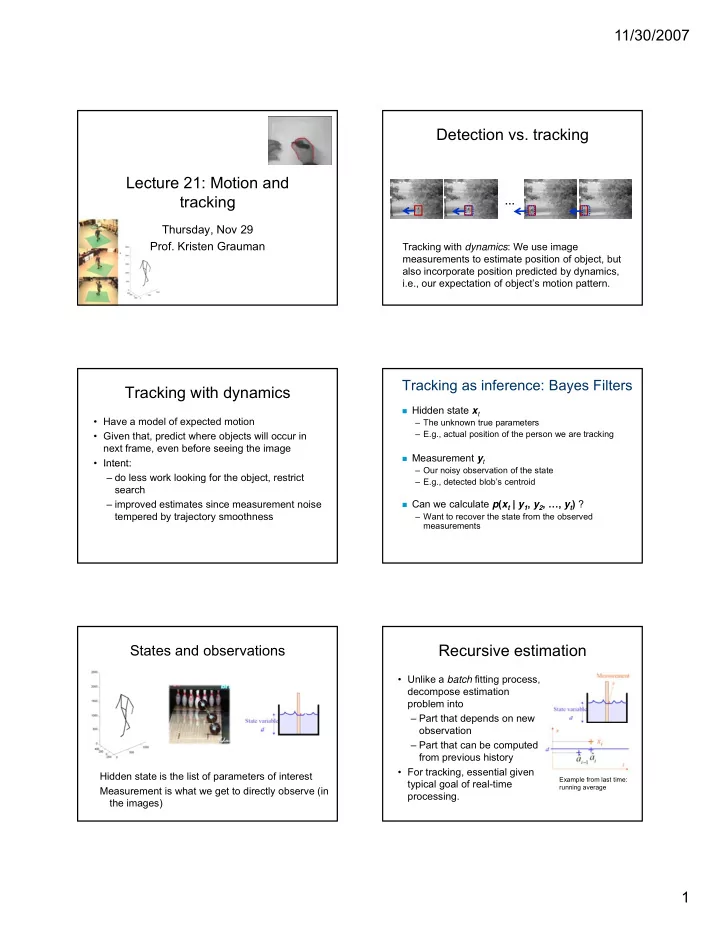
… Tracking with dynamics: We use image measurements to estimate position of object, but also incorporate position predicted by dynamics, i.e., our expectation of object’s motion pattern.

Tracking with dynamics

  • Have a model of expected motion
  • Given that, predict where objects will occur in

next frame, even before seeing the image

  • Intent:

Intent: – do less work looking for the object, restrict search – improved estimates since measurement noise tempered by trajectory smoothness

Tracking as inference: Bayes Filters

Hidden state xt

– The unknown true parameters – E.g., actual position of the person we are tracking

Measurement yt

– Our noisy observation of the state – E.g., detected blob’s centroid

Can we calculate p(xt | y1, y2, …, yt) ?

– Want to recover the state from the observed measurements

States and observations

Hidden state is the list of parameters of interest Measurement is what we get to directly observe (in the images)

Recursive estimation

  • Unlike a batch fitting process,

decompose estimation problem into – Part that depends on new p

  • bservation

– Part that can be computed from previous history

  • For tracking, essential given

typical goal of real-time processing.

Example from last time: running average

slide-2
SLIDE 2

11/30/2007 2

Tracking as inference

  • Recursive process:

– Assume we have initial prior that predicts state in absence of any evidence: P(X0) – At the first frame correct this given the value At the first frame, correct this given the value

  • f Y0=y0

– Given corrected estimate for frame t

  • Predict for frame t+1
  • Correct for frame t+1

Tracking as inference

  • Prediction:

– Given the measurements we have seen up to this point, what state should we predict?

  • Correction:

– Now given the current measurement, what state should we predict?

Independence assumptions

  • Only immediate past state influences

current state

  • Measurements at time t only depend on

the current state

Tracking as inference

  • Goal is then to

– choose good model for the prediction and correction distributions – use the updates to compute best estimate of use the updates to compute best estimate of state

  • Prior to seeing measurement
  • After seeing the measurement

Gaussian distributions, notation

  • random variable with Gaussian probability

distribution that has the mean vector μ and covariance matrix Σ.

) , ( ~ Σ μ x N

  • x and μ are d-dimensional, Σ is d x d.

d=2 d=1

Linear dynamic model

  • Describe the a priori knowledge about

– System dynamics model: represents evolution

  • f state over time, with noise

) ; ( ~

1 d t t

N Σ Dx x

– Measurement model: at every time step we get a noisy measurement of the state

) ; ( ~

m t t

N Σ Mx y

n x n n x 1 n x 1 m x n n x 1 m x 1

slide-3
SLIDE 3

11/30/2007 3

Example: randomly drifting points

  • Consider a stationary object, with state as position
  • State evolution is described by identity matrix D=I
  • Position is constant, only motion due to random

noise term

) ; ( ~

1 d t t

N Σ Dx x

) ; ( ~

m t t

N Σ Mx y

noise term.

  • State vector x is 1d position and velocity.
  • Measurement y is position only.

Example: constant velocity

) ; ( ~

1 d t t

N Σ Dx x

) ; ( ~

m t t

N Σ Mx y ξ + Δ + =

− − 1 1

) (

t t t

v t p p

noise p t p + ⎥ ⎤ ⎢ ⎡ ⎥ ⎤ ⎢ ⎡ Δ = ⎥ ⎤ ⎢ ⎡ = 1 x ⎥ ⎦ ⎤ ⎢ ⎣ ⎡ = v p x

⎥ ⎦ ⎤ ⎢ ⎣ ⎡ Δ = 1 1 t D

ζ + =

−1 t t

v v

[ ]

1 = M

noise v v

t t t

+ ⎥ ⎦ ⎢ ⎣ ⎥ ⎦ ⎢ ⎣ = ⎥ ⎦ ⎢ ⎣ =

−1

1 x

[ ]

ξ ξ + = + ⎥ ⎦ ⎤ ⎢ ⎣ ⎡ =

t t t

p v p 1 y

State’s position over time State i i velocity State and measurements position

Figures from F&P

State’s position over time State i i velocity position State and measurements position

Figures from F&P

time State’s position over time State i i velocity position position

Figures from F&P

time time measurements state

  • State is 1d position, velocity, and acceleration
  • Measurement is position only.

Example: constant acceleration

) ; ( ~

1 d t t

N Σ Dx x

) ; ( ~

m t t

N Σ Mx y ξ + Δ + =

− − 1 1

) (

t t t

v t p p

i p t t p ⎥ ⎤ ⎢ ⎡ ⎥ ⎤ ⎢ ⎡ Δ Δ ⎥ ⎤ ⎢ ⎡ 1 1

ζ + Δ + =

− − 1 1

) (

t t t

a t v v ε + =

−1 t t

a a

noise a v t a v

t t t

+ ⎥ ⎥ ⎦ ⎢ ⎢ ⎣ ⎥ ⎥ ⎦ ⎢ ⎢ ⎣ Δ = ⎥ ⎥ ⎦ ⎢ ⎢ ⎣ =

−1

1 1 x

D

1 − t

x

= M

[ ]

1

slide-4
SLIDE 4

11/30/2007 4

State’s position and velocity State’s position over time

Kalman filter as density propagation

Distribution shifts due to

  • bject dynamics model

increased uncertainty

Figure from Isard & Blake 1998

y due to random component

  • f dynamics

model peak towards observation

Kalman filter as density propagation

measurement belief belief

  • ld belief

new belief

Slide by S. Thrun and J. Kosecka, Stanford

Kalman filtering

Know prediction of state, receive current measurement Update distribution over current state estimate Know corrected state from previous time step, and all measurements up to the current one Update distribution over predicted state TIME ADVANCES i++

Time update (“Predict”) Measurement update (“Correct”)

Kalman filtering

  • Linear models + Gaussian distributions

work well (read, simplify computation)

  • Gaussians also represented compactly

prediction correction

Kalman filter for 1d state

Dynamic model

) , ( ~

2 1 d i i

dx N x σ

) , ( ~

2 m i i

mx N y σ

Want to represent and update

slide-5
SLIDE 5

11/30/2007 5

Notation shorthand Kalman filtering

Know prediction of state, receive current measurement Update distribution over current state estimate − − i i

X σ ,

Know corrected state from previous time step, and all measurements up to the current one Update distribution over predicted state TIME ADVANCES

Time update (“Predict”) Measurement update (“Correct”) + − + − 1 1, i i

X σ

Kalman filtering

Know prediction of state, receive current measurement Update distribution over current state estimate − − i i

X σ ,

Know corrected state from previous time step, and all measurements up to the current one Update distribution over predicted state TIME ADVANCES

Time update (“Predict”) Measurement update (“Correct”) + − + − 1 1, i i

X σ

Kalman filter for 1d state: prediction

  • Linear dynamic model defines expected state

evolution, with noise:

  • Want to estimate distribution for next predicted state:

) , ( ~

2 1 d i i

dx N x σ

) ) ( (

2 − −

X N

– Update the mean: – Update the variance:

+ − − = 1 i i

X d X ) ) ( , (

2

=

i i

X N σ

2 1 2 2

) ( ) (

+ − −

+ =

i d i

dσ σ σ

Predicted mean depends on state transition value (constant d), and mean of previous state. Variance depends on uncertainty at previous state, and noise of system’s model of state evolution.

Kalman filtering

Know prediction of state, receive current measurement Update distribution over current state estimate − − i i

X σ ,

Know corrected state from previous time step, and all measurements up to the current one Update distribution over predicted state TIME ADVANCES

Time update (“Predict”) Measurement update (“Correct”) + − + − 1 1, i i

X σ

  • Linear model of dynamics reflects how state is

mapped to measurements:

  • Know predicted state distribution:

Kalman filter for 1d state: correction

) ) ( , (

2 − −

=

i i

X N σ ) , ( ~

2 m i i

mx N y σ

  • Want to correct distribution over current state given

new measurement :

– Update mean – Update variance

2 2 2 2 2

) ( ) (

− − − +

+ + =

i m i i m i i

m my X X σ σ σ σ

2 2 2 2 2 2

) ( ) ( ) (

− − +

+ =

i m i m i

m σ σ σ σ σ

Corrected state estimate incorporates current measurement, predicted state, meas. model, and their uncertainties. Small measurement noise rely on? Large measurement noise rely on?

slide-6
SLIDE 6

11/30/2007 6

Constant velocity model

State

Recall this example:

State is 2d: position + velocity Measurement is 1d: position

Constant velocity model

measurements

  • n

State is 2d: position + velocity Measurement is 1d: position state time positio Kalman filter processing

  • state

x measurement * predicted mean estimate + corrected mean estimate

Constant velocity model

  • n

time bars: variance estimates positio

  • state

x measurement * predicted mean estimate + corrected mean estimate

Constant velocity model

  • n

bars: variance estimates time positio

N-d Kalman filtering

  • This generalizes to state vectors of any

dimension

  • Update rules in FP Alg 17.2

Data association

  • We’ve assumed entire

measurement (y) was cue

  • f interest for the state
  • But, there are typically

uninformative uninformative measurements too–clutter.

  • Data association: task of

determining which measurements go with which tracks.

http://www.dkimages.com/discover/previews/1002/50215713.JPG

slide-7
SLIDE 7

11/30/2007 7

Data association (single object in clutter)

  • Global nearest neighbor

– Choose to pay attention to the measurement with the highest probability given the predicted state p – Can lead to tracking non-existent object

  • Probabilistic approach

– Weight the measurements by probability given predicted state

ke/research/bats/

  • http://www.cs.bu.edu/~betk

Kalman filter limitations

  • Gaussian densities, linear dynamic model:

+ Simple updates, compact and efficient – But, unimodal distribution, only single hypothesis – Restricted class of motions defined by linear model

) , ( ~ Σ μ x N

x P(x)

Kalman filter as density propagation

Distribution shifts due to

  • bject dynamics model

increased uncertainty

Figure from Isard & Blake 1998

y due to random component

  • f dynamics

model peak towards observation What if we have several competing observations, say due to clutter? y

Recall conditional densities from skin detection example

xels in each RGB space kin pixels in f RGB space P(y | x=not skin) P(y | x=skin)

Measurement is feature y = [R G B]

% skin pix bin of R % non-sk each bin o

Bayes’ rule: P(skin | y) α P(y | skin) P(skin)

y y

Density propagation with non- Gaussian densities

Figure from Isard & Blake 1998

How to represent and update these distributions? y

slide-8
SLIDE 8

11/30/2007 8

Non-parametric representations for non-Gaussian densities

Can represent di t ib ti ith t distribution with set

  • f weighted samples

(“particles”)

Factored sampling (single frame)

Figure from Isard & Blake 1998

Represent the posterior p(x|y) non-parametrically:

  • Sample points randomly from prior density

for the state, p(x).

  • Weight the samples according to p(y|x).

Particle filtering

  • Extend idea of sampling to propagate densities
  • ver time (i.e., across frames in a video

sequence).

  • At each time step, represent posterior p(xt|yt)

with weighted sample set

  • Previous time step’s sample set p(xt|yt-1) is

passed to next time step as the effective prior

  • (a.k.a. survival of the fittest, sequential Monte

Carlo filtering, Condensation [Isard & Blake 96])

Particle filtering: Condensation

Start with weighted samples from previous time step Shift each sample according to dynamics model S d d t Spread due to randomness; this is effective prior density p(xt|yt-1) Weight the samples according to

  • bservation density

Arrive at current estimate for posterior p(xt|yt)

Figure from Isard & Blake 1998

Particle filtering: Condensation

Start with weighted samples from previous time step Sample and shift according to dynamics model S d d t Spread due to randomness; this is effective prior density p(xt|yt-1) Weight the samples according to

  • bservation density

Arrive at current estimate for posterior p(xt|yt)

Figure from Isard & Blake 1998

Particle filtering: Condensation

Start with weighted samples from previous time step Sample and shift according to dynamics model S d d t Spread due to randomness; this is effective prior density p(xt|yt-1) Weight the samples according to

  • bservation density

Arrive at current estimate for posterior p(xt|yt)

Figure from Isard & Blake 1998

slide-9
SLIDE 9

11/30/2007 9

Particle filtering: Condensation

Start with weighted samples from previous time step Sample and shift according to dynamics model S d d t Spread due to randomness; this is effective prior density p(xt|yt-1) Weight the samples according to

  • bservation density

Arrive at current estimate for posterior p(xt|yt)

Figure from Isard & Blake 1998

Particle filtering: Condensation

Start with weighted samples from previous time step Sample and shift according to dynamics model S d d t Spread due to randomness; this is effective prior density p(xt|yt-1) Weight the samples according to

  • bservation density

Arrive at current estimate for posterior p(xt|yt)

Figure from Isard & Blake 1998

Particle filtering: Condensation

The green spheres correspond to the members of the sample set, where the size of the sphere is an indication of the sample weight. The red line is the measurement density function. http://www.robots.ox.ac.uk/~misard/condensation.html

Particle filtering: what we need

Initialize according to prior

  • n state p(x0)

Conditional density p(y|x) is defined defined

  • e.g., render model

according to state x, then compare actual image and that rendering Object dynamics p(xt|xt-1)

Particle filtering

This matches our general picture of density propagation, and the prediction-correction cycle

  • f tracking with dynamics.

Condensation-based results

http://www.robots.ox.ac.uk/~vdg/dynamics.html Visual Dynamics Group, Dept. Engineering Science, University of Oxford 1998 Monitor is a distractor, multiple hypotheses necessary. Kalman filter fails once it starts tracking the monitor.

slide-10
SLIDE 10

11/30/2007 10

Condensation-based results

http://www.robots.ox.ac.uk/~vdg/dynamics.html Visual Dynamics Group, Dept. Engineering Science, University of Oxford 1998 Switching between multiple motion models.

Issues

  • Initialization

– Often done manually

  • Data association, multiple tracked objects

– Occlusions – Occlusions

  • Deformable and articulated objects
  • Constructing accurate models of dynamics

Next, a brief look at an example-based technique for estimating pose and representing human motion dynamics…

http://www.cs.wisc.edu/graphics/Talks/Gleicher/2002/AnimByExample_files/frame.htm http://www.cs.wisc.edu/graphics/Talks/Gleicher/2002/AnimByExample_files/frame.htm

Motion capture (Mocap)

Collect pose data with active sensing – special markers, cameras.

http://www.cs.wisc.edu/graphics/Talks/Gleicher/2002/AnimByExample_files/frame.htm

Motion graphs

  • Graphics application:

– Any walk on the graph is a valid motion – Can synthesize new animation:

  • Select motion clips from the graph
  • Reassemble them to form new motion

– Maintain realism of motions because clips retain subtle details of real motion.

  • Vision application:

– Non-parametric representation of human motion dynamics

slide-11
SLIDE 11

11/30/2007 11

Example-based pose estimation and animation

  • Build a two-character motion graph from examples of

people dancing with mocap

  • Populate database with synthetically generated

silhouettes in poses defined by mocap (behavior specific dynamics) dynamics)

  • Use discriminative silhouette features to identify similar

examples in database

  • Retrieve the pose stored for those similar examples to

estimate user’s pose

  • Animate user and hypothetical partner

Ren, Shakhnarovich, Hodgins, Pfister, and Viola, 2005.

Overview

Ren, Shakhnarovich, Hodgins, Pfister, and Viola, 2005.

Pose parameters

3d joint positions: [x1 y1 z1, x2 y2, z2,…x20 y20 z20] body guration, ent orientations

Rendering database examples

nt body urations, same ation

Possible silhouette features Feature selection

  • Want to find features

that are discriminative for

  • verall orientation,

d ifi b d and specific body configuration

  • Use boosting to

choose features that separate “similar” and “dissimilar” pairs well

slide-12
SLIDE 12

11/30/2007 12

Feature selection

Some features selected with AdaBoost AdaBoost based on paired classification task

Two-character motion graph

  • Dancing partners’ motions are highly correlated
  • Extend motion graph to represent partner’s pose

relative to user’s

Example-based pose estimation and animation

Ren, Shakhnarovich, Hodgins, Pfister, and Viola, 2005.

  • http://graphics.cs.cmu.edu/projects/swing/
  • Issues?

References

  • Conditional density propagation for visual tracking

(CONDENSATION), Isard and Blake, IJCV 1998.

  • Lucas Kovar Michael Gleicher Frederic Pighin. Motion
  • Graphs. ACM Transactions on Graphics 21(3) (Proceedings
  • f SIGGRAPH 2002). July 2002.
  • L. Ren, G. Shakhnarovich, J. Hodgins, H. Pfister, P. Viola,

"Learning Silhouette Features for Control of Human Motion", ACM Transactions on Graphics,2005.