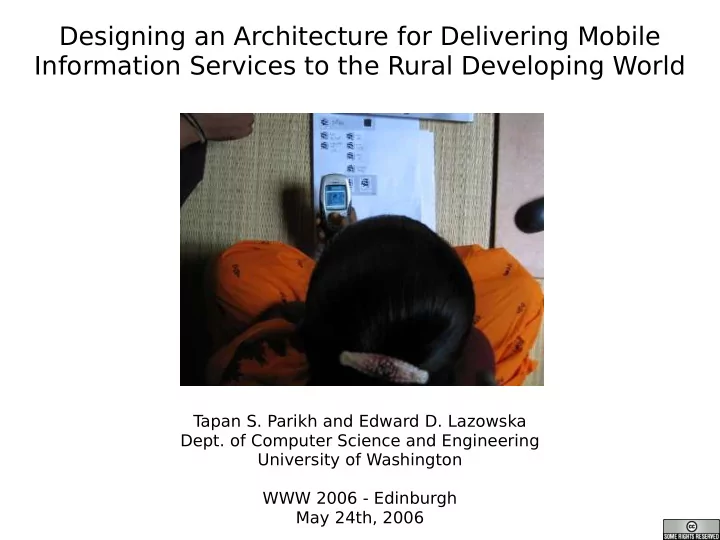
SLIDE 1 Designing an Architecture for Delivering Mobile Information Services to the Rural Developing World
T apan S. Parikh and Edward D. Lazowska
- Dept. of Computer Science and Engineering
University of Washington WWW 2006 - Edinburgh May 24th, 2006
SLIDE 2
4.8B people live in developing countries (many in rural areas) 4.8B people live in developing countries (many in rural areas) Rural developing world people have many information and Rural developing world people have many information and communication needs communication needs
– Manage finances Manage finances – Learn about business opportunities Learn about business opportunities – Access government services Access government services – Access medical guidance Access medical guidance – Communicate with friends and family Communicate with friends and family – Transact with customers, suppliers Transact with customers, suppliers Mostly met by analog means Mostly met by analog means – Paper, fax, voice, physical movement / exchange Paper, fax, voice, physical movement / exchange
The Rural Developing World
SLIDE 3
Environmental challenges Environmental challenges
– T emporally intermittent power T emporally intermittent power – Spatially intermittent connectivity Spatially intermittent connectivity – Difficult roads and transportation Difficult roads and transportation – Lack of buildings and infrastructure Lack of buildings and infrastructure
User challenges User challenges
– Low purchasing power Low purchasing power – Limited educational opportunities Limited educational opportunities – Many languages and scripts Many languages and scripts – Ubiquity of paper-based processes Ubiquity of paper-based processes
Rural Computing Challenges
SLIDE 4
– Easy to Use Easy to Use: Deal with all classes of novice users : Deal with all classes of novice users – Easy to T each Easy to T each: Conveyed by : Conveyed by word of mouth word of mouth – Easy to Distribute Easy to Distribute: Remotely, and person-to-person : Remotely, and person-to-person – Easy to Share Easy to Share: Individuals cant afford devices : Individuals cant afford devices – Easy to Develop Easy to Develop: Allow local content and applications : Allow local content and applications – Flexible Flexible: Language, culture, infrastructure varies : Language, culture, infrastructure varies – Trusted Trusted: By both users and community : By both users and community – Serving a Need Serving a Need: T echnology is a big investment : T echnology is a big investment
8 Rules for Rural Computing
SLIDE 5 Hardware is a great fit for rural conditions Hardware is a great fit for rural conditions
– Battery-powered, networked, low-cost Battery-powered, networked, low-cost – Numeric keypad familiar to billions of users Numeric keypad familiar to billions of users – Immediate utility of voice communications Immediate utility of voice communications Mobile Mobile agents agents can collect data and provide services can collect data and provide services – Common strategy for offering rural services Common strategy for offering rural services – Convenient for users / clients Convenient for users / clients – Leverage underemployed local workforce Leverage underemployed local workforce But... But... mobile apps are hard to use and develop mobile apps are hard to use and develop
The Economist, Mar 10, 2005
Mobile Phones as Rural Computers
SLIDE 6 CAM: Mobile Paper Programming T
CAMBrowser
mobile phone app to process forms
CAMForms
interactive forms
CAMScript
scripting language for form interaction
CAMBrowser
mobile phone app to process forms
<function name=”a_click”> d = input_date(“Date”, “date.wav”); i = input_int(“Interest”, “int.wav”); p = input_int(“Principal”, “pri.wav”); if (d & p & i) http_put(“...”); </function>
SLIDE 7 <function name=”a_click”> date = input_date(“Enter Date” “date.wav”); amt = input_int(“Enter Amount”, “amount.wav”); message_note(“Say your name”,”sayname.wav”); record_audio(“name.wav”); if (amt != 0) email(“tap2k@yahoo.com”, “a=”#amt, “name.wav”); </function>
CAM: System Features
Navigation Navigation
– Barcodes and printed numeric strings Barcodes and printed numeric strings used to access records and functions used to access records and functions Content - Content - XML scripting language XML scripting language – API for accessing phone features API for accessing phone features – Audio, video - play and record Audio, video - play and record Networking Networking – Synchronous Synchronous – Asynchronous Asynchronous
SLIDE 8 Small screen Small screen -
- Sequential interaction reduces decision-making
Sequential interaction reduces decision-making
Microphone / Speaker Microphone / Speaker -
- Audio feedback reinforces “dialog”-style
Audio feedback reinforces “dialog”-style
Camera Camera -
- Physical, paper-based navigation and data entry
Physical, paper-based navigation and data entry
Numeric Keypad Numeric Keypad -
- Reduces literacy and localization requirements
Reduces literacy and localization requirements
Messaging Messaging -
- Provides offline access; Reduces UI latency
Provides offline access; Reduces UI latency
Leveraging Mobile Phone “Features”
SLIDE 9 Supply Chain Supply Chain
Javid and Parikh Javid and Parikh -
ICTD 2006 2006
– Track distribution of products Track distribution of products – Manage inventory at rural warehouses Manage inventory at rural warehouses – Integrated with location tracking Integrated with location tracking
Microfinance Microfinance Parikh et al. - CHI 2006
Parikh et al. - CHI 2006
– Capture financial transactions Capture financial transactions – Monitor clients and loans Monitor clients and loans – Reduce cost of service delivery Reduce cost of service delivery
Health Monitoring Health Monitoring
– Monitor disease outbreaks Monitor disease outbreaks – Link to electronic patient records Link to electronic patient records
Some CAM Applications
SLIDE 10 SHG MIS using CAM
- Online accounting and reporting service
Online accounting and reporting service
amil Nadu, India Conducting pilot in T amil Nadu, India
- Reports will be provided to clients and bank
Reports will be provided to clients and bank
SLIDE 11 T ask: Record rural microfinance transactions T ask: Record rural microfinance transactions
– “ “Lab” and in-field testing Lab” and in-field testing – Using barcode navigation Using barcode navigation – Users: 14 field agents from villages Users: 14 field agents from villages – Literate - 7 Literate - 7th
th grade to college education
grade to college education
Results: Mobile phones Results: Mobile phones are are a usable solution a usable solution
– Most learned system with 5-10 mins of practice Most learned system with 5-10 mins of practice – Avg 30 secs per client (cut overall documentation time by ½) Avg 30 secs per client (cut overall documentation time by ½) – Less than 1% error rate Less than 1% error rate – All users described interface as All users described interface as very easy very easy or
easy
Usability T esting
Parikh et al. - CHI 2006
SLIDE 12
– Easy to Use Easy to Use: Demonstrated for novice rural users : Demonstrated for novice rural users – Easy to T each Easy to T each: Simple 1-step interaction model : Simple 1-step interaction model – Easy to Distribute Easy to Distribute: Paper, Numbers, Messages : Paper, Numbers, Messages – Easy to Share Easy to Share: One a : One agent can serve many villages gent can serve many villages – Easy to Develop Easy to Develop: XML-based scripting language : XML-based scripting language – Flexible: Flexible: Mobile Phones, SMTP, Numbers, Audio, Images Mobile Phones, SMTP, Numbers, Audio, Images – Trusted Trusted: Audio and video, linkage to paper records : Audio and video, linkage to paper records – Serve a Need Serve a Need: Several economically relevant apps : Several economically relevant apps
8 Rules for Rural Computing
SLIDE 13 Paper / Tangible UIs Paper / Tangible UIs – – XAX (CHI 1993), Navicam (CHI
XAX (CHI 1993), Navicam (CHI 1995), Paper PDA (CHI 1999), Cybercode (DARE 2000), 1995), Paper PDA (CHI 1999), Cybercode (DARE 2000), Cooltown (WWW 2001), A-Book (UIST 2002), Books with Cooltown (WWW 2001), A-Book (UIST 2002), Books with Voices (CHI 2003), PADD (UIST 2003), Visual Codes Voices (CHI 2003), PADD (UIST 2003), Visual Codes (Pervasive 2005), Semacode, Spotcode, QR codes (Pervasive 2005), Semacode, Spotcode, QR codes
Mobile UIs Mobile UIs – – West (UIST 1999), PowerBrowser (CHI 2000),
West (UIST 1999), PowerBrowser (CHI 2000), Dial-And-See (UIST 2005), WAP, SMS, IVR Dial-And-See (UIST 2005), WAP, SMS, IVR
Technology for Developing World Technology for Developing World – – Grisedale et
Grisedale et
- al. (CHI 1997), Daknet, TEK, TIER, DSH, $100 Laptop, etc.
- al. (CHI 1997), Daknet, TEK, TIER, DSH, $100 Laptop, etc.
Mobile Microfinance Data Collection Mobile Microfinance Data Collection – –
Compartamos / Accion, SKS, HP Rural Transaction System Compartamos / Accion, SKS, HP Rural Transaction System
Related Work
SLIDE 14
A new framework for rural mobile information services A new framework for rural mobile information services
– Leverage paper / mobile synergies Leverage paper / mobile synergies – Unique feature set for user / device / environment Unique feature set for user / device / environment
Many potential applications Many potential applications
– Amortize costs across many users and services Amortize costs across many users and services – Browser will be released under an open source license Browser will be released under an open source license
Lots of potential value Lots of potential value
– Villages will benefit by managing information better Villages will benefit by managing information better – World will benefit by building linkages with villages World will benefit by building linkages with villages
Conclusions
SLIDE 15
Which CAM Which CAM applications applications can have the most can have the most Impact Impact? ? – Huge potential in microfinance and related areas Huge potential in microfinance and related areas – Security, Trust, Privacy, Security, Trust, Privacy, Transparency Transparency Which of our results can be applied for Which of our results can be applied for Other Naïve Users Other Naïve Users? ? What does our system imply for What does our system imply for Mobile Device Design Mobile Device Design? ? Can we make it easy to Can we make it easy to Offer Offer Knowledge-based Services Knowledge-based Services? ? How does this all contribute to How does this all contribute to Sustainable Development Sustainable Development? ?
Future Work
SLIDE 16 events
stories analysis access knowledge multimedia paper
123
numbers
CAM
Vision: Breaking the Information Chains
SLIDE 17 Anil K. Gupta, Vijay Pratap Singh Aditya, Jaimin, Bhavin, Anil K. Gupta, Vijay Pratap Singh Aditya, Jaimin, Bhavin, Rushabh, Nilesh, Bharat, Kinjal, Kartik, Bhimsibhai, Rushabh, Nilesh, Bharat, Kinjal, Kartik, Bhimsibhai, Narayanbhai, Kaushik Ghosh, Apala Chavan, Sarit Arora, Narayanbhai, Kaushik Ghosh, Apala Chavan, Sarit Arora, Puneet Syal, Sasi Kumar, Paul Javid, Annaji, John, Bala, Puneet Syal, Sasi Kumar, Paul Javid, Annaji, John, Bala, Swami, Muthu, Ed Lazowska, David Notkin, James Landay, Swami, Muthu, Ed Lazowska, David Notkin, James Landay, Richard Anderson, Gaetano Borriello, Ken Fishkin, Scott Richard Anderson, Gaetano Borriello, Ken Fishkin, Scott Klemmer, Kentaro T
- yama, Eric Brewer, SRISTI, IIM-A, CCD,
Klemmer, Kentaro T
- yama, Eric Brewer, SRISTI, IIM-A, CCD,
Mahakalasm SHG Federations, Media Lab Asia, HFI-India, Mahakalasm SHG Federations, Media Lab Asia, HFI-India, HLFPPT, UWCSE, MLC, Intel, Microsoft Research India, HLFPPT, UWCSE, MLC, Intel, Microsoft Research India, David Bonderman, SEEP, IDRC, Sarai, ekgaon technologies David Bonderman, SEEP, IDRC, Sarai, ekgaon technologies and everyone else I have had the pleasure to work with. and everyone else I have had the pleasure to work with.
Thanks for all the Fish