Depth Breadth 1 1/30/2014 Foundational Outcomes Hydrology - - PDF document

depth
SMART_READER_LITE
LIVE PREVIEW

Depth Breadth 1 1/30/2014 Foundational Outcomes Hydrology - - PDF document

1/30/2014 SR-BOK Outcomes Sue Niezgoda, Gonzaga University January 28, 2014 Depth Breadth 1 1/30/2014 Foundational Outcomes Hydrology Stream Ecology Hydraulics Habitat Structure and Function Fluvial geomorphology Fish


slide-1
SLIDE 1

1/30/2014 1

SR-BOK Outcomes

Sue Niezgoda, Gonzaga University January 28, 2014

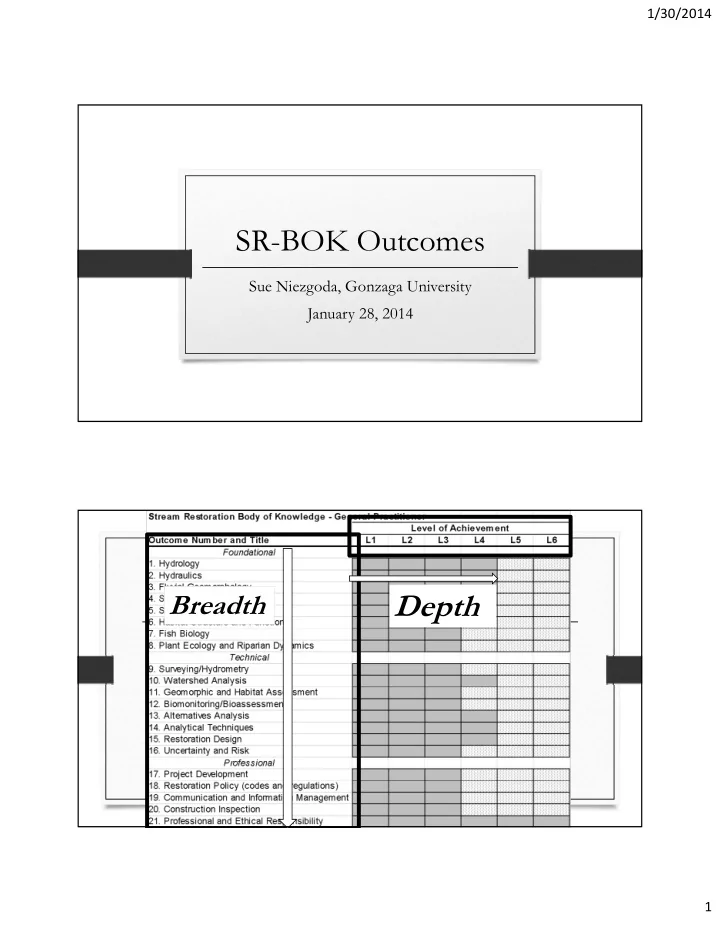
Breadth

Depth

slide-2
SLIDE 2

1/30/2014 2

Foundational Outcomes

  • Hydrology
  • Hydraulics
  • Fluvial geomorphology
  • Sediment Transport
  • Stream Ecology
  • Habitat Structure and Function
  • Fish Biology
  • Plant Ecology and Riparian

Dynamics

Hydrology (L4 - Analysis)

  • Solve physics problems related to hydrologic processes.
  • Analyze runoff generation, plant‐soil water relations, and coevolution of

fluvial geomorphology and hydrologic response.

  • Hydrologic Parameters of Interest in Stream Restoration:
  • Magnitude and Frequency
  • Duration of Daily Discharge
  • Timing of Annual Extreme Discharge Conditions
  • Rates of Change in Hydrographs
slide-3
SLIDE 3

1/30/2014 3

Converting Rainfall to Runoff

Time (hours) Peak Flow (cfs)

Q = f (A, P, CN) Q = f (A, I, C)

Precipitation P or I Q = Flow Rate q = Runoff Volume Drainage Area C or CN

Runoff Hydrograph

Rainfall Hyetograph

Hydraulics (L4 - Analysis)

  • Solve natural channel flow problems using mass, momentum,

energy

  • Analyze uniform, gradually- and rapidly-varied flow, flow

resistance, flood routing.

slide-4
SLIDE 4

1/30/2014 4

The Open Channel Flow Toolbox!

  • Continuity:
  • Shear Stress Equation:
  • Energy Equation:
  • Manning Resistance Equation:

Q = VA

Fluvial Geomorphology (L4 – Analysis)

  • Analyze fluvial processes and morphological responses in

dynamic rivers including channel response to change.

  • Apply geomorphological approach to channel restoration.
  • system-oriented, works with, rather than against, the natural

processes that shape and maintain stream channels.

  • Restoring stable, self-maintaining form; establishing interactions

between stream and riparian; restoring natural floodplain function.

slide-5
SLIDE 5

1/30/2014 5

Deep Run Creek, photos courtesy of Conor Shea

Understand the geomorphic context?

Sediment Transport (L4 – Analysis)

  • Understand sediment transport principles
  • Apply strategies of estimating sediment

transport in rivers, including incipient motion, mixed size, and alluvial transport.

  • Condit Dam Removal
  • Calculate sediment transport for channel

design alternatives, and determine when transport rates are not important.

slide-6
SLIDE 6

1/30/2014 6

Threshold Alluvial

Stream Ecology (L3 – Application)

  • Understand basic concepts of river ecology (hydrologic,

biogeochemical, biological) to determine structure and function of freshwater lotic ecosystems

  • Solve problems involving stream/habitat/hyporheic

restoration of water resources to maintain environmental flows.

slide-7
SLIDE 7

1/30/2014 7

Habitat Structure and Function (L3 – Application)

  • Apply methods to assess stream physical habitat characteristics

(e.g., mesohabitat types, velocity, depth, substrate type, riparian vegetation) as they apply to in-stream flow, monitoring, habitat quality, and fish-habitat studies.

Water Chemistry Habitat Structure Energy Sources Flow Regime Biotic Interactions

Temperature Dissolved O2 Turbidity pH Hardness Metals Nutrients Organics Substrate Channel Morphology Riparian vegetation Gradient In‐stream cover Sinuosity Bank stability Canopy Channel width/depth Nutrient availability Sunlight Organic inputs Primary production Seasonal patterns Velocity Runoff Volume Ground water Precipitation Watershed characteristics Disease Reproduction Feeding Competition Predation Parasitism Exotics

Many factors determine habitat quality

slide-8
SLIDE 8

1/30/2014 8

Fish Biology (L3 – Application)

  • Understand the comparative biology of fishes, species

traits, and habitat preferences

  • Identify common/economically important species
  • Apply knowledge to examine the effect of restoration

actions on concerned species (i.e., increased in-stream flows, dam removal, and in-channel restoration).

slide-9
SLIDE 9

1/30/2014 9

Plant Ecology and Riparian Dynamics (L3 – Application)

  • Understand plant community dynamics.
  • Apply ecological techniques (e.g., riparian habitat

mapping, riparian dynamics modeling, plant surveys/monitoring) to examine different restoration scenarios, predict riparian vegetation recruitment, and develop effective revegetation designs.

slide-10
SLIDE 10

1/30/2014 10

Technical Outcomes

  • Surveying/Hydrometry
  • Watershed Analysis
  • Geomorphic and Habitat

Assessment

  • Biomonitoring/Bioassessment
  • Alternatives Analysis
  • Analytical Techniques
  • Restoration Design
  • Uncertainty and Risk

Surveying/Hydrometry (L3 – Application)

  • Understand river field

measurement techniques.

  • Apply techniques and utilize

equipment to survey stream morphology and collect water quality and quantity and sediment transport data as it relates to stream stability assessment.

slide-11
SLIDE 11

1/30/2014 11

Watershed Analysis (L4 – Analysis)

  • Characterize connections between natural landscape

properties, human activities, and ecosystem services related to soil, sediment, water resources, and aquatic ecosystems.

  • Analyze the main processes that control water quantity,

water quality, sediment transport, and aquatic habitat.

slide-12
SLIDE 12

1/30/2014 12

Kayaker Landslide

Hydrologic Processes Sediment Processes Point Sources Nonpoint Sources Nutrient Delivery

Geomorphic and Habitat Assessment (L3 – Application)

  • Apply rapid geomorphic assessment and habitat

assessment to assess stream condition using multiple data types across scales.

  • Use the results to identify how channel, floodplain and

watershed scale stressors effect hydrological processes and alter the physical and ecological structure and habitat values of streams.

slide-13
SLIDE 13

1/30/2014 13

Habitat Assessment Rapid Geomorphic Assessment

Biomonitoring/Bioassessment (L3 – Application)

  • Understand rationale for biomonitoring and the use of

benthic invertebrates as indicators of water quality and

  • verall stream health.
  • Apply bioassessment methods to identify benthic

invertebrates using the visual description of diagnostic characters for sensitive groups (i.e., EPT index).

slide-14
SLIDE 14

1/30/2014 14

Stonefly Push-ups

Alternatives Analysis (L4 – Analysis)

  • Analyze scientific information to place restoration

alternatives in context of fluvial geomorphology, hydrology, and sediment transport in light of stream processes overlain with biologic goals and human values.

slide-15
SLIDE 15

1/30/2014 15

Analytical Techniques

  • Apply analytical tools to characterize flood

discharge and stage, sediment budgets and transport conditions, bank mechanics and erosion, and fish habitat and passage (e.g., HEC-HMS, HEC-RAS, BSTEM, BAGGS, River2D, FishXing).

slide-16
SLIDE 16

1/30/2014 16

http://stream.fs.fed.us/fishxing/yalljump.html

Restoration Design (L4 – Analysis)

  • Analyze stream restoration design approaches that

integrate geology, soils, and hydrology with hydraulics, sediment transport, and fluvial geomorphology.

  • Select an appropriate design approach.
  • Understand the basics of standards, specifications,

design notes, and drawings of design features.

slide-17
SLIDE 17

1/30/2014 17

Analog (Reference Reach) Empirical (Regime Equations) Analytical (Fundamental Equations) Hybrid Approach

Uncertainty and Risk (L3 – Application)

  • Understand design types and modes of failure,

probability of failures, expected failure costs, and uncertainty types.

  • Apply methods to reduce uncertainty.
slide-18
SLIDE 18

1/30/2014 18

Do you understand your project risks?

  • failure modes
  • likelihood of failure modes
  • consequences of failure
  • means to detect failure modes

Professional Outcomes

  • Project Development
  • Restoration Policy (Codes and Regulations)
  • Communication and Information Management
  • Construction Inspection
  • Professional and Ethical Responsibility
slide-19
SLIDE 19

1/30/2014 19

Project Development (L3 – Application)

  • Apply project and goals management principles to build

multi-agency and interdisciplinary teams, set up administrative systems, and create internal and public communication plans.

Restoration Policy (L3 – Application)

  • Understand major laws relevant to stream restoration projects,

including federal, state, and county laws, and recognize variable regulatory timeframes and show impacts on project implementation.

slide-20
SLIDE 20

1/30/2014 20

Communication and Information Management (L3 – Application)

  • Prepare and apply a plan that incorporates information

distribution, performance reporting and administrative closure and defines how effective communication of information with involved parties will be accomplished.

  • Manage and facilitate a process to ensure timely and

appropriate generation, collection, dissemination, storage and disposition of information.

Construction Inspection (L3 – Application)

  • Apply quality assurance testing and engineering

surveys and document construction activities to assure that goals of the planned project are realized during construction.

  • Coordinate with the contractor’s quality control

personnel and maintain the as-built plans.

slide-21
SLIDE 21

1/30/2014 21

Professional and Ethical Responsibility (L6 – Evaluation)

  • Critically evaluate ethical issues that arise in stream restoration,

including relationships between ethics and professional life and the particular consequences of ethical considerations within the practitioner’s own profession and the professions of others involved with the project.