Degrees of Incoherence: a framework for Bayes/non-Bayes compromises - - PowerPoint PPT Presentation

degrees of incoherence a framework for bayes non bayes
SMART_READER_LITE
LIVE PREVIEW

Degrees of Incoherence: a framework for Bayes/non-Bayes compromises - - PowerPoint PPT Presentation

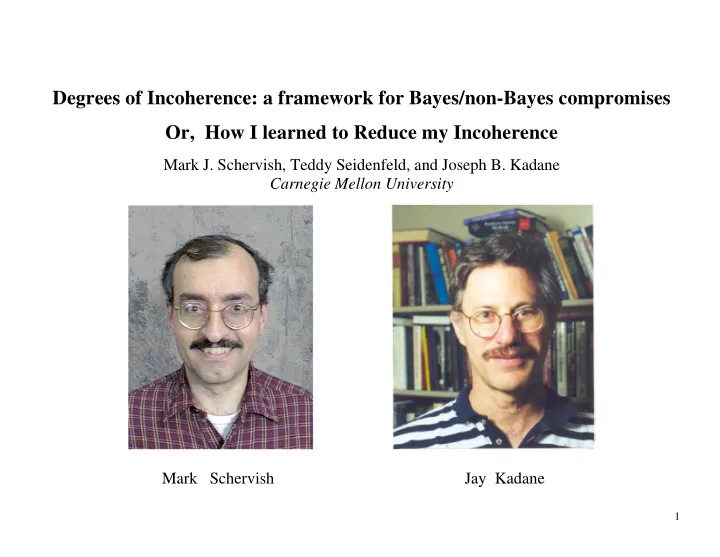
Degrees of Incoherence: a framework for Bayes/non-Bayes compromises Or, How I learned to Reduce my Incoherence Mark J. Schervish, Teddy Seidenfeld, and Joseph B. Kadane Carnegie Mellon University Mark Schervish Jay Kadane 1 Outline De


slide-1
SLIDE 1

1

Degrees of Incoherence: a framework for Bayes/non-Bayes compromises Or, How I learned to Reduce my Incoherence

Mark J. Schervish, Teddy Seidenfeld, and Joseph B. Kadane Carnegie Mellon University Mark Schervish Jay Kadane

slide-2
SLIDE 2

How I Learned to Reduce my Incoherence – NACAP July 2010

2

Outline

  • De Finetti’s coherence game, adapted for 1-sided wagers
  • Modifying the coherence game to allow for rates of incoherence

A theory of escrow for normalizing sure-gains from a Book Different escrows, and their purposes.

  • Two Applications

How incoherent are Non-Bayes Statistical procedures? Setting the level of a statistical test as function of sample size. How to make decisions from an incoherent position? You don’t have to be Coherent to use Bayes’ rule!

slide-3
SLIDE 3

How I Learned to Reduce my Incoherence – NACAP July 2010

3

Begin with a sketch of de Finetti’s Book argument for coherent wagering. A Zero-Sum (sequential) game is played between a Bookie and a Gambler, with a Moderator supervising. Let X be a random variable defined on a space of possibilities, a space that is well defined for all three players by the Moderator. The Bookie’s prevision p(X) on the r.v. X has the operational content that, when the Gambler fixes a real-valued quantity

X, p(X)

then the resulting payoff to the Bookie is

X, p(X) [ X – p(X) ],

with the opposite payoff to the Gambler.

slide-4
SLIDE 4

How I Learned to Reduce my Incoherence – NACAP July 2010

4

A simple version of de Finetti’s Book game proceeds as follows:

  • 1. The Moderator identifies a (possibly infinite) set of random variables {Xi}.
  • 2. The Bookie announces a prevision, a fair price pi = p(Xi) for buying and

selling each r.v. in the set {Xi}.

  • 3. The Gambler then chooses (finitely many) non-zero terms i =

.

  • 4. The Moderator settles up and awards Bookie (Gambler) the respective SUM
  • f his/her payoffs: Total payoff to Bookie =

. Total payoff to Gambler = – .

slide-5
SLIDE 5

How I Learned to Reduce my Incoherence – NACAP July 2010

5

Definition: The Bookie’s previsions are incoherent if the Gambler can choose terms i that assures her/him a (uniformly) positive payoff, regardless which state in obtains – so then the Bookie loses for sure. A set of previsions is coherent, if not incoherent. Theorem (de Finetti): A set of previsions is coherent if and only if each prevision p(X) is the expectation for X under a common (finitely additive) probability P.

That is, p(X) = EP(•)[X] = X dP(•)

slide-6
SLIDE 6

How I Learned to Reduce my Incoherence – NACAP July 2010

6

Two Corollaries: Corollary 1: When the random variables are indicator functions for events {Ei}, so that the gambles are simple bets – with the ’s then the stakes in a winner- take-all scheme The previsions pi are coherent if and only if Each prevision is the probability pi = P(Ei), for some (f.a.) probability P.

slide-7
SLIDE 7

How I Learned to Reduce my Incoherence – NACAP July 2010

7

On conditional probability: Definition: A called-off prevision p(X || E) for X, made by the Bookie on the condition that event E obtains, has a payoff scheme to the Bookie: X||E E[ X – p(X || E) ]. Corollary 2: Then a called-off prevision p(X || E) is coherent alongside the (coherent) previsions p(X) for X, and p(E) and E if and only if

p(X || E) is the conditional expectation under P for X, given E. That is, p(X || E) = EP(• |E)[X] = X dP(•|E) and is P(X | E) if X is an event.

  • In this sense, the Bookie’s conditional probability distribution P(•|E) is the

norm for her/his static called-off bets.

  • Coherence of called-off previsions is not to be confused with the norm for a

dynamic learning rule, e.g., when the Bookie learns that E obtains.

slide-8
SLIDE 8

How I Learned to Reduce my Incoherence – NACAP July 2010

8

There are two aspects of de Finetti’s coherence criterion that we relax.

  • 1. Previsions may be one-sided, to reflect a difference between buy and sell prices

for the Bookie, which depends upon whether the Gambler chooses a positive or negative -term in the payoff X, p(X) [ X – p(X) ] to the Bookie. For positive values of , allow the Bookie to fix a maximum buy-price.

  • Betting on event E, this gives the Bookie’s lower probability p*(E),

+ [ E – p*(E) ].

For negative values of , allow the Bookie to fix a minimum sell-price.

  • Betting against event E, this gives the Bookie’s upper probability p*(E),

[ E – p*(E) ].

At odds between the lower and upper probabilities, the Bookie rather not wager! This approach has been explored for more than 50 years!

(See http://www.sipta.org/ the Society for Imprecise Probabilities, Theories and Practices)

slide-9
SLIDE 9

How I Learned to Reduce my Incoherence – NACAP July 2010

9

For example, when dealing with upper and lower probabilities: Theorem [C.A.B. Smith, 1961]

  • If the Bookie’s one-sided betting odds p*(•) and p*(•) correspond,

respectively, to the minimum and maximum of probability values from a closed, convex set of (coherent) probabilities, then the Bookie’s wagers are coherent: then the Gambler can make no Book against the Bookie.

  • Likewise, if the Bookie’s one-sided called-off odds p*(• ||E) and p*(• ||E)

correspond to the minimum and maximum of conditional probability values, given E, from a closed, convex set of (coherent) probabilities, then they are coherent.

slide-10
SLIDE 10

How I Learned to Reduce my Incoherence – NACAP July 2010

10

  • 2. De Finetti’s coherence criterion is dichotomous.
  • A set of (one-sided) previsions is coherent – then no Book is possible,
  • r it is not, and then the previsions form an incoherent set.

BUT, are all incoherent sets of previsions equally bad, equally irrational?

  • Rounding a coherent probability distribution to 10 decimal places and

rounding the same distribution to 2 decimal places may both produce “incoherent” betting odds. Are these two equally defective?

  • Some Classical statistical practices are non-Bayesian – they have no Bayes
  • models. Are all non-Bayesian statistical practices equally irrational?
slide-11
SLIDE 11

How I Learned to Reduce my Incoherence – NACAP July 2010

11

ESCROWS for Sets of Gambles when a Book is possible In order to normalize the guaranteed gains that the Gambler can achieve by making Book against the Bookie, we introduce an ESCROW function. Let Yi = i(Xi – pi) be a wager that is acceptable to the Bookie. Let G(Y1, …., Yn) be the (minimum) guaranteed gains to the Gambler from a Book formed with gambles acceptable to the (incoherent) Bookie. An escrow function e(Y1, …., Yn) is introduced to normalize the (minimum) guaranteed gains, as follows:

slide-12
SLIDE 12

How I Learned to Reduce my Incoherence – NACAP July 2010

12

Where H is the intended measure or rate of incoherence, H(Y1, …., Yn) = Here are 7 conditions that we impose on an Escrow function, e(Y1, …, Yn) = fn(Y1, …, Yn) .

  • 1. For one (simple) gamble, Y, the player’s escrow

e(Y) = f(Y) = Z is her/his maximum possible loss from an outcome of Y. 2. e(Y1, …, Yn) = fn( e(Y1), …, e(Yn) ) = fn( Z1, …, Zn). The escrow of a set of gambles is a function of the individual escrows.

slide-13
SLIDE 13

How I Learned to Reduce my Incoherence – NACAP July 2010

13

3. fn( cZ1, …, cZn ) = c fn( Z1, …, Zn ) for c > 0. Scale invariance of escrows. 4. fn( Z1, …, Zn) = fn( Z(1), …, Z (n)) Invariance for any permutation (•).

  • 5. fn( Z1, …, Zn) is non-decreasing and continuous in each of its arguments.

6. fn( Z1, …, Zn, 0) = fn( Z1, …, Zn) When a particular gamble carries no escrow, the total escrow is determined by the other gambles. 7. fn( Z1, …, Zn) i Zi The total escrow is bounded above by the sum of the individual escrows.

slide-14
SLIDE 14

How I Learned to Reduce my Incoherence – NACAP July 2010

14

Then:

  • As a lower bound, fn( Z1, …, Zn) Max {Zi}
  • Thus, with e(Y1, …, Yn) = Max {Zi},

H(Y1, …., Yn) = is the largest possible (least charitable) measure.

  • Thus when e(Y1, …, Yn) = i Zi, then H is the smallest (most charitable)

measure of incoherence. Here we work with the most charitable measure of incoherence: The total escrow for a set of gambles is the sum of the individual escrows.

slide-15
SLIDE 15

How I Learned to Reduce my Incoherence – NACAP July 2010

15

When the escrow reflects the (incoherent) Bookie’s exposure in the set of gambles, we call the measure H the Bookie’s guaranteed rate of loss. When the escrow reflects the Gambler’s exposure, we call the measure H the Gambler’s guaranteed rate of gain. Also, we have a third perspective, neutral between the Bookie’s and Gambler’s exposures, which we use for singly incoherent previsions, as might obtain with failures of mathematical or logical omniscience. The third (neutral) perspective uses an escrow: e(Y) = | |. In the case of simple bets, this escrow is the magnitude of the stake. The neutral escrow results in a measure of coherence H that is continuous in both the random variables and previsions, unlike the case with the measures of guaranteed rates of loss or gain, above.

slide-16
SLIDE 16

How I Learned to Reduce my Incoherence – NACAP July 2010

16

Some basic results in this theory Let {E1, …., En} form a partition, and let 0 p*(Ei) p*(Ei) 1 be the Bookie’s lower and upper probabilities for these events. So, we assume that no prevision is incoherent alone. Let p*(Ei) = q and p*(Ei) = r, and So, the Bookie is incoherent if either q > 1 or r < 1. Theorem (for rate of loss – the Bookie’s escrow): (1) If p*(Ei) > 1, then the Gambler maximizes the guaranteed rate of loss by choosing the stakes (’s) equal and positive. H = [q - 1] / q (2) If p*(Ei) < 1, then the Gambler maximizes the guaranteed rate of loss by choosing the stakes (’s) equal and negative. H = [1 - r] / [n - r] (3) If the p*(Ei) , p*(Ei) 0, then these maximin solutions are unique.

slide-17
SLIDE 17

How I Learned to Reduce my Incoherence – NACAP July 2010

17

What about efficient Bookmaking from the perspective of the Gambler’s escrow, the guaranteed rate of gain? Example: If the Bookie's incoherent lower odds are (.6, .7, .2) on {E1, E2, E3}, then we note the following, by the previous Theorem: Equal stakes (1 = 2 = 3 > 0) maximizes the rate of loss, with H = 1/3. Then, since the Gambler’s escrows has the same total in this case as the Bookie under this strategy, equal stakes by Gambler produces a rate of gain of 1/3.

  • However, the Gambler can improve on this rate, upping it to 3/7,

by setting 1 = 2 > 0 and setting 3 = 0. This situation is generalized as follows.

slide-18
SLIDE 18

How I Learned to Reduce my Incoherence – NACAP July 2010

18

Reorder the atoms so that the Bookie's odds are not decreasing: pj pi whenever j i. Again, assume that 0 pj 1. Theorem (for rate of gain– the Gambler’s escrow): (1) If p*(Ei) = r < 1, then the Gambler maximizes the rate of gain by choosing the stakes equal and negative. (2) If p*(Ei) = q > 1, then the Gambler maximizes the rate of gain by choosing the stakes according to the following rule: Let k* be the first k such that p*i 1 + (k-1)pn-k with k* = n if this equality always fails. Then the Gambler sets the i all equal and positive for i n-k*+1, and sets i = 0 for all i < n - k*.

slide-19
SLIDE 19

How I Learned to Reduce my Incoherence – NACAP July 2010

19

For the rate of gain, when the Bookie’s incoherent previsions lie in the dotted region the Gambler uses only 2 previsions, but uses all 3 in the pink region.

Plane with S = 1.5 Coherent plane with S = 1 (.25, .25, 1) (1, .25, .25)

slide-20
SLIDE 20

How I Learned to Reduce my Incoherence – NACAP July 2010

20

Application-1: Statistical Hypothesis Testing at a Fixed (.05) level (See Cox, 1958) Null hypothesis H0: X ~ N[0, 2] vs. Alternative hypothesis H1: X ~ N[1, 2] Testing a simple null vs a simple alternative, so that the N-P Lemma applies. For each value of the variance, as might result from using different sample sizes, by the N-P Lemma there is a family of Most Powerful (best) Tests. Let us examine the familiar convention to give preference to tests of level = .05.

slide-21
SLIDE 21

How I Learned to Reduce my Incoherence – NACAP July 2010

21

is the chance of a type-1 error. is the chance of a type-2 error.

Table of the best -values for seven -values and six -values.

  • With the convention to choose the best test of level = .05, the following results:

With = 1.333, Test1: ( = .05; = .814) is chosen over Test2: ( = .07; = .766). With = 0.333 Test3: ( = .05; = .088) is chosen over Test4: ( = .03; = .131). But the mixed Test5 = .5 Test1 .5 Test3 has ( = .05; = .451). Whereas mixed Test6 = .5 Test2 .5 Test4 has ( = .05; = .449), which is better!

slide-22
SLIDE 22

How I Learned to Reduce my Incoherence – NACAP July 2010

22 Test-4 Test-3 Test-2 Test-1 Test-5 Test-6

= 1.3 3 3 = 0.33

slide-23
SLIDE 23

How I Learned to Reduce my Incoherence – NACAP July 2010

23

To apply our measures of incoherence, we have to get the Statistician to wager. A Classical (non-Bayesian) Statistician will not admit to (non-trivial) odds on the rival hypotheses in this problem, but will compare tests by their RISK, so see if one (weakly) dominates another. In which case the dominated test is inadmissible. The RISK (loss) function R of a statistical test T of H0 vs H1. () if = 0 (the level of the test) R(, T | ) = () if = 1 (the chance of a type-2 error) A Classical Statistician who follows the convention prefers admissible tests at the .05 level over other tests. This Statistician may be willing to trade away (to payout) the risk of the preferred test in order to receive (to be paid) the risk of another test, with a different level.

slide-24
SLIDE 24

How I Learned to Reduce my Incoherence – NACAP July 2010

24

Trading RISKS between tests this way is represented by: () - .05, if = 0 (the null) R(, T() | ) -- R(, T.05 | ) = T() () - T.05 (), if = 1 (alternative) which is of the form of a de Finetti prevision: = a(E – b) where E = H0, i.e. the null hypothesis = 0 a = [() - .05 + T() () - T.05 ()] and b = [T.05 () - T() ()] / [() - .05 + T.05 () - T() ()]

Here is a chart of the rate of loss to the Classical Statistician who trades .05-level tests based

  • n two samples of sizes (n0, n1). Each curve is identified by the size of the first sample, n0.
slide-25
SLIDE 25

How I Learned to Reduce my Incoherence – NACAP July 2010

25

slide-26
SLIDE 26

How I Learned to Reduce my Incoherence – NACAP July 2010

26

Application-2: How to wager from an incoherent position. Aside: We restrict ourselves to previsions, rather than using lower and upper previsions, in order to simplify the analysis of the Gambler’s optimal strategy. As before, let {E1, …., En} form a partition, and let 0 p(Ei) 1 be the Bookie’s previsions for these n-many events. Again, we assume that no one of these previsions is incoherent, by itself. Let p(Ei) = q. It might be that q 1, so that the Bookie’s previsions are incoherent.

  • Now, the Moderator introduces a new random variable X, measurable with

respect to this partition, i.e., X = i xiEi, and calls upon the Bookie to give a prevision for X, p(X).

slide-27
SLIDE 27

How I Learned to Reduce my Incoherence – NACAP July 2010

27

  • What can the Bookie do with the value of p(X) to avoid increasing her/his

measure of incoherence? For notational ease, order the events so that x1 x2 … xn. As before, we assume that x1 p(X) xn , so that by itself p(X) is coherent. Define μ = i xi pi You may think of μ as the pseudo-expectation for X with respect to the Bookie’s incoherent distribution P(•) for the xi.

slide-28
SLIDE 28

How I Learned to Reduce my Incoherence – NACAP July 2010

28

Theorem for the rate of loss – using the Bookie’s perspective on escrow: The Bookie can avoid increasing the rate of loss with a previsions for X, as follows:

  • If q < 1, choose p(X) to satisfy

μ + xi p(X) μ + xi

  • If q > 1, choose p(X) to satisfy

max{ x1, μ - (q-1)xn } p(X) min{ xn, μ - (q-1)x1 }

  • If q = 1, choose p(X) to satisfy the Bayes solution

μ = p(X).

slide-29
SLIDE 29

How I Learned to Reduce my Incoherence – NACAP July 2010

29

Theorem for the rate of gain – using the Gambler’s escrow: The Bookie can avoid increasing the rate of gain by setting a prevision for X as: Choose p(X) to satisfy μ + (1-q)x1 p(X) μ + (1-q)xn Corollary: You don’t have to be coherent to like Bayes’ rule!

slide-30
SLIDE 30

How I Learned to Reduce my Incoherence – NACAP July 2010

30

Consider a ternary partition {E1, E2, E3} with previsions {p1, p2, p3}. Let X be the r.v. for the called-off wager on E3 vs E1, called-off if E2 obtains. E1 E2 E3 X(E1) = 0, X(E2) = p(X), and X(E3) = 1 Thus, (X – p(X)) has the respective payoffs:

  • p(X)

(1 – p(X)) Then, e.g., with q < 1, the Bookie wants to satisfy the inequalities: p2p(X) + p3 p(X) p2p(X) + p3 + (1-q) If the Bookie uses a pseudo-Bayes value, the inequality is automatic, as follows: p(X) = p(E3 || { E1 ,E3}) = p3/( p1+p3) = “as if” calculating p(E3 | { E1 ,E3} ). Hence, betting like a coherent Bayesian makes sense even if you are incoherent!

slide-31
SLIDE 31

How I Learned to Reduce my Incoherence – NACAP July 2010

31

Summary

  • De Finetti’s dichotomous theory of 2-sided (fair) previsions may be relaxed to

permit measures of incoherence for 1-sided (lower and upper) previsions.

  • There is more than one measure of incoherence, reflecting different

perspectives: escrow functions, used for normalizing sure-losses from a Book.

  • These measures of incoherence may be applied to modulate longstanding

debates over Classical vs. Bayesian statistical methods.

  • It is feasible to reason from an incoherent position, to determine what new

previsions will not increase the already existing rate of incoherence.

slide-32
SLIDE 32

How I Learned to Reduce my Incoherence – NACAP July 2010

32

Selected References

Cox, D.R. (1958) Some problems connected with statistical inference. Ann. Math. Stat. 29, 357-363. deFinetti, B. (1974) Theory of Probability, Vol. 1. Wiley: New York. Schervish, M.J., Seidenfeld,T., and Kadane, J.B. (1997) Two Measures of Incoherence.

  • Tech. Report #660, Department of Statistics, Carnegie Mellon University, Pgh. PA 15213.

(Postscript available @ http://www.stat.cmu.edu/.) Schervish, M.J., Seidenfeld, T., and Kadane, J.B. (2000) How sets of coherent probabilities may serve as models for degrees of incoherence. International J. Uncertainty, Fuzziness, and Knowledge-Based Systems 8, 347-355. Schervish, M.J., Seidenfeld, T., and Kadane, J.B. (2002) A rate of incoherence applied to fixed-level

  • testing. Phil. Sci. 69 #3 S248-S264.

Schervish, M.J., Seidenfeld, T., and Kadane, J.B. (2002) Measuring Incoherence Sankhya 64 A, 561-587. Schervish, M.J., Seidenfeld, T., and Kadane, J.B. (2003) Measures of Incoherence. In Bayesian Statistics 7. Bernardo, J.M. et al (eds.). Oxford Univ. Press: Oxford. Smith, C.A.B. (1961) Consistency in Statistical Inference and Decision J. Royal Stat. Soc. B, 23 1-25.