SLIDE 1
Sum of Degrees of Vertices Theorem
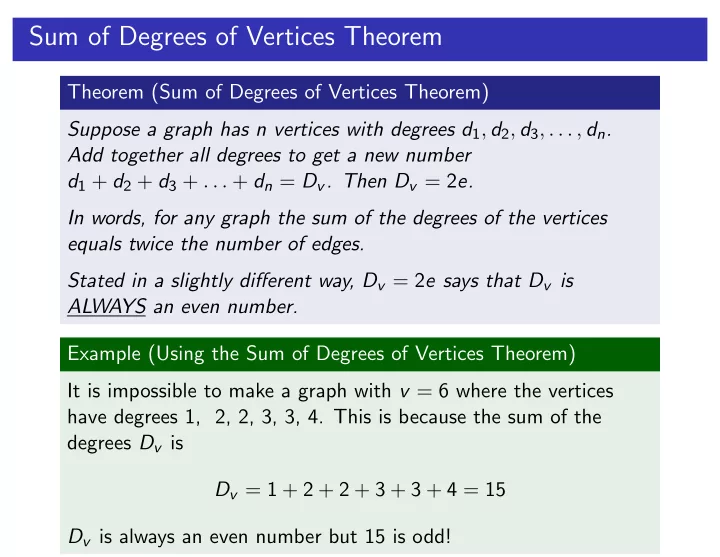
Theorem (Sum of Degrees of Vertices Theorem) Suppose a graph has n vertices with degrees d1, d2, d3, . . . , dn. Add together all degrees to get a new number d1 + d2 + d3 + . . . + dn = Dv. Then Dv = 2e. In words, for any graph the sum of the degrees of the vertices equals twice the number of edges. Stated in a slightly different way, Dv = 2e says that Dv is ALWAYS an even number. Example (Using the Sum of Degrees of Vertices Theorem) It is impossible to make a graph with v = 6 where the vertices have degrees 1, 2, 2, 3, 3, 4. This is because the sum of the degrees Dv is Dv = 1 + 2 + 2 + 3 + 3 + 4 = 15 Dv is always an even number but 15 is odd!
SLIDE 2
Using the Sum of the Degrees of Vertices Formula 1
Example (Using the Sum of the Degrees of Vertices Formula 1) Consider the following scenarios: A graph has 4 vertices with degrees 0, 0, 0, and 0. What does this graph look like? A graph has 1 vertex with degree 2. What does this graph look like? A graph has 4 vertices with degrees 2, 3, 3, and 4. How many edges are there? A graph has 4 vertices with degrees 2, 2, 2, and 4. Can you say what this graph looks like?
SLIDE 3
Using the Sum of the Degrees of Vertices Formula 2
Example (Using the Sum of the Degrees of Vertices Formula 2) Consider the following scenarios: Is it possible to have a graph with vertices of degrees: 1 and 1? Is it possible to have a graph with vertices of degrees: 1 and 2? Is it possible to have a graph with vertices of degrees: 1, 1, 2, 3? Is it possible to have a graph with vertices of degrees: 1, 1, 2, 3, 3?
SLIDE 4
Planar Graphs
Definition (Planar Graph) A graph is Planar if can be drawn in such a way that its edges do not cross. To determine if a graph is planar we have to consider isomorphic versions of the graph. Example (Using Isomorphisms to Make Planar) The graph on the left is definitely planar (edges do not cross). Even though the graph to the right does not appear to be planar,it is because it is isomorphic to the graph to the left!
SLIDE 5 Faces of a Planar Graphs
Definition (Faces of a Planar Graphs) In any planar graph, drawn with no intersections, the edges divide the planes into different regions. The regions enclosed by the planar graph are called interior faces
The region surrounding the planar graph is called the exterior (or infinite) face of the graph. When we say faces of the graph we mean BOTH the interior AND the exterior faces. We usually denote the number of faces of a planar graph by f .
BEFORE YOU COUNT FACES, IT IS VERY IMPORTANT TO FIRST DRAW A PLANAR GRAPH SO THAT NO EDGES CROSS!
SLIDE 6
Counting Faces of a Planar Graphs
Example (Counting Faces of a Planar Graphs) It is really tempting to try to count the faces in the graph below: Remember, the idea of faces only applies to Planar Graphs drawn with no edge crossings. Instead we need to redraw the graph to get an isomorphic version: In the bottom version it is easy to see there are 3 Interior Faces and 1 Exterior Face for a total of 4 Faces.
SLIDE 7
Degree of a Face
Definition (Degree of a Face) For a planar graph drawn without edges crossing, the number of edges bordering a particular face is called the degree of the face. In the graph below each of the two interior faces have degree 3. The infinite (exterior) face has degree 4. Adding up degrees gives a result that is curiously similar to one before. Theorem (Sum of the Degrees For Faces) In any planar graph, the sum of the degrees of all faces is equal to twice the number of edges. In symbols, Df = 2e.
SLIDE 8
Counting Faces and Degrees 1
Example (Counting Faces and Degrees 1) E F C D A B How many faces does this graph have? What is the degree of each face? List v, e, and f for this graph.
SLIDE 9
Making Graphs Look Planar
Here are a couple more graphs that don’t look planar at first. Can you count the faces? Left Graph (Cube) Right Graph (K3,2) Vertices v 8 5 Edges e 12 6 Faces f 6 3 These numbers are giving more evidence of some big ideas with planar graphs.
SLIDE 10
Counting Faces and Degrees 2
Example (Counting Faces and Degrees 2) E F C D A B How many faces does this graph have? What is the degree of each face? List v, e, and f for this graph.
SLIDE 11
Counting Faces and Degrees 3
Example (Counting Faces and Degrees 3) E F C D A B How many faces does this graph have? What is the degree of each face? List v, e, and f for this graph.
SLIDE 12
Euler’s Formula
Theorem (Euler’s Formula) Take any connected planar graph drawn with no intersecting edges. Let v be the number of vertices in the graph. Let e be the number of edges in the graph. Let f be the number of faces in the graph. Then v − e + f = 2. Check the planar graphs on the previous slide: Cube v − e + f = 8 − 12 + 6 = 2 K3,2 v − e + f = 5 − 6 + 3 = 2 Let’s see what Euler’s Formula can do for us!
SLIDE 13
Using Euler’s Formula 1
Example (Using Euler’s Formula 1) A B C D E F What is v? What is e? If the graph is planar, what must f be? Redraw the graph with vertices/edges moved around so the graph appears planar.
SLIDE 14
Useful Facts for Planar Graphs
We can combine the following theorems to answer questions about planar graphs. Theorem (Sum of the Degrees For Vertices) In any graph, the sum of the degrees of all vertices is equal to twice the number of edges. along with what we just looked at Theorem (Sum of the Degrees For Faces) In any planar graph, the sum of the degrees of all faces is equal to twice the number of edges. along with Euler’s Formula Theorem (Euler’s Formula) For a connected planar graph with vertices v, edges e, and faces f , the following must hold: v − e + f = 2.
SLIDE 15
Using Euler’s Formula 2
Example (Using Euler’s Formula 2) A connected planar graph has 8 vertices and 12 edges. How many faces are there? A connected planar graph has 6 vertices and 4 faces. How many edges are there? A connected planar graph has 8 vertices with degrees: 1, 1, 2, 2, 3, 3, 4, 4. How many edges are there? A connected planar graph has 8 vertices with degrees: 1, 1, 2, 2, 3, 3, 4, 4. How many faces are there?
SLIDE 16
Using Euler’s Formula 3
Example (Using Euler’s Formula 3) A connected planar graph has 6 faces and 12 edges. How many vertices are there? A connected planar graph has 4 faces with degrees: 3, 3, 4, 4. How many edges are there? A connected planar graph has 4 faces with degrees: 3, 3, 4, 4. How many vertices are there? Draw a connected planar graph with 4 faces with degrees: 3, 3, 4, 4. Is there only one such isomorphic graph?
SLIDE 17
Using Euler’s Formula 4
Example (Using Euler’s Formula 4) E D F B A C What is v? What is e? Though it doesn’t look it, this is graph is planar. What is f ?