SLIDE 1
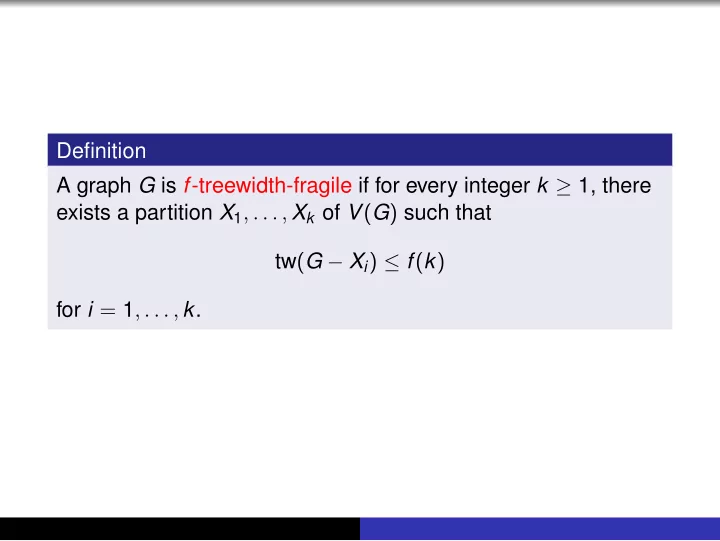
Definition A graph G is f-treewidth-fragile if for every integer k ≥ 1, there exists a partition X1, . . . , Xk of V(G) such that tw(G − Xi) ≤ f(k) for i = 1, . . . , k.
SLIDE 2
Application: Subgraph testing
Lemma H ⊆ G for a graph G of treewidth at most t can be decided in time O(t|H||G|). Observation For k = |H| + 1, if H ⊆ G, then there exists i such that V(H) ∩ Xi = ∅. Corollary Deciding H ⊆ G in time O(kf(k)|H||G| by testing H ⊆ G − X1, . . . , H ⊆ G − Xk.
SLIDE 3
Application: Chromatic number approximation
Lemma Optimal coloring of a graph G of treewidth t can be obtained in time O((t + 1)t+1|G|). Corollary Coloring by ≤ 2χ(G) colors in time O((f(2) + 1)f(2)+1|G|): use disjoint sets of colors on G − X1 and G − X2.
SLIDE 4
Application: Triangle matching
µ3(G) = maximum number of vertex-disjoint triangles in G. Lemma Triangle matching of size µ3(G) can be found in time O(4t(t + 1)!|G|) for a graph G of treewidth t. Observation For some i, Xi intersects at most 3µ3(G)/k of the optimal solution triangles ⇒ µ3(G − Xi) ≥ (1 − 3/k)µ3(G). Corollary Triangle matching of size (1 − 3/k)µ3(G) can be found in time O(f(k)4f(k)(f(k) + 1)!|G|): Return largest of results for G − X1, . . . , G − Xk.
SLIDE 5
How to prove things for proper minor-closed classes: solve bounded genus and bounded treewidth case extend to graphs with vortices incorporate apex vertices deal with clique-sums/tree decomposition
SLIDE 6
Lemma G has genus g, radius r ⇒ tw(G) ≤ (2g + 3)r. WLOG G is a triangulation: dual G⋆ is 3-regular. T BFS spanning tree of G S spanning subgraph of G⋆ with edges E(G) \ E(T).
SLIDE 7
S is connected; S0: a spanning tree of S, X ⋆ = E(S) \ E(S0) |X ⋆| = |E(S)| − |E(S0)| = (|E(G)| − |E(T)|) − |E(S0)| = |E(G)| − (|V(G)| − 1) − (|V(G⋆)| − 1) = (|V(G)| + |V(G⋆)| + g − 2) − (|V(G)| + |V(G⋆)| − 2) = g.
SLIDE 8 t(v) = vertices on path from v to root in T. X: edges of G corresponding to X ⋆. For f ∈ V(G⋆), β(f) =
t(v) |β(f)| ≤ (2g + 3)r + 1
SLIDE 9
(S0, β) is a tree decomposition: f incident with uv: {u, v} ⊆ t(u) ∪ t(v) ⊆ β(f). Tv subtree of T rooted in v:
Tv incident with edge of X ⇒ v in all bags. Otherwise: Walking around Tv shows S0[{x : v ∈ β(x)}] is connected.
SLIDE 10
Definition A graph H is a vortex of depth d and boundary sequence v1, . . . , vk if H has a path decomposition (T, β) of width at most d such that T = v1v2 . . . vk, and vi ∈ β(vi) for i = 1, . . . , k
SLIDE 11
Definition For G0 drawn in a surface, a graph G is an outgrowth of G0 by m vortices of depth d if G = G0 ∪ H1 ∪ Hm, where Hi ∩ Hj = ∅ for distinct i and j, for all i, Hi is a vortex of depth d intersecting G only in its boundary sequence, for some disjoint faces f1, . . . , fk of G0, the boundary sequence of Hi appears in order on the boundary of fi.
SLIDE 12
Lemma G outgrowth of graph G0 of Euler genus g by vortices of depth d, radius r ⇒ tw(G) < (2(2g + 3)r + 1)(d + 1). (Ti, βi) decomposition of a vortex: WLOG Ti a path in G0. G′
0: shrink interiors of vortices to single vertices;
radius(G′
0) ≤ 2r
(T, β0): Tree decomposition of G′
0 of width 2(2g + 3)r.
For v ∈ V(Ti): Replace v by βi(v) in bags of (T, β0).
SLIDE 13
Lemma G outgrowth of graph G0 of Euler genus g by vortices of depth d, radius r ⇒ tw(G) < (2(2g + 3)r + 1)(d + 1). (Ti, βi) decomposition of a vortex: WLOG Ti a path in G0. G′
0: shrink interiors of vortices to single vertices;
radius(G′
0) ≤ 2r
(T, β0): Tree decomposition of G′
0 of width 2(2g + 3)r.
For v ∈ V(Ti): Replace v by βi(v) in bags of (T, β0).
SLIDE 14
Vortex Gi is local if dGi(x, y) ≤ 2 for each x, y ∈ V(Ti). Corollary (Layer Corollary) G outgrowth of graph G0 of Euler genus g by local vortices of depth d, Z vertices at distance b, . . . , b + r from v0 ∈ V(G0) ⇒ tw(G) < (2(2g + 3)(r + 5) + 1)(d + 1). Delete vortices at distance > b + r, non-boundary vertices at distance > b + r + 1 Shrink vortices at distance < b − 2. Contract edges between vertices at distance < b − 2 ⇒ radius ≤ r + 5.
SLIDE 15
Gg,d: outgrowths of graphs of Euler genus g by vortices of depth d. Corollary Gg,d is f-treewidth-fragile for f(k) = (2(2g + 3)(k + 5) + 1)(d + 2). Add a universal vertex to each vortex to make it local. Let Xi = {v : d(v0, v) mod k = i} for i = 0, . . . , k − 1. Layer Corollary applies to each component of G − Xi.
SLIDE 16
Definition G is obtained from H by adding a apices if H = G − A for some set A ⊆ V(G) of size a. G(a) = graphs obtained by adding at most a apices to graphs from G.
SLIDE 17
Lemma G is f-treewidth-fragile ⇒ G(a) is h-treewidth-fragile for h(k) = f(k) + a. Proof. Add the apex vertices to X1.
SLIDE 18
Lemma G is f-treewidth-fragile ⇒ ω(G) ≤ 2f(2) + 2 for G ∈ G. Proof. ω(G) ≤ ω(G − X1) + ω(G − X2) ≤ 2f(2) + 2.
SLIDE 19
For a partition K1, . . . , Kk of K ⊆ V(G), a partition X1, . . . , Xk of V(G) extends it if Ki = K ∩ Xi for i = 1, . . . , k. Definition G is strongly f-treewidth-fragile if for every G ∈ G, every k ≥ 1, and every clique K in G, every partition of K extends to a partition X1, . . . , Xk of V(G) such that tw(G − Xi) ≤ f(k) for i = 1, . . . , k. Lemma G is f-treewidth-fragile ⇒ G is strongly h-treewidth-fragile for h(k) = f(k) + 2f(2) + 2. Proof. Re-distribute the vertices of K, increasing treewidth by ≤ |K| ≤ 2f(2) + 2.
SLIDE 20
Lemma G is strongly f-treewidth-fragile ⇒ clique-sums of graphs from G are strongly f-treewidth-fragile. Proof. G clique-sum of G1 and G2 on a clique Q, K ⊆ V(G). WLOG K ⊆ G1. Extend the partition of K to a partition X ′
1, . . . , X ′ k of G1.
Extend the partition Q ∩ X ′
1, . . . , Q ∩ X ′ k to a partition
X ′′
1 , . . . , X ′′ k of G2.
Let Xi = X ′
i ∪ X ′′ i ; G − Xi is a clique-sum of G1 − X ′ i and
G2 − X ′′
i :
tw(G − Xi) = max(tw(G1 − X ′
i ), tw(G2 − X ′′ i )) ≤ f(k).
SLIDE 21
Near-embeddability
Definition A graph G is a-near-embeddable in a surface Σ if for some graph G0 drawn in Σ, G is obtained from an outgrowth of G0 by at most a vortices of depth a by adding at most a apices.
SLIDE 22
Theorem (The Structure Theorem) For every proper minor-closed class G, there exist g and a such that every graph in G is obtained by clique-sums from graphs a-near-embeddable in surfaces of genus at most g. Corollary For every proper minor-closed class G, there exists a linear function f such that G is f-treewidth-fragile.