Decarbonising energy: challenges ahead Julia Brown Vice Chair of - - PDF document

decarbonising energy challenges ahead
SMART_READER_LITE
LIVE PREVIEW

Decarbonising energy: challenges ahead Julia Brown Vice Chair of - - PDF document

29/10/2017 Independent advice to government on building a low-carbon economy and preparing for climate change Wednesday 4 th October 2017 Decarbonising energy: challenges ahead Julia Brown Vice Chair of the Committee on Climate Change The


slide-1
SLIDE 1

29/10/2017 1

Independent advice to government

  • n building a low-carbon economy

and preparing for climate change

Decarbonising energy: challenges ahead

Wednesday 4th October 2017

Julia Brown Vice Chair of the Committee on Climate Change

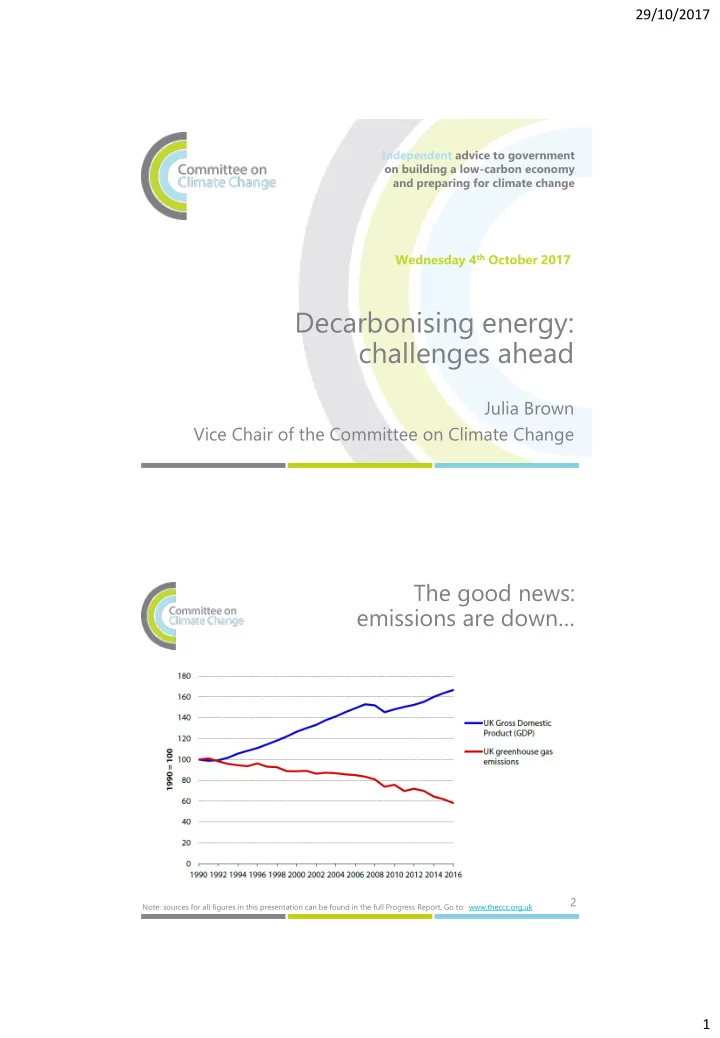
The good news: emissions are down…

Note: sources for all figures in this presentation can be found in the full Progress Report. Go to: www.theccc.org.uk

2

slide-2
SLIDE 2

29/10/2017 2

…UK is approaching global average

3

The power sector is leading

4

slide-3
SLIDE 3

29/10/2017 3

2015 to 2016

5

…through coal reduction

6

  • Reduced coal in generation: 75% of all CO2

reductions since 2012

  • Intention: no coal beyond 2025
  • Only16Mt more: less than 2 years of progress to

2050

slide-4
SLIDE 4

29/10/2017 4

Bad news: current policies won’t deliver

7

the challenge to 2030…

8

  • Power

79Mt in 2016 62% reduction

  • Buildings

89Mt in 2016 20% reduction

  • Transport

121Mt in 2016 44% reduction

  • Industry

100Mt in 2016 20% reduction

slide-5
SLIDE 5

29/10/2017 5

…and the challenge to 2050

9

  • Power

79Mt in 2016 62% reduction

  • Buildings

89Mt in 2016 20% reduction

  • Transport

121Mt in 2016 44% reduction

  • Industry

100Mt in 2016 20% reduction

and the Paris challenge…

10

  • Net zero emissions between 2050 and 2100
  • Focus on hard to treat sectors:
  • Industry
  • Aviation
  • Agriculture
  • Zero emissions:
  • Power
  • Land transport
  • Buildings
  • Negative emissions technologies essential:
  • CCS with bioenergy?
  • Wood in construction?
  • Air capture with CCS?
slide-6
SLIDE 6

29/10/2017 6

Power

11

Preparing for deeper emissions cuts

  • Growing demand: 7% by 2030
  • CCS
  • Interconnection
  • Storage
  • Flexibility
  • Demand-side response
  • Nuclear (fusion?), tidal, wind, solar, bioenergy…
  • No time for gas?
  • Cost reduction

Buildings

12

Making energy efficiency a reality

  • Insulation
  • Building standards
  • Low carbon heat:
  • Heat pumps
  • Hydrogen
  • Heat networks
  • Behaviour
slide-7
SLIDE 7

29/10/2017 7

Transport

13

Ultra-low carbon transport

  • Electric cars and vans
  • Range
  • Charging
  • Cost
  • HGVs
  • Behaviour: travel demand, virtual reality, shopping habits,

supply chains, local vs global…

  • Aviation
  • Role of biofuels
  • Role of hydrogen
  • Elon Musk’s interplanetary ambitions

Industry

14

Energy efficiency and new processes

  • CCS
  • Low carbon heat
  • New processes
  • Steelmaking via electrolysis
  • Zero carbon cement
slide-8
SLIDE 8

29/10/2017 8

Cross-cutting issues

15

  • Hard to treat sectors
  • Aviation, industry, agriculture
  • GHG removal: negative emissions
  • Carbon storing materials; bioenergy with CCS; direct air capture…
  • Bioenergy
  • Sustainability
  • Best use
  • CCS
  • Low carbon hydrogen
  • Storage – especially long term
  • Grid flexibility
  • Risk reduction and cost reduction
  • Systems thinking
  • Behaviour change

What has worked?

16

Offshore wind

  • Latest CfD auctions £50 - £70 per MWhr
  • Compared with £120 per MWhr in 2015
  • CfD policy – long term support
  • Green Investment Bank – investor confidence
  • Offshore Renewable Energy Catapult – UK technology opportunities
  • Inward investment: Siemens in Hull
slide-9
SLIDE 9

29/10/2017 9

What has worked?

17

Low carbon automotive

  • EU mandatory emissions targets
  • King Review 2007
  • Innovation support
  • TSB Low carbon Vehicle Innovation Platform
  • EV demonstrator
  • Consistent UK policy
  • OLEV
  • support for EV purchase
  • Plugged in Places…
  • Industrial strategy: Automotive Council research agenda
  • Inward investment – Tata, Toyota, Nissan…

Common factors

18

  • Framework: Climate Change Act and Budgets
  • Common European legislation
  • Relatively consistent support over significant periods:

10+ years

  • Policy interventions on a range of fronts (integrated?):
  • Research
  • Industry support
  • Innovation support
  • Investment: UK Government and inward
  • Risk reduction: demonstration
slide-10
SLIDE 10

29/10/2017 10

Actions also help wider policy objectives

These actions may require upfront investment and further action to change behaviours. 19 Mitigation Adaptation

  • Reducing

household energy bills

  • Improving health
  • Economic
  • pportunities
  • Reducing waste
  • Building 21st century

infrastructure

The actions need to focus on areas of high priority for emission reduction…

Action required across all sectors, notably: Car and van fuel efficiency targets post-2020 Strategy for energy efficiency and low carbon heat in buildings Approach to procure new low carbon electricity in 2020s Re-start CCS for industry, power and (if needed) hydrogen Strategy on soils, forestry and agriculture to reduce emissions and capture GHGs

20

slide-11
SLIDE 11

29/10/2017 11

Monitoring, assessment, adjustment and research are critical to government’s plans…

21

  • The Clean Growth Plan: needs actions in key areas. Where

action is yet to be determined, include: clear steps, decision points and criteria for decisions

  • National Infrastructure Assessment & spending decisions:

need to incorporate emissions reduction & climate risks across all infrastructure

  • UKRI programmes: addressing longer term decarbonisation

and GHG removal needs and low carbon innovation to support UK requirements and significant global market opportunities

…alongside links with the private sector, other governments & public institutions

22

  • Investors: to promote meaningful disclosure, new financing

instruments (green bonds) & flows of funds

  • Regulators: Ofgem, Pensions Regulator, Prudential

Regulatory Authority all have crucial roles to play

  • Cities & regions: core cities and new elected mayors to

promote emissions reduction and adaptation within regional economic strategies

  • Devolved administrations: in process of putting new

ambitions around climate action into law