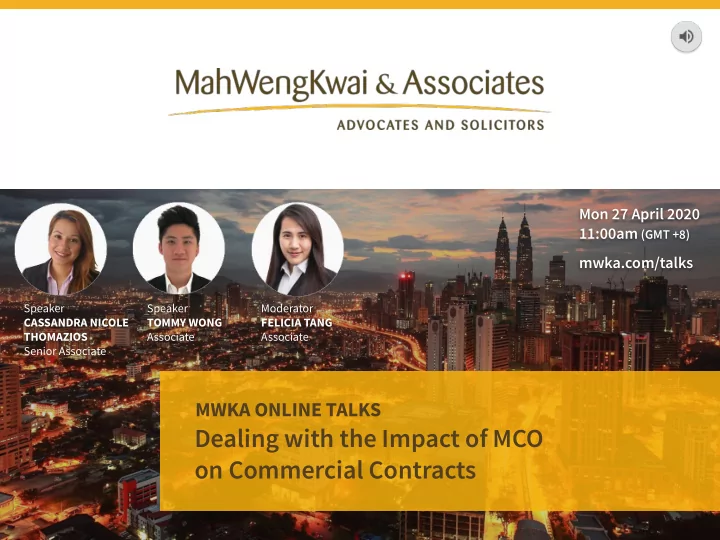
SLIDE 1 Dealing with the Impact of MCO
MWKA ONLINE TALKS
Speaker CASSANDRA NICOLE THOMAZIOS Senior Associate Speaker TOMMY WONG Associate Moderator FELICIA TANG Associate
Mon 27 April 2020 11:00am (GMT +8) mwka.com/talks
SLIDE 3 Dealing with the Impact of MCO
MWKA ONLINE TALKS
Speaker CASSANDRA NICOLE THOMAZIOS Senior Associate Speaker TOMMY WONG Associate Moderator FELICIA TANG Associate
Mon 27 April 2020 11:00am (GMT +8) mwka.com/talks
SLIDE 4 About Us
- Welcome to MahWengKwai & Associates!
- Trusted by small medium enterprises (SMEs),
family businesses and individuals.
- Established in 1985 by Dato’ Mah Weng Kwai,
now a consultant with the firm.
- Medium-sized law firm with 22 lawyers and 19 staff.
SLIDE 5 Our Services
- Full-service law firm with 4 Departments:
○ Corporate ○ Dispute Resolution ○ Employment ○ Individuals & Families
SLIDE 6 Our Practice Groups
○ ASEAN-China Desk ○ Construction ○ Foreign Direct Investment ○ Real Estate ○ Sports & eSports
SLIDE 7 MWKA Online Talks
- To share knowledge and raise awareness
- For clients, potential clients and in-house counsel
- Last Talk:
○ 24 April 2020: Introduction to Faraid and Inheritance for Muslims (Sarah Kambali and Anis Sohaimi)
○ 29 April 2020: Resolving Construction Disputes by Adjudication (Christine Toh and Hannah Patrick)
SLIDE 8 Cassandra Thomazios
- Senior Associate in our Corporate
department
- Bachelor of Laws (Hons) from
Northumbria University.
- Called to the Bar of England and
Wales (Inner Temple) in 2011
- Admitted to the Malaysian Bar in
2012
Transnational Law, King’s College London
- Commercial and corporate matters,
drafting corporate project agreements, M&A transactions
SLIDE 9 Tommy Wong
- Associate in our Corporate
department
- Bachelor of Laws (Hons) from the
University of Hertfordshire
- Called to the Bar of England and
Wales (Lincoln’s Inn) in 2017
- Admitted to the Malaysian Bar in
2019
matters, drafting corporate project agreements, M&A transactions
SLIDE 10
Ask Questions on Slido
Please scan this QR Code to access Q&A and polling platform for this talk. Post the questions that you would like to ask. Upvote/Like the questions you like. Most liked / popular questions will be discussed and answered by the speaker(s) during the Q&A session. Or visit https://www.sli.do and enter #47676
SLIDE 11 Talk Points
- Obligations of parties under an agreement
- Force Majeure
- Frustration
- Termination
- Re-negotiation of agreements and its terms and
conditions
SLIDE 12 Covid-19 Movement Control Order (“MCO”)
- Pursuant to section 11(2) of the Prevention and Control of
Infectious Diseases Act 1988 (“PCID”)
- PCID (Measures within the Infected Local Areas)
Regulations 2020 was gazetted on 18.3.2020
- Effective 18.3.2020 to 31.3.2020 and extended to
28.4.2020
- On 23.4.2020, the MCO was further extended to
12.5.2020
- Effect - restrictions on movements except for essential
services
SLIDE 13 Impact of MCO on Commercial Contracts
- Businesses except for those categorized as “Essential Services” have
been restricted to carry on its activities until the conclusion of the MCO.
- Difficulties faced by businesses:
○ Financial constraints ○ Failure to perform obligations in an agreement
SLIDE 14
Impact of MCO on Commercial Contracts
Common Questions: (1) What clauses can parties rely on for the non-performance of their respective obligations in an executed agreement? (2) Can parties renegotiate the terms and conditions of an agreement, thereby varying timelines or scope of work? (Supplemental) (3) Can parties negotiate payment or debts due and owing under commercial agreements due to financial constraint? (Settlement)
SLIDE 15 (1) Force Majeure
- “Force Majeure” is defined as:
“an unexpected event such as a war, crime or an earthquake which prevents someone from doing something that is written in a legal agreement”
- A Force Majeure clause caters for a party, or both, to be excused
from the performance of their contractual obligations should there be an occurrence of an event which is beyond the control of the parties and not anticipated or foreseen during the parties’ negotiation and execution of an agreement
SLIDE 16 (1) Force Majeure
- Are Force Majeure clauses standardized in agreements?
○
- No. Force Majeure clauses differ depending on the scope of
work and complexity of terms under an agreement.
- What type of agreements would typically contain a Force Majeure
clause? ○ Sale and Supply of Goods ○ Construction Contracts ○ Supply of Services
SLIDE 17 (1) Force Majeure
- Does the COVID-19 outbreak or the MCO fall within the ambit of a
Force Majeure clause? ○ Highly dependent on the wording of the clause
- Will courts adopt an interpretation of Force Majeure to cover the
COVID-19 outbreak or the MCO? ○ Dependent on the wording of the clause ○ Dependent on whether the parties were able to and/or did reasonably mitigate the impact of the Force Majeure event
- The burden of proof lies on the party wishing to invoke the clause.
SLIDE 18 (1) Force Majeure
- Methods of determination to support the party intending to invoke
the Force Majeure clause: ○ Did the Force Majeure clause specify the COVID-19 outbreak and/or the implementation of the MCO? ○ Is the Force Majeure clause drafted to define an event of force majeure to be “an event beyond the control of the parties”? ○ Are the obligations of the parties rendered completely impossible to fulfill?
SLIDE 19 (1) Force Majeure
- What is the effect on an agreement should a Force Majeure clause
be invoked? ○ Typically, parties would be excused and/or relieved from their contractual obligations ○ Highly dependent on the wording of the clause: ■ Is there a period of time specified to hold and/or delay the performance of the agreement? ■ Is there an effect specified in the agreement should there be an occurrence of a Force Majeure event?
SLIDE 20 Frustration of Contracts
- Doctrine of “frustration” under Section 57(2) of the Contracts Act
1950
“a contract to do an act which, after the contract is made, becomes impossible, or by reason of some event which the promisor could not prevent, unlawful, becomes void when the act becomes impossible or unlawful.”
SLIDE 21 Frustration of Contracts
- Three factors to satisfy the doctrine of “frustration”:
○ There is a supervening (frustrating) event (subsequent to the formation of the contract); ○ The said event did not occur due to the fault of either and/or both parties; ○ There is a significant change to the nature of the contractual rights, which makes it unjust to impose the contractual
- bligations on the parties.
SLIDE 22 Frustration of Contracts
- Would the COVID-19 outbreak and/or the implementation of the
MCO fall within the ambit of the doctrine of “frustration”? ○ Is there a supervening (frustrating) event? ○ Was the said event induced by either or both parties; ○ Is there is a significant change to the nature of the contractual rights, which makes it unjust to impose the contractual
- bligations on the parties?
SLIDE 23 Frustration of Contracts
Would the COVID-19 outbreak or the MCO fall within the ambit of the doctrine of “frustration”?
- The COVID-19 outbreak or the MCO is a supervening (frustrating)
event; and
- The COVID-19 outbreak or the MCO did not occur due to the fault of
either or both parties. Whether the COVID-19 outbreak or the MCO significantly changes the nature of contractual rights, rendering it unjust to impose the contractual obligations on the parties, is highly dependent on the facts of the matter.
SLIDE 24 Frustration of Contracts
What is the effect on an agreement should the agreement be deemed or found to be frustrated?
- The agreement will be rendered void - parties are discharged from
contractual obligations
SLIDE 25 Frustration of Contracts
- Section 66 of the Contracts Act 1950
“When an agreement is discovered to be void, or when a contract becomes void, any person who has received any advantage under the agreement or contract is bound to restore it, or to make compensation for it, to the person from whom he received it.”
SLIDE 26 Frustration of Contracts
- Section 15(2) of the Civil Law Act 1956
“All sums paid or payable to any party in pursuance of the contract before the time when the parties were so discharged … shall, in the case of sums so paid, be recoverable from him as money received by him for the use of the party by whom the sums were paid, and, in the case of sums payable, cease to be payable.”
SLIDE 27 Frustration of Contracts
- Davis Contractors v Fareham Urban District Council [1956] AC 696 at
- p. 729
“Frustration occurs whenever the law recognizes that without default of either party a contractual
has become incapable
being performed because the circumstances in which performance is called for would render it a thing radically different from that which was undertaken by the contract.”
SLIDE 28 Frustration of Contracts
- In Guan Aik Mok (KL) Sdn Bhd & Anor v Selangor Properties Bhd
[2007] 4 MLJ 201:
“...there are three elements woven into the fabric of the doctrine embodied in s 57. First, the event upon which the promisor relies as having frustrated the contract must have been one for which no provision has been made in the contract. If provision has been made then the parties must be taken to have allocated the risk between
- them. Second, the event relied upon by the promisor must be one for
which he or she is not responsible. Put shortly, self induced frustration is ineffective. Third, the event which is said to discharge the promise must be such that renders it radically different from that which was undertaken by the contract. The court must find it practically unjust to enforce the original promise. If any of these elements are not present on the facts of a given case, then s 57 does not bite.”
SLIDE 29 Termination
- A termination clause generally sets out the circumstances and
methods of termination in an agreement.
- Examples of circumstances where either or both parties may
terminate an agreement: ○ Breach of the terms and conditions of the agreement ○ Event of default ○ Change of control within a party (typically companies) ○ Bankruptcy or insolvency of a party ○ If it is provided for under the agreement with notice
SLIDE 30 Termination
- In the event of a breach of terms and conditions and/or an event of
default, a termination clause usually provides a specified period for the defaulting party to remedy the breach and/or default, failing which the affected party may terminate the agreement.
SLIDE 31 Termination
- How can termination of an agreement be effected?
○ Is there a specified time period for a terminating party to provide a written termination notice to the receiving party? ○ Is there a specified method of service for the written termination notice to be served?
- A termination notice usually specifies what amount to the
termination of the agreement.
SLIDE 32 (2) Re-negotiation of agreements
- Can parties renegotiate terms and conditions of an agreement after
the execution of the same? ○ Yes ○ Amendment, modification and/or variation of terms and conditions cannot be made unilaterally.
SLIDE 33 (2) Re-negotiation of agreements
- What terms and conditions should parties look to renegotiate on to
avoid termination and in satisfaction of both parties during the MCO? ○ Obligations of parties ○ Delivery of goods ○ Extension of Timelines ○ Delay ○ Payment terms
SLIDE 34 (2) Re-negotiation of agreements
○ It is highly likely that many, if not all, contractual obligations of parties cannot be performed due to the restrictions imposed by the MCO ○ Parties can mutually agree that performance of respective contractual obligations can resume upon the conclusion of the MCO
SLIDE 35 (2) Re-negotiation of agreements
- Delivery of goods and payment terms
○ These fall within the ambit of contractual obligations ○ However, parties may want to consider specifically amending the agreement to reflect the renegotiated terms and conditions ○ Examples: re-negotiation on the change of delivery dates and payment deadlines
SLIDE 36 (2) Re-negotiation of agreements
- Extension of timelines & delay
○ The imposition of the MCO may restrict parties from performing their obligations in accordance with current timelines under agreements ○ Parties can mutually agree that performance of respective contractual obligations may be extended ○ Parties may also need to renegotiate on terms and conditions relating to delays and liquidated ascertained damages
SLIDE 37 (2) Supplemental Agreements
- What can parties do to ensure their re-negotiations are agreed to in
writing to effect any amendment, modification and/or variation to their agreements upon successful re-negotiation? ○ Enter into a new agreement which specifically sets out the revocation of the original agreement and the new terms ○ Enter into a supplemental agreement to modify, vary or amend their principal agreements.
SLIDE 38 (2) Supplemental Agreements
- What is a supplemental agreement?
○ It is a secondary contractual agreement which is mutually agreed by all relevant parties to modify the original agreement ○ A supplemental agreement does not replace the original agreement but sets out amended and/or new clauses to be read together with the original agreement
SLIDE 39 (2) Supplemental Agreements
- Example of clauses that can be found in a supplemental agreement
○ Recitals ○ Interpretation ○ Amendments to the original agreement ○ Additional and/or new clauses to the original agreement ○ Boilerplate clauses
SLIDE 40 (2) Supplemental Agreements
- Upon successful re-negotiation of the terms of an agreement, it is
important that parties document such re-negotiated terms in writing, whether be it an entirely new agreement revoking the
- riginal agreement or a supplemental agreement to be read in line
with the original agreement
- This helps to avoid future disputes arising out of or in connection
with the original agreement.
SLIDE 41 (3) Settlement Agreements
- Can parties negotiate payment or debts due and owing under
commercial agreements due to financial constraint?
- Yes
- Negotiation and mutual agreement here is key
- Parties can re-negotiate payment terms to reflect an off-set or
reduced payment sum based on mutual agreement by way of a Settlement Agreement
SLIDE 42 (3) Settlement Agreements
- Parties must ensure that any modification, amendment or variation
to any payment terms under an agreement is recorded in writing by way of a Settlement Agreement to avoid inconsistency or disputes
SLIDE 43 (3) Settlement Agreements
- A Settlement agreement reflects a settlement between parties to
pay a debt due and owing by any other means and within a certain time frame: Example: Original Agreement states that a Debtor is to pay a Debt of RM1 million within 24-month. After successful negotiations, a Debtor and creditor may agree to have the Debt reduced and paid by
- ff-setting property to the Creditor.
SLIDE 44 Conclusion
- Decipher the wordings of each force majeure clause as well as
timelines, delay and termination clauses in their agreements
- Parties should consider renegotiating terms of their agreements
where possible to vary timelines or scope of work by way of a Supplemental Agreement
- Parties may want to consider negotiating settlements with creditors
to pay off debts due and owing under their agreements by way of a Settlement Agreement
SLIDE 45 Update
- There is currently a proposed tabling of a law to address the inability
to perform contractual obligations due to unforeseeable circumstances.
- The proposition has been welcomed by many for the purpose of
protecting the sanctity of contracts.
- There are suggestions for such new law to be modelled after
Singapore.
SLIDE 46
Questions?
SLIDE 47 Upcoming topics
Sign up at: https://mahwengkwai.com/talks-signup/ or go to “Events” tab on our website https://mahwengkwai.com/
Date (Day) Topic Title Speaker(s) 29.4.2020 (Wed) Resolving Construction Disputes by Adjudication (CIPAA 2012) Christine Toh Hannah Patrick 4.5.2020 (Mon) Arrest, Remand & Bail during MCO Vivien Fan Wong Chee En
SLIDE 48
Complimentary Consultation
Schedule a complimentary 30 minute video-consultation with our lawyers by filling up the form at https://mahwengkwai.com/schedule-a-meeting/
SLIDE 49
Thank you!
Notice: This presentation does not constitute legal advice and its contents should not be relied upon as such. The facts and circumstances of each and every case will differ and therefore will require specific legal advice. Feel free to contact us for legal consultation.
SLIDE 50
Complimentary Consultation
Schedule a complimentary 30 minute video-consultation with our lawyers by filling up the form at https://mahwengkwai.com/schedule-a-meeting/