SLIDE 1
1
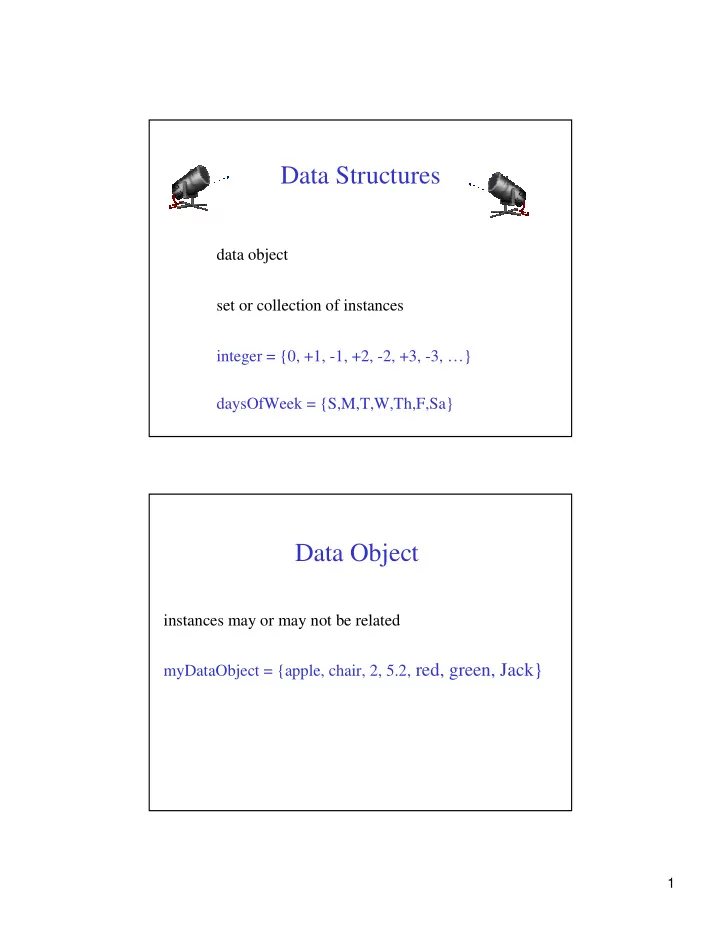
Data Structures
data object set or collection of instances integer = {0, +1, -1, +2, -2, +3, -3, …} daysOfWeek = {S,M,T,W,Th,F,Sa}
Data Object
instances may or may not be related myDataObject = {apple, chair, 2, 5.2, red, green, Jack}
SLIDE 2
2
Data Structure
Data object +
relationships that exist among instances and elements that comprise an instance
Among instances of integer 369 < 370 280 + 4 = 284
Data Structure
Among elements that comprise an instance 369 3 is more significant than 6 3 is immediately to the left of 6 9 is immediately to the right of 6
SLIDE 3
3
The relationships are usually specified by specifying operations on one or more instances. add, subtract, predecessor, multiply
Data Structure Linear (or Ordered) Lists
instances are of the form (e0, e1, e2, …, en-1) where ei denotes a list element n >= 0 is finite list size is n
SLIDE 4
4
Linear Lists
L = (e0, e1, e2, e3, …, en-1) relationships e0 is the zero’th (or front) element en-1 is the last element ei immediately precedes ei+1
Linear List Examples/Instances
Students in COP3530 = (Jack, Jill, Abe, Henry, Mary, …, Judy) Exams in COP3530 = (exam1, exam2, exam3) Days of Week = (S, M, T, W, Th, F, Sa) Months = (Jan, Feb, Mar, Apr, …, Nov, Dec)
SLIDE 5
5
Linear List Operations—size()
determine list size L = (a,b,c,d,e) size = 5
Linear List Operations—get(theIndex)
get element with given index L = (a,b,c,d,e) get(0) = a get(2) = c get(4) = e get(-1) = error get(9) = error
SLIDE 6
6
Linear List Operations— indexOf(theElement)
determine the index of an element L = (a,b,d,b,a) indexOf(d) = 2 indexOf(a) = 0 indexOf(z) = -1
Linear List Operations— remove(theIndex)
remove and return element with given index L = (a,b,c,d,e,f,g) remove(2) returns c and L becomes (a,b,d,e,f,g) index of d,e,f, and g decrease by 1
SLIDE 7
7
Linear List Operations— remove(theIndex)
remove and return element with given index L = (a,b,c,d,e,f,g) remove(-1) => error remove(20) => error
Linear List Operations— add(theIndex, theElement)
add an element so that the new element has a specified index L = (a,b,c,d,e,f,g) add(0,h) => L = (h,a,b,c,d,e,f,g) index of a,b,c,d,e,f, and g increase by 1
SLIDE 8
8
Linear List Operations— add(theIndex, theElement)
L = (a,b,c,d,e,f,g) add(2,h) => L = (a,b,h,c,d,e,f,g) index of c,d,e,f, and g increase by 1 add(10,h) => error add(-6,h) => error
Data Structure Specification
Language independent
Abstract Data Type
Java
Interface Abstract Class
SLIDE 9 9
Linear List Abstract Data Type
AbstractDataType LinearList { instances
- rdered finite collections of zero or more elements
- perations
isEmpty(): return true iff the list is empty, false otherwise size(): return the list size (i.e., number of elements in the list) get(index): return the indexth element of the list indexO f(x): return the index of the first occurrence of x in the list, return -1 if x is not in the list remove(index): remove and return the indexth element, elements with higher index have their index reduced by 1 add(theIndex, x): insert x as the indexth element, elements with theIndex >= index have their index increased by 1
- utput(): output the list elements from left to right
}
Linear List as Java Interface
An interface may include constants and abstract methods (i.e., methods for which no implementation is provided).
SLIDE 10
10
Linear List as Java Interface
public interface LinearList { public boolean isEmpty(); public int size(); public Object get(int index); public int indexOf(Object elem); public Object remove(int index); public void add(int index, Object obj); public String toString(); }
Implementing An Interface
public class ArrayLinearList implements LinearList { // code for all LinearList methods must be provided here }
SLIDE 11
11
Linear List As An Abstract Class
An abstract class may include constants, variables, abstract methods, and nonabstract methods.
Linear List As Java Abstract Class
public abstract class LinearListAsAbstractClass { public abstract boolean isEmpty(); public abstract int size(); public abstract Object get(int index); public abstract int indexOf(Object theElement); public abstract Object remove(int index); public abstract void add(int index, Object theElement); public abstract String toString(); }
SLIDE 12
12
Extending A Java Class
public class ArrayLinearList extends LinearListAsAbstractClass { // code for all abstract classes must come here }
Implementing Many Interfaces
public class MyInteger implements Operable, Zero, CloneableObject { // code for all methods of Operable, Zero, // and CloneableObject must be provided }
SLIDE 13
13
Extending Many Classes
NOT PERMITTED IN JAVA A Java class may implement as many interfaces as it wants but can extend at most 1 class.
Data Structures In Text
All but 1 of our data structures are specified as Java interfaces. Exception is Graph in Chapter 17. Java specifies all of its data structures as interfaces. java.util.List