Data Structures Topic 12 ADTS, Data Structures, Java Collections S - - PowerPoint PPT Presentation

data structures topic 12
SMART_READER_LITE
LIVE PREVIEW

Data Structures Topic 12 ADTS, Data Structures, Java Collections S - - PowerPoint PPT Presentation

Data Structures Topic 12 ADTS, Data Structures, Java Collections S S C A Data Structure is: and Generic Data Structures an implementation of an abstract data type and "An organization of information, usually in "Get


slide-1
SLIDE 1

Topic 12

S S C ADTS, Data Structures, Java Collections and Generic Data Structures

"Get your data structures correct fi t d th t f th ill first, and the rest of the program will write itself."

  • David Jones

CS 307 Fundamentals of Computer Science ADTS and Generic Data Structures

1

Data Structures

A Data Structure is:

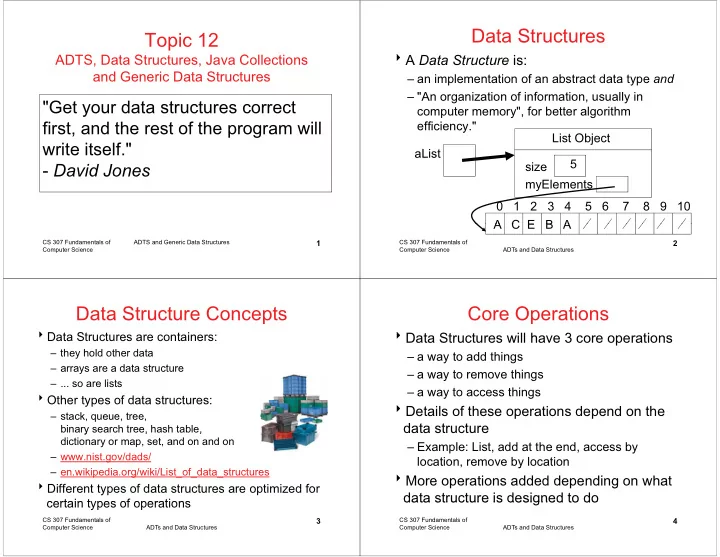
– an implementation of an abstract data type and – "An organization of information, usually in computer memory", for better algorithm ffi i " efficiency." aList List Object aList size myElements 5 y A C E B A 0 1 2 3 4 5 6 7 8 9 10

CS 307 Fundamentals of Computer Science ADTs and Data Structures

2

A C E B A

Data Structure Concepts

D S i Data Structures are containers:

– they hold other data arra s are a data str ct re – arrays are a data structure – ... so are lists

Other types of data structures: Other types of data structures:

– stack, queue, tree, binary search tree, hash table, y , , dictionary or map, set, and on and on – www.nist.gov/dads/ – en.wikipedia.org/wiki/List_of_data_structures

Different types of data structures are optimized for certain types of operations

CS 307 Fundamentals of Computer Science ADTs and Data Structures

3

certain types of operations

Core Operations

Data Structures will have 3 core operations

– a way to add things – a way to remove things – a way to access things

Details of these operations depend on the data structure

– Example: List, add at the end, access by location, remove by location y

More operations added depending on what data structure is designed to do

CS 307 Fundamentals of Computer Science ADTs and Data Structures

4

data structure is designed to do

slide-2
SLIDE 2

ADTs and Data Structures in Programming Languages Programming Languages

Modern programming languages usually h lib f d t t t have a library of data structures

– Java collections framework – C++ standard template library – .Net framework (small portion of VERY large library) – Python lists and tuples – Lisp lists

CS 307 Fundamentals of Computer Science ADTs and Data Structures

5

Data Structures in Java

Part of the Java Standard Library is the Collections Framework

– In class we will create our own data structures and discuss the data structures that exist in Java

A library of data structures Built on two interfaces

– Collection – Iterator Iterator

http://java.sun.com/j2se/1.5.0/docs/guide/coll ections/index html

CS 307 Fundamentals of Computer Science ADTs and Data Structures

6

ections/index.html

The Java Collection interface

A generic collection Can hold any object data type Which type a particular collection will hold is specified when declaring an instance of a spec ed e dec a g a sta ce o a class that implements the Collection interface Helps guarantee type safety at compile time Helps guarantee type safety at compile time

CS 307 Fundamentals of Computer Science ADTs and Data Structures

7

Methods in the Collection interface

public interface Collection<E> public interface Collection<E> { public boolean add(E o) public boolean addAll(Collection<? extends E> c) public void clear() public void clear() public boolean contains(Object o) public boolean containsAll(Collection<?> c) public boolean equals(Object o) public boolean equals(Object o) public int hashCode() public boolean isEmpty() public Iterator<E> iterator() public Iterator<E> iterator() public boolean remove(Object o) public boolean removeAll(Collection<?> c) public boolean retainAll(Collection<?> c) pub c boo ea eta (Co ect o c) public int size() public Object[] toArray() public <T> T[] toArray(T[] a)

CS 307 Fundamentals of Computer Science ADTs and Data Structures

8

p [] y( [] ) }

slide-3
SLIDE 3

The Java ArrayList Class

Implements the List interface and uses an array as its internal storage container It is a list, not an array The array that actual stores the elements of e a ay t at actua sto es t e e e e ts o the list is hidden, not visible outside of the ArrayList class ay s c ass all actions on ArrayList objects are via the methods methods ArrayLists are generic.

Th h ld bj t f t !

CS 307 Fundamentals of Computer Science ADTs and Data Structures

9

– They can hold objects of any type!

ArrayList's (Partial) Class Diagram Class Diagram

Iterable Object Collection AbstractCollection List AbstractList ArrayList

CS 307 Fundamentals of Computer Science ADTs and Data Structures

10

Back to our Array Based List

Started with a list of ints Don't want to have to write a new list class for every data type we want to store in lists Moved to an array of Objects to store the y j elements of the list

// from array based list y private Object[] myCon;

CS 307 Fundamentals of Computer Science ADTS and Generic Data Structures

11

Using Object

In Java, all classes inherit from exactly one

  • ther class except Object which is at the top
  • f the class hierarchy

Object variables can point at objects of their declared type and any descendants

– polymorphism p y p

Thus, if the internal storage container is of type Object it can hold anything type Object it can hold anything

– primitives handled by wrapping them in objects. int – Integer, char - Character

CS 307 Fundamentals of Computer Science ADTS and Generic Data Structures

12

g ,

slide-4
SLIDE 4

Difficulties with Object

Creating generic containers using the Object data type and polymorphism is relatively straight forward Using these generic containers leads to some difficulties

– Casting – Type checking

Code examples on the following slides Code examples on the following slides

CS 307 Fundamentals of Computer Science ADTS and Generic Data Structures

13

Attendance Question 1

What is output by the following code?

ArrayList list = new ArrayList(); String name = "Olivia"; list.add(name); System out print( list get(0) charAt(2) ); System.out.print( list.get(0).charAt(2) );

  • A. i
  • B. O
  • C. l
  • D. No output due to syntax error.

E No output due to runtime error

  • E. No output due to runtime error.

CS 307 Fundamentals of Computer Science ADTS and Generic Data Structures

14

Code Example - Casting

Assume a list class

ArrayList li = new ArrayList(); li.add(“Hi”); System.out.println( li.get(0).charAt(0) ); // previous line has syntax error // previous line has syntax error // return type of get is Object // Object does not have a charAt method // j // compiler relies on declared type System.out.println( ((String)li.get(0)).charAt(0) ); // must cast to a String

CS 307 Fundamentals of Computer Science ADTS and Generic Data Structures

15

Code Example – type checking

//pre: all elements of li are Strings public void printFirstChar(ArrayList li){ String temp; for(int i = 0; i < li.size(); i++) { temp = (String)li.get(i); if( temp.length() > 0 ) S t t i tl ( System.out.println( temp.charAt(0) ); } } // what happens if pre condition not met?

CS 307 Fundamentals of Computer Science ADTS and Generic Data Structures

16

slide-5
SLIDE 5

Too Generic?

Does the compiler allow this?

ArrayList list = new ArrayList(); list.add( "Olivia" ); list.add( new Integer(12) ); list add( new Rectangle() ); list.add( new Rectangle() ); list.add( new ArrayList() );

A Yes

  • A. Yes
  • B. No

CS 307 Fundamentals of Computer Science ADTS and Generic Data Structures

17

Is this a bug or a feature?

CS 307 Fundamentals of Computer Science ADTS and Generic Data Structures

18

"Fixing" the Method

// ll l t f li St i //pre: all elements of li are Strings public void printFirstChar(ArrayList li){ String temp; String temp; for(int i = 0; i < li.size(); i++){ if( li.get(i) instanceof String ){ ( g ( ) g ){ temp = (String)li.get(i); if( temp.length() > 0 ) System.out.println( temp.charAt(0) ); } } }

CS 307 Fundamentals of Computer Science ADTS and Generic Data Structures

19

}

Generic Types

Java has syntax for parameterized data types Referred to as Generic Types in most of the literature A traditional parameter has a data type and can store various values just like a variable ca s o e a ous a ues jus e a a ab e public void foo(int x) Generic Types are like parameters but the Generic Types are like parameters, but the data type for the parameter is data type

lik i bl th t t d t t

CS 307 Fundamentals of Computer Science ADTS and Generic Data Structures

20

– like a variable that stores a data type

slide-6
SLIDE 6

Making our Array List Generic

D t t i bl d l d i l h d Data type variables declared in class header public class GenericList<E> { The <E> is the declaration of a data type parameter for the class

– any legal identifier: Foo, AnyType, Element, DataTypeThisListStores Sun style guide recommends terse identifiers – Sun style guide recommends terse identifiers

The value E stores will be filled in whenever a programmer creates a new GenericList a programmer creates a new GenericList

GenericList<String> li = new GenericList<String>();

CS 307 Fundamentals of Computer Science ADTS and Generic Data Structures

21

new GenericList<String>();

Modifications to GenericList

instance variable

private E[] myCon;

Parameters on

– add, insert, remove, insertAll , , ,

Return type on

– get – get

Changes to creation of internal storage container container

myCon = (E[])new Object[DEFAULT_SIZE];

Constructor header does not change

CS 307 Fundamentals of Computer Science ADTS and Generic Data Structures

22

Constructor header does not change

Using Generic Types

Back to Java's ArrayList ArrayList list1 = new ArrayList();

– still allowed, a "raw" ArrayList – works just like our first pass at GenericList j p – casting, lack of type safety

CS 307 Fundamentals of Computer Science ADTS and Generic Data Structures

23

Using Generic Types

i i i 2 ArrayList<String> list2 = new ArrayList<String>(); – for list2 E stores String

list2.add( "Isabelle" ); System.out.println( list2.get(0).charAt(2) ); //ok g list2.add( new Rectangle() ); // syntax error // syntax error

CS 307 Fundamentals of Computer Science ADTS and Generic Data Structures

24

slide-7
SLIDE 7

Parameters and Generic Types

Old version

//pre: all elements of li are Strings public void printFirstChar(ArrayList li){

New version

//pre: none

public void printFirstChar(ArrayList<String> li){

Elsewhere

ArrayList<String> list3 = new ArrayList<String>(); y g y g (); printFirstChar( list3 ); // ok ArrayList<Integer> list4 = new ArrayList<Integer>(); printFirstChar( list4 ); // syntax error

CS 307 Fundamentals of Computer Science ADTS and Generic Data Structures

25

printFirstChar( list4 ); // syntax error

Generic Types and Subclasses

i i ArrayList<ClosedShape> list5 = new ArrayList<ClosedShape>(); list5.add( new Rectangle() ); list5.add( new Square() ); list5.add( new Circle() ); // all okay list5 can store ClosedShapes and any descendants of ClosedShape

CS 307 Fundamentals of Computer Science ADTS and Generic Data Structures

26