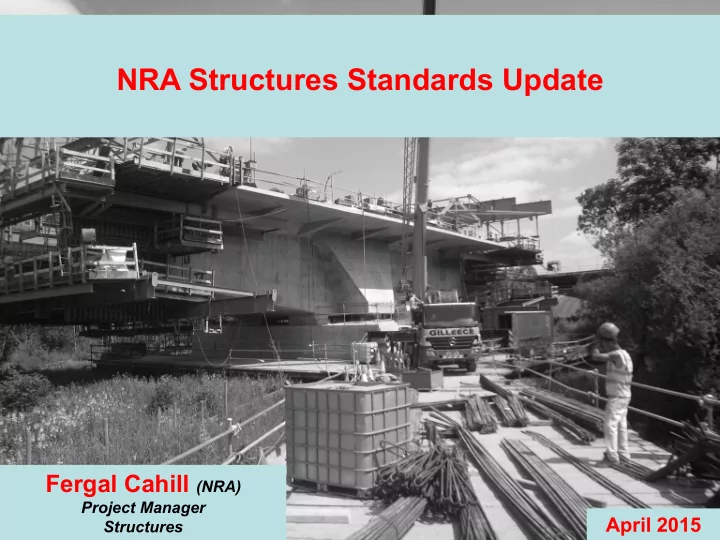
SLIDE 1 NRA Structures Standards Update
Fergal Cahill (NRA)
Project Manager Structures
April 2015
SLIDE 2 Presentation Outline
- Drivers of Change
- Structures Specification – NRA Manual Contract Documents Road Works (NRA MCDRW)
- Structures Standards – NRA Design Manual for Roads & Bridges (NRA DMRB)
- The Evolving EuroCodes
- NRA Weigh-In-Motion (WIM)
SLIDE 3 Drivers of Change
What’s Driving Change?
EuroCodes Outdated or Unclear Standards / Specifications Background Reading / Advice Notes – No contractual relevance Poor Construction practice + Lessons learnt New Materials Formatting EuroNorms Construction Products Regulations (CPR) No more Addendums
SLIDE 4 Structures Specifications – NRA MCDRW
NRA SD 02 Volume Contents
5 new documents have been published recently Working on updating 3 others – available 2015
SLIDE 5 Series 1700 (December 2013) -
Structural Concrete
Overview
- EuroCodes (IS EN 1992) based on assumption of construction and workmanship
(execution) to IS EN 13670 (Construction Management; Falsework & Formwork; Reinforcement; Prestressing; Concreting; Precast Elements; and Geometrical Tolerances)
- New Series 1700 now aligned with IS EN 13670 (Concrete Execution Code)
- New Series 1700 is based on new HA Series 1700 (rewritten for Ireland)
- Full review and update of all product standards referenced within Series 1700
to ensure compliance with the latest EuroNorms
- Provides general requirements to Designers compiling contract specific
structural concrete specifications on NRA schemes
Structures Specifications – NRA MCDRW
SLIDE 6 Series 1700 -
Structural Concrete
Items of Note:
- Execution Specification (1701.3)
- Before commencement of construction of any works the execution specification
relevant to that works must be complete and available (Table NG 17/1)
- Execution Class (1701.4)
- All works shall be built in accordance with Execution Class 3
- A set of requirements specifying quality levels for construction of the works (Inspection
- f Material & Products; Inspection of Execution; Documentation of Inspection)
- Self Compacting Concrete (1706.3)
- Not permitted for any insitu works
- If proposed in factory produced precast elements - prior approval of ER required
- If approved by ER – Shall conform to IS EN 206-9 & Testing to IS EN 12350-8 to 12
Structures Specifications – NRA MCDRW
SLIDE 7 Series 1700 -
Structural Concrete
Items of Note:
- Trial Panels (1708.1)
- This is not new! But we don’t get them on-site?
- Required (prior to works) for all exposed concrete
- To demonstrate surface finish can be achieved by the methods proposed
- Curing of Concrete (1710.5)
- Curing Class 3 (Cl 8.5 of IS EN 13670 & Annex F) required
- Duration – function of the development of 28 days compressive strength (50%)
- Concrete must be protected against harmful effects of weather (rain, temperature etc)
- Geometrical Tolerances (1728)
- Tolerances have been provided for road structures
- Irrespective of geometrical tolerances used - Modified partial safety factors (IS EN
1992-1-1 / IS EN 13369) not permitted
Structures Specifications – NRA MCDRW
SLIDE 8 Series 1700 -
Structural Concrete
Items of Note:
- CE Marking of Precast Products
- IS EN 13670 considers precast elements to be products. The key standards are:
- IS EN 15050 – Bridge Elements
- IS EN 14844 – Box Culverts
Structures Specifications – NRA MCDRW
SLIDE 9 Series 1800 (June 2014) -
Structural Steelwork
Overview
- Old Series 1800 based on BS 5400 Part 6 - now obsolete
- EuroCodes (IS EN 1993) based on assumption of executing to IS EN 1090-2
- New Series 1800 based on IS EN 1090-2 (Steel Execution Code)
- Based on new Highways Agency Series 1800 (rewritten for Ireland) which in turn is
based on BSi PD 6705 (Recommendations for the execution of steel bridges to EN 1090-2)
- Provides general requirements to Designers compiling contract specific
structural steelwork specifications in accordance with IS EN 1090-2
- Aim is to ensure technically sound choices are made, resulting in bridges being
executed as economical as possible, whilst maintaining the level of reliability implicit of IS EN 1990 & IS EN 1993
Structures Specifications – NRA MCDRW
SLIDE 10 Series 1800 -
Structural Steelwork
Main Differences between IS EN 1090-2 & BS 5400-6
- User Decision:
- 200 NDPs within IS EN 1090-2 compared to 39 within BS 5400-6
- Scope of Application:
- IS EN 1090-2 applies to all types of structural steelwork (BS 5400-6 specific to
bridges)
- Reference Standards:
- IS EN 1090-2 references over 100 new European standards many of which replace
British Standards (referenced within BS 5400-6)
- Material Grades:
- Range for plates & sections has increased from S460 (BS 5400-6) to S690 (IS EN
1090-2)
Structures Specifications – NRA MCDRW
SLIDE 11 Series 1800 -
Structural Steelwork
Main Differences between IS EN 1090-2 & BS 5400-6
- Product Forms:
- IS EN 1090-2 covers high strength cables (BS 5400-6 did not)
- Execution Methods:
- IS EN 1090-2 allows laser & plasma cut holes (not covered in BS 5400-6)
- Personnel Qualification:
- IS EN 1090-2 has qualification requirements for welding co-ordinators, welders &
weld inspectors. BS 5400-6 did not address this.
- Quality Management:
- IS EN 1090-2 addresses the subject of quality documentation & quality plans in a
more explicit manner.
Structures Specifications – NRA MCDRW
SLIDE 12 Series 1800 -
Structural Steelwork
Main Differences between IS EN 1090-2 & BS 5400-6
- Quality Control:
- IS EN 1090-2 is based on Factory Production Control (FPC) which is on-going and
testing is not specific to any particular contract or structure. BS 5400-6 does not address FPC.
- Acceptance Levels:
- As a result of FPC, target quality levels must be high enough to cover the most
quality sensitive design situations. BS 5400-6 quality based on fitness for purpose.
- Geometrical Tolerances:
- IS EN 1090-2 has more comprehensive requirements than BS 5400-6.
- Surface Treatment:
- IS EN 1090-2 covers the application of surface coatings (BS 5400-6 did not)
Structures Specifications – NRA MCDRW
SLIDE 13 Series 1800 -
Structural Steelwork
Items of Note:
- CE Marking of Products
- Open Sections – IS EN 10025-1
- Hollow Sections – IS EN 10210-1
- Plates – IS EN 10025-1
- CE Marking of fabricated structural steelwork
- Fabricated structural steelwork – IS EN 1090-1
- Execution Class
- Consequence Class (CC) + Service Category (SC) + Production Category (PC) =
Execution Class (EXC1, EXC2, EXC3 or EXC4)
- For bridges EXC3 shall generally (Cl. 1804.1.2) – i.e. EXC4 for long span bridges
Structures Specifications – NRA MCDRW
SLIDE 14 Series 1800 -
Structural Steelwork
Items of Note:
- Responsibility of Main Contractor to carry out due diligence of Steelwork Contractor
- Steelwork Contractor appointed must have an Execution Class equal to that
required for the project (EXC3 typically)
- Compliance with IS EN 1090-1 is no small task and places obligations on the
steelwork contractor that are onerous and take significant time to put in place
- Steelwork Contractor must demonstrate compliance with the CPR and CE Marking:
- Factory Production Control (FPC) Certificate – issued by a notified body
- Welding Certificate – issued by a notified body
- Declaration of Performance (DoP) – issued by steelwork contractor
Structures Specifications – NRA MCDRW
SLIDE 15
Series 1800 -
Structural Steelwork
Structures Specifications – NRA MCDRW
SLIDE 16 Series 1800 (December 2014) –
Road Construction Details – Steelwork for Structures (RCD/1800/1 to RCD/1800/9)
Overview
- RCDs updated to reflect a revised sign clamping detail for each of the groups –
ensures future versatility
- RCDs updated to take account of the EuroCodes (all BS references removed)
- RCDs updated to take account of the EuroNorms
- The purpose of the Family Groups is to ensure a consistency of structural form
across the network
Structures Specifications – NRA MCDRW
SLIDE 17 Series 1800 –
Road Construction Details – Steelwork for Structures (RCD/1800/1 to RCD/1800/9)
Items of Note
- All Gantry’s require an independent Design & Check to be undertaken
- All Gantry legs < 4.5m from edge of carriageway shall be designed for impact
(regardless of presence of vehicle restraint system)
- All section sizes and details are minimum indicative sizes only
- It is the responsibility of the Designer to avoid clashes of the clamps and
steelwork
- A 750mm concrete plinth has been introduced for all Family Groups
- All splices and connections to be fully top coated after assembly - All gaps to
be sealed
Structures Specifications – NRA MCDRW
SLIDE 18
Series 1800 –
Road Construction Details – Steelwork for Structures (RCD/1800/1 to RCD/1800/9)
Structures Specifications – NRA MCDRW
SLIDE 19 Series 1900 (June 2014) -
Protection of Steelwork against Corrosion
Overview
- Based on new Highways Agency Series 1900 (rewritten for Ireland)
- Takes account of updates made to NRA BD 35/14 (Quality Assurance Scheme for Paints)
- No changes to maintenance painting clauses (1970 to 1984)
- Compatible with IS EN 1090-2 – Execution of Steel Structures
- Provides guidance to Designers compiling contract specific specifications pertaining
to surface preparation and corrosion protection
- Provides guidance to those undertaking the works
- Aim to provide economic safe working life from steel assets
Structures Specifications – NRA MCDRW
SLIDE 20 Structures Specifications – NRA MCDRW
Main Changes Maintenance Painting Section Remains
SLIDE 21 Series 1900 -
Protection of Steelwork against Corrosion
Structures Specifications – NRA MCDRW
Items of Note:
- Update of Table 19/1 (Permissible Paint Item Numbers)
- 2 added / 16 deleted
- Update of Table 19/2B (System Requirements for Bridges)
- Minimum dft for the system increased from 475 to 525 microns
- Paint Testing is Required - CREST is Testing Authority
- has always been required but not typically undertaken!!
- ‘A’ samples (quality assurance) – if >500 litres (previously 1000 litres)
- ‘B’ samples (application control) – required in all cases
SLIDE 22 Series 1900 -
Protection of Steelwork against Corrosion
Structures Specifications – NRA MCDRW
Items of Note:
- Independent Painting Inspection Firm Required
- Shall be employed by the Contractor
- Inspect & Test all corrosion protection systems in-shop and on-site
- Personnel – shall be certified painting inspectors (Level 2 Icorr Cert / CIP Level 2)
- ER must review and approve CVs
- Inspectors Report required to be submitted to ER within 5 days of inspection
- Thermally sprayed metal coating – excluded from general protection of bridges
- Aluminium – preferred thermally sprayed metal coating (where appropriate – bearings,
CCTV masts, lighting columns)
- Zinc metal spray no longer permissible
SLIDE 23
Series 1900 -
Protection of Steelwork against Corrosion
Structures Specifications – NRA MCDRW
SLIDE 24
Series 1900 -
Protection of Steelwork against Corrosion
Structures Specifications – NRA MCDRW
SLIDE 25 Series 2400 (December 2013) -
Brickwork, Blockwork & Stonework
Items of Note
- New Clauses pertaining to the Masonry Repointing of Historic Structures have
been added
- (17) Clauses 2401 to 2416 pertain to brickwork, blockwork & stonework within
new construction
- (16) Clauses 2450 to 2465 pertain to historic structures
- A Lime Mortar shall be used for the repointing of all Historic Structures (and any
- ther structure originally constructed using a lime mortar)
- Series 2400 has been updated to reflect the latest EuroNorms – All outdated
British Standards have been removed (e.g. BS 4027 ~ IS EN 197-1)
- A new RCD (RCD/2400/7) pertaining to the Principles of Stonemasonry has been
created
Structures Specifications – NRA MCDRW
SLIDE 26
Series 2400 (December 2013) -
Road Construction Details – Walls (RCD/2400/7)
Structures Specifications – NRA MCDRW
SLIDE 27 Series 2500 (June 2014) -
Road Construction Details – Special Structures (RCD/2500/1 to RCD/2500/3)
Overview
- Concern about poor quality agricultural underpasses being constructed
beneath the national road network
- These were typically one off developments and were constructed with little or
no consideration to NRA standards (sub-standard)
- Aim to produce a set of RCDs that would inform all parties of keys issues to be
addressed (prior to any works being undertaken)
- Pulls together all NRA requirements into one location
- An extensive set of drawing notes have been included (RCD/2500/3)
Structures Specifications – NRA MCDRW
SLIDE 28 Series 2500 -
Road Construction Details – Special Structures (RCD/2500/1 to RCD/2500/3)
Items of Note
- Design:
- Chartered Engineer with previous National Road Design Experience required
- Prior to Planning Application a TAR must be submitted to the NRA for approval
- No gabions permitted as part of any earth retention system
- Eurocodes / EuroNorms & NRA DMRB & NRA MCDRW
- Vehicle Restraint System:
- In accordance with NRA TD 19 for approach / departure lengths, working widths
- Execution:
- Road opening licence required from the relevant LA
- Construction Sequence & Traffic Management to be agreed with LA (and
addressed within TAR)
Structures Specifications – NRA MCDRW
SLIDE 29 Series 2500 -
Road Construction Details – Special Structures (RCD/2500/1 to RCD/2500/3)
Items of Note
- Road Safety Audit:
- Stage 2 & Stage 3 Road Safety Audits required (NRA HD 19)
- Road Reinstatement:
- Proposals must be approved by the LA prior to any works taking place
(condition of the road opening licence)
- Health and Safety:
- PSDP, PSCS & Risk Assessments required in accordance with Safety, Health
& Welfare (Construction) Regulations
Structures Specifications – NRA MCDRW
SLIDE 30
Structures Specifications – NRA MCDRW
SLIDE 31
Structures Specifications – NRA MCDRW
SLIDE 32 Series 5500 – Structural Concrete Repair Structures Specifications – NRA MCDRW
Look Ahead (Future Work 2015) – 4 new documents planned for 2015
- NRA Series 2000 Waterproofing for Concrete Structures:
- To be rewritten from scratch to suit the Irish market
- To be reviewed in conjunction with planned update of BD47 & BA47
- NRA Series 2100 Bridge Bearings:
- To be rewritten from scratch to suit the Irish market
- To be reviewed in conjunction with planned update of BD20
- NRA Series 2300 Bridge Expansion Joints & Sealing of Gaps:
- To be rewritten from scratch to suit the Irish market
- To be reviewed in conjunction with planned update of BD33 & BA26
- NRA Series 5500 Structural Concrete Repairs:
- No NRA specification pertaining to concrete repair to date
- To be based upon draft HA Concrete Repair Specification
- IS EN 1504 Products & Systems for the Protection/Repair of Concrete Structures
SLIDE 33
Structures Standards – NRA DMRB
http://nrastandards.nra.ie
SLIDE 34 Structures Standards – NRA DMRB
Section Number Title 1.2.1 BD 36 Evaluation of Maintenance Costs in Comparing Alternative Designs for Highway Structures 1.2.2 BA 28 Evaluation of Maintenance Costs in Comparing Alternative Designs for Highway Structures 1.3.4 BA 40 Tack Welding of Reinforcing Bars 1.3.13 BA 53 Bracing Systems and the Use of U-Frames in Steel Highway Bridges 1.3.14 BD 10 Design of Highway Structures in Areas of Mining Subsidence 1.3 BA 19 The Use of BS 5400: Part 3 1.3 BA 24 Early Thermal Cracking of Concrete 1.3.15 BA 84 Use of Stainless Steel Reinforcement in Highway Structures 1.3 BE 23 Shear Key Decks 1.3 BE 5 Rules for the Design and Use of Freyssinet Concrete Hinges in Highway Structures. 1.3.8 BA 57 Design for Durability
NRA GD 02 – Volume Contents Volume 1 – Structures – Approval Procedures & General Design 11 Documents Withdrawn
SLIDE 35 Structures Standards – NRA DMRB
NRA GD 02 Volume 1
9 documents retained 1 new document added
SLIDE 36 Structures Standards – NRA DMRB
Overview
- Provides requirements for the treatment of existing structures affected by road
widening schemes
- Based on HA BD 95/07 (rewritten for Ireland)
- Describes the process to be applied through preliminary & detailed design
- Provides advice to commonly encountered situations (typical current design standard
requirements not met by existing structures) – Appendix B
- Reuse as much existing infrastructure as possible where economical to do so
(e.g. Departures for existing non-compliances?)
- Clarifies the requirements for Assessment of Existing structures (Review of Existing
Assessment Form – REAF – Appendix A)
NRA BD 95/14 (Dec 2014) -
Treatment of Existing Structures on Road Widening Schemes
SLIDE 37 Structures Standards – NRA DMRB
The Procedure for Dealing with Existing Structures - Process Flow Chart Everything should combine to form the Preliminary Design Report (PDR) – this
- ccurs within Phase 1 to 4 of
a scheme
SLIDE 38
Structures Standards – NRA DMRB
NRA BD 95/14 (Dec 2014) -
Treatment of Existing Structures on Road Widening Schemes
SLIDE 39
Structures Standards – NRA DMRB
NRA BD 95 - Treatment of Existing Structures on Road Widening Schemes
SLIDE 40 Structures Standards – NRA DMRB
NRA GD 02 – Volume Contents Volume 2 – Structures – Design & Materials 16 Documents Withdrawn
Section Number Title 2.1.1 BD 41 Reinforced Clay Brickwork Retaining Walls of Pocket-Type and Grouted-Cavity Type Construction 2.1.2 BD 42 Design of Embedded Retaining Walls and Bridge Abutments 2.1.3 BD 68 Crib Retaining Walls 2.1.4 BA 68 Crib Retaining Walls 2.1.5 BD 70 Strengthened/Reinforced Soils and Other Fills for Retaining Walls and Bridge Abutments 2.1 BD 30 Backfilled Retaining Walls and Bridge Abutments 2.1.7 BA 80 Use of Rockbolts 2.2.1 BD 26 Design of Lighting Columns 2.2.2 BA 48 Pedestrian Protection at Head Walls, Wing Walls and Retaining Walls 2.2.11 BD 83 Design of CCTV Masts 2.2.13 BD 88 Design of Cantilever Masts for Traffic Signals and/or Speed Cameras 2.3.2 BA 37 Priority Ranking of Existing Parapets 2.3.7 BA 82 Formation of Continuity Joints for Use in Bridge Decks 2.3.9 BA 92 The use of recycled Aggregates in Structural Concrete 2.4.2 BA 27 Quality Assurance Scheme for Paints and Similar Protective Coatings 2.2 BE 7 Departmental Standard (Interim) Motorway Sign/Signal Gantries
SLIDE 41
Structures Standards – NRA DMRB
NRA GD 02 Volume 2 19 documents retained 3 new documents added
SLIDE 42 Structures Standards – NRA DMRB
NRA BD 94/14 (Dec 2014) -
Design of Support Structures for Roadside Furniture
Overview
- Replaces NRA Addendums to BD26 (Design of Lighting Columns); BD83 (Design of
CCTV Masts); & BD88 (Design of Cantilever Masts for Traffic Signals and/or Speed Cameras)
- Standalone NRA BD - Covers the design of support structures for roadside
furniture (Lighting Columns; Masts to support CCTV, Traffic Signals, Speed Cameras; Traffic Signs)
- It incorporates the provisions of IS EN 40 (Lighting Columns) & IS EN 12899 (Fixed
Vertical Road Traffic Signs)
- To be used when designing a support structure from first principles (typically these
support structures are supplied as proprietary products – off the shelf)
- All proprietary products should be checked for compliance with this standard
SLIDE 43 Structures Standards – NRA DMRB
NRA BD 94/14 (Dec 2014) -
Design of Support Structures for Roadside Furniture
Items of Note:
- Foundations (Chapter 11) – Support Structures typically off the shelf but
foundations responsibility of Design Engineer
- A TAR is required for certain minor structures (e.g. High Masts for lighting or cameras) in
accordance with NRA BD2 (CAT 1)
- All design shall be in accordance with the Eurocodes
- Design Working Life (Cl 5.2) shall be in compliance with IS EN 1990 – Working
Life Category 3 (up to 50 years for masts supporting lighting columns / traffic signals) & Working Life Category 4 (50-120 years for high mast lighting)
- Fatigue Criteria (Cl 5.10 – 5.16) – dependent on geometrical configuration &
fabrication
SLIDE 44
Structures Standards – NRA DMRB
NRA BD 94/14 (Dec 2014) -
Design of Support Structures for Roadside Furniture
SLIDE 45 Structures Standards – NRA DMRB
NRA BD 51/14 (Dec 2014) -
Portal and Cantilever Sign / Signal Gantries
Overview
- Replaces NRA Addendum to HA BD51/98 (17 years old)
- Based on new Highways Agency BD51/14 (rewritten for Ireland)
- Sets out the structural design requirements for Gantries (in terms of the EuroCodes)
- Updated to comply with the EuroCodes & EuroNorms (removal of obsolete references)
- Linked to the Series 1800 RCDs (Gantry groups 1 to 5) – all plate sizes are
minimum sizes (prohibited to reduce plate / weld sizes)
- Relevant to any sign structure that cantilevers out over the carriageway / hard
shoulder
- Identification Plates shall be attached to each new structure
SLIDE 46 Structures Standards – NRA DMRB
NRA BD 51/14 -
Portal and Cantilever Sign / Signal Gantries
Items of Note
- 60 year design life for gantry structures
- 5.8m vertical clearance required
- The limiting Structural Deformations (serviceability limit state) for gantries (Table 3.1)
specified within BD51/98 have been retained
- Vehicle impact loading specified is similar to that stated within the NA to IS EN
1991-1-7
- The combined effects of axial compression / tension; torsion & biaxial bending
must be checked
- Must check if a gantry is dynamically sensitive
- Supports within 4.5m of carriageway – must design for impact (regardless of VRS)
SLIDE 47 Structures Standards – NRA DMRB
NRA BD 35/14 (June 2014) -
Quality Assurance Scheme for Paints and similar Protective Coatings
- Provides details of the quality assurance
scheme for paints
- Provides Specifiers; Designers; &
Supervisors of works guidance on the
- peration of the quality assurance
scheme for paints
- Provides Manufacturers; Certifiers; &
Testers of paints with paint material requirements
SLIDE 48 Structures Standards – NRA DMRB
NRA BD 35/14 -
Quality Assurance Scheme for Paints and similar Protective Coatings
- Replaces NRA addendum to BD 35/99 – completely outdated (16 years old)
- Based on Highways Agency BD35/14 (rewritten for Ireland)
- Updated Appendix A – Manual of Paints for Structural Steelwork
- Provides data on paints permitted for use on NRA painting contracts
- 2 items added (Item No. 109, 167)
- 16 items deleted (Item No. 14, 32, 35, 47, 50, 70, 74, 124, 132, 133, 134, 135, 141, 150, 151, 156)
- Changes based on extensive research programme conducted in UK
- Developed in conjunction with industry
- Balance of performance v cost v traffic disruption on national roads
- For maintenance painting – refer to NRA BD 87 & contract specific requirements
SLIDE 49 Structures Standards – NRA DMRB
NRA BD 35/14 -
Quality Assurance Scheme for Paints and similar Protective Coatings
Quality Assurance Scheme
1. Certification of Paints
- BBA HAPAS (or equivalent) required for all paint systems (www.bbacerts.co.uk)
- Ensures required level of corrosion protection
- Certification must be submitted to ER for approval
2. Testing of ‘A’ and ‘B’ samples
- Requirements specified in Series 1900
- Independent Testing Authority – CREST (or equivalent)
SLIDE 50 Structures Standards – NRA DMRB
NRA BD 35/14 -
Quality Assurance Scheme for Paints and similar Protective Coatings
- Paints described using standard terminology
- Enables paints to be described in generic terms
- Without specifying trade names
SLIDE 51 Structures Standards – NRA DMRB
NRA DMRB Volume 2 – Structures: Design & Materials
Look Ahead (Future Work 2015) – 4 new documents planned
1. New NRA BD - Expansion Joints
- BD33 Expansion Joints for Use in Highway Bridge Decks + BA47 Expansion
Joints for Use in Highway Bridge Decks
2. New NRA BD – Hydrophobic Pore Liner / Coatings
- BD43 Criteria and Materials for the Impregnation of Concrete Highway Structures +
BA 85 Coatings for Concrete Highways Structures & Ancillary Structures
3. New NRA BD – Waterproofing & Surfacing
- BD47 Waterproofing & Surfacing of Concrete Bridge Decks + BA47 Waterproofing
& Surfacing of Concrete Bridge Decks
4. New NRA BD – Bridge Bearings
- BD20 Bridge Bearings: Use of BS 5400 Part 9 (1983)
SLIDE 52 Structures Standards – NRA DMRB
NRA GD 02 Volume Contents Volume 3 Structures – Inspection & Maintenance Until recently Volume 3 was not formally implemented – background reading only 41 Documents Added:
- Section 1 Inspection – 4
- Section 3 Repair - 5
SLIDE 53 Structures Standards – NRA DMRB
41 Documents Added:
- Section 4 Assessment – 16
NRA GD 02 Volume Contents Volume 3 Structures – Inspection & Maintenance
SLIDE 54 Structures Standards – NRA DMRB
41 Documents Added:
- Section 5 Standards & Advice Notes
superseded by Eurocodes but required for assessment – 16
NRA GD 02 Volume Contents Volume 3 Structures – Inspection & Maintenance
SLIDE 55 Structures Standards – NRA DMRB
NRA DMRB Volume 3 – Structures: Inspection & Maintenance
Look Ahead (Future Work 2015) – 9 new documents planned 1. NRA BD 300 EIRSPAN – Inventory Manual 2. NRA BD 301 EIRSPAN – Principle Inspection 3. NRA BD 302 EIRSPAN – Routine Inspection 4. NRA BD 303 The Stage I Structural Assessment of Road Structures 5. NRA BD 304 The Stage II Structural Assessment of Road Structures 6. NRA BD 89 The Conservation of Road Structures 7. NRA BD 27 The Protection and Repair of Concrete Road Structures 8. NRA BD 97 The Assessment of Scour and other Hydraulic Actions at Road Structures 9. NRA BD 86 The Assessment of Road Bridges & Structures for the Effects of Abnormal &
Exceptional Abnormal Load Vehicles using SV & SOV Load Models
SLIDE 56 Structures Standards – NRA DMRB
NRA BD 86/15 (March 2015) -
The Assessment of Road Bridges & Structures for the Effects of Abnormal & Exceptional Abnormal Load Vehicles using SV & SOV Load Models
What is it?:
- A standard to assess bridges for the effects of abnormal vehicles (in
combination with the effects of C&U vehicles and permanent loads)
- Provides requirements on how to determine the “Vehicle Rating” and
“Reserve Factor” for a particular structure When would you use it?:
- As directed by NRA BD 101 (significant deterioration)
- In the management of Abnormal Vehicle movements
- And as agreed with the structures section of the NRA
SLIDE 57 Structures Standards – NRA DMRB
What benefits does it provide?
- More realistic abnormal load models (v HB Load Model)
- Attainment of higher load capacity ratings (particularly for spans < 10m)
- Flexibility to modify Overload Factor & Dynamic Amplification Factor
NRA BD 86/15 -
The Assessment of Road Bridges & Structures for the Effects of Abnormal & Exceptional Abnormal Load Vehicles using SV & SOV Load Models
SLIDE 58
Structures Standards – NRA DMRB
Abnormal Loads ~ SV 80 to 196 Exceptional Abnormal Loads ~ SOV 250 to SOV 600
SLIDE 59
Structures Standards – NRA DMRB
NRA BD 86/15
Abnormal & Exceptional Abnormal Load Models
HB Load Model SV196 Load Model SOV Load Models
SLIDE 60
Structures Standards – NRA DMRB
NRA BD 86/15 -
The Assessment of Road Bridges & Structures for the Effects of Abnormal & Exceptional Abnormal Load Vehicles using SV & SOV Load Models
SLIDE 61 Structures Standards – NRA DMRB
NRA BD 86/15
- Reserve Factors – ability of a bridge to carry an abnormal load model
- Capacity/Demand Ratio > 1.0
SLIDE 62 The Evolving EuroCodes
History
- 10 EuroCode standards (58 individual parts)
- developed between late 1970s and 2010
- so took about 30 years to develop
- Introduced in 31st March 2010
- design to Eurocodes becomes mandatory (CEN)
- withdrawal of conflicting national codes
- Now 2015 (5 year review) - need to evolution to ensure:
- remain current
- fit for purpose
SLIDE 63 The Evolving EuroCodes
History
- European Commission (Dec 2012) – Mandate M/515
- request CEN to develop a detailed work programme for the
future activities of CEN/TC250
- CEN/TC250 respond to EC:
- May 2013 – 138 page document
- Over 1000 experts across Europe involved in response
- 77 discrete tasks (evolving)
- “Towards a second generation of EN Eurocodes”
- 5 year Programme (2015 – 2020)
- €10 Million Budget
SLIDE 64 Towards a second generation of EN EuroCodes
1. Improve the existing codes (make them easier to use)
- Feedback from practitioners – systematic reviews
- Improve the clarity - Enhance User friendliness
- Simply routes through the codes
- Reduce the amount of national variation (NDPs)
- Reduce number of alternate design methods
- Remove rules of little practical use
- Substantial additions required
- Incorporate new state of the art
- Needs of the market
The Evolving EuroCodes
SLIDE 65 The Evolving EuroCodes
Towards a second generation of EN EuroCodes
2. Develop new codes
- Existing Structures & Assessment (WG2)
- JRC Policy Report – “New European Technical Rules for the Assessment &
Retrofitting of Existing Structures”
- http://eurocodes.jrc.ec.europa.eu/showpublication.php?id=535
- Purpose is to stimulate debate – NOT for use
- Comments required by 9th September 2015
- Structural Glass (WG3)
- Fibre Reinforced Polymers (WG4)
- Membrane Structures (WG5)
- Robustness (WG6)
SLIDE 66 The Evolving Eurocodes
NSAI EuroCodes Consultative Committee
- ECC Replaces NEAC (Oct 2013)
- NSAI TC 015 – mirrors CEN/TC250
- ECC Advises NSAI on all things EuroCodes
SLIDE 67 NRA Weigh-In-Motion (WIM)
Site #1 Donabate, Dublin Site #2 Black Bull, Meath Site #3 Maynooth, Kildare Site #4 Lewistown, Kildare Site #5 Gorey, Wexford Site #6 Citywest South, Dublin
SLIDE 68
Camera’s Traffic Loops Control Cabinet WIM Sensors
NRA Weigh-In-Motion (WIM)
SLIDE 69
NRA Weigh-In-Motion (WIM)
SLIDE 70
- We’re blind – The NRA have no HCV loading / overload Network Indicators
- Overloaded Trucks / Axles cause a lot of damage to Roads & Bridges
- The relationship between axle weight & pavement damage is not linear
- 4th Power Law - Overloaded Axles cause exponential damage to pavements
- Initial NRA focus – determine the state of truck loading on National Primary’s
- Knowledge facilitates more efficient management & maintenance
- Need a couple of years of good data prior to any detailed analysis being
conducted (............12 months so far)
NRA Weigh-In-Motion (WIM)
SLIDE 71 WIM STATISTICS
Bridge Design & Assessment Road Pavement Design & Assessment Road Safety
Trucks Level of illegal Overloading Research & Development
NRA Weigh-In-Motion (WIM)
SLIDE 72 SECTION 3 - Cumulative GVW Histogram
One Year of Data (2014) - Across all 6 Sites
46T Limit 50T to 70T - Probably
Tail - 76T to 190T – you would hope these are all permit trucks! 190T
NRA Weigh-In-Motion (WIM)
SLIDE 73
NRA Weigh-In-Motion (WIM)
8 Axle – 137T 10 Axle – 123T 3 Axle – 48T
11T - 17T - 18T
5 Axle – 72T
3 Axle Limit– 26T 85% Overloaded 5 Axle Limit – 42T 71% Overloaded 6 Axle Limit – 46T 70% Overloaded
6 Axle – 78T
10T – 12T – 17T – 13T – 13T – 13T
SLIDE 74 Engineers Ireland Presentation
- http://www.engineersireland.ie/Communications/Engineer-TV-Archive.aspx
- Communications / Engineers TV Archive
- “Traffic Monitoring Systems across the National Road Network” - (11/02/15)
NRA Weigh-In-Motion (WIM)
SLIDE 75 Many Thanks for your Attention
Any queries, contact: Fergal Cahill (NRA)
fcahill@nra.ie