Ecosan Services Foundation Nanchoz Zimmermann Dipl. Ing. ETH - - PDF document
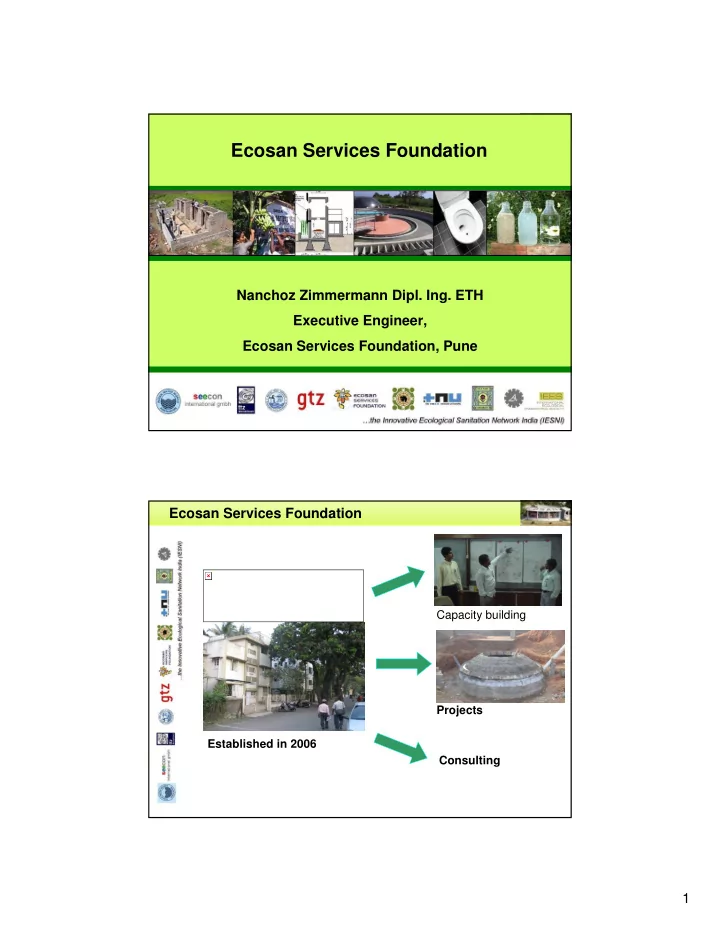
Ecosan Services Foundation Nanchoz Zimmermann Dipl. Ing. ETH Executive Engineer, Ecosan Services Foundation, Pune Ecosan Services Foundation Capacity building Projects Established in 2006 Consulting 1 IESNI Members of the Innovative
2
IESNI
Source: GTZ
Members of the Innovative Ecological Sanitation Network India (IESNI):
Indian Water Works Association, India Seecon international, Switzerland Technologie- Transfer Zentrum and der Hochschule Bremerhaven, Germany The Network University, Netherlands Maharashtra Jeevan Pradhikaran, India Ecosan Services Foundation, India German Technical Cooperation, Germany Navsarjan Trust, India Kalyani University, India ACTS, India International Ecological Engineering Society, Switzerland
Innovative Ecological Sanitation Network India (IESNI)
Supporting the development of:
- innovative ecological sanitation systems (closed loop
systems) for India (for rural and urban applications)
- the institutional and economical framework for
implementation of innovative ecological sanitation systems in India
- the acceptance of reusing recycled nutrients in agricultural
applications Implementing and evaluating pilot projects in India. Providing capacity building, knowledge dissemination, experience sharing and implementation support
Logos der Partner IESNI – a virtual network
Objektives:
3 Role of ESF into the IESNI
Training courses Pilot Projects Comercial projects Feasibilty studies
IESNI
CO-Organisation of National Workshop on Sustainable Sanitation
Objective of the Ecosan Course
Source: GTZ
Many successful ecosan projects raised awareness and acceptance for innovative ecological sanitation solutions worldwide. But: Significant lack of qualified local personnel to implement projects at the grassroots level.
Two-week participatory and interdisciplinary ecosan training course, which enables local participants to plan, implement and maintain their own ecosan projects.
4 ESF training courses basics lectures technolgies case studies excursions / site visits
- 1. week
- 2. week
source: gtz
Ecosan Services Foundation
Teaching Methods
Source: GTZ
Lectures
International team of ecosan experts from India, Thailand, Switzerland, Germany and Austria.
5
Teaching Methods
Source: GTZ
Group Works
Interactive group works from assessing drawbacks of conventional sanitation systems to the designing and planning of real ecosan projects.
Teaching Methods
Source: GTZ
Role Plays
By playing different roles, participants get an insight into the requirements of different stakeholder groups to a sustainable sanitation system.
6
Teaching Methods
Source: GTZ
Case Studies
Case studies give the participants insight into working ecosan projects.
Teaching Methods
Source: GTZ
Field Trip to Ecosan Projects
By visiting ecosan projects in a two-day field trip, participants see working ecological sanitations systems in practice, which is very important for their thorough understanding of the concept.
7
Teaching Methods
Source: GTZ
Field Trip to Ecosan Projects Teaching Methods
Source: GTZ
Own Ecosan Case Study Development
In the second week of the course, participants develop an outline of an real ecosan project including the project background, decision making process, a holistic reuse concept and technical alternatives.
8
Used Material
Source: GTZ
Promotion Flyers Course Folder for every participant Ecosan Curriculum 2.0 CD Used Material
Source: GTZ
Learning Material: Capacity Building for Ecological Sanitation Ecosan Models
9
Ecosan Course Certification:
On completion of the course ,the participants get;
- A course certificate from the International Ecological Engineering
Society (IEES), Switzerland and the Innovative Ecological Sanitation Network India (IESNI)
- Ecosan Expert Card
Course Statistics
- So far, 5 courses have been held, 3 2-weeks
courses and 2 one-week courses. More than 60 participants have been trained.
- 5 projects planned/implemented by former course
participants
- Participants come from
- NGOs
- Government agencies
- Universities
- Private companies
- Course participants from various Indian states,
Bangladesh, Philippines and China
- Course structure contributes to establishing a good
network for sustainable sanitation
10
Feedback from Students
Source: GTZ
“We learned a holistic approach to sanitation and project management.” Ashish Deshpande, MJP Maharashtra “The interactive approach is an unusual teaching method in
- India. We enjoyed it and