Whither NEAC An Overview of the Past, Present An Overview of the - - PDF document

whither neac
SMART_READER_LITE
LIVE PREVIEW

Whither NEAC An Overview of the Past, Present An Overview of the - - PDF document

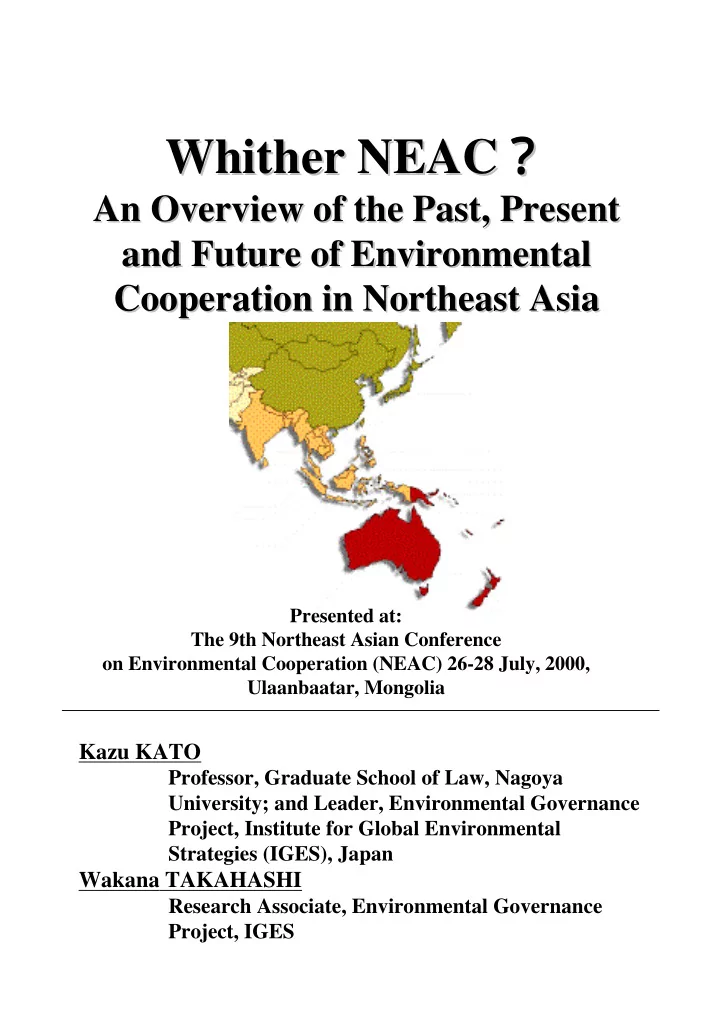
Whither NEAC Whither NEAC An Overview of the Past, Present An Overview of the Past, Present and Future of Environmental and Future of Environmental Cooperation in Northeast Asia Cooperation in Northeast Asia Presented at: The 9th


slide-1
SLIDE 1

Presented at: The 9th Northeast Asian Conference

  • n Environmental Cooperation (NEAC) 26-28 July, 2000,

Ulaanbaatar, Mongolia

Kazu KATO

Professor, Graduate School of Law, Nagoya University; and Leader, Environmental Governance Project, Institute for Global Environmental Strategies (IGES), Japan

Wakana TAKAHASHI

Research Associate, Environmental Governance Project, IGES

Whither NEAC Whither NEAC? ?

An Overview of the Past, Present An Overview of the Past, Present and Future of Environmental and Future of Environmental Cooperation in Northeast Asia Cooperation in Northeast Asia

slide-2
SLIDE 2

1

A Historical Perspective

Globalization of environmental problems, perceptions and

policy responses as evidenced by the 1972 Stockholm Conference (UNCHE) UNEP created within the UN system

The need for regional cooperation increasingly recognized,

even prior to the Stockholm Conference, to address issues of common concern, particularly concerning the conservation and management of internationally shared natural resources

  • e. g. international waters and semi-enclosed seas

fisheries migratory birds and animals

Regional approaches promoted by UNEP

  • e. g. Establishment of Regional Offices within UNEP

Institutional support to UN Regional Economic Commissions, including ESCAP Regional Seas Programme

Paradigm

shift from “environmental protection” to “sustainable development” World Conservation Strategy (1980) WCED (the Brundtland Commission) report (1987)

The Rio Earth Summit (UNCED 1992)

Agenda 21 calls for global partnership and enhanced cooperation at regional and subregional levels.

slide-3
SLIDE 3

2

Regional Environmental Programmes in the Asia-Pacific Region I. The Region As a Whole: the RAP for ESSD

The 1st Ministerial Conference of ESCAP on Environment

and Development held in 1985, releases the 1st State of the Environment report for Asia and the Pacific.

The 2nd Ministerial Conference adopts a “Regional Strategy

for ESSD.”

Regional Action Programme 1996-2000 adopted by the 3rd

Ministerial Conference.

The 4th MCED (to be held in Kitakyushu, Japan in early

September 2000) is expected to adopt a revised RAP, 2001- 2005, emphasizing its ownership by member countries while calling for further regional cooperation and subregional delivery. II. Subregional Environmental Programmes Southeast Asia

ASEAN Sub-regional Environmental Programme (ASEP

I~III, 1977~1992) and subsequent Strategic Plans of Action

  • n Environment. Coordinated by the ASEAN Senior

Officials on the Environment (ASOEN) and at various levels of government, serviced by the ASEAN secretariat.

ASEAN Agreement on the Conservation of Nature and

Natural Resources (1985, has not entered into force)

Cooperation Plan on Transfrontier Pollution (1995), and

Regional Haze Action Plan (1997)

East Asian Sea Action Plan (1981~ , revised in 1994) The Mekong River Commission (MRC) revived and the

Agreement on Cooperation for Sustainable Development of the Mekong River Basin signed in 1996

slide-4
SLIDE 4

3

The South Pacific

South

Pacific Regional Environmental Programme (SPREP) and the South Pacific Action Plan on Marine Environment adopted in 1982

Noumea Convention for the Conservation of Natural

Resources and the Environment (1986)

SPREP as an international organization established in

1992 (came into being in 1995)

Revised Action Plans, and a new Strategy document being

prepared for adoption later this year (2000) South Asia

South

Asia Co-operative Environment Programme (SACEP) established in 1981

South Asian Seas Action Plan (1995) Male Declaration on Prevention and Control of Air

Pollution and its Likely Transboundary Effects (1998) Hindu Kush/Himalayas

International

Center for Integrated Mountain Development (ICIMOD) established in 1983

Initial work programmes, followed by core programmes

and regional collaborative programmes Central Asia

International Fund for the Aral Sea (IFAS)

slide-5
SLIDE 5

4

NEASPEC NEASPEC ASEAN ASEAN (ASEP, etc) (ASEP, etc) SACEP SACEP SPREP SPREP ICIMOD ICIMOD

Source: http://www.theodora.com/maps

RAP RAP (ESCAP) (ESCAP) MRC MRC

slide-6
SLIDE 6

5

Environmental Cooperation in Northeast Asia

The burgeoning (almost bursting) emergence of multilateral

as well as bilateral programmes and forums, in the post- UNCED period

At different levels of international and national governance,

with a multiple layer of actors and participants

With different geographical and thematic /issue coverage With different institutional arrangements (if at all)

I. Cooperation At the Subregional Level

  • A. Intergovernmental Programmes and Forums

Northeast Asian Conference on Environmental Cooperation (NEAC)

An outgrowth of the Japan-ROK Environmental Symposium

held since 1988, NEAC was first organized and hosted by Japan in 1992, and continues to be held annually in different participating countries, largely funded by the Environment Agency of Japan (EAJ).

Has turned into a forum for exchange of information and

policy dialogue on a wide range of topics among environmental authorities of national and local governments and other experts, often held in conjunction with a symposium open to the public.

slide-7
SLIDE 7

6

Northeast Asian Subregional Programme on Environmental Cooperation (NEASPEC)

The establishment of NEASPEC agreed at the 1st Meeting of

Senior Officials (SOM) on Environmental Cooperation in Northeast Asia held in Seoul, ROK in 1993. Since then, holding highly formal meetings through diplomatic channels every one or two years, serviced by the ESCAP secretariat.

The framework NEASPEC adopted at the 3rd SOM, held in

1996 in Mongolia

3 priority areas identified (energy and air pollution, ecosystem

management, and capacity building), and a number of projects carried out with funding from ADB.

Moving toward a more permanent structure with the

establishment of a core fund, strongly promoted by ROK. Action Plan for the Protection, Management and Development of the Marine and Coastal Environment of the Northwest Pacific Region (NOWPAP)

The latest addition (1994) to the Regional Seas Programme of

UNEP, and still in the formative stages of institutional structure, specific action plans and projects. Tripartite Environment Ministers Meeting (TEMM)

Building on existing bilateral agreements for environmental

cooperation between China, ROK and Japan, elevated in 1999 to a trilateral ministerial meeting on a regular (annual) basis, with possibilities to carry out agreed cooperative projects.

Priority areas: a) raising awareness and the sense of

"environmental community" among the 3 countries; b) global environmental issues such as biodiversity and climate change; c) air pollution and marine environment; d)environmental technology, industry, and research

slide-8
SLIDE 8

7

Tumen River Area Development Programme (TRADP)

Basically a regional economic development programme for the

Tumen River among the 5 riparian states of China, North and South Korea, Mongolia, and Russia) promoted by UNDP.

A Strategic Action Programme (SAP) and the Tumen

Programme Environmental Action Plan developed to deal with international water pollution and loss of biodiversity, with a $ 5 million funding from GEF over two years in 2000.

  • B. Cooperative Network of Local Governments

Association of Northeast Asia Regional Governments

Established in 1996, with 34 local governments from 5

countries of the region participating, with a coordinating body and rotating secretariat provided by the host local government.

Subcommittee on Environment established in 1998

  • C. NGO Networks and Forums

North Asia and North Pacific Environmental Partnership (NAPEP, formerly known as NEANPEF) Atmosphere Action Network East Asia (AANEA) And many others working on single issues, especially on migratory birds and wetlands

slide-9
SLIDE 9

8

II. Multilateral Cooperation Covering East Asia/ Asia-Pacific Region

  • A. Intergovernmental

Acid Deposition Monitoring Network in East Asia (EANET)

With preparatory work initiated by EAJ in 1993, the pilot

phase was started in 1998, and is expected to go into full

  • peration at the end of 2000. So far, largely funded and

secretariat services provided by Japan, but some form of cost- sharing is being sought. Environment Congress for Asia and the Pacific (ECO ASIA)

An informal forum for exchange of information and policy

dialogue among environmental ministers of the Asia-Pacific region initiated by EAJ in 1991, meeting on a yearly basis, funded and serviced by EAJ.

Some projects are being carried out under its authority:

  • e. g. ECO ASIA Long-term Perspective Project (LTPP)

ECO ASIA Information Network (ECO ASIA Net) Asia-Pacific Regional Seminar on Climate Change

A regional forum for exchange of information and views

related to climate change initiated EAJ in 1991, being held every year in various parts of the region, has now become institutionalized in the UNFCCC/Kyoto Protocol process, with the participation of many relevant international organizations, including the UNFCCC secretariat and GEF. But continues to be funded mainly by JEA.

slide-10
SLIDE 10

9

Asia-Pacific Economic Cooperation (APEC)

Though mainly a policy forum for economic cooperation

established in 1989, growing importance is attached to dealing with environmental issues:

  • e. g. The 1st APEC Environmental Ministerial Meeting held

in 1994 issued an “APEC Environmental Vision” Statement. A three-pronged environmental work programme: 1) integration of environment and development; 2) sustainable cities, clean technologies, and the marine environment; and 3) long-term focus on food, energy, environment, economic growth, and population. Asia-Pacific Network for Global Change Research (APN)

An intergovernmental network to promote research on long-

term changes in the earth's climate, ocean and terrestrial systems, established in 1995, with its headquarters in Kobe, Japan

  • B. Intergovernmental, with NGO Support

Asia-Pacific Migratory Waterbird Protection Strategy

Formulated in 1994 at the 7th Meeting of the Ramsar

Convention CCP, leading to the establishment of :

  • e. g. Northeast Asian Crane Site Network Center (1997)

East Asian Australasian Shorebird Network Center (1997)

slide-11
SLIDE 11

10

  • C. NGO Initiatives

Asia-Pacific NGOs Environmental Conference (APNEC)

First held in Bangkok, Thailand in 1991, and has since met

every one or two years, with participation of NGOs and scholars from countries of the region. Promoted and financial arrangements facilitated mainly by the Japan Environment Council (JEC), has published its first NGO White Paper on Environment in Asia in 1998 (in Japanese) and in 1999 (in English) There are many others predating UNCED, such as: Asian NGO Coalition for Agrarian Reform and Rural Development (ANGOC) Asia Pacific People's Environment Network (APPEN)

slide-12
SLIDE 12

11

Environmental Cooperation in Northeast Asia

IG or Non-G Geographic coverage Thematic coverage Inst'nal arr'ts/ Secretariat Funding NEAC

IG NEA C Host country EAJ & host countries

NEASPEC IG

NEA C (3 priority areas) SOM/ ESCAP ADB, ESCAP as necessary

NOWPAP

IG NEA Marine environment UNEP Countries & UN system

TEMM

IG NEA (China, ROK, Japan) C (4 priority areas) MOEs 3 Gov'ts

TRADP

IG NEA pollution, biodiversity UNDP UNDP, GEF and

  • ther donors

Ass'n of NEA Reg. Gov'ts

Local gov'ts NEA C Rotating Local gov'ts

NAPEP

Non-G NEA + North Pacific C

  • Exec. com'ttee/ IGES External sources

AANEA

Non-G NEA Atmosphere ROK NGOs External sources

* IG: intergovernmental (includes inter-ministerial/agency level) * Non-G: non-governmental *C (thematic coverage): comprehensive

slide-13
SLIDE 13

12

IG/ Non-G Geographic coverage Thematic coverage Inst'nal arr'ts/ Secretariat Funding RAP

IG AP C ESCAP Countries & UN system

ECO ASIAIG

AP C EAJ EAJ

EANET

IG EA Acid deposition EAJ (interim) EAJ (interim)

  • Reg. Seminar on

CC

IG AP Climate change EAJ EAJ/ UNFCCC etc

APEC

IG AP & N&S America C APEC Sec. Self

APN

IG AP C (global) GOJ/ Hyogo GOJ/ Hyogo

Migratory Waterbird Strategy

IG/ Non-G AP Migratory waterbirds Ramsar Convention sec. Self

(e.g.) NEA Crane Network

IG/ Non-G NEA Cranes Network Self/ External sources

APNEC

Non-G AP C ROK/ Japan JEC/ External sources

* IG: intergovernmental (includes inter-ministerial/agency level) * Non-G: non-governmental *C (thematic coverage): comprehensive

slide-14
SLIDE 14

13

Major Features of Environmental Cooperation in Northeast Asia

Compared to other subregions, the relatively recent (post-

UNCED) emergence

  • f

a multitude

  • f

subregional environmental programmes, forums and bilateral agreements

Some of these appear to be comprehensive in their scope of

activities or issues to be dealt with (NEAC, NEASPEC, TEMM, NAPEP, ECO ASIA, etc.), or are at least intended to be so, while some focus on a single issue (EANET, Crane Networks).

Some

multilateral initiatives target the subregion

  • f

Northeast Asia, while some others target the whole region of East Asia or, more broadly, Asia and the Pacific.

The initiatives were established through different channels.

There has been little coordination among them, and there is considerable overlap and redundancy.

Some do not have clear, long-term goals.

Many do not have a solid institutional structure and secure

source of funding, except for those provided largely by Japan.

Priority areas identified include air pollution (acid rain),

inland and coastal water pollution, loss of biodiversity and deforestation.

The status of participating countries differs from one

initiative to another, depending

  • n

the international membership of the host country/organization.

The assistance and involvement of international organizations

such as UN/ESCAP, UNEP, UNDP, and ADB have been crucial in facilitating such initiatives.
slide-15
SLIDE 15

14

Prospects for the Future

Difficulties remain, especially in respect of the complex

geopolitics of the subregion and the predominance of Japan as the single largest source of bilateral financial/technical assistance.

But there are hopeful signs as well. South Korea’s economy

has quickly recovered form the “IMF shock”, and coupled with the recent détente between North and South (a flurry of new diplomatic moves in the region surrounding North Korea), the ROK is playing an increasingly active leadership role in promoting multilateral environmental cooperation.

Let a hundred flowers bloom? Definitely “Yes,” especially in

the early formative stages of environmental cooperation in Northeast Asia.

However, there is clearly a need now to establish a systematic

relationship among all the initiatives that will create synergy for strengthening cooperation among the various programmes and forums, including NEASPEC, NEAC, TEMM and NAPEP, by defining the role of each mechanism for environmental cooperation.

slide-16
SLIDE 16

15

Conceptually, there are two options to put this into effect:

Option A: Hierarchical Model

NEASPEC

to provide the

  • verall

framework for environmental cooperation in Northeast Asia as an official intergovernmental programme, itself within the framework of RAP 2001-2005 and beyond. All other existing programmes, projects, and forums would become a component (or a medium for implementing a part) of NEASPEC.

NEASPEC

would be designed to serve as a truly comprehensive programme of action, clearly setting out its

  • bjectives, goals and strategies, identifying priority areas and

projects, providing for collaboration and partnerships with the private sector businesses, NGOs and scientific/research communities, and supported by an institutional structure built on a solid financial basis. Option A: Hierarchical Model RAP NEASPEC NAPEP NOWPAP NEAC TEMM EANET Etc Projects Projects (NEA component )

slide-17
SLIDE 17

16

Option B: Horizontal/Multi-layer Linkage Model

With NEASPEC at the hub of a wheel, linkages with other

programmes and forums would be provided by means of, for example, joint planning and implementation of projects, holding joint or back-to-back meetings and workshops, or by linking each other on the Internet. Option B: Horizontal Linkage Model NEASPEC NAPEP EANET

NEAC

TEMM

NEA Regional Gov’ts APN, etc

NOWPAP

slide-18
SLIDE 18

17

N.B. : The two models are not mutually exclusive, and in reality, elements of both will have to be utilized, as exemplified in the “modular multilateralism” of the Baltic Sea region (See attached paper by Wakana Takahashi, p.13-15.) Alternatively, since Option B is closer to the present state

  • f affairs, it could be adopted in the near term, in transition in the

longer term to Option A. W hat is the Role of NEAC?

NEAC was started primarily as a forum for exchange of

information and policy dialogue among environmental ministries/agencies of participating countries, but over the years has developed into an open and flexible channel of communication and discussion among environmental authorities of both national and local governments as well as experts from scientific and NGO communities.

The range of topics covered by NEAC is very broad and

comprehensive, often taking up issues which are only now emerging on the horizon or those related to other policy domains, sectors and disciplines. In either of the two options, NEAC can play a vital role by providing expert views on setting the agenda and priorities for NEASPEC, and by acting as a channel of communication between different programmes, forums, and other stakeholders, or even as a catalyst in implementing some of the programmes and projects.

slide-19
SLIDE 19

18

Kazu Kato, IGES In Conclusion,

Some Personal Observations & Suggestions

(1) De-emphasize the role of Japan (and of EAJ) as the predominant financier and promoter

  • f

bilateral environmental programmes and projects in the subregion. (2) At the same time, more Japanese support should be directed towards subregional, multilateral programmes and mechanisms. (3) We are very much encouraged by, and strongly support, the ROK’s leadership and various initiatives (such as TEMM) in taking the subregional/mulitilateral approach to environmental cooperation in Northeast Asia. (4) NEAC should become a truly open, transparent and comprehensive forum/process for promoting cooperation and partnership among environmental authorities (national and local governments), private sector businesses, civil society

  • rganizations

(CSOs), and research/academic communities. (5) But it should NEVER become a project-based or project implementation mechanism.