Dairy-4-Future project Diffuser les innovations pour un levage - - PowerPoint PPT Presentation

dairy 4 future project
SMART_READER_LITE
LIVE PREVIEW

Dairy-4-Future project Diffuser les innovations pour un levage - - PowerPoint PPT Presentation

Dairy-4-Future project Diffuser les innovations pour un levage laitier plus rsilient dans lEspace Atlantique Propagating innovations for more resilient dairy farming in the Atlantic area A. Le Gall Interreg Atlantic Area -


slide-1
SLIDE 1

1

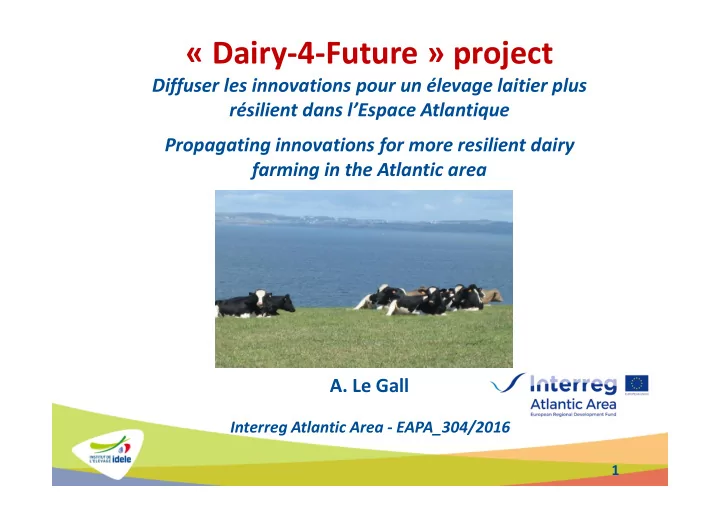
« Dairy-4-Future » project

Diffuser les innovations pour un élevage laitier plus résilient dans l’Espace Atlantique Propagating innovations for more resilient dairy farming in the Atlantic area

  • A. Le Gall

Interreg Atlantic Area - EAPA_304/2016

slide-2
SLIDE 2

Context: dairy industry important!

  • Dairy farming: a major economic activity in the Atlantic Area
  • About 20 % of milk production in Europe-28
  • 80 000 dairy farms and 100 000 dairy farmers and employees
  • 70 000 employees in the dairy industry
  • Several large dairy industries (Lactalis, Sodiaal, Glanbia,

Savencia,…)

  • Good soil and climatic conditions for fodder production and

grazing: one of the more favorable areas of the World to produce

milk

  • Dairy industry is ambitious and shows important growth
  • bjectives: +50% in Ireland from 2010 to 2020, +20% in the west of

France from 2015 to 2020

Dairy-4-Future project 2

slide-3
SLIDE 3

Dairy sector is facing several challenges

Dairy-4-Future project 3

  • Improving cost-efficiency and economic resilience of dairy

farms: milk production is rather oriented dairy commodities, subject to greater volatility

  • A more efficient use of resources (feed, water,…) and control of

environmental impacts: dairy sector has to cope with national commitments about GHG (COP 21, COP 23)

  • A milk producers generational renewal, with need to strengh

attractiveness of dairy farming

  • Expected increase of size of dairy farms needs to improve work

efficiency and human resource management

slide-4
SLIDE 4

Interreg Atlantic Area Program (2014-2020)

Programme priority: 1. Stimulating innovation and

competitiveness

Programme specific objective1.2: Strengthening the transfer of

innovation results to facilitate the emergence of new products, services and processes

Objectives:

  • Improve cooperation between public, private and research

actors to foster innovation and transnational cohesion

  • Encourage innovation by transnational collaboration
  • Create a better cooperation between firms, social organizations

and R&D bodies

4

Dairy-4-Future: one of the 42 projects accepted on 102 full projects and 408 Expression of Interest

slide-5
SLIDE 5

2003-2006 2009-2013 2013-2015 2016-2018

Green Dairy Interreg AA Idele Dairyman Interreg NW WUR Autograssmilk FP7-SME Teagasc EuroDairy H2020 AHDB/WUR Dairy-4-Future Interreg AA Idele

2018-2021

N, NO3, P N, P (Carbon, biodiversity) AMS and grazing Use of resources Biodiversity Socio-economic resilience Use of resources Carbon Socio- economic resilience

Strong cooperation trough European projects

slide-6
SLIDE 6

A project on dairy farming on Atlantic Area, from Scotland to Açores

Dairy-4-Future project 6 The Environmental Stratification of Europe, from Marc Metzger & Bob Bunce Wageningen UR

slide-7
SLIDE 7

Rainfall and temperatures in Europe

Average temperature (degrees) over 1950-2000 (data wordclim, map IDELE) Average total rainfall (mm) over 1950- 2000 (data wordclim, map IDELE)

slide-8
SLIDE 8

Important length growing period on Atlantic Area

8

Length of growing period (LGP in days) is defined as the period during the year when average temperatures are greater than or equal to 5 °C and precipitation plus moisture stored in the soil exceed half the potential evapotranspiration (P>0.5 ETP). FAO data.

> 240 days

  • f growing

period

slide-9
SLIDE 9

Dairy-4-Future project 9

  • Project leader : Institut de l’Elevage
  • 11 partners :

– SRUC (Scotland) – CAFRE (Northern Ireland) – Teagasc (Southern Ireland) – AHDB (England and wales) – Institut de l’Elevage (France) – CRAB (Brittany) – Inra Lusignan (Nouvelle Aquitaine) – Neiker (Basque Country) – CIAM/INGACAL (Galicia) – UTAD (North Portugal) – ISA Lisbonne (South Portugal/Açores)

  • 21 Associated partners

A strong consortium of 11 partners

slide-10
SLIDE 10

A strong and friendly consortium

Dairy-4-Future project 10

Meeting in Porto, October 2016

slide-11
SLIDE 11

Dairy-4-Future project 11

21 associated partners from dairy sector

United Kingdom Spain France Ireland Portugal

slide-12
SLIDE 12

Dairy-4-Future project 12

Concept of Dairy-4-Future project

One of the most favorable area in the world to produce milk (soils, climates, people, skills,…)

Potential for more milk with low inputs (legumes vs fertilisers, forage vs concentrates), smart dairy farming (grazing, GMO free), low environmental footprint (low GHG, C. sequestration by grassland, low pesticides, biodiversity…)

Distinctions (production differentiation strategies of dairy products for more value) Value for dairy farmers, dairy industry and dairy regions of Atlantic Area

slide-13
SLIDE 13

Dairy-4-Future project 13

Dairy-4-Future program: 7 work-Packages

  • WP0. Project preparation (IDELE –France)
  • WP1. Project coordination (IDELE –France)
  • WP 2. Communication (UTAD-Portugal)
  • WP3. Capitalization (AHDB-England and Wales)
  • WP4. Dairy sector analysis (IDELE –France)
  • WP5. Fostering dairy sector economic resilience in the Atlantic Area

(SRUC-Scotland)

  • WP6. Sharing knowledge to improve resource use efficiency on

dairy farms in the Atlantic Area (Teagasc-Ireland)

  • WP7. Sustainable systems for the future (INGACAL- Galicia)
slide-14
SLIDE 14

Organization of Dairy-4-Future project

14

WP 1 Project coordination (Idele) WP 2 Communication (UTAD) WP 4 Dairy sector analysis (Idele) WP 5 Socio-economic resilience (SRUC) WP 6 Resource use efficiency (Teagasc) WP 7 Sustainable dairy systems for the future (INGACAL) WP 3 Capitalization (AHDB)

slide-15
SLIDE 15

A project with dairy farmers, based

  • n their expertise and experience
  • A network of 100 pilot farmers
  • Exchanges between groups of

farmers

  • Pilot farmers invited at Summer

symposium in 2020

  • Visit of dairy farms at each

seminar

Dairy-4-Future project 15

slide-16
SLIDE 16

Dairy-4-Future project 16

Dairy-4-Future program: operational objectives

  • Analyse economic, social and environmental performances of

dairy farms to identify innovative and more efficient dairy systems

  • Evaluate ecosystems services offered by dairy production
  • Identify, study and disseminate on success stories in the value

chain

  • Share and test innovations and innovative dairy systems
  • Propose recommandations and incentive measures for regional

policies

  • Prepare a framework for an increased cooperation between

stakeholders

slide-17
SLIDE 17

Dairy-4-Future project 17

  • WP1. Project coordination

(IDELE)

  • Action 1.1. Overall management and administrative governance

(IDELE)

  • Action 1.2. Project strategy, planning and management (IDELE)
  • Action 1.3. Project reporting (IDELE)

With support of Absiskey

slide-18
SLIDE 18

Dairy-4-Future project 18

  • WP2. Communication

(UTAD-Portugal)

  • Action 2.1. D4F brand identity and planning of dissemination

activities (UTAD + ISA + IDELE)

  • Action 2.2. Interactive website and social networks (UTAD)
  • Action 2.3. Open days at experimental and pilot farms (CRAB)
  • Action 2.4. Thematic workshops and final conference (UTAD)
slide-19
SLIDE 19

Dairy-4-Future project 19

  • WP3. Capitalization

(AHDB-England and Wales)

  • Action 3.1. Analysis of the Agricultural Knowledge and

Innovation Systems related to dairy farming in the Atlantic Area

(AHDB)

  • Action 3.2. Development of a project capitalization and

exploitation plan (AHDB)

  • Action 3.3. Integrating economic development with

environmental sustainability (AHDB)

  • Action 3.4. Training the trainers (Neiker)
  • Action 3.5. Dairy 4 Future Symposium (AHDB + IDELE)
  • Action 3.6. Long-term impacts (AHDB)
slide-20
SLIDE 20

Dairy-4-Future project 20

  • WP4. Dairy sector analysis

(IDELE-France)

  • Action 4.1. Analysis of dairy sector (dairy farming, dairy

industry and markets, main issues, SWOT analysis) (IDELE)

  • Action 4.2. Assessment of rendered services (IDELE)
  • Action 4.3.Case studies on value chain (1 for each region)
  • Action 4.4. Prospect for milk growth until 2025 (Teagasc)

(IDELE)

slide-21
SLIDE 21

Dairy-4-Future project 21

  • WP5. Fostering dairy sector

economic resilience in the Atlantic Area (SRUC-Scotland)

  • Action 5.1. Economic evaluation of 100 pilot farms (SRUC)
  • Action 5.2. Safeguarding Atlantic area enterprise resilience

through innovative practices (SRUC)

  • Action 5.3. External factors effecting the profitability of dairy

farms in the Atlantic Area (IDELE)

  • Action 5.4. Knowledge and tools exchange, communication and

performance measurement to improve economic resilience on dairy farms (SRUC)

slide-22
SLIDE 22

Dairy-4-Future project 22

  • WP6. Sharing knowledge to improve

resource use efficiency on dairy farms in the Atlantic Area (Teagasc-Ireland)

  • Action 6.1. New knowledge and technology to improve resource

use efficiency on farms (CAFRE)

  • Action 6.2. Evaluation of best practices on 10 resource-efficient

experimental dairy farms (Teagasc)

  • Action 6.3. Evaluation of resource use efficiency on 100 pilot dairy

farms (IDELE)

  • Action 6.4. Sharing of knowledge through farmer exchange visits

(CRAB)

slide-23
SLIDE 23

Dairy-4-Future project 23

  • WP7. Sustainable systems for the future

(INGACAL-Galicia)

  • Action 7.1. Synergy between resource efficiency and economics

(INGACAL)

  • Action 7.2. Blue print systems for 2020/2025 (INGACAL)
  • Action 7.3. Roadmaps for a sustainable dairy future (INGACAL)
  • Action 7.4. Indicators to align dairy farms and products with

market requirements (AHDB)

slide-24
SLIDE 24

Dairy-4-Future project 24

A network of 10 experimental farms A network of 100 pilot farms

slide-25
SLIDE 25

Dairy-4-Future project 25

A network of 100 innovative dairy farms

slide-26
SLIDE 26

What pilot farms and farmers?

  • Motivated dairy farmers, open for exchanges
  • Innovated dairy farms, examples for dairy farming of tomorrow
  • Dairy farms with good technical, economical and environmental (N

balance, C footprint) performances

  • Pilot dairy farms are not are necessarily representative of average

dairy farms

  • If possible, dairy farms close to experimental farms, which are testing

innovative dairy systems, in order to have exchanges between pilot farms and experimental farms

  • If possible, dairy farms related to production differentiation approach

with dairy groups

Dairy-4-Future project 26

slide-27
SLIDE 27

A network of 10 experimental farms with test of innovative systems

CAFRE dairy centre-N. Ireland Crichton farm- Scotland Duchy college- Cornwall Solohead Teagasc- S. Ireland Blanche Maison - Normandie

Trévarez – Brittanny

Mabegondo - Galicia Oasys-Lusignan – New Aquitaine

Kildalton – S. Ireland

slide-28
SLIDE 28

Dairy-4-Future project 28

A network of 10 experimental farms with test of innovative systems (1/3)

Partner Site Systems carried out Comments

SRUC Crichton Standard Energy

ME 11.3 MJ/kg DM (Housed)

High Energy

ME 12.2 MJ/kg DM (Housed) X 2 contrasting genetic lines Work already made about N balance and C footprint for two contrasted systems: Low forage (indoors/TMR) High forage (grazing ++)

Teagasc Kildalton Open Source Sustainable farm

Resource use efficiency (nutrients, water, energy) Biodiversity

Teagasc Solohead Low Carbon system Control system

Target of 0,6 eq CO2/l SF6 and Closed static chambers (N2O)

CAFRE Greenmount Moderate input, high

  • utput grass and forage

technology demonstration system

Ammonia emission reduction, energy efficiency, constructed wetland dirty water remediation

slide-29
SLIDE 29

Dairy-4-Future project 29

A network of 10 experimental farms with test of innovative systems (2/3)

Partner Site Systems carried out Comments

AHDB Duchy college (Stoke Climsland) 4 mini herds with contrasted systems

300 cows in a series of up to 4 ‘mini herds’; each exploring the costs and benefits of multiple management and production regimes

CA/Idele Blanche Maison Agroecological system

88 Normande cows 90 % grassland/AA 24-27 months af first

  • calving. 4 periods of AB

CA/Idele Trévarez Low carbon system

120 cows 60 % grassland/AA 24 months at fisrt calving Target of 0,5-0,7 kg Eq CO2/l (Net CF)

slide-30
SLIDE 30

Dairy-4-Future project 30

A network of 10 experimental farms with test of innovative systems (3/3)

Partner Site Systems carried out Comments

Inra Lusignan (New

Aquitaine)

An agroecological system with agroforestry adapted to climate change

A diversified system to save and use efficiently fossil energy and water, and to foster resilience and multifunctionality Agroforestry: 1300 trees

CIAM Mabegondo

S1.- Traditional S2.- Improved: S3.- Draught resilient S4.- Grazing S5.- Grazing improved

Neiker College farm To be precised

slide-31
SLIDE 31

Towards low carbon dairy systems

31 Present situation in France Tomorrow ?

Enteric CH4 0,5 N2O Grazing 0,06 Ferti N 0,08

CH4 + N2O Effluents 0,06

Energy 0,06 Inputs 0,18

Emissions 0,95 kg Eq CO2/ l

Grassland Hedges

Sequestration 0,25 kg Eq CO2/ l

Net CF 0,7 kg Eq CO2/ l

Enteric CH4 0,4 N2O Grazing 0,06 Ferti N 0,04 CH4 + N2O Effluents 0,03 Energy 0,03 Inputs 0,09

Emissions 0,65 kg Eq CO2/ l Sequestration

Grassland 0,3

Hedges - Agroforestry 0,1

0,5 kg Eq CO2/l

Net CF 0,15 kg Eq CO2/l

Covercrops 0,1

slide-32
SLIDE 32

CH4 N2O

  • CH4

N2O

  • CO2
  • N2O

CH4 N2O N2O

  • !"
  • #
  • CO2

$

  • CH4

N2O CO2

HFC N2O

Carbon accounting at farm scale, derived from LCA approach

  • Gestim method, 2010

Tier 3 (IPCC) LCA approach

slide-33
SLIDE 33

Inputs

Fertilizers

Outputs

Conc. Straw Cattle Energy Milk Cattle

N Leaching

Crops

Experimental farms: a whole farm system approach

Gaseous emissions (CH4, NH3, N2O, N2)

N fixation

Need to have complete and separate systems (herds/surfaces) with FYM/effluent recycling

slide-34
SLIDE 34

Methods, metrics and tools: relay on previous projects

  • Data collection for pilot farms: use tools used within

Dairyman and EuroDairy and integrate updated methodology to consider C accounting/C footprint

  • Experimental farms: harmonization of metrics to assess C,

N and P emissions => Use guidelines prepared in Cantogether project

  • ….

Dairy-4-Future project 34

slide-35
SLIDE 35

Main outputs and deliverables

Outputs

  • Blue print systems wich combine

economics and environmental topics

  • Recommandations and indicators

for production differenciation strategies

  • Roadmaps for a sustainable dairy

future

  • Expertise and innovations for

farmers, advisors and journalists

  • Strategy for long term impact

Deliverables

  • Factsheets, technical and

scientific publications,…

  • Digital material
  • Open days in farms and

experimental farms

  • Stakeholders meetings
  • Summer symposium
  • Regional conferences
  • Final seminar

date Dairy-4-Future project 35

slide-36
SLIDE 36

Budget and share of grant

Partner

Total budget (€) Interreg grant (€) Share of grant (%)

Institut de l'Elevage

721 610 541 208 19

SRUC

360 120 270 090 9,2

CAFRE

368 100 276 075 9,4

AHDB Dairy

361 640 271 230 9,3

Teagasc

475 172 356 379 12,2

CRAB

314 300 235 725 8,1

INRA

144 500 108 375 3,7

Neiker

285 500 214 125 7,3

INGACAL

330 475 247 856 8,5

UTAD

281 975 211 481 7,2

ISA

255 760 191 820 6,6

Total

3 899 152 2 924 364 100,0

slide-37
SLIDE 37

Share of budget: mainly for labour

N° days 6 614 days Staff costs 2 212 337 € 57 % Accommodation 437 700 € 11 % External expertise 1 149 000 € 29 % Equipment 100 000 € 2,5 % Total 3 899 152 € 100 % Labour staff: around 7 500 days = 35 Full time = 8,7 Full time.year-1 Exchanges between/for farmers: 200 000 € = 2 000 €/pilot farm

slide-38
SLIDE 38

Some key figures of similar projects

Green Dairy Interreg AA Idele

5 countries, 11 regions, 10 partners Interreg III B, Budget : 4 millions € 3 years

Dairyman Interreg NW WUR

7 countries, 10 regions, 10 partners Interreg IV B, Budget : 9 millions € 4 years

EuroDairy H2020 AHDB/WUR

14 countries, 20 partners H2020 TN, Budget : 2 millions € 3 years

Dairy-4- Future Interreg AA Idele

5 countries, 14 regions, 11 partners Interreg, Budget : 3,9 millions € 4 years

slide-39
SLIDE 39

What value for money ?

Dairy production of Atlantic Area: 30 millions tons of Milk.year-1 Turn over of dairy production at farm gate: 10 billions € Our ambition :

  • + 10% of milk : 1 billion €
  • Costs saved (5 cts/l): 1,5 billion €
  • Added value on milk (2 cts/l): 0,7

billion €

  • Total: 3,2 billion € for dairy farming
  • Equivalent of 65 000 revenues at 50

000 € Excellent value for money: 3,9 millions € for Dairy-4-Future / > 3 billions € for dairy farming

slide-40
SLIDE 40

A 48 months project

Dairy-4-Future project 40

Jan Feb March April May June July Aug Sep Oct Nov Dec Jan Feb March April May June July Aug Sep Oct Nov Dec Jan Feb March April May June July Aug Sep Oct Nov Dec Jan Feb March April May June July Aug Sep Oct Nov Dec

WP0 Project Preparation (Idele) WP1 Project Coordination (Idele)

A1.1 Overall management and administrative governance (Absiskey) A1.2 Project strategy, planning and management (Absiskey) A1.3 Project Reporting (Absiskey)

WP2 Communication (UTAD-Portugal)

A2.1 D4F brand identity and planning of dissemination activities (UTAD / ISA / Idele) A2.2 Interactive website and social networks (UTAD) A2.3 Open days at experimental and pilot farms (CRAB) A2.4 Thematic workshops and final conference (UTAD)

WP3 Capitalization (AHDB-England and Wales)

A3.1 Analysis of the Agricultural Knowledge and Innovation Systems related to dairy farming in the Atlantic Area (AHDB) A3.2 Development of a project capitalization and exploitation plan (AHDB) A3.3 Integrating economic development with environmental sustainability (AHDB) A3.4 Training the trainers (Neiker) A3.5 Dairy 4 Future Symposium (AHDB / Idele) A3.6 Long-term impacts (AHDB)

WP4 Dairy sector analysis (Idele- France)

A4.1 Analysis of dairy sector (dairy farming, dairy industry and markets, main issues, SWOT analysis) (Idele) A4.2 Assessment of rendered services (Idele) A4.3 Case studies on value chain (1 for each region) (Idele) A4.4 Prospect for milk growth until 2025 (Teagasc)

WP5 Fostering dairy sector economic resilience in the Atlantic Area (SRUC- Scotland)

A5.1 Economic evaluation of 100 pilot farms (SRUC) A5.2 Safeguarding Atlantic area (SRUC) A5.3 External factors effecting the profitability of dairy farms in the Atlantic Area (Idele) A5.4 Knowledge and tools exchange, communication and performance measurement to improve economic resilience on dairy farms (SRUC)

WP6 Sharing knowledge to improve resource use efficiency on dairy farms in the Atlantic Area (Teagasc- Ireland)

A6.1 New knowledge and technology to improve resource use efficiency on farms (CAFRE) A6.2 Evaluation of best practices on 10 resource-efficient experimental dairy farms (Teagasc) A6.3 Evaluation of resource use efficiency on 100 pilot dairy farms (Idele) A6.4 Sharing of knowledge through farmer exchange visits

WP7 Sustainable systems for the future (INGACAL-Galicia)

Action 7.1 Synergy between resource efficiency and economics (INCAGAL) A7.2 Blue print systems for 2020/2025 (INCAGAL) A7.3 Roadmaps for a sustainable dairy future (INCAGAL) A7.4 Indicators to align dairy farms and products with market requirements (AHDB)

Interreg Atlantic Area - Dairy-4-Future

2018 2019 2020 2021

slide-41
SLIDE 41

An external advisory committee with dairy systems experts

Dairy-4-Future project 41

M.T Bonneau, Dairy farmer, French Dairy Farmers Federation, France J.L Peyraud, Scientist, INRA and Animal Task Force, France

  • J. Oenema, Scientist, WUR,

The Netherlands

  • F. Sineiro, Professor, ,

University of Santiago de Compostela, Spain Ireland Dairy farmer, UK

To be precised To be precised

slide-42
SLIDE 42

42

slide-43
SLIDE 43

Dairy-4-Future and EuroDairy

  • Common points

– Both projects focus on innovation and demonstration of best practice in dairy – Both have pilot farms (120 and 100 respectively) – Two themes are common (Resource efficiency and socio-economic resilience). Four - if you add in welfare and biodiversity which were mentioned in latest versions of D4F ! – Modus operandi - seminars, exchange visits, some of the methodologies, mentio

  • f operational groups all common to EuroDairy

– Many partners are common to both

  • Main differences

– Dairy-4-Future is tackling more strategic issues in relation to regional development of the industry in the AA region (hence the regional analysis, emphasis on appropriate policy making, long-term link to market conditions and signals, specific environmental concerns pertinent to the region) – Has a greater component of research – Is more top down than bottom up (hence production of blue prints)