CWE PRESENTATION RUBRIC Candidates Name: Presentation Topic: - - PowerPoint PPT Presentation

cwe presentation rubric candidate s name presentation
SMART_READER_LITE
LIVE PREVIEW

CWE PRESENTATION RUBRIC Candidates Name: Presentation Topic: - - PowerPoint PPT Presentation

CWE PRESENTATION RUBRIC Candidates Name: Presentation Topic: Date: Criteria:


slide-1
SLIDE 1

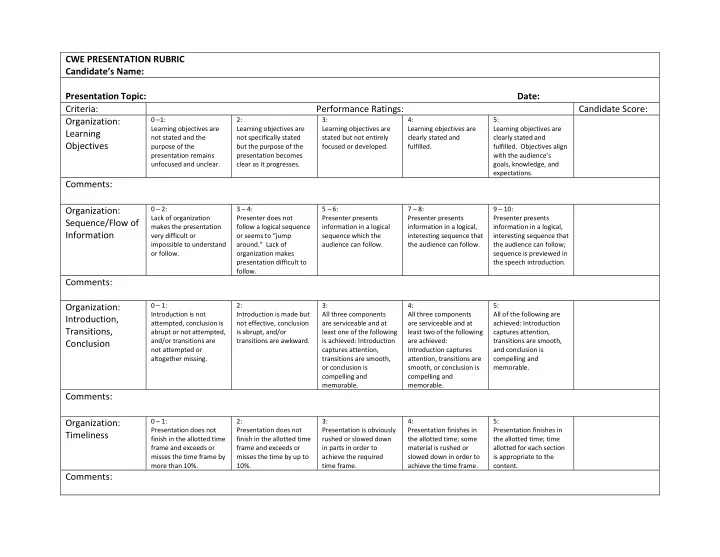
CWE PRESENTATION RUBRIC Candidate’s Name: Presentation Topic: Date: Criteria: Performance Ratings: Candidate Score: Organization: Learning Objectives

0 –1: Learning objectives are not stated and the purpose of the presentation remains unfocused and unclear. 2: Learning objectives are not specifically stated but the purpose of the presentation becomes clear as it progresses. 3: Learning objectives are stated but not entirely focused or developed. 4: Learning objectives are clearly stated and fulfilled. 5: Learning objectives are clearly stated and

  • fulfilled. Objectives align

with the audience’s goals, knowledge, and expectations.

Comments: Organization: Sequence/Flow of Information

0 – 2: Lack of organization makes the presentation very difficult or impossible to understand

  • r follow.

3 – 4: Presenter does not follow a logical sequence

  • r seems to “jump

around.” Lack of

  • rganization makes

presentation difficult to follow. 5 – 6: Presenter presents information in a logical sequence which the audience can follow. 7 – 8: Presenter presents information in a logical, interesting sequence that the audience can follow. 9 – 10: Presenter presents information in a logical, interesting sequence that the audience can follow; sequence is previewed in the speech introduction.

Comments: Organization: Introduction, Transitions, Conclusion

0 – 1: Introduction is not attempted, conclusion is abrupt or not attempted, and/or transitions are not attempted or altogether missing. 2: Introduction is made but not effective, conclusion is abrupt, and/or transitions are awkward. 3: All three components are serviceable and at least one of the following is achieved: Introduction captures attention, transitions are smooth,

  • r conclusion is

compelling and memorable. 4: All three components are serviceable and at least two of the following are achieved: Introduction captures attention, transitions are smooth, or conclusion is compelling and memorable. 5: All of the following are achieved: Introduction captures attention, transitions are smooth, and conclusion is compelling and memorable.

Comments: Organization: Timeliness

0 – 1: Presentation does not finish in the allotted time frame and exceeds or misses the time frame by more than 10%. 2: Presentation does not finish in the allotted time frame and exceeds or misses the time by up to 10%. 3: Presentation is obviously rushed or slowed down in parts in order to achieve the required time frame. 4: Presentation finishes in the allotted time; some material is rushed or slowed down in order to achieve the time frame. 5: Presentation finishes in the allotted time; time allotted for each section is appropriate to the content.

Comments:

slide-2
SLIDE 2

Content: Statements are factual and relevant

0 - 3 More than three facts are incorrect. Ideas very simplistic, presenter shows signs of confusion

  • r misunderstanding of

the topic, focus not clear. 4 - 8 Most facts are correct. Mostly simplistic or unfocused ideas, little or no sense of purpose or control or the topic. 9 - 13 Most facts are correct, but technical details and explanation is lacking. Presenter appears to grasp the topic but appears at times to be weak, unclear, or too broad in scope. 14 – 17: Presenter demonstrated a good grasp of the topic. Most facts are correct, and the technical explanation is adequate. 16 – 20: All facts are correct, and the technical explanation is both concise and

  • complete. Presenter

demonstrates an excellent grasp of the topic.

Comments: Content: Pronunciation of wine-related terms

0 – 1: Basic wine terms are misused or mispronounced throughout the presentation. 2: The presentation contains 5 or more l errors of usage or pronunciation of wine- related terms. 3: The presentation contains 3 or 4 errors in the use or pronunciation

  • f wine-related terms.

4: The presentation contains 1 or 2 errors in the use or pronunciation

  • f wine-related terms.

5: Exceptional accuracy of use and pronunciation of wine-related terms.

Comments: Content: Appropriate for Targeted Audience

0 – 1: Content does not relate to the audience’s needs, interests, or level of knowledge. 2: Content is only sometimes appropriate for the knowledge level

  • f the audience.

3: Content addresses the topic at hand; speaker understands the topic but may speak above or below the level of audience knowledge. 4: Content is valuable and relevant to the audience; presentation is likely to add to the audience’s knowledge. 5: Content is valuable and relevant to the audience; presentation makes a significant contribution to the audience’s knowledge.

Comments: Supporting Materials

0 – 3: No supporting visual aids, graphics, or support material is used. 4 - 6: Visual aids, graphics, or support materials are used but do not increase

  • r are a distraction from

audience understanding. 7 - 9: Visual aids, graphics, or support materials are used in a way that somewhat supports audience understanding. 10 - 12: Visual aids, graphics, or support materials are used in a way that supports the material and audience understanding. 13 - 15: Visual aids, graphics, or support materials are of a professional quality and are used in a way that supports audience engagement.

Comments: Oration: Voice and Demeanor

0 – 2: Presenter mumbles, audience members cannot hear,

  • verwhelming use of

filler words, distracting gestures. 3 - 4: Presenter is sometimes hard to hear or follow due to mumbling, distracting gestures, or use of distracting filler words. 5 - 6: Presenter speaks in a clear voice and can be heard by the audience, but is somewhat monotone or distracting. 7 - 8: Verbal expression is proficient but some inconsistency in skill may be observed. 9 - 10: Verbal expression is clear, comprehensible, and articulate.

Comments:

slide-3
SLIDE 3

Oration: Method

  • f Delivery

0 – 1: The speaker obviously reads the presentation. 2: Over-dependence on notes is observed; visual aids may overwhelm the speaker or distract the audience. 3: Speaker has clearly rehearsed the presentation, however some dependence on notes is observed. 4: Speaker is well- rehearsed, somewhat confident with the material, and generally able to speak extemporaneously. 5: Speaker is obviously well- rehearsed, confident regarding the material, and able to speak extemporaneously.

Comments: Audience Engagement

0 – 2: Speaker is dismissive, alienating, or hostile towards the audience. 3 – 4: Speaker is unresponsive to the audience and shows little understanding of audience engagement. 5 – 6: Speaker is responsive to the audience at various points throughout the presentation. 7 – 8: Speaker is generally responsive to the audience and demonstrates the use of some audience engagement techniques. 9 – 10: Speaker is responsive to the audience; speaker uses a variety of audience engagement techniques throughout.

Comments: Professionalism

0- 1: Demeanor and appearance is unprofessional and inappropriate for the setting. 2: Demeanor or appearance are somewhat unprofessional or inappropriate for the setting. 3: Demeanor and appearance is acceptable for the context of the presentation. 4: Demeanor or appearance is professional and appropriate to the context of the presentation. 5: Demeanor and appearance are both highly professional and appropriate to the context of the presentation.

Comments: Total Score out of a Possible 100: Pass or Fail (Minimum passing score is 65): Evaluator/Name and Signature: Additional Comments:

slide-4
SLIDE 4