II APPENDIX II FINAL PRESENTATION SCORING RUBRIC TEACHER for - - PowerPoint PPT Presentation

ii
SMART_READER_LITE
LIVE PREVIEW

II APPENDIX II FINAL PRESENTATION SCORING RUBRIC TEACHER for - - PowerPoint PPT Presentation

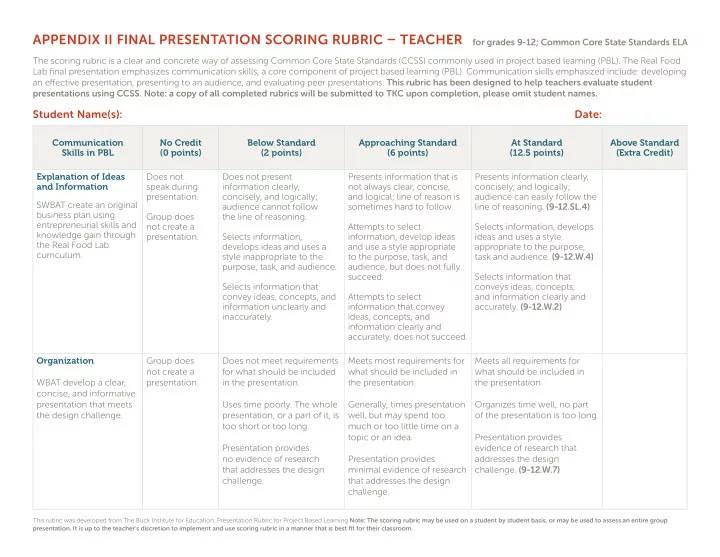
II APPENDIX II FINAL PRESENTATION SCORING RUBRIC TEACHER for grades 9-12; Common Core State Standards ELA The scoring rubric is a clear and concrete way of assessing Common Core State Standards (CCSS) commonly used in project based learning


slide-1
SLIDE 1

Communication Skills in PBL No Credit (0 points) Below Standard (2 points) Approaching Standard (6 points) At Standard (12.5 points) Above Standard (Extra Credit) Explanation of Ideas and Information SWBAT create an original business plan using entrepreneurial skills and knowledge gain through the Real Food Lab curriculum. Does not speak during presentation. Group does not create a presentation. Does not present information clearly, concisely, and logically; audience cannot follow the line of reasoning. Selects information, develops ideas and uses a style inappropriate to the purpose, task, and audience. Selects information that convey ideas, concepts, and information unclearly and inaccurately. Presents information that is not always clear, concise, and logical; line of reason is sometimes hard to follow. Attempts to select information, develop ideas and use a style appropriate to the purpose, task, and audience, but does not fully succeed. Attempts to select information that convey ideas, concepts, and information clearly and accurately, does not succeed. Presents information clearly, concisely, and logically; audience can easily follow the line of reasoning. (9-12.SL.4) Selects information, develops ideas and uses a style appropriate to the purpose, task and audience. (9-12.W.4) Selects information that conveys ideas, concepts, and information clearly and

  • accurately. (9-12.W.2)

Organization WBAT develop a clear, concise, and informative presentation that meets the design challenge. Group does not create a presentation. Does not meet requirements for what should be included in the presentation. Uses time poorly. The whole presentation, or a part of it, is too short or too long. Presentation provides no evidence of research that addresses the design challenge. Meets most requirements for what should be included in the presentation. Generally, times presentation well, but may spend too much or too little time on a topic or an idea. Presentation provides minimal evidence of research that addresses the design challenge. Meets all requirements for what should be included in the presentation. Organizes time well, no part

  • f the presentation is too long.

Presentation provides evidence of research that addresses the design

  • challenge. (9-12.W.7)

The scoring rubric is a clear and concrete way of assessing Common Core State Standards (CCSS) commonly used in project based learning (PBL). The Real Food Lab fjnal presentation emphasizes communication skills, a core component of project based learning (PBL). Communication skills emphasized include: developing an efgective presentation, presenting to an audience, and evaluating peer presentations. This rubric has been designed to help teachers evaluate student presentations using CCSS. Note: a copy of all completed rubrics will be submitted to TKC upon completion, please omit student names.

This rubric was developed from The Buck Institute for Education, Presentation Rubric for Project Based Learning Note: The scoring rubric may be used on a student by student basis, or may be used to assess an entire group

  • presentation. It is up to the teacher’s discretion to implement and use scoring rubric in a manner that is best fjt for their classroom.

for grades 9-12; Common Core State Standards ELA

Student Name(s): Date:

APPENDIX II FINAL PRESENTATION SCORING RUBRIC – TEACHER

II

slide-2
SLIDE 2

Communication Skills in PBL No Credit (0 points) Below Standard (2 points) Approaching Standard (6 points) At Standard (12.5 points) Above Standard (Extra Credit) Presentation Aids SWBAT design a presentation using technology to efgectively communicate ideas. Does not use visual aids or media. Attempts to use visual aids or media, but they do not add to or may distract from the presentation Uses visual aids or media, but they may sometimes distract from tor not add to the presentation. Sometimes has trouble incorporating visual or media aids smoothly into the presentation. Uses well-produced visual aids or media to enhance understanding of reasoning and to add interest. (9-12.SL.5) Smoothly incorporates visual aids or media into presentation. Uses technology, including the internet, to produce an efgective presentation. (9-12.W.6) Response to Audience Questions SWBAT interpret inquires and synthesize a cohesive response. Does not respond to audience questions. Attempts to address audience questions (goes

  • fg topic or misunderstands

without seeking clarifjcation). Answers audience questions, but not always clearly or completely. Answers audience questions clearly and completely. (9-12.SL.3) Seeks clarifjcation, admits “I don’t know” or explains how the answer might be found when unable to answer a

  • question. (9-12.SL.1)

Participation in Team Presentation SWBAT collaborate efgectively to produce an efgective presentation. Group does not present. Not all members participate,

  • nly one or two speak.

All team members participate, but not equally. All team members participate for about the same length of time. All team members can answer questions about the topic, not just their part of it. (9-12.SL.1)

This rubric was developed from The Buck Institute for Education, Presentation Rubric for Project Based Learning Note: The scoring rubric may be used on a student by student basis, or may be used to assess an entire group

  • presentation. It is up to the teacher’s discretion to implement and use scoring rubric in a manner that is best fjt for their classroom.

Student Name(s): Date:

for grades 9-12; Common Core State Standards ELA

APPENDIX II FINAL PRESENTATION SCORING RUBRIC – TEACHER

slide-3
SLIDE 3

This rubric was developed from The Buck Institute for Education, Presentation Rubric for Project Based Learning Note: The scoring rubric may be used on a student by student basis, or may be used to assess an entire group

  • presentation. It is up to the teacher’s discretion to implement and use scoring rubric in a manner that is best fjt for their classroom.

Communication Skills in PBL No Credit (0 points) Below Standard (2 points) Approaching Standard (6 points) At Standard (12.5 points) Above Standard (Extra Credit) Peer Evaluation Perspective SWBAT assess their peers’ presentations using the student rubric. Does not ask questions. Completes zero student scoring rubrics. Does not ask questions. Attempts to complete all student scoring rubrics. Asks questions that are not clear or complete. Asks questions that distract from the presentation topic. Completes all student scoring rubrics. Asks questions clearly and completely and provides clarifjcation, as needed. (9-12.SL.3) Develops questions that are relevant to and build upon the presentation topic. (9-12.SL.1) Usage of Curriculum Vocabulary SWBAT generate original thoughts and ideas using Real Food Lab curriculum vocabulary. Does not speak during presentation. Does not use domain- specifjc words and phrases during the presentation. Attempts to used domain- specifjc words and phrases during the presentation, but does not succeed. Acquires and uses accurately domain-specifjc words and phrases during the

  • presentation. (9-12.L.6)

Usage of Standard English Conventions SWBAT develop and deliver presentation text that is free of spelling, capitalization, grammar, and punctuation errors. Does not speak during presentation Does not demonstrate command of the conventions of standard English grammar. Does not demonstrate command of the conventions of standard English capitalization, punctuations, and spelling. Demonstrates command of the conventions of standard English grammar and usage in presentation text and while speaking, most of the time. Demonstrates command of the conventions of standard English capitalization, punctuations, and spelling in presentation text, most of the time. Demonstrates command of the conventions of standard English grammar and usage in presentation text and while

  • speaking. (9-12.L.1)

Demonstrates command of the conventions of standard English capitalization, punctuations, and spelling in presentation text. (9-12.L.2)

Student Name(s): Date:

for grades 9-12; Common Core State Standards ELA

APPENDIX II FINAL PRESENTATION SCORING RUBRIC – TEACHER

slide-4
SLIDE 4

This rubric was developed from The Buck Institute for Education, Presentation Rubric for Project Based Learning Note: The scoring rubric may be used on a student by student basis, or may be used to assess an entire group

  • presentation. It is up to the teacher’s discretion to implement and use scoring rubric in a manner that is best fjt for their classroom.

Communication Skills in PBL No Credit (0 points) Below Standard (2 points) Approaching Standard (6 points) At Standard (12.5 points) Above Standard (Extra Credit) Notes: Explanation of Ideas and Information Organization Presentation Aids Response to Audience Questions Participation in Team Presentation Peer Evaluation Perspective Usage of Curriculum Vocabulary Usage of Standard English Conventions

Student Name(s): Summary Table: Date:

/100 for grades 9-12; Common Core State Standards ELA

APPENDIX II FINAL PRESENTATION SCORING RUBRIC – TEACHER