
SLIDE 1
Curve Fitting Re-visited, Bishop1.2.5
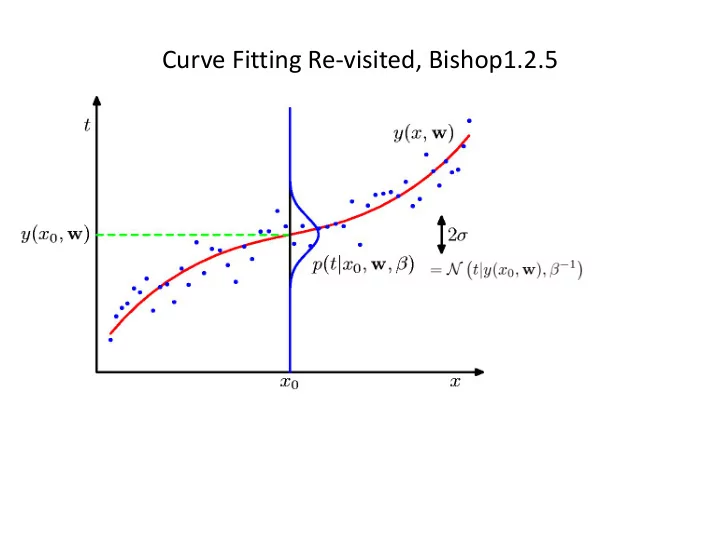
Curve Fitting Re-visited, Bishop1.2.5 Maximum Likelihood Bishop - - PowerPoint PPT Presentation
Curve Fitting Re-visited, Bishop1.2.5 Maximum Likelihood Bishop 1.2.5 Model Likelihood differentiation Maximum Likelihood N N t n | y ( x n , w ) , 1 p ( t | x , w , ) = . (1.61) n =1 As we did in the
Curve Fitting Re-visited, Bishop1.2.5
Maximum Likelihood Bishop 1.2.5
Maximum Likelihood
p(t|x, w, β) =
N
N tn|y(xn, w), β−1 . (1.61) As we did in the case of the simple Gaussian distribution earlier, it is convenient to maximize the logarithm of the likelihood function. Substituting for the form of the Gaussian distribution, given by (1.46), we obtain the log likelihood function in the form ln p(t|x, w, β) = −β 2
N
{y(xn, w) − tn}2 + N 2 ln β − N 2 ln(2π). (1.62) Consider first the determination of the maximum likelihood solution for the polyno-
1 βML = 1 N
N
{y(xn, wML) − tn}2 . (1.63)
p(t|x, wML, βML) = N t|y(x, wML), β−1
ML
(1.64) take a step towards a more Bayesian approach and introduce a prior
Giving estimates of W and beta, we can predict
Predictive Distribution
MAP: A Step towards Bayes 1.2.5
Determine by minimizing regularized sum-of-squares error, . Regularized sum of squares
Entropy 1.6
Important quantity in
Differential Entropy
Put bins of width ¢ along the real line For fixed differential entropy maximized when in which case
The Kullback-Leibler Divergence
P true distribution, q is approximating distribution
Decision Theory
Inference step Determine either or . Decision step For given x, determine optimal t.
Minimum Misclassification Rate
Mixtures of Gaussians (Bishop 2.3.9)
Single Gaussian Mixture of two Gaussians Old Faithful geyser: The time between eruptions has a bimodal distribution, with the mean interval being either 65
±10 minutes, Old Faithful will erupt either 65 minutes after an eruption lasting less than 2 1⁄2 minutes, or 91 minutes after an eruption lasting more than 2 1⁄2 minutes.
Mixtures of Gaussians (Bishop 2.3.9)
into a complex model:
Component Mixing coefficient K=3
Mixtures of Gaussians (Bishop 2.3.9)
Mixtures of Gaussians (Bishop 2.3.9)
expectation maximization algorithm (Chapter 9).
Log of a sum; no closed form maximum.
Homework
Parametric Distributions
Basic building blocks: Need to determine given Representation: or ? Recall Curve Fitting
We focus on Gaussians!
The Gaussian Distribution
Central Limit Theorem
Gaussian as N grows.
Geometry of the Multivariate Gaussian
Moments of the Multivariate Gaussian (2)
A Gaussian requires D*(D-1)/2 +D parameters. Often we use D +D or Just D+1 parameters.
Partitioned Conditionals and Marginals, page 89
Maximum Likelihood for the Gaussian (1)
Given i.i.d. data , the log likelihood function is given by
∂ ∂A ln |A| = A−1T (C.28) ∂ ∂x
= −A−1 ∂A ∂x A−1 (C.21) ∂ ∂ATr (AB) = BT. (C.24)
Maximum Likelihood for the Gaussian (2)
Bayes’ Theorem for Gaussian Variables
Contribution of the Nth data point, xN
Sequential Estimation
correction given xN correction weight
Bayesian Inference for the Gaussian (1)
the likelihood function for µ is given by
Bayesian Inference for the Gaussian (2)
Bayesian Inference for the Gaussian (4)
Prior
Bayesian Inference for the Gaussian (5)
when we observe the Nth data point.
Nonparametric Methods (1)
not always be suitable; for example, consider modelling a multimodal distribution with a single, unimodal model.
shape of the distribution being modelled.
Nonparametric Methods (2)
Histogram methods partition the data space into distinct bins with widths ¢i and count the number of
all bins, Di = D.
bins in each dimension will require MD bins!
Nonparametric Methods (3)
density p(x) and consider a small region R containing x such that
) and if N is large If the volume of R, V, is sufficiently small, p(x) is approximately constant over R and Thus
V small, yet K>0, therefore N large?
Nonparametric Methods (4)
kernel function (Parzen window)
Nonparametric Methods (5)
p(x), use a smooth kernel, e.g. a Gaussian
h acts as a smoother.
Nonparametric Methods (6)
Density Estimation: fix K, estimate V from the data. Consider a hypersphere centred on x and let it grow to a volume, V ?, that includes K of the given N data points. Then
K acts as a smoother.
Nonparametric Methods (7)
with the entire data set.
storage and computation.
K-Nearest-Neighbours for Classification (1)
, we have
K-Nearest-Neighbours for Classification (2)
K = 1 K = 3
K-Nearest-Neighbours for Classification (3)
twice the optimal error (obtained from the true conditional class distributions).
Bayesian Inference for the Gaussian (6)
µ is known. The likelihood function for l=1/s2 is given by
Bayesian Inference for the Gaussian (8)
with the likelihood function for l to obtain
Bayesian Inference for the Gaussian (9)
Bayesian Inference for the Gaussian (10)
µ0=0, b=2, a=5, b=6
Bayesian Inference for the Gaussian (12)
Partitioned Gaussian Distributions
Maximum Likelihood for the Gaussian (3)
Under the true distribution Hence define
Moments of the Multivariate Gaussian (1)
thanks to anti-symmetry of z