Cultural Barriers to the Adoption of Systems Engineering Research - - PowerPoint PPT Presentation

cultural barriers to the adoption of systems engineering
SMART_READER_LITE
LIVE PREVIEW

Cultural Barriers to the Adoption of Systems Engineering Research - - PowerPoint PPT Presentation

Cultural Barriers to the Adoption of Systems Engineering Research Cox, W. M., Alm R., You Are What You Spend, NY Times, Feb 10, 2008. Ricardo Valerdi, Ph.D. 2 nd Asia-Pacific Conference on Systems Engineering Yokohama, Japan


slide-1
SLIDE 1

Cultural Barriers to the Adoption of Systems Engineering Research

Ricardo Valerdi, Ph.D. [rvalerdi@mit.edu] 2nd Asia-Pacific Conference on Systems Engineering Yokohama, Japan September 22, 2008

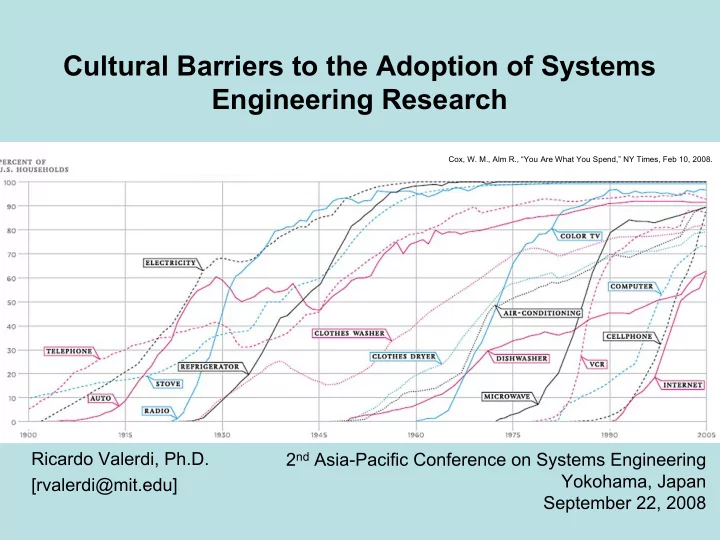
Cox, W. M., Alm R., “You Are What You Spend,” NY Times, Feb 10, 2008.

slide-2
SLIDE 2

2

Objectives

1. Provide an overview of the research in adoption, culture/technology 2. Explore relevant factors

– Attributes of successful measurement systems – Determinants of organizational culture – Culture of technology

3. Share survey results 4. Bridge the gap between the ivory tower and main street

slide-3
SLIDE 3

3

Guiding Questions

  • What makes SE research adoptable?

– Technology adoption, organizational culture

  • What aspects of organizational culture

enable/hinder adoption of SE research?

– “Demand” side, instrumentalist view (adopter-based)

  • What role do the embedded cultures play in the

adoption of tools?

– “Supply” side, determinist (developer-based)

slide-4
SLIDE 4

4

Human-Human Interface

slide-5
SLIDE 5

5

MoProSoft Example

  • CMMI fared well in the U.S., but what about Mexico?
  • 92% of Mexican software companies are small/medium-sized (< 100

people) and average process capability level is 0.9 (Oktaba 2006)

  • Only 3 Mexican companies have achieved level 2; 33 are level 1
  • Modelo

de Procesos para la Industria de Software (MoProSoft)

Oktaba, H., “MoProSoft: A Process Model for Small Enterprises,” Proceedings of the 1st International Research Workshop for Process Improvement in Small Settings, CMU/SEI-2006-SR-001, Software Engineering Institute – Carnegie Mellon University, 2006. Adequate for low-maturity SMEs Inexpensive to adopt Permissible as a national standard Specific for SW dev. and maint. Based on int. recognized practices ISO9000:2000 Yes Yes Yes No No CMM/CMMI Yes No No Yes Yes ISO/IEC 12207 ? ? Yes Yes Yes ISO/IEC 15504 ? ? Yes Yes No

slide-6
SLIDE 6

6

Technology Acceptance Model

Demand side/adopter based

  • Perceived usefulness

– The degree to which a person believes that using a particular system would enhance his or her job performance

  • Perceived ease of use

– The degree to which a person believes that using a particular system would be free of effort

Davis, F. D., Perceived Usefulness, Perceived Ease of Use, and User Acceptance of Information Technology, MIS Quarterly, 13(3), 319-339, 1989.

slide-7
SLIDE 7

7

  • Well documented
  • Trialabilty
  • Low barrier of entry
  • Transparency
  • Demonstrates value
  • Variety of incentives
  • Tailorable
  • Information freshness
  • Relative advantage
  • Compatibility
  • On-going peer support
  • Credibility

What Makes an SE Tool Adoptable?

(survey Qs)

  • Agility
  • Flexibility
  • Failure modes
  • Enabled by IT
slide-8
SLIDE 8

8

COSYSMO Adoption Process

Historical Data Collection Call for Participation Check Relevance / Informal Mapping Understand inputs and identify pilot programs Informal mapping at the WBS level Test run Industry Calibrated model Tailor COSYSMO to

  • rganization

Local Calibration Large-scale rollout to

  • ther projects

Train Champion Training for Users Piloting Institutionalization / adoption = V&V

  • pportunity

Valerdi, R., Miller, C., “From Research to Reality: Making COSYSMO a trusted estimation tool in your

  • rganization,” 17th INCOSE Symposium, June 2007, San Diego, CA.
slide-9
SLIDE 9

9

Social Science

  • Power distance –

the extent to which a society accepts the unequal distribution of power in the

  • rganization
  • Uncertainty avoidance –

the extent to which people are comfortable or uncomfortable with uncertainty and little structure

  • Individualism –

the extent to which individuals are supposed to be self- reliant and look after themselves, versus being more integrated into a group

  • Masculinity or Femininity –

hardness

  • vs. softness; toughness vs. tenderness
  • Long term or short term orientation

– the culture’s members having a stance on delayed, or immediate, gratification

Management

  • Innovation and risk taking

– willing to experiment, take risks, encourage innovation

  • Attention to detail

– paying attention to being precise vs. saying its “good enough for chopped salad”

  • Outcome orientation

  • riented to

results vs. oriented to process

  • People orientation –

degree of value and respect for people. Are people considered unique talents, or is an engineer an engineer an engineer?

  • Individual vs. Team orientation

– are individuals most highly noted, or are collective efforts

  • Aggressiveness

– taking action, dealing with conflict

  • Stability

  • penness to change

Dimensions of Organizational Culture

Hofstede, G., Culture and organizations: Software of the mind. London: McGraw-Hill, 1991. O’Reilly, C., Chatman, J., & Caldwell, D., People and organizational culture: A profile comparison approach to assessing person-organization fit. Academy

  • f Management Journal, 34, 487-516, 1991.
slide-10
SLIDE 10

10 Hofstede, G., Culture and organizations: Software of the mind. London: McGraw-Hill, 1991.

slide-11
SLIDE 11

11

Example: Raytheon Legacy

  • American Appliance Company (1922)
  • Submarine Signal Corporation (1946)
  • Raytheon Manufacturing Company (1959)
  • Beech Aircraft (1980)
  • Hughes/General Dynamics Missiles (1992)
  • E-Systems (1995)
  • Texas Instruments Defense Systems &

Electronics (1997)

http://www.raytheon.com/ourcompany/stellent/groups/public/documents/image/cms04_024719.swf

slide-12
SLIDE 12

12

Determinants of Culture

  • Culture as: social heritage, human behavior,

values, control, rules, etc. (Bodley 1996)

  • Organizational culture is influenced by

– Legacy processes – Customer demands – Product/systems delivered – Geographic location – Etc.

Which attributes of organizational culture enable or hinder the adoption of SE tools?

Bodley, J., Cultural Anthropology: Tribes, States, and the Global System, Mayfield, 1996.

slide-13
SLIDE 13

13

Absorptive Capacity

  • An organization’s ability to value, assimilate, and apply

new knowledge (Cohen & Levinthal 1990)

  • One reason for companies to invest in R&D

instead of simply buying the results (e.g. patents)

– Internal R&D teams increase the absorptive capacity of a company

Predictors

  • Receptivity: The firm's overall ability to be aware of,

identify and take effective advantage of technology

  • Innovative Routines: Practiced routines that define a

set of competencies the firm is capable of doing confidently and the focus of the firm's innovation efforts

Cohen, W. M., Levinthal, D. A., Absorptive capacity: A new perspective on learning and innovation, Administrative Science Quarterly, 35(1), pp. 128-152, 1990.

slide-14
SLIDE 14

14

Dynamic Forces of Implementation

Repenning, N. P., A simulation-based approach to understanding the dynamics of innovation implementation, Organization Science, 13(2), 109-127, 2002. Key B = balancing R = reinforcing

slide-15
SLIDE 15

15

Culture of Technology

supply side/developer-based

  • Product architecture often mirrors organizational

architecture

  • Technology is not

culturally, morally, and politically value neutral (Pacey 1983)

– Snowmobile must fit into a pattern of activity which belongs to a particular lifestyle and set of values

Pacey, A., The Culture of Technology, MIT Press, 1983.

slide-16
SLIDE 16

16

Culture of Technology

Cont.

Technology Practice Cultural Aspect

Goals, values, and ethical codes, belief in progress, awareness and creativity

Organizational Aspect

Economic and industrial activity, professional activity, users and consumers, trade unions

Technical Aspect

Knowledge, skill, and technique, tools, machines, chemicals, resources, products and wastes General meaning

  • f “technology”

Restricted meaning

  • f “technology”

Pacey, A., The Culture of Technology, MIT Press, 1983.

slide-17
SLIDE 17

17

Attributes Survey

Walden, D., Kano’s Methods for Understanding Customer-Defined Quality, Center for Quality

  • f Management Journal, 2(4), 1993.
  • Must-be

– referring to attributes where user is dissatisfied from its absence but never rises above neutral no matter how much of the attribute exists (i.e., good brakes).

  • One-dimensional

– referring to increasing user satisfaction from the presence of this attribute and decreasing satisfaction from its absence (i.e., gas mileage).

  • Attractive

– indicates areas in which the user is more satisfied when the measurement system has the attribute but is not dissatisfied when it is absent; lack of an attribute leads to a neutral reaction (i.e., radio antenna that lowers into car body).

slide-18
SLIDE 18

18

Ranking of Adoption Attributes (n=35)

Adoption Attributes

2.63 2.49 2.4 2.29 2.29 2.23 2.23 2.11 1.97 1.89 1.77 1.57 0.5 1 1.5 2 2.5 3 Well_Documented Credibility Demonstrates_value Low_Barrier_of_Entry Information_Freshness Transparency Compatibility Tailorable On-going_Peer_Support Variety_of_Incentives Relative_Advantage Trialability Attribute Score

Must-be One- dimensional Attractive

slide-19
SLIDE 19

19

Ivory Tower and Main Street

Muller, G., “Industry and Academia: Why Practitioners and Researchers are Disconnected,” 15th INCOSE Symposium, Rochester, NY, 2005.