WIOA Populations with Barriers and Proposed Solutions WIOA BARRIER - - PowerPoint PPT Presentation

wioa populations with barriers and proposed solutions
SMART_READER_LITE
LIVE PREVIEW

WIOA Populations with Barriers and Proposed Solutions WIOA BARRIER - - PowerPoint PPT Presentation

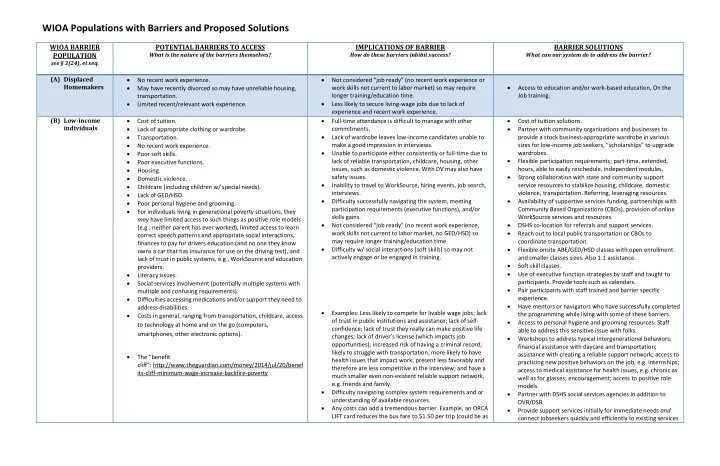
WIOA Populations with Barriers and Proposed Solutions WIOA BARRIER POTENTIAL BARRIERS TO ACCESS IMPLICATIONS OF BARRIER BARRIER SOLUTIONS What is the nature of the barriers themselves? How do these barriers inhibit success? What can our system


slide-1
SLIDE 1

WIOA Populations with Barriers and Proposed Solutions

WIOA BARRIER POPULATION

see § 3(24), et seq.

POTENTIAL BARRIERS TO ACCESS

What is the nature of the barriers themselves?

IMPLICATIONS OF BARRIER

How do these barriers inhibit success?

BARRIER SOLUTIONS

What can our system do to address the barrier?

(A) Displaced Homemakers

  • No recent work experience.
  • May have recently divorced so may have unreliable housing,

transportation.

  • Limited recent/relevant work experience.
  • Not considered “job ready” (no recent work experience or

work skills not current to labor market) so may require longer training/education time.

  • Less likely to secure living-wage jobs due to lack of

experience and recent work experience.

  • Access to education and/or work-based education, On the

Job training. (B) Low-income individuals

  • Cost of tuition.
  • Lack of appropriate clothing or wardrobe.
  • Transportation.
  • No recent work experience.
  • Poor soft skills.
  • Poor executive functions.
  • Housing.
  • Domestic violence.
  • Childcare (including children w/ special needs).
  • Lack of GED/HSD.
  • Poor personal hygiene and grooming.
  • For individuals living in generational poverty situations, they

may have limited access to such things as positive role models (e.g., neither parent has ever worked), limited access to learn correct speech patterns and appropriate social interactions, finances to pay for drivers education (and no one they know

  • wns a car that has insurance for use on the driving test), and

lack of trust in public systems, e.g., WorkSource and education providers.

  • Literacy issues.
  • Social services involvement (potentially multiple systems with

multiple and confusing requirements).

  • Difficulties accessing medications and/or support they need to

address disabilities.

  • Costs in general, ranging from transportation, childcare, access

to technology at home and on the go (computers, smartphones, other electronic options).

  • The “benefit

cliff”: http://www.theguardian.com/money/2014/jul/20/benef its-cliff-minimum-wage-increase-backfire-poverty

  • Full-time attendance is difficult to manage with other

commitments.

  • Lack of wardrobe leaves low-income candidates unable to

make a good impression in interviews.

  • Unable to participate either consistently or full-time due to

lack of reliable transportation, childcare, housing, other issues, such as domestic violence. With DV may also have safety issues.

  • Inability to travel to WorkSource, hiring events, job search,

interviews.

  • Difficulty successfully navigating the system, meeting

participation requirements (executive functions), and/or skills gains.

  • Not considered “job ready” (no recent work experience,

work skills not current to labor market, no GED/HSD) so may require longer training/education time.

  • Difficulty w/ social interactions (soft skills) so may not

actively engage or be engaged in training.

  • Examples: Less likely to compete for livable wage jobs; lack
  • f trust in public institutions and assistance; lack of self-

confidence; lack of trust they really can make positive life changes; lack of driver’s license (which impacts job

  • pportunities); increased risk of having a criminal record;

likely to struggle with transportation; more likely to have health issues that impact work; present less favorably and therefore are less competitive in the interview; and have a much smaller even non-existent reliable support network, e.g. friends and family.

  • Difficulty navigating complex system requirements and or

understanding of available resources.

  • Any costs can add a tremendous barrier. Example, an ORCA

LIFT card reduces the bus fare to $1.50 per trip (could be as

  • Cost of tuition solutions.
  • Partner with community organizations and businesses to

provide a stock business-appropriate wardrobe in various sizes for low-income job seekers, “scholarships” to upgrade wardrobes.

  • Flexible participation requirements; part-time, extended,

hours, able to easily reschedule, independent modules.

  • Strong collaboration with state and community support

service resources to stabilize housing, childcare, domestic violence, transportation. Referring, leveraging resources.

  • Availability of supportive services funding, partnerships with

Community Based Organizations (CBOs), provision of online WorkSource services and resources.

  • DSHS co-location for referrals and support services.
  • Reach out to local public transportation or CBOs to

coordinate transportation.

  • Flexible onsite ABE/GED/HSD classes with open enrollment

and smaller classes sizes. Also 1:1 assistance.

  • Soft skill classes.
  • Use of executive function strategies by staff and taught to
  • participants. Provide tools such as calendars.
  • Pair participants with staff trained and barrier specific

experience.

  • Have mentors or navigators who have successfully completed

the programming while living with some of these barriers.

  • Access to personal hygiene and grooming resources. Staff

able to address this sensitive issue with folks.

  • Workshops to address typical intergenerational behaviors;

financial assistance with daycare and transportation; assistance with creating a reliable support network; access to practicing new positive behaviors on the job, e.g. internships; access to medical assistance for health issues, e.g. chronic as well as for glasses; encouragement; access to positive role models.

  • Partner with DSHS social services agencies in addition to

DVR/DSB.

  • Provide support services initially for immediate needs and

connect jobseekers quickly and efficiently to existing services

slide-2
SLIDE 2

WIOA Populations with Barriers and Proposed Solutions

high as $3.25/trip without ORCA LIFT) but it is still cost- prohibitive when there is insufficient funds to meet basic needs as-is.

  • Sometimes an increase in income means losing crucial

subsidies (childcare, housing, food benefits, medical insurance, utility assistance) that help people out of poverty. to meet those needs on a longer-term basis.

  • Include the “benefit cliff” in job search strategies. Ultimately,

good jobs, with living wages, predictable schedules, and benefits are the best path out of

  • poverty. http://www.clasp.org/resources-and-

publications/publication-1/How-Todays-Safety-Net- Promotes-Work-And-How-To-Do-More-1.pdf (C) Indians, Alaska Natives, and Native Hawaiians

  • Available employment opportunities and job market are

saturated.

  • Limited resources for providing education and training

are not tied to prospective employment opportunities or markets.

  • Natural resources extraction employment is often cyclical
  • r subject to diminishing resources. Individuals with

experience in these areas may only work during specific seasons or periods of availability/abundance.

  • Lack of comprehensive employment planning which takes

the totality of an individual’s barriers to employment into account.

  • Individuals without local family support who live in or

move to urban centers may not have necessary life skills

  • r resources to maintain a search for employment or

develop marketable job skills.

  • Many new and prospective job opportunities are

centered on service industry employment, are filled quickly, and may be filled by tribal members formerly living away from the reservation who decide to return, and therefore do not reduce the number of unemployed.

  • Lacking entry into the job market to begin with, many

unemployed do not have the resources to extend their job search activities beyond the reservation or near- reservation areas.

  • Individuals unemployed or under-employed are faced

with addressing personal and/or family distress, behavioral health needs, basic subsistence and/or household needs and possible legal obligations in addition to developing employment search and retention skills.

  • Individuals who relocate to more populous areas in

search of employment without adequate family or social services support may fail to improve their condition.

  • Partnerships between employers in need of trained

personnel, and specific training provided by the tribe or accessible from the reservation to fill particular avenues

  • f employment.
  • Development of employment opportunities connected

with a resource for purposes other than extraction.

  • For instance, forestry harvesting to be replaced

by wood products manufacture, sales and marketing.

  • Seasonal unemployment due to lack of resource

harvesting opportunities replaced by work at sustaining and enhancing the resource.

  • Identify individuals/populations that may be able to

maintain suitable earnings through reduced employment and increase hours available for work

  • pportunities.
  • Partnership with local employers with sufficient work
  • pportunities to justify limited investment in point-to-

point transportation provided by the tribe.

  • Pursue governmental contracting opportunities that

may provide for work to be performed from reservation and near-reservation areas.

(D) Individuals with disabilities, including youth who are individuals with disabilities

Physical Disabilities?

  • Transportation can be difficult and services may be located too

far away.

  • (Chair-Users): Moving around a cluttered or disorganized

environment is difficult, even if technically ADA compliant.

  • On-going treatment or need to address disability related

unscheduled events (e.g. flare-ups).

  • Need assistance w/ Activities of Daily Living (ADLs).
  • Services are too far away for a person with physical

disabilities to practically access; public transportation is insufficient/unavailable.

  • (Chair-Users): Physical access to the building is difficult or
  • nerous for chair-users if the environment doesn’t facilitate

access.

  • Unable to participate either consistently or full-time.
  • Difficulty w/ ADLs such as using the bathroom, grooming,

eating (low blood sugar so may need a snack).

  • Virtual delivery of online services could eliminate the need

for individuals with physical disabilities to travel.

  • (Chair-Users): Ensure ADA compliance, but also be mindful of

footprint and room layout to facilitate access.

  • Flexible participation requirements; part-time, extended,

hours, able to easily reschedule, independent modules, Internet access.

  • Staff trained on strategies to resolve an issue as it occurs;

quick onsite fix of equipment, adjust table, adjust volume.

  • Staff trained on available state and community resources, co-
slide-3
SLIDE 3

WIOA Populations with Barriers and Proposed Solutions

  • Design of One stop office with multiple locations within the

area where individual needs to access services.

  • Lack of Staff awareness and training on best practices of

engaging with individuals with disabilities. location (DVR, DSHS).

  • Partner with social service agencies in addition to DVR/DSB.

Sensory Disabilities (blind/low-vision, deaf and hard of hearing)?

  • (Blind/Low-Vision): Computer equipment is often inaccessible.
  • Limited staff training and education on the ADA and best

practices with assisting individuals with disabilities.

  • (non-ASL speakers) Deaf or hard of hearing individuals do not

all “speak” ASL (American Sign Language). Example Deaf individual from Ukrainian who is able to work and need job search assistance and possible initial on the job coaching/support.

  • (Blind/Low-Vision): Lack of accessible computer equipment

makes it difficult to develop resumes and undertake training.

  • (Non-ASL speakers) Non-ASL person cannot use ASL to

communicate with job counselors and employers.

  • (Blind/Low-Vision): Paperless one-stop environment that

facilitates access on personal devices.

  • Partner with social service agencies in addition to DVR/DSB.
  • (non-ASL speakers) Establish process to help non-ASL

speakers access services at the office and create or develop a group of service providers who can provide language support to non-ASL speakers. Maybe use video conferencing (SKYPE, FaceTime or similar) to make that resource available on- demand.

Behavioral or Mental Health Disabilities?

  • (Individuals with ADHD): Too much noise and stimuli at the
  • ne-stop.
  • (Individuals with Non-Apparent Disability): Lack of

understanding/knowledge of their own disability can interfere with appropriate accommodations or services.

  • (Refugees and immigrants): Cultural stereotypes and attitudes

prevent many from seeking services to address mental health issues.

  • (Individuals with ADHD): Accessing public spaces such as

computer labs can be counterproductive.

  • (Individuals with Non-Apparent Disability): Computer-based

assessment tests may not be effective.

  • (Refugees and immigrants): A person may appear to be

difficult to work with, anxious, unreliable, but refuses to seek services or gets angry when staff brings up counseling

  • r treatment options.
  • (Individuals with ADHD): Train staff to recognize need for

quiet environment for some job seekers.

  • (Individuals with Non-Apparent Disability): Train staff to

recognize signs of different types of behavioral or mental health disabilities and how to connect job seekers with the appropriate supports.

  • (Refugees and immigrants): Provide training to staff to

understand cultural sensitivity behavioral and mental health

  • issues. This guide provides good information about this

issue: http://form.jotform.us/form/51666347065157?

Cognitive Disabilities?

  • Poor executive functions.
  • Diagnosed or undiagnosed learning disabilities.
  • (Refugees): Lack of understanding/knowledge of their own

experience can interfere with appropriate accommodations or services.

  • Difficulty successfully navigating the system, meeting

participation requirements (executive functions), and/or skills gains.

  • Difficulty with social interactions (soft skills) so may not

actively engage or be engaged in training.

  • Cannot learn in classroom setting or the “usual” (whatever

that may be) way or setting.

  • (Refugees) Symptoms of trauma (learning difficulties,

lethargy, non-responsiveness to tasks or due dates) may be mistaken for cognitive disabilities.

  • Curricula/staff able to adjust training to meet the learning

style/needs of the participant.

  • Soft skill classes.
  • Use of executive function strategies by staff and taught to
  • participants. Provide tools such as calendars.
  • Access to learning disability testing or vocational testing

instruments specific to a particular LD.

  • (Refugees) Staff training in tandem with close connection

with refugee resettlement agencies to integrate employment services with resettlement assistance.

Others? Please specify:

  • (Individuals using a Service Animal): Lack of policy or

understanding of service animal’s purpose; obstacles to physical access that inhibit people from using a service animal.

  • (Individuals using a Service Animal): The service animal may

be asked to wait “outside,” even though the individual relies on it for equal accessibility.

  • (Individuals using a Service Animal): Design policy that is

inclusive of service animals, train staff on purpose of service animal. (E) Older individuals

  • Uncomfortable with technology.
  • May have physical disabilities.
  • Need assistance w/ Activities of Daily Living (ADLs).
  • Real or perceived decline in workplace skills and

ability/interest in learning new skills.

  • Transportation.
  • Focus on Youth in Transition and adults younger than 40 years
  • Unable to use computers, Internet, printers, faxes so unable

to benefit from in-place programming.

  • See physical disabilities.
  • Difficulty w/ ADLs such as using the bathroom, grooming,

eating (low blood sugar so may need a snack.

  • Less able to compete for living-wage job.
  • Feeling lost in the One-Stop system with the focus on
  • Have mentors or navigators who have successfully completed

the programming.

  • Partner with another older person.
  • Curricula/staff able to adjust training to meet the learning

style/needs of the participant.

  • Physical disabilities.
  • Staff sensitive and able to address any ADL related issues.
slide-4
SLIDE 4

WIOA Populations with Barriers and Proposed Solutions

  • f age.
  • Stigma of failure to being employed.
  • Challenges of technology expectations.
  • The onset of hearing loss; physical issues.

younger adults.

  • Manifestations of the changes in hearing and physical

abilities.

  • Have a break room with healthy snacks (no pop machine,

processed food vending machines).

  • Access to work-based learning, such as on-the-job training

and paid work experience, to demonstrate their skills to a potential employer.

  • SCSEP program more engaged with the overall one stop

system.

  • Training and education to staff focused on working with the

aging workforce.

  • Emotional support/managing stress groups.
  • Partnerships with social services agencies in addition to

DVR/DSB. (F) Ex-offenders

  • Reduces employability through limiting available labor market.
  • Unaware of bonding.
  • Don’t know how to market themselves.
  • Pre-incarceration skills out of date.
  • May not report entire conviction history.
  • No recent work experience.
  • Poor soft skills (perhaps institutionalized behavior).
  • Low-income, cognitive, mental health and behavior (in

previous section of this chart). Often, these folks have a number of these issues.

  • Depending on the conviction, limited access to jobs in specific

fields, such as health care.

  • Depending on the conviction, limited access to financial

assistance for education.

  • Limited number of employers able or willing to hire.
  • May require more staff assistance.
  • Just not able to get a job due to limited labor market, staff

not being aware of conviction history.

  • Not considered “job ready” (no recent work experience,

work skills not current to labor market, no GED/HSD) so may require longer training/education time

  • Difficulty with social interactions (soft skills) so may not

actively engage or be engaged in training.

  • Limited access to education and employment. Risk to

reoffending if continued limited access to earn a living, which leads to an increased risk of being incarcerated again.

  • Staff specially trained on local employer requirement for

hire, bonding, how to address conviction history in interview.

  • Use any jobs held while incarcerated (kitchen, correctional

industries, landscaping) on resumes. Capture these transferrable skills.

  • Get references from supervisors and vocational information

from the institution.

  • Run Washington State Patrol background check and check

what employers would see if they ran it.

  • Work with pro bono attorneys or others to get records sealed
  • r expunged.
  • Develop pool of employers willing to take a chance on these

folks.

  • Strong assessment tool to identify non-apparent or unknown

barriers.

  • Specialized career guidance, an opportunity to regain

confidence and identify a skill set that can be used in a field the individual is likely to have both immediate and longer term success, and financial assistance with education as necessary. (G) Homeless individuals

  • Transportation.
  • No recent work experience.
  • Poor soft skills.
  • Poor executive functions.
  • Housing.
  • Unable to participate either consistently or full-time due to

lack of reliable transportation, childcare, housing, DV. With DV may also have safety issues.

  • Difficulty successfully navigating the system, meeting

participation requirements (executive functions), and/or skills gains.

  • Not considered “job ready” (no recent work experience,

work skills not current to labor market, no GED/HSD) so may require longer training/education time.

  • Difficulty w/ social interactions (soft skills) so may not

actively engage or be engaged in training.

  • No mailing address or voice mail – also no access to phone
  • r stamps.
  • Flexible participation requirements; part-time, extended,

hours, able to easily reschedule, independent modules

  • Strong collaboration with state and community support

service resources to stabilize housing, childcare, DV,

  • transportation. Referring, leveraging resources.
  • DSHS co-location for referrals and support services (clothing,

hygiene products, transportation vouchers).

  • Reach out to local public transportation or Community Based

Organizations to coordinate transportation.

  • Flexible onsite ABE/GED/HSD classes with open enrollment

and smaller classes sized. Also 1:1 assistance.

  • Soft skill classes.
  • Use of executive function strategies by staff and taught to
slide-5
SLIDE 5

WIOA Populations with Barriers and Proposed Solutions

  • Domestic Violence (DV).
  • Childcare (including children w/ special needs).
  • Lack of GED/HSD.
  • Poor personal hygiene and grooming.
  • No physical or mailing address.
  • Unaddressed physical or mental health needs.

*Homeless folks should not be stereotyped so some of these may not apply.

  • Potential lack of a variety of necessities when seeking

employment, such as address, phone number, reliable food source; potentially extreme trauma-based reactions; potentially living in constant state of fight or flight; potentially limited to no child care; potentially limited to no transportation; potentially limited to no hope for the future; lack of medical assistance; lack of work clothes; lack of sense of security and self-confidence; potential domestic situations they were fleeing; and the need for money is so immediate there may be limited time/access/ability for necessary education/certifications.

  • Lack of documentation required for eligibility.
  • Strong assessment tool to identify non-apparent or

unknown barriers.

  • Stress and trauma-induced behaviors at both WorkSource

and on the job/during interview; lack of access to present as professional as necessary for interviews; lack of childcare if/when finds a job; lack of medical assistance for chronic or

  • ther needs; extreme fear and distrust.
  • Cannot prove age, selective service, eligibility to work in the

U.S., home address.

  • participants. Provide tools such as calendars.
  • Pair participants with staff trained and barrier specific

experience.

  • Have mentors or navigators who have successfully completed

the programming while being homeless.

  • Access to personal hygiene and grooming resources. Staff

able to address this sensitive issue with folks.

  • Specialized career guidance, including opportunities to

immediately earn money/access to work-based learning, required close working partnerships with homeless programs, financial access for medical, food, shelter, transportation, trauma-sensitive workshops and staff.

  • Acceptance of self-attestation, navigation, or referral to

appropriate agencies to secure documentation. (H) Youth who are in or have aged

  • ut of foster

care

  • Lack of proper/appropriate interview clothing.
  • Lack of positive role models who work.
  • Homelessness.
  • Hygiene issues.
  • Lack of experience of having to follow a regular schedule.
  • Transportation.
  • Lack of cell phone or a consistent contact number.
  • Lack of "soft skills" or knowledge of professionalism.
  • Criminal history.
  • Location.
  • Low education level or mental disability.
  • Vital documents.
  • Low self-esteem/confidence.
  • Verbal skills/appropriate language and vocabulary.
  • Living in a foster home that is too restrictive.
  • No career training before entering college.
  • Biological parents are not supportive to young person's plan.
  • Not graduating from high school.
  • The number of regular meetings that youth need to attend to

maintain resources.

  • Difficulty with people in authority position.
  • Parenting.
  • Low level of life skills.
  • Without proper work attire the employer may think that

the individual is not invested in a job.

  • Don't feel the need to work as it has been role modeled to

live off government funding.

  • Difficult to search and maintain jobs while couch surfing.
  • Hard to maintain hygiene when not accessible to products
  • r showers. Hygiene issues cause employment issues.
  • Do not have experience developing or following their own
  • schedules. This makes it hard to follow through/commit to

being somewhere at a specific time.

  • No means of a way to get to a job.
  • Difficult to hold a job if you cannot be reached or contact an

employer if needed. The person is seen as unreliable.

  • Without knowledge or ability to communicate or be social

in the appropriate settings can limit opportunities.

  • Criminal history can cause a barrier in the application

process.

  • Employment is limited in rural areas.
  • May lack the intellectual knowledge and/or ability needed

to hold down a job and could lose the job for not understanding.

  • Without proper documents young people will not be able to

gain employment.

  • Do not feel good about themselves or feel good enough to
  • More programs like Goodwill that includes job training and

interview and work wear-Provide trendy clothing that appeals to a younger audience.

  • 1) Provide job shadowing 2) Provide job mentors 3) Develop

realistic job fairs that target young people's job interests and have younger professionals manning the booths.

  • Develop rental program that will assist with first month and

security deposit for newly hired employees.

  • 1) Provide a variety of free hygiene products 2) Provide

locations that will allow free and daily showering and laundering.

  • Create a trial work program that can ease individuals into the

work force.

  • 1) Have funding available to reimburse foster parents or
  • ther caregivers 2) Offer incentives-taxi rides, gas vouchers
  • r fuel cards so they can provide to those who can provide a

ride to work 3) Free bus passes for working individuals.

  • Provide free cell phones for job seekers and employed

individuals.

  • Education classes related to the importance of these soft

skills or one-on-one support.

  • 1) Clarification of what needs to be addressed on an

application and in an interview for a criminal offense, both juvenile and adult 2) Record sealing made readily available 3)

slide-6
SLIDE 6

WIOA Populations with Barriers and Proposed Solutions

  • Difficulty with time management.
  • No personal references.
  • Employer biases.
  • Lack of advocacy skills.
  • Not aware of resources or understanding that the message is

target for them. apply for work.

  • The use of the wrong language can make it less likely to

hired.

  • May not be allowed to access work due to rules of the

foster home.

  • Having a hard obtaining employment even after graduation

from college due to not having skills to be employed.

  • Are not able to plan for work if their support systems are

discouraging their plans to succeed.

  • Cannot access jobs without high school completion.
  • Requirements to meet with providers to maintain active

status to receive benefits and supports. Various meetings require less availability to work.

  • Difficult to parent and hold a job. May have to call in more
  • ften to meet the child's needs.
  • Not being prepared for work can cause not arriving on time
  • r be ready to work once they are at work.
  • Being late for work is viewed as unreliable and may be

dismissed if it occurs too often.

  • Without references the job application is incomplete and

may not be hired.

  • Foster care is seen by society as a negative and an employer

may discriminate.

  • Cannot articulate and respond in an inappropriate way and

may lose jobs.

  • Do not know what is available and will not seek the support

that is needed to obtain a job. identify more jobs that will hire with criminal convictions.

  • Outreach with rural areas and/or assistance in finances for

transportation.

  • 1) Increase case management and/or provide intensive

training for a particular skill or job 2) Provide "crisis support" when mental health interferes with ability to do the job.

  • Obtain documents prior to exiting foster care. Create a

process and provide funding for replacing lost vital documents after exiting foster care.

  • Create confidence workshops and provide empowerment
  • pportunities.
  • Provide more exposure to young professional environments.
  • 1) Training for caregivers to teach ways to be supportive

towards work ready 2) Provide job readiness skills in high schools.

  • Provide job training during high school and again in college.
  • Develop mentoring programs for job readiness.
  • Offer a variety of support programs that will assist with

completing schooling requirements.

  • 1) More flexibility meeting program requirements 2) Create

flexible work exceptions when the individual is required for

  • ther day time obligations.
  • 1) Trainings on how to work with authority figures 2) Provide

engagement trainings to employers.

  • Affordable childcare that is accessible and open for extended

hours.

  • On-the-job life skills training.
  • On-the-job trainings on time management.
  • Ensuring youth have connections to significant people.
  • Employer trainings on the culture of foster care.
  • 1) Provide leadership skill building at college settings and

work settings 2) provide work mentors.

  • 1) Marketing campaign that reaches out to young people 2)

Systems collaboration-end silos (education, child welfare, mental health, employment). (I) English Language Learners, individuals with low levels

  • f literacy,

individuals facing substantial cultural barriers

  • Getting assistance in their primary language is difficult or

impossible in a given location.

  • Illiteracy in both English and their native language.
  • Cannot communicate in English (Oral, written or both).
  • Lack of English-language computer knowledge.
  • WorkSource is set-up to utilize computer-based job search

techniques and teach clients job search skills.

  • Cultural understanding (both on behalf of the client and the

WorkSource staff).

  • The language barrier can be impossible to overcome and

drive the participant away.

  • LEP clients need one-on-one individualized assistance to

apply for jobs.

  • Without a full cultural understanding of all the immigrant

cultures (i.e., opposite gender interaction, religious customs, means of communication, time management), assistance can be unproductive or occasionally offensive.

  • Lack of English understanding makes it very difficult to

provide assistance by someone who does not speak the same language.

  • Most LEP clients cannot use computers nor computerized
  • Ensure front-line/intake staff are trained in cultural

sensitivity, can use “emergency” translator tools like Google Translate.

  • Provide cultural competency training for all WorkSource

employees.

  • Hire bilingual, bi-cultural ethnic case managers based upon

the population groups in the area.

  • Allocate staff time based upon needs of clients, and LEP

clients will need greater staff time per client.

  • Offer greater hands-on assistance with applications and basic

computer skills training.

slide-7
SLIDE 7

WIOA Populations with Barriers and Proposed Solutions

  • LEP clients require very individualized, labor intensive services.
  • ELL populations avoid WorkSource office in general due to lack
  • f services and communication barriers.
  • (Refugees & Immigrants) many are resourceful at surviving on

very little and it is difficult for them to move out of that comfort zone into an unknown future. systems to apply for jobs in English.

  • LEP clients need translation assistance at the job interviews

and to understand the job requirements. This would require WorkSource staff to frequently be out of the WorkSource center.

  • Need classes offered in client’s primary language (in areas

with multiple languages for LEP, will require many classes space will be an issue).

  • ELL jobseekers are turned away at the counter with either

expressed or implied message that they can get better services at a community based organization (CBO) that serves their population. These CBOs have language and cultural support for ELL jobseekers but they have a smaller capacity to serve individuals and may have less access to potential job opening available through the Employment Security Department.

  • (Refugees & Immigrants) may limit opportunities they seek
  • r turn down good opportunities out of fear of the

unknown but the job counselor may misunderstand the motivation behind these decisions.

  • Offer on-site ESL classes.
  • Bring more employers into WorkSource who will hire LEP

clients.

  • Flex staffing to allow LEP case workers to assist clients at

interviews outside of WorkSource.

  • Increase group room space to allow classes to be taught in

native language.

  • Translation is just a starting point to effective service to ELL
  • jobseekers. Staff also requires cultural knowledge and

sensitivity to address all jobseekers, ELL or not, that the customer is important and will be treated equitably.

  • (Refugee & immigrants) train staff to look beyond the

surface, build trust with the jobseeker and help the jobseeker see possibilities beyond their comfort zone. (J) Eligible migrant and seasonal farmworkers

  • Low literacy levels in both Spanish and English.
  • Limited English Proficient.
  • Limited Spanish Proficient.
  • Low level of technological skills and knowledge.
  • Mobility (migrant farmworkers).
  • Not aware of services available to them.
  • Limited ability to read in native language, and possibly not

at all in either Spanish or English.

  • Unable to communicate with monolingual WIOA providers,

which limits access.

  • Many MSFWs are indigenous from very remote areas of

their native country and speak only in their own dialect.

  • Limits their access to online options, resume writing, other

technological options that are accessible by more tech savvy customers.

  • Migrant farmworkers travel from city to city, and, usually,

from state to state. They are not in an area long enough to enroll and benefit from training programs, and don’t build relationships with labor exchange providers as easily as farmworkers who live in one area.

  • Can’t access WIOA services if they are not aware of what’s

available either because they don’t come into the office, or staff are not making the proper referrals or informing them

  • f their options.
  • Provide English as a Second Language classes. Also, Spanish

classes would be helpful. Research shows that people who are proficient in their native language can apply the concept

  • f reading and language acquisition to learning a second

language.

  • Provide interpreters and more bilingual staff in areas with

large numbers of MSFWs. Also, provide information in all forms, i.e. written, spoken, online, in Spanish.

  • Seek out interpreters or staff that speak dialects in areas of

high concentration of indigenous MSFWs.

  • Offer basic computer classes with bilingual instructors. Teach

information and strategies specifically related to the need, such as resume programs, online job search, application completion, using the Internet. Also, use programs like KeyTrain for those MSFWs who have some English

  • proficiency. Most importantly, expose them to technology

and get them used to it.

  • Create a network so that WIOA program staff can coordinate

with providers in different areas and states. Help the MSFWs make connections with staff in other offices and states. Is it possible under WIOA to provide services to the same participant in two different states for continuity?

  • Conduct outreach to farmworkers, preferably in coordination

with WIOA 167 staff to educate them on training and job service options. Train WorkSource center staff to provide information to MSFWs about the full array of services available to them.

slide-8
SLIDE 8

WIOA Populations with Barriers and Proposed Solutions

(K) Individuals within 2 years

  • f exhausting

lifetime eligibility under TANF

  • Lack of resources and supports to engage in an active job-

search.

  • Could be barriers similar to low-income, single participants –

please see above.

  • Lack of childcare, transportation, work-hour options makes

the necessary training and education for employment a daunting task.

  • (L) Single parents

(including single pregnant women)

  • Transportation.
  • No recent work experience.
  • Housing.
  • Childcare (including children w/ special needs).
  • Lack of GED/HSD.
  • Time and resource need to participate in job search and

training.

  • Unable to participate either consistently or full-time due to

lack of reliable transportation, childcare, housing.

  • Not considered “job ready” (no recent work experience,

work skills not current to labor market, no GED/HSD) so may require longer training/education time.

  • Single parents have to take care of many demands on their
  • wn. This means they may be in a job search class and must

get to the school to take care of their child who just had a medical issue. They may also need transportation to the school either on the bus or buy fuel for an aging car. Since most support services are aimed at employment-related activities, they may not qualify for either support if they are trying to reach their child. Moreover, each time they make a choice between job search and family, they may be seen as unreliable because of missing important appointments to take care of children.

  • Flexible participation requirements; part-time, extended,

hours, able to easily reschedule, independent modules.

  • Strong collaboration with state and community support

service resources to stabilize housing, childcare, DV,

  • transportation. Referring, leveraging resources.
  • DSHS co-location for referrals and support services.
  • Reach out to local public transportation or CBOs to

coordinate transportation.

  • Flexible onsite ABE/GED/HSD classes with open enrollment

and smaller classes sized. Also 1:1 assistance.

  • Have mentors or navigators who have successfully completed

the programming while living w/ some of these barriers.

  • Customize job search support to help single parents so they

can meet needs for their family and themselves. (M) Long-term unemployed individuals

  • Could be barriers similar to low-income, single participants –

please see above.

  • Lack of up to date credentials and skills.
  • Cannot navigate current job search/application

environment, cannot successfully compete for an appropriate job.

  • Provide access to industry recognized short term training,

population specific workshops offered at WorkSource locations, one-on-one counseling to improve motivation and esteem and assistance with job search (TIME) (N) Other groups as the Governor determines? Please Specify: ________________

  • UNIVERSAL BARRIERS

TO ACCESS

What barriers to access effect all populations?

  • Lack of co-location of services in any one location.
  • Appropriate physical accommodations and technology.
  • “Inside jargon” that confuses the public.
  • Inability to navigate the complex web of employment, training,

and support services available.

  • Distrust of sharing personal/private information in unfamiliar

environment.

  • Lack of support systems.
  • Lack of co-location can be particularly burdensome in rural

areas, where WorkSource centers may be geographically distant from each other; populations with barriers may be discouraged from accessing geographically disparate services (or unable to access).

  • motivation, lack of skill gain/progress Unable to participate

either consistently or full-time, poor.

  • Virtual service delivery can help address the co-location of

services issue; we need to also improve the way we communicate the concept of a “comprehensive one-stop” and not give false expectations that every service may be available at every service location (satellites and affiliates).

  • Strong collaboration and with state and community support

service resources- perhaps there’s a faith-based organization

  • r support group that can provide support and

encouragement.

slide-9
SLIDE 9

WIOA Populations with Barriers and Proposed Solutions

  • Inexperienced staff, high rate of staff turnover, staff pressure

to meet goals resulting in “cherry picking” of customers and/or lack of attention/service.

  • Lack of co-location even in non-rural areas is burdensome

as WS staff can serve thousands upon thousands of individually annually, and they cannot be expected to be experts in serving all populations. Co-location would mean population-specific experts would be located within the same building, at least occasionally, and in addition to providing direct client services, he/she could offer suggestions for improved access, provide staff training, and hopefully have access to resources to provide specialized equipment/resources/tools/software.

  • Poor outcomes, bad public relations/poor reputation of

WorkSource, wasted resources, continued unemployment/under employment.

  • Facilitate events (e.g. Job Club) where participants get to

know each other and develop supportive relationships.

  • Use of mentors.
  • Better pay rates, online training resources in addition to in

person sessions, recognition/benefits for attaining Certified Workforce Professional designation, better defined leadership roles in WorkSource sites (hard to manage expectations and responsibilities for myriad partner agency staff).