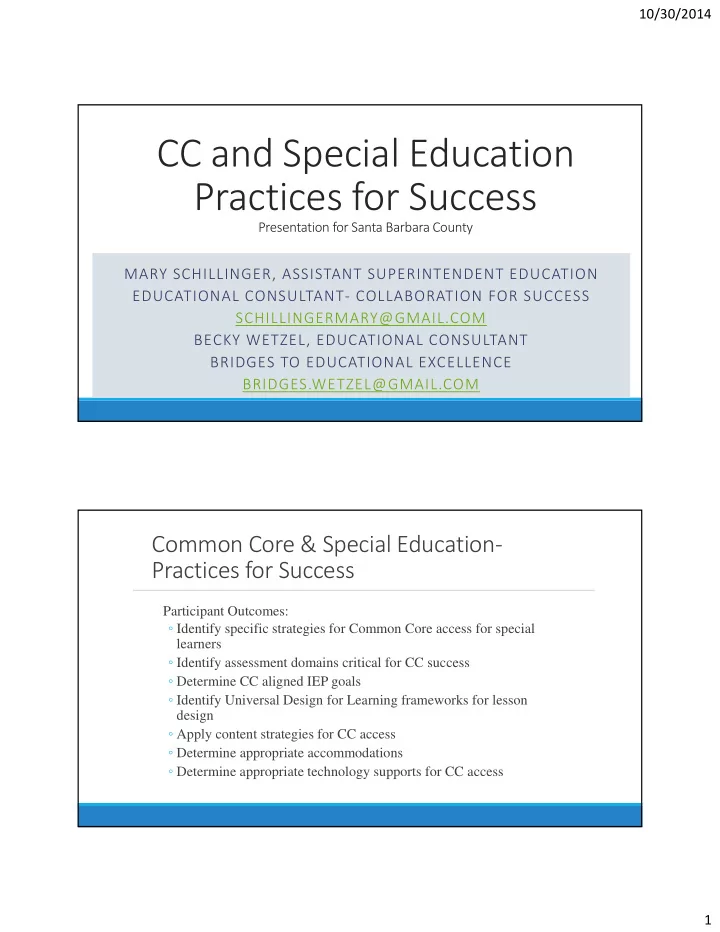
CC and Special Education Practices for Success Presentation for Santa - - PDF document

cc and special education practices for success
SMART_READER_LITE
LIVE PREVIEW

CC and Special Education Practices for Success Presentation for Santa - - PDF document

10/30/2014 CC and Special Education Practices for Success Presentation for Santa Barbara County MARY SCHILLINGER, ASSISTANT SUPERINTENDENT EDUCATION EDUCATIONAL CONSULTANT COLLABORATION FOR SUCCESS SCHILLINGERMARY@GMAIL.COM BECKY WETZEL,


slide-1
SLIDE 1

10/30/2014 1

CC and Special Education Practices for Success

Presentation for Santa Barbara County

MARY SCHILLINGER, ASSISTANT SUPERINTENDENT EDUCATION EDUCATIONAL CONSULTANT‐ COLLABORATION FOR SUCCESS SCHILLINGERMARY@GMAIL.COM BECKY WETZEL, EDUCATIONAL CONSULTANT BRIDGES TO EDUCATIONAL EXCELLENCE BRIDGES.WETZEL@GMAIL.COM

Common Core & Special Education‐ Practices for Success

Participant Outcomes:

  • Identify specific strategies for Common Core access for special

learners

  • Identify assessment domains critical for CC success
  • Determine CC aligned IEP goals
  • Identify Universal Design for Learning frameworks for lesson

design

  • Apply content strategies for CC access
  • Determine appropriate accommodations
  • Determine appropriate technology supports for CC access
slide-2
SLIDE 2

10/30/2014 2

Common Core Shifts and Sped. Implications

Common Core State Standards Not your grandmothers standards……

Fewer Clearer Higher

slide-3
SLIDE 3

10/30/2014 3

Timeline………… Common Core in 2014 / 15 SBAC Assessment in Spring 2015 Common Core Curriculum Adoptions State approval – some subjects not until 2016 Hmmmmmmmmmmmmmmm “The Common Core State Standards initiative provides a historic

  • pportunity to improve access to

rigorous academic content standards for students with disabilities!”

  • Dr. M. McLaughlin, Univ. of Maryland & Pres. CEC
slide-4
SLIDE 4

10/30/2014 4

It’s about access!!

UDL ACCESS

It’s about access….

CCSS

General Education

Co‐ Teaching

Accommodations WITHIN Core

slide-5
SLIDE 5

10/30/2014 5

Supporting Special Education Students in Common Core

ASSISTIVE TECHNOLOGY ACCOMMODATIONS & STRATEGIES U D L

Shifts and Implications for Special Education

Higher text complexity – non- fiction text at higher Lexile levels!

Intensive reading intervention Access to higher level non- fiction text through Universal Design strategies Technology solutions – text to speech

slide-6
SLIDE 6

10/30/2014 6

Lexile Consideration.

Intensive reading intervention to increase the functional lexile level For informational reading, keep the essential concepts but reduce the lexile level to the independent reading lexile level Consider technology solutions….

Online solutions www.newsela.com

slide-7
SLIDE 7

10/30/2014 7

Shifts and Implications for Special Education

Academic Vocabulary Focus

Use of multi-means and strategies for teaching and using academic vocabulary.

slide-8
SLIDE 8

10/30/2014 8

Academic Vocabulary

Collaborate with General Educators Unwrap Anchor Standards – isolate academic vocabulary critical to Anchor Standards Marzano Academic Vocabulary Lists available

  • n-line

Teach strategies for academic vocabulary comprehension Use technology to support the learning

  • f academic vocabulary

Files Available

http://bit.ly/fb93Ba

slide-9
SLIDE 9

10/30/2014 9

Shifts and Implications for Special Education

Building knowledge through content- rich nonfiction

Access to general education – project based collaborative projects. Flipped classroom technology for priming and reviewing.

Shifts and Implications for Special Education

Math concepts prioritized and “spiraling” across grade levels.

IEP focus on math Learning Progressions and Anchor Standards. Use of technology!

slide-10
SLIDE 10

10/30/2014 10

Learning Progressions

CDE Book All the Learning Progressions

slide-11
SLIDE 11

10/30/2014 11

Shifts and Implications for Special Education

Computer based Next Generation Assessments with increased rigor & application base. Technology skills embedded in standards. Digital Literacy goals Frequent practice with application based problems.

Shifts and Implications for Special Education

Instructional practices focused

  • n projects,

collaboration, & flipped classroom models. IEP goals for Executive Functioning & Social Skills for group projects.

slide-12
SLIDE 12

10/30/2014 12

Shifts and Implications for Special Education

Skills critical to success in school with Common Core! Assessment in

Executive Functioning Group work social skills Digital Literacy skills Communication skills Cognitive and Conative abilities

CC Shifts and IEP Implications …. P 84 ‐ 85

slide-13
SLIDE 13

10/30/2014 13

Considerations for IEP Development .. P 86‐87 Support Shifts

Assessment Student Profile Goals & Supports Placement Options

C C Focus Areas

slide-14
SLIDE 14

10/30/2014 14

Reducing Cognitive Load & Common Core G & O

INCREASING COGNITIVE PROCESSING

Cognitive Load

“ Students understand and remember ideas better when they have to transform those ideas from one form to another. Apparently it is in this transformation process that the author’s ideas become the reader’s ideas, rendering them more memorable.”

(Person & Fielding , 1991)

slide-15
SLIDE 15

10/30/2014 15

Reduce Cognitive Load

“Cognitive load refers to the total amount of mental activity imposed on working memory at a specific instance in time…(class period or lesson)” McEwan-Adkins, 2010)

Cognitive Load

Weight of a cognitive load = number of elements that need to be remembered. What students remember depends more on what they already know than on what you tell them!

slide-16
SLIDE 16

10/30/2014 16

Instructional Implications

Present only one important concept or idea at a time.

  • Short presentation of new concepts
  • Processing activity to connect new information to

prior knowledge

  • Repeat sequence

Consider using technology as part of the processing activity to create an artifact.

Videoscribe

http://www.sparkol.com/products/videoscribe

slide-17
SLIDE 17

10/30/2014 17

Use a Strategy

Linking prior knowledge to new information….. LINCS Vocabulary Strategy

(Edwin Ellis, Permission Granted)

LINCS List the parts (say and spell) Identify a reminding word (sounds like) Note a LINCing story Create a LINCing picture Self - test

slide-18
SLIDE 18

10/30/2014 18

Fief Fief

Large area of land given in Medieval times by the King for service in the King’s army.

Rhyming word from current knowledge…..Thief

Thethiefstole the deed to the fief!

Index Card

slide-19
SLIDE 19

10/30/2014 19

L ist the parts…. Show visual ….

slide-20
SLIDE 20

10/30/2014 20

Identify a reminding word

A word already in your working memory that rhymes with

Steinbock

Reminding word…..

slide-21
SLIDE 21

10/30/2014 21

N ote a LINCing story… Create a LINCing picture..

Draw a Picture

slide-22
SLIDE 22

10/30/2014 22

Examine Depth of Knowledge

http://bit.ly/fb93Ba

Files available to download

Examine Depth of Knowledge

http://bit.ly/fb93Ba

Files available to download

slide-23
SLIDE 23

10/30/2014 23

Gradual Release to Independence (P34-35)

slide-24
SLIDE 24

10/30/2014 24

Concept Mastery Routine p 54 – 55

Gain a deep understanding of a specific concept Strategic process for students to define, summarize, and explain a concept Identifying essential concepts in the Common Core Standards Good lead-in activity for group projects where deep understanding of the key concept(s) is critical

slide-25
SLIDE 25

10/30/2014 25

Angle Length Square Parallelogram Rhombus Square Parallelogram Rhombus Rectangle Circle Triangle Line Open Angle 90 degree angles Equal Length Sides Circles Curved Lines Open Angles 4 Sides Corners Closed Angles

Quadrilateral

Four sided shape

A Quadrilateral is a type of Polygon.

Question Exploration Routine p 58 - 59

Graphic organizer connecting information related to a critical question Key terms related to a critical question Good for understanding complex text and informational text Good group activity as lead in to a project based activity

slide-26
SLIDE 26

10/30/2014 26

Universal Design for Learning

slide-27
SLIDE 27

10/30/2014 27

Universal Design for Learning

Provides all individuals equal opportunities to learn Provides flexibility in the ways:

  • Information is presented
  • Students respond and demonstrates

knowledge and skills

  • Are engaged with expectations for

learning

Universal Design for Learning

Reduces barriers in instruction Provides appropriate:

  • Accommodations
  • Supports
  • Challenges

While maintaining high expectations for all students Provides all individuals equal

  • pportunities to learn

Provides flexibility in the ways:

  • Information is presented
  • Students respond and

demonstrates knowledge and skills

  • Are engaged with expectations

for learning

slide-28
SLIDE 28

10/30/2014 28

CAST: Brain Networks

  • The what of learning

Recognition Network

  • The how of learning

Strategic Network

  • The why of learning

Affective Network

slide-29
SLIDE 29

10/30/2014 29

P 30

UDL Framework

Representation

  • Perception
  • Language,

mathematical expressions and symbols

  • Comprehension

Action & Expression

  • Physical action
  • Expression and

communication

  • Executive

functions Engagement

  • Recruiting

interest

  • Sustaining

effort and persistence

  • Self regulation
slide-30
SLIDE 30

10/30/2014 30

Implementing UDL

  • Specific learning
  • utcome
  • Common Core

Standard

Set Learning Goal

  • Methods,

materials, assessment

  • Define the barriers

Analyze Status

  • Identify methods,

materials and assessments

  • Develop a plan

Apply UDL

Executive Functioning

slide-31
SLIDE 31

10/30/2014 31

Executive functioning skills…

Do you…. Start projects without all the needed materials?? Have a messy, disorganized desk? Get disturbed by unexpected interruptions? Have many unfinished projects? Have great ideas but fail to get the job done? Have trouble staying on the same topic when talking?? Have trouble remembering things, even for a few minutes??

Executive Functioning Skills

Activating

Self— Regulating

Memory

Modulating Emotions

Effort

Focusing

slide-32
SLIDE 32

10/30/2014 32

What are Executive Functioning Skills?

Organization Planning / prioritization Meta-cognition / “thinking through problems” Assignment completion Note taking Goal directed persistence Working memory

Flexibility On task – Focus Time management Self-control Emotional Control Response inhibition Sustained attention Task initiation

A Control Tower in our Heads

slide-33
SLIDE 33

10/30/2014 33

Two Index Areas

BEHAVIORAL REGULATION INDEX

Inhibit Shift Emotional Control Monitor

METACOGNITION INDEX

Working Memory Plan / Organize Organization of Materials Task Completion

Two Functions of Exec. Function

Thinking Organizing Regulating

Task Completion

slide-34
SLIDE 34

10/30/2014 34

Executive Function 101 Resource

http://www.ncld.org/learning‐disability‐resources/ebooks‐guides‐toolkits/ebook‐executive‐function‐101

Implications

Assess in the area of Executive Functioning Develop IEP goals for Executive Functioning Determine the Executive Functioning skills required for CC lessons

  • Build in pre-teaching of the Ex F skill
  • Build in reinforcement for the demonstration of the

Executive Functioning skills

slide-35
SLIDE 35

10/30/2014 35

Executive Functioning

ACTIVITY

Hit the Skill Target! - FOCUS

slide-36
SLIDE 36

10/30/2014 36

Hit the Target!

Jose I didn’t play with my pencil kit! I focused! Abbe I got frustrated – it was hard! Joey I didn’t melt down!

Activity

MATCH THE EXECUTIVE FUNCTIONING CATEGORY TO THE QUOTE.

slide-37
SLIDE 37

10/30/2014 37

Age Expectations

Executive Functioning Informal Assessment..

slide-38
SLIDE 38

10/30/2014 38

Executive Functioning & IEPs

Executive functioning skills are critical for success in Common Core Standards Identify the executive functioning skills within the standard(s) Develop IEP goals for skill deficit areas Strategically teach and reinforce Executive Functioning skills

Executive Skill Intervention Planning

Select the target skill

  • Based on skills required
  • Common Core Standard / Anchor Standards

Determine Three Prong Approach

  • Environmental Supports / Modifications
  • Strategy to teach the specific skill(s)
  • Incentives / Data Charting
slide-39
SLIDE 39

10/30/2014 39

Three Prong Intervention

Environmental Modifications Instructional Strategies Incentive Systems

Plan the Three Prong Approach – Environmental Supports / Modifications

Placement in the Classroom Structured work station Teacher / peer cueing prior to beginning work Class chart of steps of assignment Organized work space Video of task steps for review Work ‘buddy’ Time deadline with incremental ‘cues’ Whole class; organization of supplies etc. Whole class; group work Modify the Task; shorter, more explicit, manipulatives, check-off sheets Task modifications – scaffolding; content frames, subtasks with due dates, graphic

  • rganizers, scoring rubrics, sentence frames,

content organizers

slide-40
SLIDE 40

10/30/2014 40

Plan the Three Prong Approach – Instructional Strategies

Define / demonstrate the target skill Develop a visual chart showing the elements of the skill Develop a video modeling the steps of the skill Model the skill with the student on a short activity Develop a planning template / graphic organizer for the skill Determine a ‘cue’ to be used as a reminder of the target skill

Plan the Three Prong Approach – Incentive Systems

Determine the incentive for the individual student (must be reinforcing to the student) Determine the level of the incentive:

  • Verbal reinforcements
  • Physical tokens, points
  • Group incentives

Determine criteria for measuring progress

slide-41
SLIDE 41

10/30/2014 41

Teaching Executive Functioning Skills

Step 1: Describe the problem behavior and associated Executive Functioning Skill(s) Step 2: Set a goal Step 3: Establish a procedure or set of steps to reach the goal – checklists etc. Step 4: Monitor the student following the procedure Step 5: Evaluate and revise if needed Step 6: Fade the monitoring & reinforce positive outcomes

Deconstruct the Standard(s)

Reading for Informational Text Gr. 4 # 9 “Integrate information from two texts on the same topic in order to write or speak about the subject knowledgeably.” What are the executive functioning skills needed for successful completion of this standard?

slide-42
SLIDE 42

10/30/2014 42

Cognitive & Conative Skills

Common Core Standards – Skills and Sub Skills

Academic Skill (Standard) Cognitive Conative Executive Functioning Digital

slide-43
SLIDE 43

10/30/2014 43

What’s a Conative Skill?

Conative

Motivation Striving Instinct Volition Intention

Conative Skills “Mental Toughness”

Resiliency Cultivating a growth mindset ‐”I’ll give it my best shot….” Avoiding negative thinking Taking various perspectives Conflict resolution Handling controversy

slide-44
SLIDE 44

10/30/2014 44

Conative Skills and Common Core

Problem Solving Tasks “Chunk” & Scaffold the concepts Reinforce “Stick – to – It” Behaviors

Developing Common Core Aligned IEP Goals

slide-45
SLIDE 45

10/30/2014 45

IEP Goals and Common Core

IEP teams shall develop … IEP teams shall develop … “an “an Individualized Individualized Education Program (IEP) which includes Education Program (IEP) which includes annual annual goals aligned with goals aligned with and and chosen to chosen to facilitate (students’) attainment of facilitate (students’) attainment of grade

grade level academic standards.” level academic standards.”

34 CFR 34 CFR €300.39 (b)(3) €300.39 (b)(3)

IEP Goal Development

slide-46
SLIDE 46

10/30/2014 46

Key Documents to Have for Goal Development

Common Core State Standards Anchor Standards for all areas Deconstructed standards by grade level Academic vocabulary lists by subject Math Practices by grade level Digital literacy skills & grade level expectations State Common Core learning skill progression lists Executive Functioning Skill expectations by grade

Some great resources… State Standards!

slide-47
SLIDE 47

10/30/2014 47

Some great resources… Talkingteaching Learning Progressions Learning Progression

slide-48
SLIDE 48

10/30/2014 48

Some great resources… Achieve the Core…. Math Some great resources… CA West Ed Version

slide-49
SLIDE 49

10/30/2014 49

Math Practices.. “Habits of Mind” K‐12 Learning Targets

Orange Co.

Start with………

Solid Present Level of Performance including;

  • Learning Modality strengths / deficits for UDL
  • Expressive
  • Receptive
  • Communication
  • Output Modality
  • Motivation preferences
slide-50
SLIDE 50

10/30/2014 50

Developing CC Aligned IEP Goals

Determine the learning strengths and deficits of the student.

  • Executive Functioning Skills
  • Technology Skills
  • Cognitive & Conative Skills
  • Group project skills

Student CC Profile P 89 Know strengths & deficits for CC Success!

slide-51
SLIDE 51

10/30/2014 51

IEP Goal Development Sequence

Present Levels Common Core Skills & Demands Individualized Core Aligned Goals

Seven Step Process Colorado State Dept. of Ed. Exceptional Student Services Unit

Consider grade level standards Gather / analyze assessment data Develop PLAAFP Develop Goals aligned to Gr. Level Standards Monitor/report student progress I D Specially Designed Instruction

Plan for Assessment

1 2 3 4 5 6 7

slide-52
SLIDE 52

10/30/2014 52 P 95

Goals address UDL Learning Preferences

Representation:

  • Given….
  • “After listening to a grade level informational passage and viewing

a short video of the same concepts………….” Expression:

  • Will demonstrate…..
  • “will use word processing to write a two-paragraph reflective essay

summarizing the impact of the information in his personal life with 80% accuracy in 2 out of 3 trials over 4 months….”

slide-53
SLIDE 53

10/30/2014 53

Standards Cornerstone Elements & Associated Skills

Determine the Cornerstone element(s) of a standard! RI 8.6 – Determine an author’s point of view or purpose in a text and analyze how the author acknowledges and responds to conflicting evidence or viewpoints. Cornerstone: Determine author’s purpose. Associated Skill: Theory of Mind Academic Vocab.

Cornerstone Elements

Grade 4 Reading Literature Standard 3 Describe in depth a character, setting, or event in a story or drama, drawing on specific details in the text. Cornerstones: Character Setting Event Skills: Reading comprehension and vocabulary

slide-54
SLIDE 54

10/30/2014 54

Steps to IEP Alignment – (p 126)

  • Assessment in CC skill areas
  • Development of Present Levels of Performance aligned with CC
  • DECONSTRUCT GRADE LEVEL STANDARDS
  • DETERMINE Essential Learning Targets (Trellis where necessary)
  • DETERMINE method of ‘Representation’ (Condition(s)) (Audience /

Arena)

  • DETERMINE method of ‘Action and Expression’ (Behavior(s)
  • DETERMINE degree of accuracy required for meeting goal
  • DETERMINE evaluation / data collection method

Put it all together….

PLOPS

Standards Skills & Targets UDL Student Preferences IEP Goals Assessment & Data Collection

slide-55
SLIDE 55

10/30/2014 55

But first…. A word about measureable goals………..

WRITING GOALS & OBJECTIVES A Mnemonic Device

A B C D E

slide-56
SLIDE 56

10/30/2014 56

(A) As Appropriate..

A = Audience , Arena...As Appropriate Where or with whom the behavior is to

  • ccur....

during circle time, free time, in general education language arts With a peer buddy, independently On the playground, at the store..

B .... Behavior

B = Behavior Measurable by one of the five senses.... Will write, recite Will sit at desk Will point to Tell answers to questions Will jump rope.....

slide-57
SLIDE 57

10/30/2014 57

C ‐ Conditions

C = Conditions Under what conditions or with what modifications.. Given a core math text With teacher prompts, Using a calculator... On ½ inch lines.... Given verbal and visual prompts.... Using an editing checklist... Using a 2 wheel bicycle....

D Degree

D = Degree Both the time line ( by___, in 6 months,) and the measurable criteria In 4/5 trials With 80% accuracy In 3 / 5 opportunities For 3 minutes without falling...

slide-58
SLIDE 58

10/30/2014 58

E Evaluation

What tool will be used to measure progress Teacher made test Informal Assessment Work samples Curriculum Based Assessment Observation and Charting

It starts with the grade level standards…..

slide-59
SLIDE 59

10/30/2014 59

Deconstruct the standards………….

STANDARD

ESSENTIAL CONSTRUCT(S) OF THE STANDARD Essential Elements Of the Standard

SUPPORTS

DECONSTRUCT …… DECONSTRUCT ……

slide-60
SLIDE 60

10/30/2014 60

Deconstruct this Standard….

Reading for Lit. K‐5 Gr. 4 Compare / Contrast Standard 6

Compare and contrast the point of view from which different stories are narrated, including the difference between first – and third‐person narrations.

Theory

  • f Mind

WRITE

Implied Skills..

Reading

Interpret

Focus & Attention

Consider…..

UNIVERSAL DESIGN STUDENT’S LEARNING STRENGTHS

slide-61
SLIDE 61

10/30/2014 61

Representation Action & Expression Specific Criteria

Components of Measurable Goal

(From GoalbookToolkit PP)

Representation

Representation (From GoalbookToolkit PP)

How will the task be presented to the student?

Given _________________, Linus will … Given _________________, Linus will … After __________________, Linus will … After __________________, Linus will …

slide-62
SLIDE 62

10/30/2014 62

Representation

Representation (From GoalbookToolkit PP)

After independently reading a grade level article, … After independently reading a grade level article, … After listening to a grade level article read aloud and then reading independently, … After listening to a grade level article read aloud and then reading independently, …

Action & Expression

Expression From Goalbook Toolkit PP

What observable evidence will the student produce when they perform the task?

… , Linus will ____________________ … , Linus will ____________________

slide-63
SLIDE 63

10/30/2014 63

Action & Expression

Expression (From Goalbook Toolkit PP)

… Linus will write a brief

summary of the article (5-8 sentences) which describes the author’s main idea, includes at least three of the author’s key points, and use at least three quotations from the text.

… Linus will write a brief

summary of the article (5-8 sentences) which describes the author’s main idea, includes at least three of the author’s key points, and use at least three quotations from the text.

Goal Development – Focus of Goals

Grade Level Expectancies Academic Standards Based Goals Learning Skills Support Access

  • Common Core State

Standards

  • Instructional Shifts
  • Deficit areas to access

Grade Level Standards

  • Require Specialized

Instruction

  • Deficit areas in

foundational skills

  • Academic Literacy / Exec.
  • Func. / Social Skills / Digital

Literacy

slide-64
SLIDE 64

10/30/2014 64

Gap Analysis and Target Area Selection

Grade Level Academic Standards & Instructional Shifts

PLAAFPs Identify strengths Identify areas of grade level competency Identify impact of deficit on access to the CORE

IEP Goals IEP Supports

Sammy 8th Grade

IEP / Specific Learning Disability / OHI ‐ ADHD

  • Difficulty organizing concepts
  • Reading and Writing skills significantly delayed
  • Difficulty staying on topic in speaking and writing
  • Visual modality strength
  • Proficient with word processing and computer

use

slide-65
SLIDE 65

10/30/2014 65

Grade Level Standard

W.8.1 Write arguments to support claims with clear reasons and relevant evidence. (a) Introduce claim(s), acknowledge and distinguish the claim(s) from alternate or opposing claims, and

  • rganize the reasons and evidence logically. (b)Support claims(s)

with logical reasoning and relevant evidence, using accurate, credible sources and demonstrating an understanding of the topic or text. (c) Use words, phrases, and clauses to create cohesion and clarify the relationships among claim(s), counterclaims, reasons, and evidence. (d) Establish and maintain a formal style. (e) Provide a concluding statement or section that follows from and supports the argument presented.

Trellis to Review Learning Progression

Functional Level Standard for Sammy: W.6.1 Write arguments to support claims with clear reasons and relevant

  • evidence. Introduce claim(s) and organize the reasons and evidence
  • clearly. Support claim(s) with logical reasoning and relevant evidence,

using accurate, credible sources and demonstrating an understanding of the topic or text. Use words, phrases, and clauses to clarify the relationships among claim(s) and reasons. Establish and maintain a formal style. Provide a concluding statement or section that follows from the argument presented.

slide-66
SLIDE 66

10/30/2014 66

Trellising …. (Yes, it’s a verb!)

  • 1. Select the Anchor / Grade Level Standard for the

student’s grade placement.

  • 2. Deconstruct the standard for essential skills.
  • 3. Backward map, or “trellis” down the standards of the

learning progression to reach the present performance level to see the essential elements.

  • 4. Don’t trellis any further than necessary to maintain rigor!
  • 5. Write goals for additional skills needed for successful

attainment; eg. Executive functioning

Look at the Grade Level standard and the Learning Progressions

slide-67
SLIDE 67

10/30/2014 67

Deconstruct the Standards

Break the standard down to identify small, explicit, learning targets. Important for goal writing and for lesson / unit planning

Knowledge Targets

What knowledge or understanding is required to achieve this standard? VERBS: LIST, NAME, IDENTIFY, DEVELOP, CALCULATE

Reasoning Targets

What mental processes are required to achieve the standard? INFER, PREDICT, ANALYZE, EVALUATE, COMPARE

Skill Targets

What are the performance skills required to demonstrate competence on the standard? ORAL FLUENCY, COUNTING, SORTING, COMPREHEND

Product Targets

What is the concrete product or products that students will need to create to show mastery of the standard? GRAPH, PLAY, SKIT, STORY, CHART, ESSAY

Learning Targets p 94

slide-68
SLIDE 68

10/30/2014 68

Deconstruct!

Student’s Learning Modality Strength Profile

slide-69
SLIDE 69

10/30/2014 69

Sammy’s Goal

In a classroom setting, when presented with choice of 2 persuasive writing topics, Sammy will choose one topic independently and write a paragraph that includes a topic sentence, 3 supporting (evidence) sentences to support his claim and a conclusion sentence, maintain the topic throughout the paragraph with 75% accuracy in each attempt over a semester as measured by teacher made tests and assignments.

Identify the Executive Functioning Skills Needed for the Lesson

Activating – Initiating the task Sequencing – Making a sequential list of steps Focusing Skills – Sustaining focus on the task Self – Monitoring – resisting distraction Determine what – if any support needed……

slide-70
SLIDE 70

10/30/2014 70

Identify the Key Academic Vocabulary

Cause and effect relationship Comparison Contrast Exclamatory sentence Main idea Point of view

Identify Specially Designed Instruction

Cornerstone Elements Goal

Grade Level Standards

Access Goals

(Executive Functioning, Social

Skills, Digital)

Foundational Skills Goals Related to the Grade Level Standard

Accommodations

Least Restrictive Environment

slide-71
SLIDE 71

10/30/2014 71

Specially Designed Instruction

  • Facilitates ACCESS to Rigor and Content in the

general education environment and curriculum

  • Success oriented
  • Linked to Colorado Academic GRADE LEVEL

Standards

  • Uses and promotes Universal Design for Learning

strategies

  • Belief system that Special Education Student CAN

access rigor!

Determine Accommodations

Team huddles to determine if accommodations are needed!

slide-72
SLIDE 72

10/30/2014 72

Universal Tools

Embedded Supports:

  • Breaks
  • Digital Calculator
  • Digital Notepad
  • Highlighter
  • Mark for Review
  • Math Tools (i.e. ruler)
  • Spell check
  • Dictionary

Non‐embedded Supports

  • Breaks
  • Scratch Paper
  • Thesaurus (for full write tasks)
  • *Based on student preference

and selection

Designated Supports

Embedded Supports:

  • Color Contrast
  • Text to Speech (not for reading

passages)

  • Translated Test Directions for EL
  • Dual Language Translations for

EL

Non-embedded Supports

  • Bilingual Dictionary
  • Color Contrast
  • Magnification
  • Read Aloud (not for reading

passages)

  • Scribe (for math and non-writing

items)

  • Separate Setting
  • *Identify PRIOR to administration
slide-73
SLIDE 73

10/30/2014 73

Accommodations‐ (IEP or 504)

Embedded Supports:

  • American Sign Language
  • Braille
  • Closed Captioning
  • Text-to-Speech (for gr 3-5; 1-

2%)

Non-embedded Supports

  • Abacus
  • Calculator (Braille, Talking)
  • Alternate Response Options
  • (adapted keyboards, touch screen,

head wand)

  • Print on Demand
  • Read Aloud
  • Scribe
  • Speech to Text

Your turn………………

slide-74
SLIDE 74

10/30/2014 74

Groups – Student Profile

As a group, create the present levels ‐ strengths and deficits for a fictional student who is similar to the students you work with. Determine the Representation Modality Strength and the Action & Expression Modality Strength. Look at the Common Core Anchor Standard provided. Decide what type of goals you would write for your student based on the pyramid of access to rigor goals descriptions. Be ready to share the types of goals you would recommend and your reasoning.

Write Common Core Aligned Goals

JACOB

  • Review the Profile Sheet for Jacob with your group
  • Review the Grade Level Standard for your group’s

domain

  • Deconstruct the standard for essential elements
  • Write a CC aligned goal for Jacob
  • Share your goal
slide-75
SLIDE 75

10/30/2014 75

Files Available

http://bit.ly/fb93Ba

Thanks & Good Luck!