CSE5390 & 7390 Special Topics in Ubiquitous and Cognitive - - PowerPoint PPT Presentation

cse5390 7390
SMART_READER_LITE
LIVE PREVIEW

CSE5390 & 7390 Special Topics in Ubiquitous and Cognitive - - PowerPoint PPT Presentation

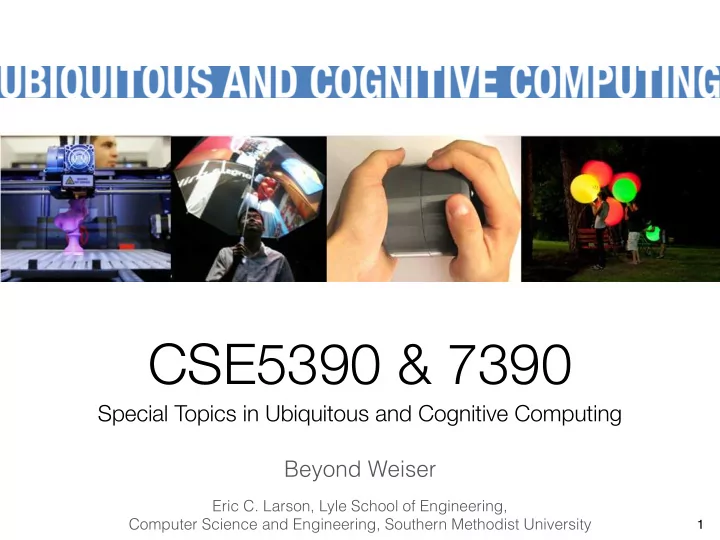
CSE5390 & 7390 Special Topics in Ubiquitous and Cognitive Computing Beyond Weiser Eric C. Larson, Lyle School of Engineering, Computer Science and Engineering, Southern Methodist University 1 1 class logistics look at the schedule

slide-1
SLIDE 1

1

Special Topics in Ubiquitous and Cognitive Computing

CSE5390 & 7390

Beyond Weiser

Eric C. Larson, Lyle School of Engineering, Computer Science and Engineering, Southern Methodist University

1

slide-2
SLIDE 2

class logistics

  • look at the schedule for discussion assignments
  • anyone not assigned?
  • first on deck:
  • any troubles viewing the lectures for Thursday?
  • anyone need an arduino?
  • downloading editor for class paper (due in about 10 days)

2

https://drive.google.com/open?id=0B1AKbN_BN69aY0VncFNBYTdFc2M

slide-3
SLIDE 3

agenda

  • Blythe: hitchhiker’s guide to ubicomp
  • reading for the misreading
  • reframing the story
  • Abowd: collective computing
  • beyond the idea of ubicomp
  • …or how to make ubicomp fit into today’s paradigm

3

Yvonne Rogers Paul Dourish Gregory Abowd

slide-4
SLIDE 4
  • professor at Newcastle University
  • design ethnography
  • both a writer and a a research scientist
  • also an artist

mark blythe

4

slide-5
SLIDE 5

hitchhiker’s ubicomp

5

  • a critique on ubicomp through literary devices
  • give insights toward framing new ubicomp technology and design
  • deconstructionism, psychoanalytic, and feminism
  • parallel future readings: Arthur Dent and Joe Chip
  • incompetence versus political discord
slide-6
SLIDE 6

general criticism

6

  • ubicomp writing is always “just around the corner”
  • ubicomp is far more messy than weiser’s vision, thus “we have not

noticed its arrival”

  • benign political and cultural context
  • related criticisms:
  • context is really hard
  • inference is imperfect
  • the panopticon
slide-7
SLIDE 7
  • the vision of ubicomp will never be more than a vision

…in the same way that AI will never be a human

7

slide-8
SLIDE 8

criticisms of weiser’s ubicomp

  • context and intelligence are too hard... successes thus far are

underwhelming

  • when “it” gets its wrong, we are extremely frustrated
  • technology abandonment

8

slide-9
SLIDE 9

the panopticon

  • easy to think we are always watched (and could be)
  • easy to overstep bounds

9

“Such panopticon developments elicit a knee-jerk reaction of horror in us”

  • Yvonne Rogers
slide-10
SLIDE 10

back to Blythe

  • literary devices as scientific critical thought
  • pastiche writing
  • bring out thematic criticism otherwise left dormant
  • much more visceral than just criticizing! why?

10

slide-11
SLIDE 11

taking Sal apart

11

  • Sal feels “cosy” from seeing the neighborhood
  • …like Winston smith “loves” big brother
  • she sees her children through a “window”
  • her perspectives are mediated…
  • she gets the manual to her garage door
  • …because its too difficult to operate
  • she “logs in” to work automatically
  • is she getting “clocked in” by superiors?
  • Sal at breakfast:
  • pen: there is a direct link to her office at the table…
slide-12
SLIDE 12

Sal and Joe

12

  • deconstruct:
  • is sal keeping “tabs” on joe?
  • is there a shadow of anxiety and fear?
  • the big other…
  • psychoanalysis:
  • maybe it is collegial, maybe joe wants to be watched
  • “to see without being seen”, technology is aware of

its potential intrusiveness

  • surveillance without intrusion in this case
slide-13
SLIDE 13

Sal as a woman

13

  • third generation feminism: rights of males and females

is based upon more than a forced choice

  • where are her priorities? newspaper versus breakfast?

does she have a choice?

  • technical domination: does technology necessitate that

she appears to be working, never interacting “too long” with the children to be judged as not selecting “work”?

  • total collapse of home versus work has more effect
  • n the social perceptions of females than males… ?
  • what does this say about technology mirroring culture,

prejudice, and furthering mainstream opinion?

slide-14
SLIDE 14

pastiche

14

slide-15
SLIDE 15

Arthur Dent

15

  • new technology: the fundamental design flaws of

technology are hidden by their superficial design flaws

  • the alarm clock
  • the garage door
  • a common mistake in designing something completely

foolproof is to underestimate the ingenuity of complete fools…

  • is uncooperative technology more likely to be

mastered? or abandoned?

slide-16
SLIDE 16

Joe Chip

16

  • new technology: it ignores the status of Sal as a

executive, Sal’s utopia is Joe’s social dystopia

  • widening the technology gap
  • benign social contexts: technology is fine
  • what happens when there is conflict
  • a cheating spouse? a party at your parent’s

house?

  • consider weiser’s data trails in today’s political

landscape…

slide-17
SLIDE 17

moving on to next paper

  • has anything swayed your opinion from after Weiser’s vision?
  • one central point: ubicomp technology is written in the narrative of

Weiser’s Sal, with the varied and pointed problems largely ignored

  • for this class: know the limitations of a technology and be realistic

about your design

17

slide-18
SLIDE 18
  • Is setting out to define the next generation vision
  • AY-bowd
  • director of health systems institute
  • IT and health delivery
  • technology and autism
  • aware home research initiative
  • at the forefront of ubicomp, with Weiser

gregory abowd

18

slide-19
SLIDE 19

different criticisms

  • is Abowd defining a fourth generation of computing?
  • “rather than focus on the socio-technical criticisms, I draw

attention to missing elements in ubiquitous computing’s technical definition that could be leveraged today”

  • what separates ubicomp from collective computing?

19

collective intelligence: shared or group intelligence that emerges from the collaboration, collective efforts, and competition of many individuals

slide-20
SLIDE 20

different criticisms

  • the available technology shapes fourth generation computing
  • “practices develop around technologies, and technologies are

adapted and incorporated into practices” -Paul Dourish

  • the three most influential pieces are:

20

says Abowd!

slide-21
SLIDE 21

the cloud

  • some argue that the level of connectivity for ubicomp is not possible
  • “an emphasis on integration, albeit imperfect, is important

going forward”

  • computing beyond the device
  • health and wellness
  • productivity
  • entertainment
  • education

21

slide-22
SLIDE 22

the crowd

  • mechanical turk, online games
  • fills in gap that inference can never get right
  • key question: temporary versus mainstay
  • key ubicomp difference: we may not know the source of

intelligence…

22

slide-23
SLIDE 23

the shroud

  • the internet of things
  • the internet of nouns
  • “The last decade’s human body augmented

by a powerful pocket sized smartphone will face competition from a physically disaggregated collection of devices screaming for an aggregated experience”

—Gregory Abowd

  • spontaneous refiguring to deliver the right

tools…better?

23

I don’t always call it #IoT… but when I do

slide-24
SLIDE 24

why focus on applications

24

  • “practices develop around technologies, and technologies are

adapted and incorporated into practices” -Paul Dourish

  • key advantages:
  • marketplace not ignored
  • practicality is key
  • focus on applications that successfully employ cloud, crowd,

shroud

  • …which means fitting a problem to a tool (or does it)?
slide-25
SLIDE 25

driver: personal navigation

25

  • to improve: more shroud
  • faster and more JIT access to information
  • wearables
  • HUD in cars
slide-26
SLIDE 26

follow on app: health

26

  • extending services of health professionals
  • managing questions
  • patients like me
  • shroud gives:
  • unprecedented access to physical signals
slide-27
SLIDE 27

follow on app: education

27

  • the MOOC with social networking
  • classroom experiences — how?
slide-28
SLIDE 28

follow on app: commerce

28

  • the supply chain
  • who needs what
  • opinion about products and services
  • tracking and responsiveness
  • conflict management
slide-29
SLIDE 29

discussion

29

  • what is the fundamental difference in ubiquitous and

collective computing?

slide-30
SLIDE 30

for next class...

  • next time: in class assignment in teams
  • get your micro controllers!!!
  • one week from Thursday: class paper
  • try to use this editor (cloud, crowd, shroud project):

30

https://drive.google.com/open?id=0B1AKbN_BN69aY0VncFNBYTdFc2M

slide-31
SLIDE 31

31

Special Topics in Ubiquitous and Cognitive Computing

CSE5390 & 7390

Beyond Weiser

Eric C. Larson, Lyle School of Engineering, Computer Science and Engineering, Southern Methodist University

31

slide-32
SLIDE 32

Back up Slides

32

slide-33
SLIDE 33

what next ubicomp?

CSE5390 & 7390 Special Topics in Ubiquitous Computing

33

  • optional reading from Gregory Abowd
slide-34
SLIDE 34

what next ubicomp?

CSE5390 & 7390 Special Topics in Ubiquitous Computing

34

  • ubicomp as a niche area doesn’t make sense
  • its too broad to be an area of computing
  • ubicomp research no longer has a well defined vision
  • ... its the job of industry now! (maybe)
slide-35
SLIDE 35

weiser was right

CSE5390 & 7390 Special Topics in Ubiquitous Computing

35

  • scaled computing exists (albeit with some counterexamples)
  • interconnected devices are pervasive
  • different levels of ownership are pervasive
  • (don’t worry about disposable electronics)
  • ... and now the research is done
slide-36
SLIDE 36

distinguished ubicomp

CSE5390 & 7390 Special Topics in Ubiquitous Computing

36

  • living laboratories
  • maker community
  • your-noise-is-my-signal
  • multi-disciplinary
  • has multi-disciplinary helped or harmed collaborative

communities? (double duty)

slide-37
SLIDE 37

apps vs tech (theory vs apps)

CSE5390 & 7390 Special Topics in Ubiquitous Computing

37

  • applications research vs. technology research
  • both have excellent track records
  • ...except when they don’t (hammer in search of a nail)
  • our best work goes beyond exploratory research and into the field

where it has the greatest impact

slide-38
SLIDE 38

an example: mainstream

CSE5390 & 7390 Special Topics in Ubiquitous Computing

38

  • developers were no longer computer scientists
  • not true for ubicomp (?)
  • comes back to the programming interface--its not a 3D world...

(this gets back to Matt’s original assertion of Abowd’s datatypes)

  • ubicomp needs a well defined fourth generation of computing
slide-39
SLIDE 39

CSE5390 & 7390 Special Topics in Ubiquitous Computing

39

slide-40
SLIDE 40

agenda

  • last time: the vision of ubicomp, 10 year anniversary edition
  • Rogers: engaging ubicomp
  • context, ecology, and criticism
  • application areas: ubicomp without ubiquity
  • Blythe: hitchhiker’s guide to ubicomp
  • reading for the misreading
  • reframing the story

CSE5390 & 7390 Special Topics in Ubiquitous Computing

40

slide-41
SLIDE 41

engaging ubicomp

  • thesis: the vision of ubicomp will never be more

than a vision (in the same way that AI will never be a human)

CSE5390 & 7390 Special Topics in Ubiquitous Computing

41

slide-42
SLIDE 42

context is impossible

  • understanding context ... is more subtle, fluid, and idiosyncratic than

any machine can ever understand (like behavior, mood, and intention)

  • ubicomp is doomed by intractable ethical and computational

problems...

  • would we depend on computers?
  • will our ability to learn and remember suffer?
  • instead...

CSE5390 & 7390 Special Topics in Ubiquitous Computing

42

slide-43
SLIDE 43

ecology of resources

  • no need for invisibility, just an ensemble of resources
  • ... an internet of things...basically
  • design to extend and support what people do
  • let person take the initiative in choosing the tool

CSE5390 & 7390 Special Topics in Ubiquitous Computing

43

slide-44
SLIDE 44

criticisms of weiser’s ubicomp

  • context and intelligence are too hard... successes thus far are

underwhelming

  • when “it” gets its wrong, we are extremely frustrated

CSE5390 & 7390 Special Topics in Ubiquitous Computing

44

slide-45
SLIDE 45

criticisms: data integration

  • “While newer technological developments may enable more

accurate data to be detected and collected it is questionable as to how effectively it can be used. It still involves Herculean efforts to understand, interpret and act upon in real-time and in meaningful ways.”

  • people are unpredictable to our models, especially in real time

CSE5390 & 7390 Special Topics in Ubiquitous Computing

45

IBM Blue Eyes

slide-46
SLIDE 46

criticisms: assistive care

  • researchers choose this because “target” and “use scenario” are

easily described

  • easy to overstep bounds

CSE5390 & 7390 Special Topics in Ubiquitous Computing

46

“Such panopticon developments elicit a knee-jerk reaction of horror in us”

slide-47
SLIDE 47

rethinking pervasive

  • not an array of invisible sensors, but a rich environment of tools
  • interactions should be provocative, telling, thoughtful
  • non-experts should be able to build designs (only possible in simple

approaches)

  • “practices develop around technologies, and technologies are

adapted and incorporated into practices” -Paul Dourish

CSE5390 & 7390 Special Topics in Ubiquitous Computing

47

slide-48
SLIDE 48

app area: learn and play

CSE5390 & 7390 Special Topics in Ubiquitous Computing

48

“Is it not the case that children can be highly creative and imaginative when given simply a cardboard box to play with? If so, why go to such lengths to provide them with new tools?”

“UbiComp and physical toys can both provoke and stimulate, but promote different kinds of learning and collaboration among children”

slide-49
SLIDE 49

app area: science & thought

CSE5390 & 7390 Special Topics in Ubiquitous Computing

49

  • extended periods of

learning and analysis

  • critical thought

“…create opportunities for groups of students to explore ‘patient’ science”

slide-50
SLIDE 50

app area: behavior change

CSE5390 & 7390 Special Topics in Ubiquitous Computing

50

“A challenge… is for long term studies to … show that it is the perpetual and time-sensitive nature of the sensed data and the type of feedback provided that contributes to behavioral modification”

slide-51
SLIDE 51

the “new” ubicomp?

CSE5390 & 7390 Special Topics in Ubiquitous Computing

51

  • a more realistic vision?
  • visionary?
  • is calm computing not relevant if ubicomp tech is not completely

pervasive?

  • a paradigm shift: practical ubicomp?
slide-52
SLIDE 52

CSE5390 & 7390 Special Topics in Ubiquitous Computing

52

  • we will never create an artificial human
slide-53
SLIDE 53

CSE5390 & 7390 Special Topics in Ubiquitous Computing

53