CSE5390 & 7390 Special Topics in Ubiquitous and Cognitive - - PowerPoint PPT Presentation

cse5390 7390
SMART_READER_LITE
LIVE PREVIEW

CSE5390 & 7390 Special Topics in Ubiquitous and Cognitive - - PowerPoint PPT Presentation

CSE5390 & 7390 Special Topics in Ubiquitous and Cognitive Computing Weisers Vision Eric C. Larson, Lyle School of Engineering, Computer Science and Engineering, Southern Methodist University 1 class logistics in class assignment


slide-1
SLIDE 1

Weiser’s Vision

1

Eric C. Larson, Lyle School of Engineering, Computer Science and Engineering, Southern Methodist University

Special Topics in Ubiquitous and Cognitive Computing
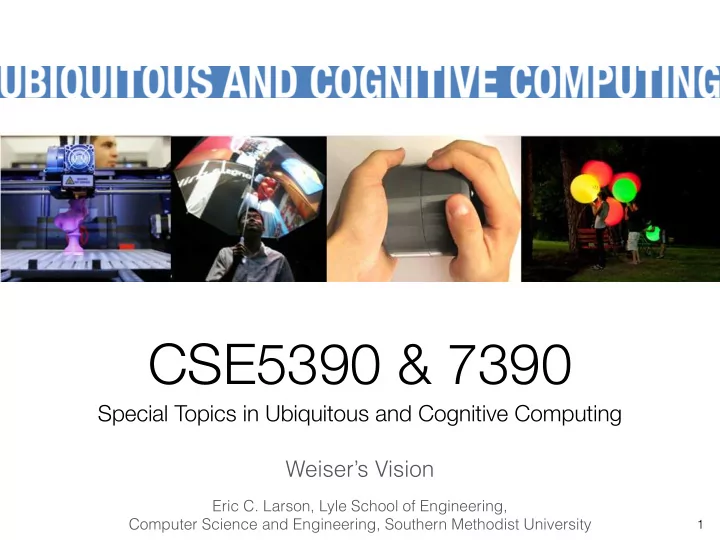
CSE5390 & 7390

slide-2
SLIDE 2

class logistics

  • in class assignment videos are up for next week!
  • …i think…
  • post your introduction and preferred discussions for leading

during class to the forum

  • due next time!

2

slide-3
SLIDE 3

agenda

  • weiser’s early vision of ubicomp
  • calm technology
  • maybe some criticism

3

slide-4
SLIDE 4

papers from 1991 and 1993

4

alien technology?

slide-5
SLIDE 5

mark weiser

5

slide-6
SLIDE 6

papers discussion

6

slide-7
SLIDE 7

the computer for the 21st century

7

  • technology is immediately

recognizable, mundane

  • overview:
  • psychologically invisible
  • needs no explanation
  • easy to ignore or focus on

we are trying to conceive a new way of thinking about computers in the world, one that takes into account the natural human environment and allows the computers themselves to vanish into the background

slide-8
SLIDE 8

the computer for the 21st century

8

  • technology is immediately

recognizable, mundane

  • overview:
  • psychologically invisible
  • needs no explanation
  • easy to ignore or focus on

we are trying to conceive a new way of thinking about computers in the world, one that takes into account the natural human environment and allows the computers themselves to vanish into the background

slide-9
SLIDE 9

the computer for the 21st century: tools

9

“The state of the art is perhaps analogous to the period when scribes had to know as much about making ink or baking clay as they did about writing” is this true today?

slide-10
SLIDE 10

the computer for the 21st century: box

10

  • criticism: it cannot be a

personal computer

  • suggest: shift focus to the

task, not the tool

“by analogy to writing, carrying a super-laptop is like owning just one very important book. Customizing this book … does not begin to capture the power

  • f true literacy.”
slide-11
SLIDE 11

shift focus to the task

11

  • an example: medicine
  • a counter example: medicine
slide-12
SLIDE 12

criticism: multimedia

12

  • used to get our attention, rather than be in periphery
slide-13
SLIDE 13

criticism: virtual reality

13

  • used to get our attention, rather than be in periphery
  • draws you out of everyday life
slide-14
SLIDE 14

criticism?

14

  • used to get our attention, rather than be in periphery
  • draws you out of everyday life...
  • is this any better?
slide-15
SLIDE 15

15

slide-16
SLIDE 16

how to make technology vanish

16

  • metaphor: the electric motor
  • simpler, easier installation
  • cheaper than system of pulleys
  • each device is more powerful

through autonomy

slide-17
SLIDE 17

how to make technology vanish

17

  • metaphor: the electric motor
  • simpler, easier installation
  • cheaper than system of pulleys
  • each device is more powerful

through autonomy

modern day equivalent

slide-18
SLIDE 18

weiser’s key issues for phase 1

18

  • a computer should know:
  • location
  • if a system knew where it was, and size of what

it connected to

  • scale
  • tabs (lots per room)
  • pads (10-20 per room)
  • boards (1-2 per room)
slide-19
SLIDE 19
  • a computer should know:
  • location
  • if a system knew where it was, and size of what

it connected to

  • scale
  • tabs (lots per room)
  • pads (10-20 per room)
  • boards (1-2 per room)

weiser’s key issues

19

does this exist today?

slide-20
SLIDE 20
  • a computer should know:
  • location
  • if a system knew where it was, and size of what

it connected to

  • scale
  • tabs (lots per room)
  • pads (10-20 per room)
  • boards (1-2 per room)

weiser’s key issues

20

does this exist today? do these exist today?

slide-21
SLIDE 21

tabs?

21

slide-22
SLIDE 22

tabs?

22

slide-23
SLIDE 23

weiser’s tabs?

23

slide-24
SLIDE 24

pads?

24

slide-25
SLIDE 25

pads?

25

slide-26
SLIDE 26

weiser’s pads?

26

slide-27
SLIDE 27

boards?

27

slide-28
SLIDE 28

boards?

28

slide-29
SLIDE 29

weiser’s boards?

29

slide-30
SLIDE 30

sal

30

what happened to sal?

  • wakes, automated coffee
  • neighbor trail (what happened while you slept)
  • kids awake, notified
  • pen used in newspaper
  • foreview mirror for traffic (and coffee, and parking)
  • automated login and windows for other places
  • “shared” office with Joe
  • collaborative workspace with Joe

ease of the day? privacy? computer addiction? ability to communicate? choice and diversity?

slide-31
SLIDE 31

becca

31

https://www.youtube.com/watch?v=UMoLoSJYGew

slide-32
SLIDE 32

weiser’s message

32

  • ubicomp is not about creating something new, but making the

unremarkable faster, easier, and more enjoyable

  • fit the computing to the problem, don’t fit the problem into a

tool

  • pose no barrier to personal interactions
  • make the physical a tacit dimension
  • security: make it like in real life
  • ubiquitous computing should mean the decline of the

computer addict

  • (help overcome information overload) make computing calm...
slide-33
SLIDE 33

weiser’s message

33

  • ubicomp is not about creating something new, but making the

unremarkable faster, easier, and more enjoyable

  • fit the computing to the problem, don’t fit the problem into a

tool

  • pose no barrier to personal interactions
  • make the physical a tacit dimension
  • security: make it like in real life
  • ubiquitous computing should mean the decline of the

computer addict

  • (help overcome information overload) make computing calm...

ubiquitous computing is about conscious design

slide-34
SLIDE 34

the coming age of calm computing

34

slide-35
SLIDE 35

why calm: the eras of computing

35

  • mainframes
  • personal computers
  • internet
  • mobile computing
  • ubicomp
slide-36
SLIDE 36

why calm: the eras of computing

36

  • mainframes
  • personal computers
  • internet
  • mobile computing
  • ubicomp

…to have more time to be more fully human, we must radically rethink goals, context, and technology … crowding into our lives

If computers are everywhere they better stay out of the way

slide-37
SLIDE 37

elements of “calm”

37

  • center versus peripheral attention
  • calm computing: allows naturally streaming between them
  • periphery informs without overwhelming

facial cues in a conversation

slide-38
SLIDE 38

the dangling string

38

make the unseen, seen…

slide-39
SLIDE 39

weiser’s (best?) calm example

39

  • look out for information
  • other’s can look in
  • private enough to control
slide-40
SLIDE 40

the multicast

40

slide-41
SLIDE 41

everyday calm examples?

41

how could this be made calm

slide-42
SLIDE 42

research based calm examples

42

slide-43
SLIDE 43

research based calm examples

43

slide-44
SLIDE 44

vision: spurring discussion

44

slide-45
SLIDE 45

for next class...

  • do questions for discussion next week
  • author spotlight: Gregory Abowd and Mark Blythe
  • papers from 2014 and last month’s cover article for IEEE

Computer

  • be on the look out for videos to watch before Thursday’s in class

assignment!

  • next week: A0 due!

45

slide-46
SLIDE 46

Weiser’s Vision

46

Eric C. Larson, Lyle School of Engineering, Computer Science and Engineering, Southern Methodist University

Special Topics in Ubiquitous and Cognitive Computing

CSE5390 & 7390