CSE5390 & 7390 Special Topics in Ubiquitous and Cognitive - - PowerPoint PPT Presentation

cse5390 7390
SMART_READER_LITE
LIVE PREVIEW

CSE5390 & 7390 Special Topics in Ubiquitous and Cognitive - - PowerPoint PPT Presentation

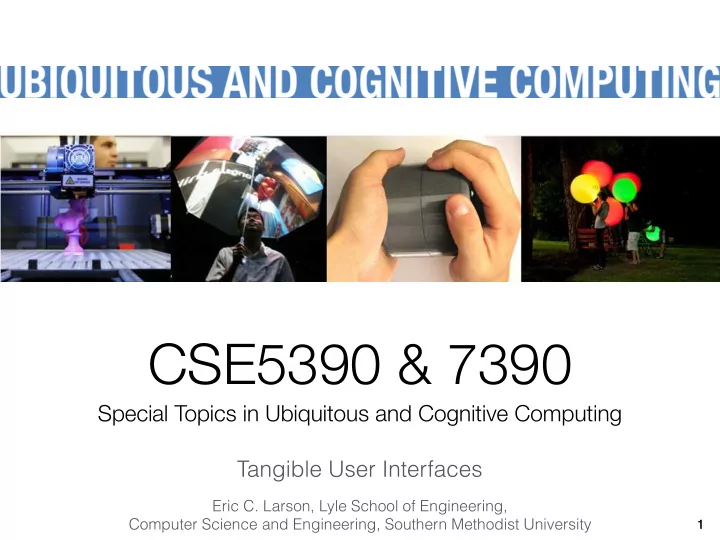
CSE5390 & 7390 Special Topics in Ubiquitous and Cognitive Computing Tangible User Interfaces Eric C. Larson, Lyle School of Engineering, Computer Science and Engineering, Southern Methodist University 1 1 class logistics P1 Due this

slide-1
SLIDE 1

1

Special Topics in Ubiquitous and Cognitive Computing

CSE5390 & 7390

Tangible User Interfaces

Eric C. Larson, Lyle School of Engineering, Computer Science and Engineering, Southern Methodist University

1

slide-2
SLIDE 2

class logistics

  • P1 Due this Friday by 5PM
  • no class this Thursday!
  • next up for lecture: Danh, Luke, Alex
  • natural gestures
  • how were flipped lecture videos last time?

2

slide-3
SLIDE 3

presenting discussion

  • I am sitting in the audience
  • but I still start lecture…
  • you summarize the points of the paper
  • trade off as often as possible: don’t divide by section
  • bring in your own stories
  • use contemporary issues, examples
  • open up debate
  • less text >= lots of text

3

slide-4
SLIDE 4

presenting discussion

  • these papers are different: less vision; more building
  • how does it fit into the vision of ubicomp?
  • motivate the work like you wrote it (own the paper)
  • explain what was built or evaluated (and if you liked it)
  • is it good science or just a novel idea?
  • what can we learn from it?

4

slide-5
SLIDE 5

UbiComp Visions

  • lots of talking thus far, no real apps - is this how you guys feel?

5

say Weiser’s vision again!

slide-6
SLIDE 6

agenda

  • tangible bits then and now (ish)

6

slide-7
SLIDE 7

tangible bits

  • Hiroshi Ishii, Associate Director of the MIT Media Lab

7

the development of tangible interfaces requires the rigor of both scientific and artistic review

slide-8
SLIDE 8

tangible bits

  • to make the digital bits of information tangible and graspable, physically-

embodied digital information in physical space

  • 1997:
  • computer beats chess world champion (at chess)
  • steve jobs returns to apple
  • end of oklahoma city bombing trial
  • 2008:
  • obama elected president
  • heath ledger dies
  • tornado in burma; earthquakes in china

8

slide-9
SLIDE 9

tangible bits

9

tangible bits is about scientific art projects conceived in such a way to be visionary which lasts generations…

slide-10
SLIDE 10

art and science

10

slide-11
SLIDE 11

tangible bits 1997

  • claim is that it is different than ubiquitous computing
  • thesis: tangible interfaces afford more traditional interaction and are

naturally ubiquitous

  • ubicomp genre: interaction
  • “Interactions between people and cyberspace are now

largely confined to traditional GUI-based boxes sitting

  • n desktops or laptops. The interactions with these

GUIs are separated from the ordinary physical environment within which we live and interact.”

11

slide-12
SLIDE 12

TUI example 1: metaDESK

12

slide-13
SLIDE 13

TUI example 1: metaDESK

13

what are tangible equivalents of other UI design elements? modal image list box toggles date/time picker breadcrumbs notifications

slide-14
SLIDE 14

TUI example 2: ambientROOM

14

  • tangible gives better affordances
  • when constant, we tune it out
  • changes trigger attention
  • would this be a better way to get

notifications?

  • TUI3: they also did transBOARD
  • but it wasn’t all that compelling
slide-15
SLIDE 15

TUI example 2: ambientROOM

15

slide-16
SLIDE 16

strengths / weaknesses

16

  • explored an unprecedented number of new interactions

techniques

  • extremely technical implementations without technical baggage
  • but this also hides deficiency in the design
  • how many people thought all these things were created

and usable?

  • visionary in that it codified a field of existing research and made

it into a field of HCI

  • created the field of tangible computing
  • tangible UIs are limited in a way that pixels are not
slide-17
SLIDE 17

tangible bits 2008

  • claim TUI are appropriate for many spaces, but not general

computing

  • thesis: application space of TUIs is mature and we are ready to

move to the next phase

  • ubicomp genre: interaction and vision
  • “Where the sea meets the land, life has blossomed into a

myriad of unique forms in the turbulence of water, sand, and wind. At another seashore between the land

  • f atoms and the sea of bits, we are now facing the

challenge of reconciling our dual citizenships in the physical and digital worlds.”

17

slide-18
SLIDE 18

tangible bits 2008

18

  • TUI has many genres for applications:
  • tangible telepresence
  • kinetic memory
  • constructive assembly
  • tokens and constraints
  • tabletop surfaces
  • continuous plastic (deformable)
  • augmented everyday objects
  • ambient media

slides provided by Hiroshi Ishii

slide-19
SLIDE 19

designing tangible bits

19

  • build on design through MVC
  • defines how each element communicates

model view controller

controller has direct reference to view and model view “targets” generic controller from actions model “radios” to subscribers

slide-20
SLIDE 20

designing tangible bits

20

  • build on design through MVC
  • defines how each element communicates

digital information tangible view controller

info “radios” to subscribers view “targets” generic controller from actions controller has direct reference to view and model, interprets collisions

intangible view

visual/force feedback

slide-21
SLIDE 21

21

tangible view intangible view

design gets complicated quickly

slide-22
SLIDE 22

properties of a tangible view

22

  • often NOT visual changes that get conveyed
  • weight
  • size
  • temperature
  • texture
  • springy-ness
  • sound
  • shadow

tangible view

excellent affordances: plus the tactile representation in our brain!

slide-23
SLIDE 23

an example of tangible

23

slide-24
SLIDE 24

vision should not be ignored

24

slide-25
SLIDE 25

25

Through the design of a variety of TUIs, however, we have learned that TUIs are limited by the rigidity

  • f “atoms” in comparison with the fluidity of “bits”.

TUIs have limited ability to change the form or properties of physical objects in real time. This constraint can make the physical state of TUIs inconsistent with the underlying digital models.

the elephant in the room

slide-26
SLIDE 26

26

slide-27
SLIDE 27

27

a vision for 100 years

slide-28
SLIDE 28

28

a vision for 100 years

slide-29
SLIDE 29

29

a vision for 100 years

slide-30
SLIDE 30

for next class...

  • Thursday: no class!
  • Tuesday: first student lead discussion
  • natural user interfaces

30

slide-31
SLIDE 31

31

Special Topics in Ubiquitous and Cognitive Computing

CSE5390 & 7390

Tangible User Interfaces

Eric C. Larson, Lyle School of Engineering, Computer Science and Engineering, Southern Methodist University

31 31

slide-32
SLIDE 32

phantom haptics: leveraging the digital

CSE5390 & 7390 Special Topics in Ubiquitous Computing

32

  • thesis: richer haptic output can be

achieved

  • ubicomp genre: interaction
  • problem: creating phantom

sensations from a vibration array

slide-33
SLIDE 33

phantom haptics: technique

CSE5390 & 7390 Special Topics in Ubiquitous Computing

33

slide-34
SLIDE 34

phantom haptics: evaluation

CSE5390 & 7390 Special Topics in Ubiquitous Computing

34

  • four users
  • various continuous motions
  • “clarity” of creeping effect was then evaluated
slide-35
SLIDE 35

strengths and weaknesses

CSE5390 & 7390 Special Topics in Ubiquitous Computing

35

  • work in progress
  • weak user study
  • interesting idea, with good motivation
  • no control case
  • limited to entertainment
  • only on back!
slide-36
SLIDE 36

more tangible bits

36