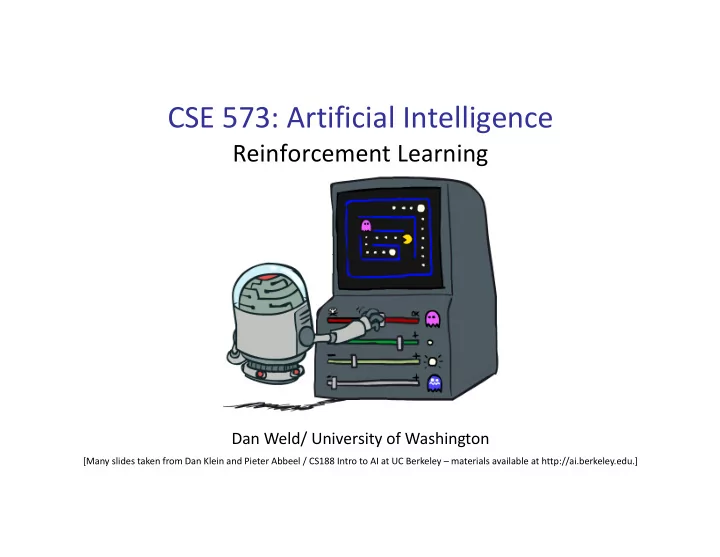
SLIDE 1 CSE 573: Artificial Intelligence
Reinforcement Learning
Dan Weld/ University of Washington
[Many slides taken from Dan Klein and Pieter Abbeel / CS188 Intro to AI at UC Berkeley – materials available at http://ai.berkeley.edu.]
SLIDE 2 Logistics
Title: Neural Question Answering over Knowledge Graphs Speaker: Wenpeng Yin (University of Munich) Time: Thursday, Feb 16, 10:30 am Location: CSE 403
2
SLIDE 3 Offline (MDPs) vs. Online (RL)
Offline Solution (Planning) Online Learning (RL) Monte Carlo Planning
Simulator
Diff: 1) dying ok; 2) (re)set button
SLIDE 4
§ Forall i
§ Initialize wi = 0
§ Repeat Forever
Where are you? s. Choose some action a Execute it in real world: (s, a, r, s’) Do update:
difference ß [r + γ Maxa’ Q(s’, a’)] - Q(s,a)
Forall i do:
Approximate Q Learning
SLIDE 5
Exploration vs. Exploitation
SLIDE 6 107
Two KINDS of Regret
§ Cumulative Regret:
§ achieve near optimal cumulative lifetime reward (in expectation)
§ Simple Regret:
§ quickly identify policy with high reward (in expectation)
SLIDE 7 Regret
108
Reward Time
∞
Exploration policy that minimizes cumulative regret Minimizes red area
SLIDE 8 Regret
109
Reward Time
∞
Exploration policy that minimizes simple regret… For any time, t, minimizes red area after t
t
SLIDE 9 110
RL on Single State MDP
§ Suppose MDP has a single state and k actions
§ Can sample rewards of actions using call to simulator § Sampling action a is like pulling slot machine arm with random payoff function R(s,a)
s a1 a2 ak
R(s,a1) R(s,a2) R(s,ak)
Multi-Armed Bandit Problem
… …
Slide adapted from Alan Fern (OSU)
SLIDE 10 116
Cumulative Regret Objective
s a1 a2 ak … hProblem: find arm-pulling strategy such that the expected total reward
at time n is close to the best possible (one pull per time step)
5Optimal (in expectation) is to pull optimal arm n times 5UniformBandit is poor choice --- waste time on bad arms 5Must balance exploring machines to find good payoffs and exploiting current
knowledge
Slide adapted from Alan Fern (OSU)
SLIDE 11 Idea
- The problem is uncertainty… How to quantify?
- Error bars
𝜈 " − 𝜈 < log (2 𝜀) 2𝑜
- If arm has been sampled n times,
With probability at least 1- 𝜀:
Slide adapted from Travis Mandel (UW)
SLIDE 12 Given Error bars, how do we act?
- Optimism under uncertainty!
- Why? If bad, we will soon find out!
Slide adapted from Travis Mandel (UW)
SLIDE 13 Upper Confidence Bound (UCB)
𝜈 "/ + 2log (𝑢) 𝑜/
- 1. Play each arm once
- 2. Play arm i that maximizes:
- 3. Repeat Step 2 forever
Slide adapted from Travis Mandel (UW)
SLIDE 14 125
UCB Performance Guarantee
[Auer, Cesa-Bianchi, & Fischer, 2002]
Theorem: The expected cumulative regret of UCB 𝑭[𝑺𝒇𝒉𝒐] after n arm pulls is bounded by O(log n)
Is this good?
log 𝑜 𝑜
𝑭[𝑺𝒇𝒉𝒐]
- Yes. The average per-step regret is O log 𝑜
𝑜
𝑭[𝑺𝒇𝒉𝒐]
𝑜
Theorem: No algorithm can achieve a better expected regret (up to constant factors)
Slide adapted from Alan Fern (OSU)
SLIDE 15 UCB as Exploration Function in Q-Learning
126
§ Forall s, a
§ Initialize Q(s, a) = 0, nsa = 0
§ Repeat Forever
Where are you? s. Choose action with highest Qe Execute it in real world: (s, a, r, s’) Do update: Nsa += 1; difference ß [r + γ Maxa’ Qe(s’, a’)] - Qe(s,a) Q(s,a) ß Qe(s,a) + 𝛽(difference)
Let Nsa be number of times one has executed a in s; let N = Nsa
Σ
sa
Let Qe(s,a) = Q(s,a) + √ log(N)/(1+nsa)
SLIDE 16
Video of Demo Q-learning – Epsilon-Greedy – Crawler
SLIDE 17
Video of Demo Q-learning – Exploration Function – Crawler
SLIDE 18 A little history…
William R. Thompson (1933): Was the first to examine MAB problem, proposed a method for solving them 1940s-50s: MAB problem studied intentively during WWII, Thompson was ignored 1970’s-1980’s: “Optimal” solution (Gittins index) found but is intractable and incomplete. Thompson ignored. 2001: UCB proposed, gains widespread use due to simplicity and “optimal” bounds. Thompson still ignored. 2011: Empricial results show Thompson’s 1933 method beats UCB, but little interest since no guarantees. 2013: Optimal bounds finally shown for Thompson Sampling
Slide adapted from Travis Mandel (UW)
SLIDE 19
Thompson’s method was fundamentally different!
SLIDE 20 Bayesian vs. Frequentist
- Bayesians: You have a prior, probabilities
interpreted as beliefs, prefer probabilistic decisions
- Frequentists: No prior, probabilities interpreted as
facts about the world, prefer hard decisions (p<0.05)
UCB is a frequentist technique! What if we are Bayesian?
SLIDE 21
Bayesian review: Bayes’ Rule
𝑞 𝜄 𝑒𝑏𝑢𝑏) = 𝑞 𝑒𝑏𝑢𝑏 𝜄 𝑞(𝜄) 𝑞(𝑒𝑏𝑢𝑏) 𝑞 𝜄 𝑒𝑏𝑢𝑏) ∝ 𝑞 𝑒𝑏𝑢𝑏 𝜄 𝑞(𝜄)
Likelihood Prior Posterior
SLIDE 22
Bernoulli Case
What if distribution in the set {0,1} instead of the range [0,1] ? Then we flip a coin with probability p à Bernoulli distribution! To estimate p, we count up numbers of ones and zeros Given observed ones and zeroes, how do we calculate the distribution of possible values of p?
SLIDE 23
Beta-Bernoulli Case
Beta(a,b) à Given a 0’s and b 1’s, what is the distribution over means? Prior à pseudocounts Likelihood à Observed counts Posterior à pseudocounts + observed counts
SLIDE 24 How does this help us?
Thompson Sampling:
- 1. Specify prior (e.g., using Beta(1,1))
- 2. Sample from each posterior distribution to get
estimated mean for each arm.
- 3. Pull arm with highest mean.
- 4. Repeat step 2 & 3 forever
SLIDE 25
Thompson Empirical Results
And shown to have optimal regret bounds just like (and in some cases a little better than) UCB!
SLIDE 26 137
What Else ….
hUCB & Thompson is great when we care about cumulative regret hI.e., when the agent is acting in the real world hBut, sometimes all we care about is finding a good arm quickly hE.g., when we are training in a simulator hIn these cases, “Simple Regret” is better objective
SLIDE 27 138
Two KINDS of Regret
§ Cumulative Regret:
§ achieve near optimal cumulative lifetime reward (in expectation)
§ Simple Regret:
§ quickly identify policy with high reward (in expectation)
SLIDE 28 139
Simple Regret Objective
Protocol: At time step n the algorithm picks an
“exploration” arm 𝑏𝑜 to pull and observes reward 𝑠
𝑜 and also picks an arm index it thinks is best 𝑘𝑜
(𝑏𝑜, 𝑘𝑜 and 𝑠
𝑜 are random variables).
If interrupted at time n the algorithm returns 𝑘𝑜.
𝑆∗ 𝑘𝑜 𝐹[𝑇𝑆𝑓𝑜] = 𝑆∗ − 𝐹[𝑆(𝑏𝑘𝑜)]
𝑠
𝑜
𝑘𝑜
𝑏𝑜, 𝑘𝑜 and 𝑠
𝑜
Expected Simple Regret (𝑭[𝑻𝑺𝒇𝒉𝒐]): difference
between 𝑆∗ and expected reward of arm 𝑘𝑜 selected by our strategy at time n 𝐹[𝑇𝑆𝑓𝑜] = 𝑆∗ − 𝐹[𝑆(𝑏𝑘𝑜)]
SLIDE 29 How to Minimize Simple Regret?
What about UCB for simple regret?
- Theorem: The expected simple regret of
UCB after n arm pulls is upper bounded by O 𝑜−𝑑 for a constant c.
Seems good, but we can do much better (at least in theory).
Ø Intuitively: UCB puts too much emphasis on pulling the best arm Ø After an arm is looking good, maybe better to see if ∃a better arm
SLIDE 30 141
Incremental Uniform (or Round Robin)
Bubeck, S., Munos, R., & Stoltz, G. (2011). Pure exploration in finitely-armed and continuous-armed bandits. Theoretical Computer Science, 412(19), 1832-1852
Algorithm:
At round n pull arm with index (k mod n) + 1 At round n return arm (if asked) with largest average reward
𝑓−𝑑𝑜
Theorem: The expected simple regret of Uniform after n arm pulls is upper bounded by O 𝑓−𝑑𝑜 for a constant c.
- This bound is exponentially decreasing in n!
Compared to polynomially for UCB O 𝑜−𝑑 .
𝑓−𝑑𝑜
SLIDE 31 142
Can we do even better?
Algorithm -Greedy : (parameter ) § At round n, with probability pull arm with best average reward so far, otherwise pull one of the other arms at random. § At round n return arm (if asked) with largest average reward
Tolpin, D. & Shimony, S, E. (2012). MCTS Based on Simple Regret. AAAI Conference on Artificial Intelligence.
𝜗 0 < 𝜗 < 1
- 𝜗
- Theorem: The expected simple regret of 𝜗-
Greedy for 𝜗 = 0.5 after n arm pulls is upper bounded by O 𝑓−𝑑𝑜 for a constant c that is larger than the constant for Uniform (this holds for “large enough” n).
SLIDE 32 Summary of Bandits in Theory
PAC Objective:
§
UniformBandit is a simple PAC algorithm
§
MedianElimination improves by a factor of log(k) and is optimal up to constant factors
Cumulative Regret:
§
Uniform is very bad!
§
UCB is optimal (up to constant factors)
§
Thomson Sampling also optimal; often performs better in practice
Simple Regret:
§
UCB shown to reduce regret at polynomial rate
§
Uniform reduces at an exponential rate
§
0.5-Greedy may have even better exponential rate
SLIDE 33 Theory vs. Practice
- The established theoretical relationships among bandit
algorithms have often been useful in predicting empirical relationships.
SLIDE 34 Simple regret vs. number of samples
UCB maximizes Qa + √ ((2 ln(n)) / na) UCB[sqrt] maximizes Qa + √ ((2 √n) / na)
Theory vs. Practice
simple regret
SLIDE 35 That’s all for Reinforcement Learning!
§ Very tough problem: How to perform any task well in an unknown, noisy environment! § Traditionally used mostly for robotics, but…
146
Reinforcement Learning Agent Data (experiences with environment) Policy (how to act in the future) Google DeepMind – RL applied to data center power usage