SLIDE 1 1
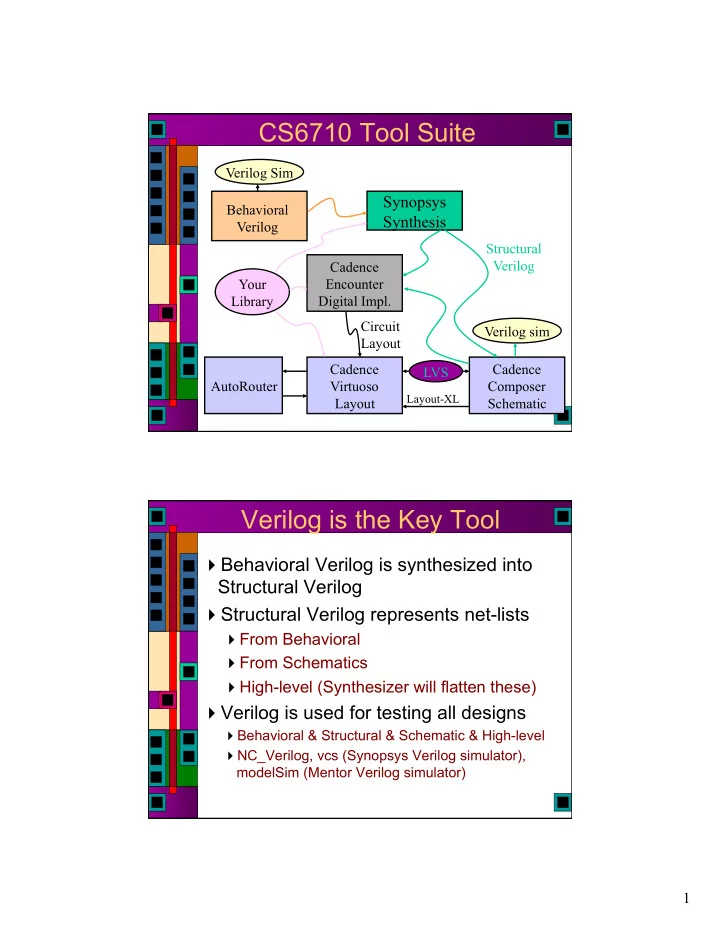
CS6710 Tool Suite
Synopsys Synthesis
Cadence Encounter Digital Impl. Cadence Composer Schematic Cadence Virtuoso Layout AutoRouter Your Library Verilog Sim Verilog sim Behavioral Verilog Structural Verilog Circuit Layout LVS
Layout-XL
Verilog is the Key Tool
Behavioral Verilog is synthesized into Structural Verilog Structural Verilog represents net-lists
From Behavioral From Schematics High-level (Synthesizer will flatten these)
Verilog is used for testing all designs
Behavioral & Structural & Schematic & High-level NC_Verilog, vcs (Synopsys Verilog simulator), modelSim (Mentor Verilog simulator)
SLIDE 2 2
Verilog has a Split Personality
Hardware Description Language (HDL)
Reliably & Readably
Create hardware Document hardware
Testbench creation language
Create external test environment
Time & Voltage Files & messages
Are these two tasks
Related? Compatible?
Verilog as HDL
Want high level modeling
unification at all levels
from fast functional simulation, accurate device simulation
support simulation based validation (verification?)
How could we do this?
behavioral model mapped to transistors pragmas: throughput, latency, cycle time, power…
Reality
we rely on designers to do most of these xforms therefore:
different algorithms => try before you buy… use only a subset of the language. RTL and schematic design used to support Verilog System-C and other HLD models for co-simulation, etc.
SLIDE 3 3
Synthesis
This lecture is only about synthesis...
Quick Review
Module name (args…); begin parameter ...; // define parameters input …; // define inputs
- utput …; // define outputs
wire … ; // internal wires reg …; // internal regs, possibly output // the parts of the module body are // executed concurrently <primitive instantiations> <continuous assignments> <always blocks> endmodule
SLIDE 4
4
Quick Review
Continuous assignments to wire vars
assign variable = exp; Results in combinational logic
Procedural assignment to reg vars
Always inside procedural blocks (always blocks in particular for synthesis) blocking
variable = exp;
non-blocking
variable <= exp;
Can result in combinational or sequential logic
Verilog Description Styles
Verilog supports a variety of description styles
Structural
explicit structure of the circuit e.g., each logic gate instantiated and connected to others
Behavioral
program describes input/output behavior of circuit many structural implementations could have same behavior e.g., different implementation of one Boolean function
SLIDE 5
5
Synthesis: Data Types
Possible Values (wire and reg):
0: logic 0, false 1: logic 1, true Z: High impedance Note: no X in synthesis…
Digital Hardware: The domain of Verilog
Either logic (gates)
outputs represented by wire variables
Or storage (registers & latches)
outputs represented by reg variables
Synthesis: Data Types
Register declarations
reg a; \\ a scalar register reg [3:0] b; \\ a 4-bit vector register output g; \\ an output can be a reg reg g; output reg g; \\ Verilog 2001 syntax
Wire declarations
wire d; \\ a scalar wire wire [3:0] e; \\ a 4-bit vector wire output f; \\ an output can be a wire
SLIDE 6
6
Parameters
Used to define constants
parameter size = 16, foo = 8; wire [size-1:0] bus; \\ defines a 15:0 bus
Synthesis: Assign Statement
The assign statement creates combinational logic
assign LHS = expression;
LHS can only be wire type expression can contain either wire or reg type mixed with operators
wire a,c; reg b; output out; assign a = b & c; assign out = ~(a & b); \\ output as wire wire [15:0] sum, a, b; wire cin, cout; assign {cout,sum} = a + b + cin;
SLIDE 7
7
Synthesis: Basic Operators
Bit-Wise Logical
~ (not), & (and), | (or), ^ (xor), ^~ or ~^ (xnor)
Simple Arithmetic Operators
Binary: +, - Unary: - Negative numbers stored as 2’s complement
Relational Operators
<, >, <=, >=, ==, !=
Logical Operators
! (not), && (and), || (or) assign a = (b > ‘b0110) && (c <= 4’d5); assign a = (b > ‘b0110) && !(c > 4’d5);
Synthesis: Operand Length
When operands are of unequal bit length, the shorter operator is zero-filled in the most significant bit position
wire [3:0] sum, a, b; wire cin, cout, d, e, f, g;
assign sum = f & a; assign sum = f | a; assign sum = {d, e, f, g} & a; assign sum = {4{f}} | b; assign sum = {4{f == g}} & (a + b); assign sum[0] = g & a[2]; assign sum[2:0] = {3{g}} & a[3:1];
SLIDE 8
8
Synthesis: More Operators
Concatenation
{a,b} {4{a==b}} { a,b,4’b1001,{4{a==b}} }
Shift (logical shift)
<< left shift >> right shift assign a = b >> 2; // shift right 2, division by 4 assign a = b << 1; // shift left 1, multiply by 2
Arithmetic
assign a = b * c; // multiply b times c assign a = b * ‘d2; // multiply b times constant (=2) assign a = b / ‘b10; // divide by 2 (constant only) assign a = b % ‘h3; // b modulo 3 (constant only)
Synthesis: Operand Length
Operator length is set to the longest member (both RHS & LHS are considered). Be careful.
wire [3:0] sum, a, b; wire cin, cout, d, e, f, g; wire[4:0]sum1; assign {cout,sum} = a + b + cin; assign {cout,sum} = a + b + {4’b0,cin}; assign sum1 = a + b; assign sum = (a + b) >> 1; // what is wrong?
SLIDE 9
9
Synthesis: Extra Operators
Funky Conditional
cond_exp ? true_expr : false_expr wire [3:0] a,b,c; wire d; assign a = (b == c) ? (c + ‘d1): ‘o5; // good luck
Reduction Logical
Named for impact on your recreational time Unary operators that perform bit-wise operations on a single operand, reduce it to one bit &, ~&, |, ~|, ^, ~^, ^~ assign d = &a || ~^b ^ ^~c;
Synthesis: Assign Statement
The assign statement is sufficient to create all combinational logic What about this:
assign a = ~(b & c); assign c = ~(d & a);
SLIDE 10 10
Synthesis: Assign Statement
The assign statement is sufficient to create all combinational logic What about this:
assign a = ~(b & c); assign c = ~(d & a);
A C B D
Simple Behavioral Module
// Behavioral model of NAND gate module NAND (out, in1, in2);
input in1, in2; assign out = ~(in1 & in2); endmodule
SLIDE 11 11
Simple Behavioral Module
// Behavioral model of NAND gate module NAND (out, in1, in2);
input in1, in2; // Uses Verilog builtin nand function // syntax is func id (args); nand i0(out, in1, in2); endmodule
Simple Structural Module
// Structural Module for NAND gate module NAND (out, in1, in2);
input in1, in2; wire w1; // call existing modules by name // module-name ID (signal-list); AND2X1 u1(w1, in1, in2); INVX1 u2(out,w1); endmodule
SLIDE 12 12
Simple Structural Module
// Structural Module for NAND gate module NAND (out, in1, in2);
input in1, in2; wire w1; // call existing modules by name // module-name ID (signal-list); // can connect ports by name... AND2X1 u1(.Q(w1), .A(in1), .B(in2)); INVX1 u2(.A(w1), .Q(out)); endmodule
Primitive Gates
Multiple input gates
<gatename> [delay] [id] (out, in1, in2, in3...); and, or, nand, nor, xor, xnor
Multiple output gates
<gatename> [delay] [id] (out1, out2, ... outn, in);
buf, not
Tristate gates
<gatename> [delay] [id] (out, in, ctrl); bufif1, bufif0, notif1, notif0
SLIDE 13
13
Primitive Gates
Delay: three types for gates
#(delaytime) same delay for all transitions #(rise,fall) different delay for rise and fall #(rise, fall, turnoff) for tristate gates
Each delay number can be:
single number i.e. #(2) or #(2,3) min/typ/max triple i.e. #(2:3:4) or #(2:3:4, 3:2:5)
Primitive Gates
and (out, a, b); nand i0 (out a b c d e f g); xor #(2,3) (out a b c); buf (Y A); buf #(2:3:4, 3:4;5) _i1 (y, a); bufif1 (out, in, ctl); notif0 #(1, 2, 3) (Y, A, S);
SLIDE 14 14
Primitive Gates
OR – you can skip the delays on each gate, and use a specify block for the whole module
Specifies from module input to module
Outputs must be driven by a primitive gate The syntax defines the delay for each path from input to output
Simple Behavioral Module
// Behavioral model of NAND gate module NAND (out, in1, in2);
input in1, in2; nand _i0(out, in1, in2); // include specify block for timing specify (in1 => out) = (1.0, 1.0); (in2 => out) = (1.0, 1.0); endspecify endmodule
SLIDE 15 15
Specify Block Types
Parallel Connection (one to one) Full Connection (one to many)
Parallel Specify
module A ( q, a, b, c, d )
input a, b, c, d;
wire e, f;
// specify block containing delay statements
specify
( a => q ) = 6; // delay from a to q
( b => q ) = 7; // delay from b to q
( c => q ) = 7; // delay form c to q
( d => q ) = 6; // delay from d to q
endspecify
// module definition
- r o1( e, a, b );
- r o2( f, c, d );
exor ex1( q, e, f ); endmodule
SLIDE 16 16
Full Specify
module A ( q, a, b, c, d )
input a, b, c, d;
wire e, f;
// specify block containing full connections
specify
( a, d *> q ) = 6; // delay from a and d to q
( b, c *> q ) = 7; // delay from b and c to q
endspecify
// module definition
- r o1( e, a, b );
- r o2( f, c, d );
exor ex1( q, e, f ); endmodule
Full Specify
// a[63:0] is a 64 bit input register and // q[7:0] is an 8 bit output register // this would require 64 x 8 = 512 parallel // connections, but only 1 full
specify ( a *> q ) = 8; // eqivalent to 512 parallel connections endspecify
SLIDE 17 17
Specify needs a gate!
module DCX1 (CLR, D, CLK, Q); input CLR, D, CLK;
reg Q_i; always @(posedge CLK or negedge CLR) if (CLR == 0) Q_i = 1'b0; else Q_i = D; buf _i0 (Q, Q_i); specify (CLK => Q) = (1.0, 1.0); (CLR => Q) = (1.0, 1.0); $setuphold(posedge CLK, D, 0.1, 0.0); $recovery(negedge CLR, posedge CLK, 0.0); endspecify endmodule
Simple Behavioral Module
// Behavioral model of NAND gate module NAND (out, in1, in2);
input in1, in2; nand _i0(out, in1, in2); // include specify block for timing specify (in1 => out) = (1.0, 1.0); (in2 => out) = (1.0, 1.0); endspecify endmodule
SLIDE 18
18
Procedural Assignment
Assigns values to register types They involve data storage
The register holds the value until the next procedural assignment to that variable
The occur only within procedural blocks
initial and always initial is NOT supported for synthesis!
They are triggered when the flow of execution reaches them
Always Blocks
When is an always block executed?
always
Starts at time 0
always @(a or b or c)
Whenever there is a change on a, b, or c Used to describe combinational logic
always @(posedge foo)
Whenever foo goes from low to high Used to describe sequential logic
always @(negedge bar)
Whenever bar goes from high to low
SLIDE 19 19
Synthesis: Always Statement
The always statement creates…
always @sensitivity LHS = expression;
@sensitivity controls when LHS can only be reg type expression can contain either wire or reg type mixed with
Logic reg c, b; wire a; always @(a, b) c = ~(a & b); always @* c = ~(a & b); Storage reg Q; wire clk; always @(posedge clk) Q <= D;
Procedural Control Statements
Conditional Statement
if ( <expression> ) <statement> if ( <expression> ) <statement> else <statement>
“else” is always associated with the closest previous if that lacks an else. You can use begin-end blocks to make it more clear
if (index >0) if (rega > regb) result = rega; else result = regb;
SLIDE 20 20
Multi-Way Decisions
Standard if-else-if syntax If ( <expression> ) <statement> else if ( <expression> ) <statement> else if ( <expression> ) <statement> else <statement>
Procedural NAND gate
// Procedural model of NAND gate module NAND (out, in1, in2);
reg out; input in1, in2; // always executes when in1 or in2 // change value always @(in1 or in2) begin
end endmodule
SLIDE 21 21
Procedural NAND gate
// Procedural model of NAND gate module NAND (out, in1, in2);
reg out; input in1, in2; // always executes when in1 or in2 // change value always @(in1 or in2) begin
end endmodule
Is out combinational?
Synthesis: NAND gate
input in1, in2;
reg n1, n2; // is this a flip-flop? wire n3, n4; always @(in1 or in2) n1 = ~(in1 & in2); always @* n2 = ~(in1 & in2); assign n3 = ~(in1 & in2); nand u1(n4, in1, in2); Notice always block for combinational logic Full sensitivity list, but @* works (2001 syntax) Can then use the always goodies Is this a good coding style?
SLIDE 22 22
Procedural Assignments
Assigns values to reg types
Only useable inside a procedural block Usually synthesizes to a register
But, under the right conditions, can also result in combinational circuits
Blocking procedural assignment
LHS = timing-control exp a = #10 1; Must be executed before any assignments that follow (timing control is optional) Assignments proceed in order even if no timing is given
Non-Blocking procedural assignment
LHS <= timing-control exp b <= 2; Evaluated simultaneously when block starts Assignment occurs at the end of the (optional) time-control
Procedural Synthesis
Synthesis ignores all that timing stuff So, what does it mean to have blocking
- vs. non-blocking assignment for
synthesis?
begin begin A=B; A<=B; B=A; B<=A; end end begin begin A=Y; A<=Y; B=A; B<=A; end end
? ?
SLIDE 23 23
Synthesized Circuits
begin A = Y; B = A; end begin A <= Y; B <= A; end begin B = A; A = Y; end
D Q clk D Q clk D Q clk D Q clk A B A B Y Y A B A B
Synthesized Circuits
D Q clk D Q clk D Q clk D Q clk A B A B Y Y A B A B
always @(posedge clk) begin A = Y; B = A; end always @(posedge clk) begin B = A; A = Y; end always @(posedge clk) begin A <= Y; B <= A; end always @(posedge clk) begin B <= A; A <= Y end
clk clk
SLIDE 24 24
Assignments and Synthesis
Note that different circuit structures result from different types of procedural assignments
Therefore you can’t mix assignment types in the same always block Non-blocking is often a better model for hardware
Real hardware is often concurrent…
Blocking is often better for setting subsets of signals
Set them to defaults at beginning, then reset only the ones that change
Comparator Example
Using continuous assignment
Concurrent execution of assignments
Module comp (a, b, Cgt, Clt, Cne); parameter n = 4; input [n-1:0] a, b;
assign Cgt = (a > b); assign Clt = (a < b); assign Cne = (a != b); endmodule
SLIDE 25 25
Comparator Example
Using procedural assignment
Non-blocking assignment implies concurrent
Module comp (a, b, Cgt, Clt, Cne); parameter n = 4; input [n-1:0] a, b;
reg Cgt, Clt, Cne; always @(a or b) begin Cgt <= (a > a); Clt <= (a < b); Cne <= (a != b); end endmodule
Modeling a Flip Flop
Use an always block to wait for clock edge Module dff (clk, d, q); input clk, d;
reg q; always @(posedge clk) d = q; endmodule
SLIDE 26
26
Synthesis: Always Statement
This is a simple D Flip-Flop
reg Q; always @(posedge clk) Q <= D; @(posedge clk) is the sensitivity list The Q <= D; is the block part The block part is always “entered” whenever the sensitivity list becomes true (positive edge of clk) The LHS of the <= must be of data type reg The RHS of the <= may use reg or wire
Synthesis: Always Statement
This is an asynchronous clear D Flip-Flop
reg Q; always @(posedge clk, posedge rst) if (rst) Q <= ‘b0; else Q <= D;
Notice , instead of or
Verilog 2001…
Positive reset
SLIDE 27
27
Synthesis: Always Statement
reg Q;
always @(posedge clk, posedge rst, posedge set) if (rst) Q <= ‘b0; else if (set) Q <= ‘b1; else Q <= D;
What is this? What is synthesized?
> beh2str foo.v foo_str.v UofU_Digital.db
Synthesis: Always Statement
reg Q;
always @(posedge clk, posedge rst, posedge set) if (rst) Q <= ‘b0; else if (set) Q <= ‘b1; else Q <= D;
What is this? What is synthesized?
SLIDE 28
28
Synthesis: Always Statement
reg Q;
always @(posedge clk, posedge rst, posedge set) if (rst) Q <= ‘b0; else if (set) Q <= ‘b1; else Q <= D;
What is this? What is synthesized?
Synthesis: Always Statement
reg Q;
always @(posedge clk) if (rst) Q <= ‘b0; else if (set) Q <= ‘b1; else Q <= D;
What is this?
SLIDE 29 29
Synthesis: Always Statement
reg Q;
always @(posedge clk) if (rst) Q <= ‘b0; else if (set) Q <= ‘b1; else Q <= D;
What is this?
Inferred memory devices in process in routine set line 5 in file '/home/elb/IC_CAD/syn-f06/set.v'. =============================================================================== | Register Name | Type | Width | Bus | MB | AR | AS | SR | SS | ST | ====================================================== | Q_reg | Flip-flop | 1 | N | N | N | N | N | N | N | ===============================================================================
module foo ( clk, rst, set, D, Q ); input clk, rst, set, D;
wire N3, n2, n4; dff Q_reg ( .D(N3), .G(clk), .CLR(n2), .Q(Q) ); tiehi U6 ( .Y(n2) ); nor2 U7 ( .A(rst), .B(n4), .Y(N3) ); nor2 U8 ( .A(D), .B(set), .Y(n4) ); endmodule
SLIDE 30 30
module foo ( clk, rst, set, D, Q ); input clk, rst, set, D;
wire N3, n2, n4; dff Q_reg ( .D(N3), .G(clk), .CLR(n2), .Q(Q) ); tiehi U6 ( .Y(n2) ); nor2 U7 ( .A(rst), .B(n4), .Y(N3) ); nor2 U8 ( .A(D), .B(set), .Y(n4) ); endmodule
D clk Q n4 N3 set rst clr D A B Out 0 0 1 0 1 0 1 0 0 1 1 0
Synthesis: Always Statement
reg P,Q; reg [3:0] R;
always @(posedge clk) begin Q <= D; P <= Q; R <= R + ‘h1; end
What is this? Will it synthesize? Simulate?
SLIDE 31 31
Synthesis: Always Statement
module testme ( D, P, Q, R, clk );
input D, clk;
wire N0, N1, N2, N3, n1, n7, n8, n9; dff Q_reg ( .D(D), .G(clk), .CLR(n1), .Q(Q) );
dff P_reg ( .D(Q), .G(clk), .CLR(n1), .Q(P) );
dff R_reg_0_ ( .D(N0), .G(clk), .CLR(n1), .Q(R[0]) );
dff R_reg_1_ ( .D(N1), .G(clk), .CLR(n1), .Q(R[1]) );
dff R_reg_2_ ( .D(N2), .G(clk), .CLR(n1), .Q(R[2]) );
dff R_reg_3_ ( .D(N3), .G(clk), .CLR(n1), .Q(R[3]) );
tiehi U9 ( .Y(n1) );
xor2 U10 ( .A(R[3]), .B(n7), .Y(N3) );
nor2 U11 ( .A(n8), .B(n9), .Y(n7) );
xor2 U12 ( .A(n8), .B(n9), .Y(N2) );
invX1 U13 ( .A(R[2]), .Y(n9) );
nand2 U14 ( .A(R[1]), .B(R[0]), .Y(n8) );
xor2 U15 ( .A(R[1]), .B(R[0]), .Y(N1) );
invX1 U16 ( .A(R[0]), .Y(N0) );
endmodule
Synthesis: Always Statement
This is a simple D Flip-Flop
reg Q; always @(posedge clk) Q <= D;
So is this
reg Q; always @(posedge clk) Q = D;
= is for blocking assignments <= is for nonblocking assignments
SLIDE 32 32
Constants
parameter used to define constants
parameter size = 16, foo = 8; wire [size-1:0] bus; \\ defines a 15:0 bus externally modifiable scope is local to module
localparam not externally modifiable
localparam width = size * foo;
`define macro definition
`define value 7’d53 assign a = (sel == `value) & b; scope is from here on out
Example: Counter
module counter (clk, clr, load, in, count); parameter width=8; input clk, clr, load; input [width-1 : 0] in;
- utput [width-1 : 0] count;
reg [width-1 : 0] tmp; always @(posedge clk or negedge clr) begin if (!clr) tmp = 0; else if (load) tmp = in; else tmp = tmp + 1; end assign count = tmp; endmodule
SLIDE 33 33
Synthesis: Modules
module the_top (clk, rst, a, b, sel, result); input clk, rst; input [3:0] a,b; input [2:0] sel;
wire[3:0] sum, dif, alu; adder u0(a,b,sum); subber u1(.subtrahend(a), .subtractor(b), .difference(dif)); assign alu = {4{(sel == ‘b000)}} & sum | {4{(sel == ‘b001)}} & dif; always @(posedge clk or posedge rst) if(rst) result <= ‘h0; else result <= alu; endmodule
Synthesis: Modules
// Verilog 1995 syntax module adder (e,f,g); parameter SIZE=2; input [SIZE-1:0] e, f;
assign g = e + f; endmodule // Verilog 2001 syntax module subber #(parameter SIZE = 3) (input [SIZE-1:0] c,d, output [SIZE-1:0]difference); assign difference = c - d; endmodule
SLIDE 34 34
Synthesis: Modules
module the_top (clk, rst, a, b, sel, result); parameter SIZE = 4; input clk, rst; input [SIZE-1:0] a,b; input [2:0] sel;
- utput reg [SIZE-1:0] result;
wire[SIZE-1:0] sum, dif, alu; adder #(.SIZE(SIZE)) u0(a,b,sum); subber #(4) u1(.c(a), .d(b), .difference(dif)); assign alu = {SIZE{sel == ‘b000}} & sum | {SIZE{sel == ‘b001}} & dif; always @(posedge clk or posedge rst) if(rst) result <= ‘h0; else result <= alu; endmodule
Multi-Way Decisions
Standard if-else-if syntax If ( <expression> ) <statement> else if ( <expression> ) <statement> else if ( <expression> ) <statement> else <statement>
SLIDE 35 35
Priority vs. Parallel Choice (if)
module priority (a, b, c, d, sel, z); input a,b,c,d; input [3:0] sel;
reg z; always @(a or b or c or d or sel) begin z = 0; if (sel[0]) z = a; if (sel[1]) z = b; if (sel[2]) z = c; if (sel[3]) z = d; end endmodule
Priority vs. Parallel Choice
module parallel (a, b, c, d, sel, z); input a,b,c,d; input [3:0] sel;
reg z; always @(a or b or c or d or sel) begin z = 0; if (sel[3]) z = d; else if (sel[2]) z = c; else if (sel[1]) z = b; else if (sel[0]) z = a; end endmodule
SLIDE 36
36
Priority Encoders Priority Encoders
SLIDE 37
37
Case Statements
Multi-way decision on a single expression
case ( <expresion> ) <expression>: <statement> <expression>, <expression>: <statement> <expression>: <statement> default: <statement> endcase
Case Example
reg [1:0] sel; reg [15:0] in0, in1, in2, in3, out; case (sel) 2’b00: out = in0; 2’b01: out = in1; 2’b10: out = in2; 2’b11: out = in3; endcase
SLIDE 38
38
Another Case Example
// simple counter next-state logic // one-hot state encoding… parameter [2:0] s0=3’h1, s1=3’h2, s2=3’h4; reg[2:0] state, next_state; always @(input or state) begin case (state) s0: if (input) next_state = s1; else next_state = s0; s1: next_state = s2; s2: next_state = s0; endcase end
input state next_state 001 010 100
Weird Case Example
Verilog allows you to put a value in the case slot, and test which variable currently has that value… reg [ 2:0] curr_state, next_state; parameter s1=3’b001, s2=3’b010, s3=3’b100 case (1) curr_state[0] : next_state = s2; curr_state[1] : next_state = s3; curr_state[2] : next_state = s1; endcase
SLIDE 39 39
Latch Inference
Incompletely specified if and case statements cause the synthesizer to infer latches always @(cond) begin if (cond) data_out <= data_in; end This infers a latch because it doesn’t specify what to do when cond = 0
Fix by adding an else In a case, fix by including default:
Full vs. Parallel
Case statements check each case in sequence A case statement is full if all possible
- utcomes are accounted for
A case statement is parallel if the stated alternatives are mutually exclusive These distinctions make a difference in how cases are translated to circuits…
Similar to the if statements previously described
SLIDE 40 40
Case full-par example
// full and parallel = combinational logic module full-par (slct, a, b, c, d, out); input [1:0] slct; input a, b, c, d;
reg out; // optimized away in this example always @(slct or a or b or c or d) case (slct) 2’b11 : out <= a; 2’b10 : out <= b; 2’b01 : out <= c; default : out <= d; // really 2’b10 endcase endmodule
Synthesis Result
Note that full-par results in combinational logic
SLIDE 41 41
Case notfull-par example
// a latch is synthesized because case is not full module notfull-par (slct, a, b, c, d, out); input [1:0] slct; input a, b, c, d;
reg out; // NOT optimized away in this example always @(slct or a or b or c) case (slct) 2’b11 : out <= a; 2’b10 : out <= b; 2’b01 : out <= c; endcase endmodule
Synthesized Circuit
Because it’s not full, a latch is inferred…
SLIDE 42 42
Case full-notpar example
// because case is not parallel - priority encoding // but it is still full, so no latch… // this uses a casez which treats ? as don’t-care module full-notpar (slct, a, b, c, out); ... always @(slct or a or b or c) casez (slct) 2’b1? : out <= a; 2’b?1 : out <= b; default : out <= c; endcase endmodule
Synthesized Circuit
It’s full, so it’s combinational, but it’s not parallel so it’s a priority circuit instead
- f a “check all in parallel” circuit
SLIDE 43
43
Case notfull-notpar example
// because case is not parallel - priority encoding // because case is not full - latch is inferred // uses a casez which treats ? as don’t-care module full-notpar (slct, a, b, c, out); ... always @(slct or a or b or c) casez (slct) 2’b1? : out <= a; 2’b?1 : out <= b; endcase endmodule
Synthesized Circuit
Not full and not parallel, infer a latch
SLIDE 44
44
Verification
CASE matches all (works like ===) CASEX uses “z”, “x”, “?” as don’t care CASEZ uses “z”, “?” as don’t care Beware: Matches first valid case
Synthesis
CASE works like == CASEX uses “?” as don’t care CASEZ uses “?” as don’t care
Get off my Case Get off my Case
Order Matters
SLIDE 45 45
Get off my Case FSM Description
One simple way: break it up like a schematic
A combinational block for next_state generation A combinational block for output generation A sequential block to store the current state
Next state Logic State in clk Next_state current State
Logic
Mealy only
SLIDE 46 46
Modeling State Machines
// General view module FSM (clk, in, out); input clk, in;
reg out; // state variables reg [1:0] state; // next state variable reg [1:0] next_state; always @posedge(clk) // state register state = next_state; always @(state or in); // next-state logic // compute next state and output logic // make sure every local variable has an // assignment in this block endmodule Next state Logic State in clk Next_state State
FSM Desciption
SLIDE 47 47
Verilog Version
module moore (clk, clr, insig, outsig); input clk, clr, insig;
// define state encodings as parameters parameter [1:0] s0 = 2'b00, s1 = 2'b01,s2 = 2'b10, s3 = 2'b11; // define reg vars for state register // and next_state logic reg [1:0] state, next_state; //define state register (with //synchronous active-high clear) always @(posedge clk) begin if (clr) state = s0; else state = next_state; end // define combinational logic for // next_state always @(insig or state) begin case (state) s0: if (insig) next_state = s1; else next_state = s0; s1: if (insig) next_state = s2; else next_state = s1; s2: if (insig) next_state = s3; else next_state = s2; s3: if (insig) next_state = s1; else next_state = s0; endcase end // assign outsig as continuous assign assign outsig = ((state == s1) || (state == s3)); endmodule
Verilog Version
module moore (clk, clr, insig, outsig); input clk, clr, insig;
// define state encodings as parameters parameter [1:0] s0 = 2'b00, s1 = 2'b01, s2 = 2'b10, s3 = 2'b11; // define reg vars for state register and next_state logic reg [1:0] state, next_state; //define state register (with synchronous active-high clear) always @(posedge clk) begin if (clr) state = s0; else state = next_state; end
SLIDE 48
48
Verilog Version Continued...
// define combinational logic for next_state always @(insig or state) begin case (state) s0: if (insig) next_state = s1; else next_state = s0; s1: if (insig) next_state = s2; else next_state = s1; s2: if (insig) next_state = s3; else next_state = s2; s3: if (insig) next_state = s1; else next_state = s0; endcase end
Verilog Version Continued...
// now set the outsig. This could also be done in an always // block... but in that case, outsig would have to be // defined as a reg. assign outsig = ((state == s1) || (state == s3)); endmodule
SLIDE 49 49
Unsupported for Synthesis
Delay (Synopsys will ignore #’s) initial blocks (use explicit resets) repeat wait fork event deassign force release
More Unsupported Stuff
You cannot assign the same reg variable in more than one procedural block // don’t do this… always @(posedge a)
always @(posedge b)
SLIDE 50 50
Combinational Always Blocks
Be careful…
always @(sel) always @(sel or in1 or in2) if (sel == 1) if (sel == 1)
else out = in2; else out = in2; Which one is a good mux?
Combinational Always Blocks
Be careful…
always @(sel) always @(sel or in1 or in2) if (sel == 1) if (sel == 1)
else out = in2; else out = in2; Which one is a good mux? Always @* if (sel == 1) out = in1; else out = in2;
SLIDE 51
51
Sync vs. Async Register Reset
// synchronous reset (active-high reset) always @(posedge clk) if (reset) state = s0; else state = s1; // async reset (active-low reset) always @(posedge clk or negedge reset) if (reset == 0) state = s0; else state = s1;
Finite State Machine
S1 S0 1 S2 1 S3 1 S4 1 1
Four in a Row
SLIDE 52
52
Textbook FSM Textbook FSM
Polarity? Always use <= for FF? Comments
SLIDE 53
53
Documented FSM Waveform Test Bench
SLIDE 54
54
Waveform
Pay attention to first few cycles...
FSM
SLIDE 55
55
FSM FSM
SLIDE 56
56
One-Hot FSM One-Hot FSM Counting
SLIDE 57
57
Oops No Asynchronous Sets
SLIDE 58
58
That’s better Synchronous Clear
SLIDE 59
59
Synchronous Clear Synchronous Clear
Is asynchronous clear really asynchronous? What about set-up & hold with respect to clock edge?
SLIDE 60
60
ROM vs. Verilog ROM vs. Verilog
SLIDE 61
61
ROM vs. Verilog ROM vs. Verilog
SLIDE 62
62
ROM vs. Verilog ROM vs. Verilog
SLIDE 63
63
ROM vs. Verilog