CS475 / CM375 Lecture 17: Nov 8, 2011 QR Algorithm and Reduction to - - PDF document

cs475 cm375 lecture 17 nov 8 2011
SMART_READER_LITE
LIVE PREVIEW

CS475 / CM375 Lecture 17: Nov 8, 2011 QR Algorithm and Reduction to - - PDF document

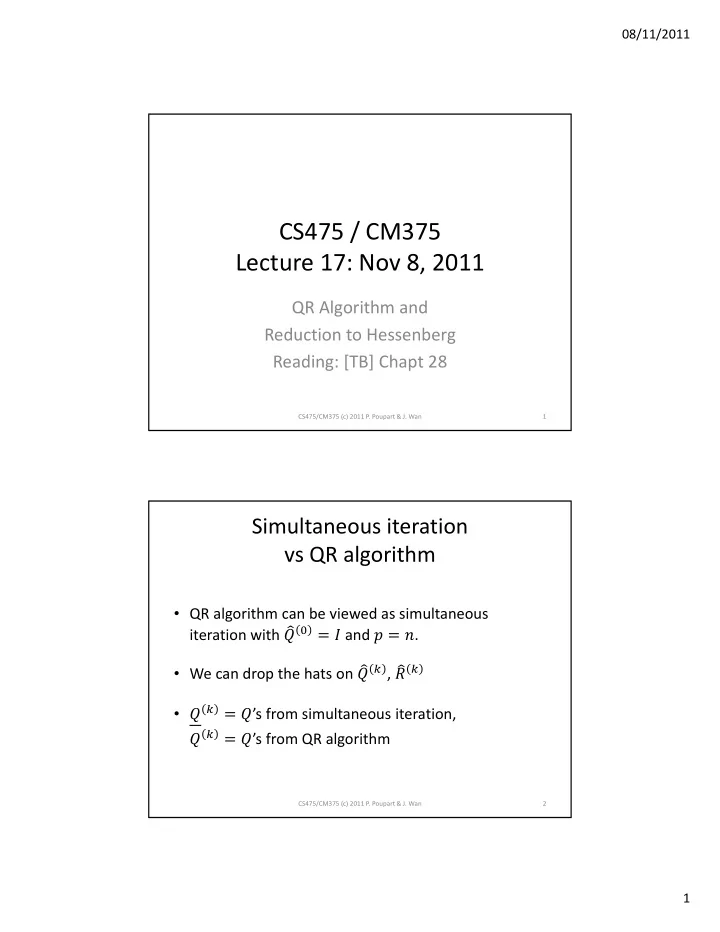
08/11/2011 CS475 / CM375 Lecture 17: Nov 8, 2011 QR Algorithm and Reduction to Hessenberg Reading: [TB] Chapt 28 CS475/CM375 (c) 2011 P. Poupart & J. Wan 1 Simultaneous iteration vs QR algorithm QR algorithm can be viewed as simultaneous


slide-1
SLIDE 1

08/11/2011 1

CS475 / CM375 Lecture 17: Nov 8, 2011

QR Algorithm and Reduction to Hessenberg Reading: [TB] Chapt 28

CS475/CM375 (c) 2011 P. Poupart & J. Wan 1

Simultaneous iteration vs QR algorithm

  • QR algorithm can be viewed as simultaneous

iteration with and .

  • We can drop the hats on

,

  • ’s from simultaneous iteration,

’s from QR algorithm

CS475/CM375 (c) 2011 P. Poupart & J. Wan 2

slide-2
SLIDE 2

08/11/2011 2

Simultaneous iteration revisited

  • Simultaneous iteration can be written as:

For 1,2, … ← ←

end

New matrices for proof purpose

CS475/CM375 (c) 2011 P. Poupart & J. Wan 3

QR algorithm revisited

  • QR algorithm can be written as:

For 1,2, … ← ← … … end

New matrices for proof purpose

CS475/CM375 (c) 2011 P. Poupart & J. Wan 4

slide-3
SLIDE 3

08/11/2011 3

Equivalence

  • Theorem: The two algorithms generate identical

sequences of matrices , and and they are

(1) (2)

  • CS475/CM375 (c) 2011 P. Poupart & J. Wan

5

Equivalence

  • Proof: by induction. The case 0 is trivial since

and . Suppose it is true for 1. Simultaneous iteration:

CS475/CM375 (c) 2011 P. Poupart & J. Wan 6

slide-4
SLIDE 4

08/11/2011 4

Equivalence

  • Proof continued…

QR algorithm:

CS475/CM375 (c) 2011 P. Poupart & J. Wan 7

Convergence of the QR algorithm

(1) ⟹ QR algorithm effectively computes , factors

  • f i.e., orthonormal basis for

(2) ⟹ The diagonal of are Rayleigh quotients of column vectors of

  • As columns of ⟶ eigenvectors,

the Rayleigh quotients ⟶ eigenvalues

CS475/CM375 (c) 2011 P. Poupart & J. Wan 8

slide-5
SLIDE 5

08/11/2011 5

Convergence of the QR algorithm

  • – Here

, are columns and of

– Eventually

→ , → ,

– Therefore

0 ∀

  • ∴ converges to a diagonal matrix

CS475/CM375 (c) 2011 P. Poupart & J. Wan 9

Convergence of the QR algorithm

  • Theorem: Assume ⋯ || and has

all nonsingular leading principal minors. As → ∞, converges linearly to , … , and converges at the same rate to . The rate of convergence is max

  • CS475/CM375 (c) 2011 P. Poupart & J. Wan

10

slide-6
SLIDE 6

08/11/2011 6

Example

2 1 1 1 3 1 1 1 4

CS475/CM375 (c) 2011 P. Poupart & J. Wan 11

Example

21 7 1 5 7 7 4 4 20

CS475/CM375 (c) 2011 P. Poupart & J. Wan 12

slide-7
SLIDE 7

08/11/2011 7

Practical QR

  • It is expensive to compute the QR

factorization of a square matrix

  • In practice, we first reduce to a Hessenberg

matrix if and to a tridiagonal matrix if

  • The resulting QR factorization would be

if and if

CS475/CM375 (c) 2011 P. Poupart & J. Wan 13

Reduction to Hessenberg

  • r Tridiagonal
  • The matrix can be nonsymmetric in general
  • Why Hessenberg? Why not triangular?

CS475/CM375 (c) 2011 P. Poupart & J. Wan 14

slide-8
SLIDE 8

08/11/2011 8

Reduction to Hessenberg

  • r Tridiagonal
  • Be less ambitious and choose

that leaves 1st row

unchanged

CS475/CM375 (c) 2011 P. Poupart & J. Wan 15

Reduction to Hessenberg

  • r Tridiagonal
  • In general:

… and upper Hessenberg

  • Complexity:

– Flops(Reduction to Hessenberg)

  • – Flops(Reduction to tridiagonal)
  • CS475/CM375 (c) 2011 P. Poupart & J. Wan

16