CS475/CM375 Lecture 4: Sept 22 Sparse Gaussian Elimination, Graph - - PDF document

cs475 cm375 lecture 4 sept 22
SMART_READER_LITE
LIVE PREVIEW

CS475/CM375 Lecture 4: Sept 22 Sparse Gaussian Elimination, Graph - - PDF document

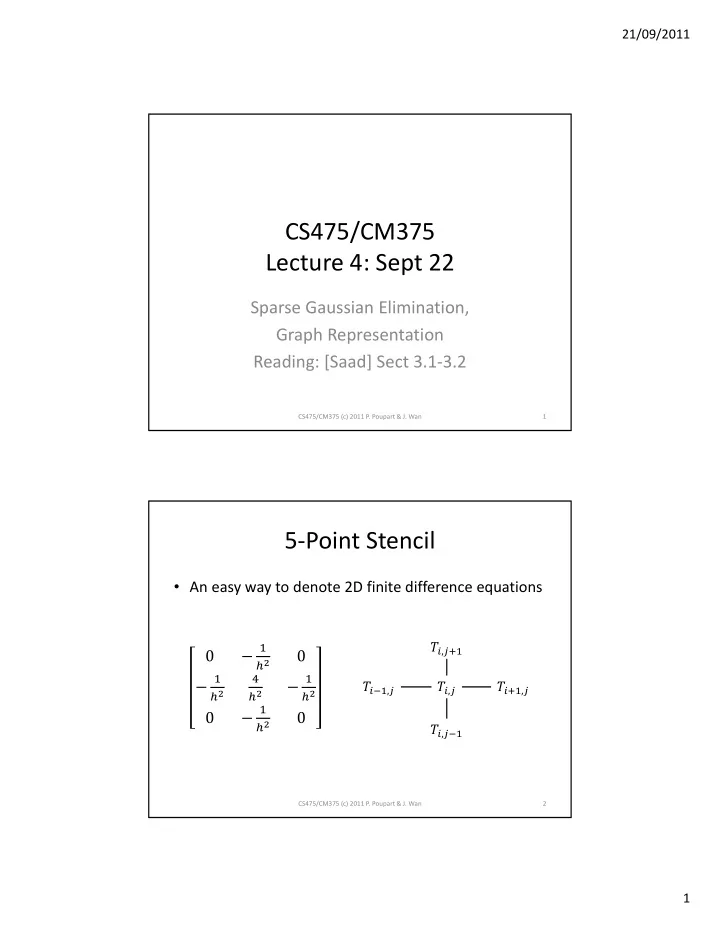
21/09/2011 CS475/CM375 Lecture 4: Sept 22 Sparse Gaussian Elimination, Graph Representation Reading: [Saad] Sect 3.1 3.2 CS475/CM375 (c) 2011 P. Poupart & J. Wan 1 5 Point Stencil An easy way to denote 2D finite difference


slide-1
SLIDE 1

21/09/2011 1

CS475/CM375 Lecture 4: Sept 22

Sparse Gaussian Elimination, Graph Representation Reading: [Saad] Sect 3.1‐3.2

CS475/CM375 (c) 2011 P. Poupart & J. Wan 1

5‐Point Stencil

  • An easy way to denote 2D finite difference equations
  • ,

, , , ,

CS475/CM375 (c) 2011 P. Poupart & J. Wan 2

slide-2
SLIDE 2

21/09/2011 2

Numbering of unknowns

  • Picture:
  • Note: the values on the boundary are zero
  • The unknowns are:
  • ,

, ⋯ ,

  • ,

, ⋯ , ⋮ ⋮ ⋱ ⋮

  • ,

, ⋯

  • ,
  • Total number ≡

CS475/CM375 (c) 2011 P. Poupart & J. Wan 3

Natural ordering

  • Ordering: first in the x‐direction, then y‐direction

– i.e.,

,, ,, … , ,; ,, ,, …

  • The system of linear equations

1, 1:

  • ,
  • ,
  • ,

,

2, 1:

  • ,
  • ,
  • ,
  • ,

,

⋮ , :

  • ,
  • ,
  • ,

,

CS475/CM375 (c) 2011 P. Poupart & J. Wan 4

slide-3
SLIDE 3

21/09/2011 3

Matrix Form

  • Example 4, 16

CS475/CM375 (c) 2011 P. Poupart & J. Wan 5

Graph Representation of Matrices

  • Given a sparse matrix , a node is associated with

each row.

  • If , 0, there exists an edge from node to
  • 1

2 3 4 :

CS475/CM375 (c) 2011 P. Poupart & J. Wan 6

slide-4
SLIDE 4

21/09/2011 4

Graph for Symmetric Matrices

  • For symmetric matrices, arrows can be dropped (as

well as self loops)

  • 1

2 3 4 :

CS475/CM375 (c) 2011 P. Poupart & J. Wan 7

Physical/Geometric Interpretation

  • Graph of a matrix often has a simple

physical/geometric interpretation

– 1D Laplacian : – 2D Laplacian :

CS475/CM375 (c) 2011 P. Poupart & J. Wan 8

slide-5
SLIDE 5

21/09/2011 5

GE and Matrix Graph

  • “Visualize” eliminations by matrix graph

e.g.

  • :

GE fill‐in

CS475/CM375 (c) 2011 P. Poupart & J. Wan 9

GE and Matrix Graph

  • Elimination of node produces a new graph with

– Node deleted, all edges containing node deleted – New edge , added (fill‐in) if there was an edge , & , in the old graph.

  • Notes

– Matrix (with symmetric structure) graph is unchanged by renumbering of the nodes – But orderings (which nodes to be removed first) may result in much less fill during GE.

CS475/CM375 (c) 2011 P. Poupart & J. Wan 10

slide-6
SLIDE 6

21/09/2011 6

Ordering Algorithms

  • Consider the following matrix graph:
  • Assume ≫ . If we use the natural ordering,

what would the matrix look like?

  • CS475/CM375 (c) 2011 P. Poupart & J. Wan

11

Ordering Algorithms

  • If we had numbered along y‐direction first, the

matrix becomes:

  • Which ordering results in less fill? Why?

CS475/CM375 (c) 2011 P. Poupart & J. Wan 12

slide-7
SLIDE 7

21/09/2011 7

Band Matrices

  • Note: GE preserves band structure

– Picture:

  • Amount of work to factor a band matrix:

– where bandwidth – x‐first ordering →

  • – y‐first ordering →
  • CS475/CM375 (c) 2011 P. Poupart & J. Wan

13

Envelope Methods

  • In general, bandwidth is not the same for each row

– Example:

  • In each row, fill can occur only between the 1st

nonzero entry and the diagonal.

  • To limit the amount of fill, keep the envelope as close

to the diagonal as possible

CS475/CM375 (c) 2011 P. Poupart & J. Wan 14

slide-8
SLIDE 8

21/09/2011 8

Envelope Methods

  • Try to number nodes so that graph neighbours have

numbers as close together as possible

– Example:

CS475/CM375 (c) 2011 P. Poupart & J. Wan 15