CS475/CM375 Lecture 8: Oct 6, 2011 Iterative Methods Reading: [Saad] - - PDF document

cs475 cm375 lecture 8 oct 6 2011
SMART_READER_LITE
LIVE PREVIEW

CS475/CM375 Lecture 8: Oct 6, 2011 Iterative Methods Reading: [Saad] - - PDF document

05/10/2011 CS475/CM375 Lecture 8: Oct 6, 2011 Iterative Methods Reading: [Saad] Chapt 4 CS475/CM375 (c) 2011 P. Poupart & J. Wan 1 SOR Iteration Successive Over Relaxation (SOR) and


slide-1
SLIDE 1

05/10/2011 1

CS475/CM375 Lecture 8: Oct 6, 2011

Iterative Methods Reading: [Saad] Chapt 4

CS475/CM375 (c) 2011 P. Poupart & J. Wan 1

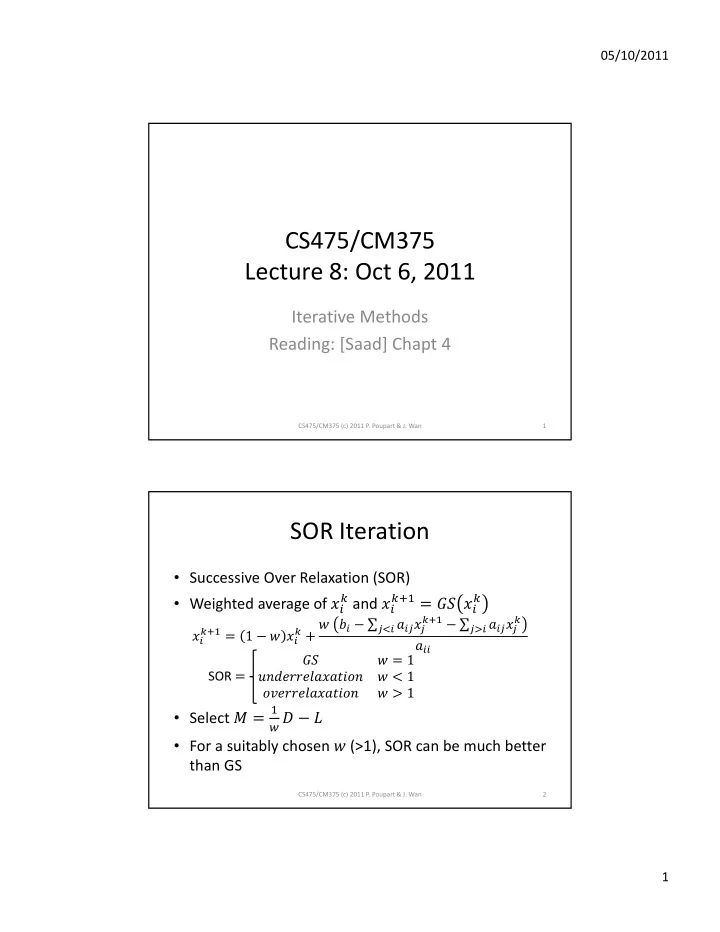
SOR Iteration

  • Successive Over Relaxation (SOR)
  • Weighted average of

and

  • 1

  • SOR
  • 1
  • 1
  • 1
  • Select
  • For a suitably chosen (>1), SOR can be much better

than GS

CS475/CM375 (c) 2011 P. Poupart & J. Wan 2

slide-2
SLIDE 2

05/10/2011 2

Convergence Analysis

  • Q1: Under what conditions does the iteration

converge?

  • Q2: If the iteration converges, how fast is it?
  • Def: is an eigenvalue and an eigenvector of if

( 0)

  • Def: the spectral radius of , , is the largest

absolute value of the eigenvalues of

CS475/CM375 (c) 2011 P. Poupart & J. Wan 3

Convergence Analysis

  • Theorem: the iterative method

is convergent for any and if and only if 1

  • is called the iteration matrix
  • is called the rate of convergence

CS475/CM375 (c) 2011 P. Poupart & J. Wan 4

slide-3
SLIDE 3

05/10/2011 3

Minimization Formulation

  • Assume is SPD. Consider the functional:

  • Theorem: The solution of is equivalent to the

solution of the minimization problem: min

CS475/CM375 (c) 2011 P. Poupart & J. Wan 5

Minimization Formulation

  • Proof: the minimizer satisfies 0 i.e.
  • – Note
  • – Hence
  • CS475/CM375 (c) 2011 P. Poupart & J. Wan

6

slide-4
SLIDE 4

05/10/2011 4

Minimization Formulation

  • Since is convex, then local min = global min
  • Picture:

CS475/CM375 (c) 2011 P. Poupart & J. Wan 7

Search Directions

  • Idea: minimize along the direction 0
  • Let current approximation
  • Define
  • Determine by min along

– i.e., min

CS475/CM375 (c) 2011 P. Poupart & J. Wan 8

slide-5
SLIDE 5

05/10/2011 5

Search Directions

  • Let ≡
  • Hence 0

and

CS475/CM375 (c) 2011 P. Poupart & J. Wan 9

Search Directions

  • Notes

1. is SPD ⟹ 0

  • 2. What is the optimal search direction ?
  • Picture:

CS475/CM375 (c) 2011 P. Poupart & J. Wan 10

slide-6
SLIDE 6

05/10/2011 6

Steepest Descent

  • Local optimal direction
  • Consider
  • Then 0

changes in at in the direction

  • Idea: make ′0 as negative as possible by varying

CS475/CM375 (c) 2011 P. Poupart & J. Wan 11

Steepest Descent

  • Assume
  • 1. Then

′0 is max if steepest descent ′0 is min if steepest descent

  • (where )

CS475/CM375 (c) 2011 P. Poupart & J. Wan 12

slide-7
SLIDE 7

05/10/2011 7

Steepest Descent

  • Steepest descent method:

step length

  • The optimal

( /)

  • Also

CS475/CM375 (c) 2011 P. Poupart & J. Wan 13

Steepest Descent

  • Algorithm

Given , compute for 0,1,2, … end

CS475/CM375 (c) 2011 P. Poupart & J. Wan 14

slide-8
SLIDE 8

05/10/2011 8

Steepest Descent

  • Notes
  • 1. Only 1 matrix‐vector product per iteration
  • 2. “Nonlinear” iterative method:

i.e.,

  • CS475/CM375 (c) 2011 P. Poupart & J. Wan

15