CS137: Today Electronic Design Automation Topological Worst Case - - PDF document

cs137 today electronic design automation
SMART_READER_LITE
LIVE PREVIEW

CS137: Today Electronic Design Automation Topological Worst Case - - PDF document

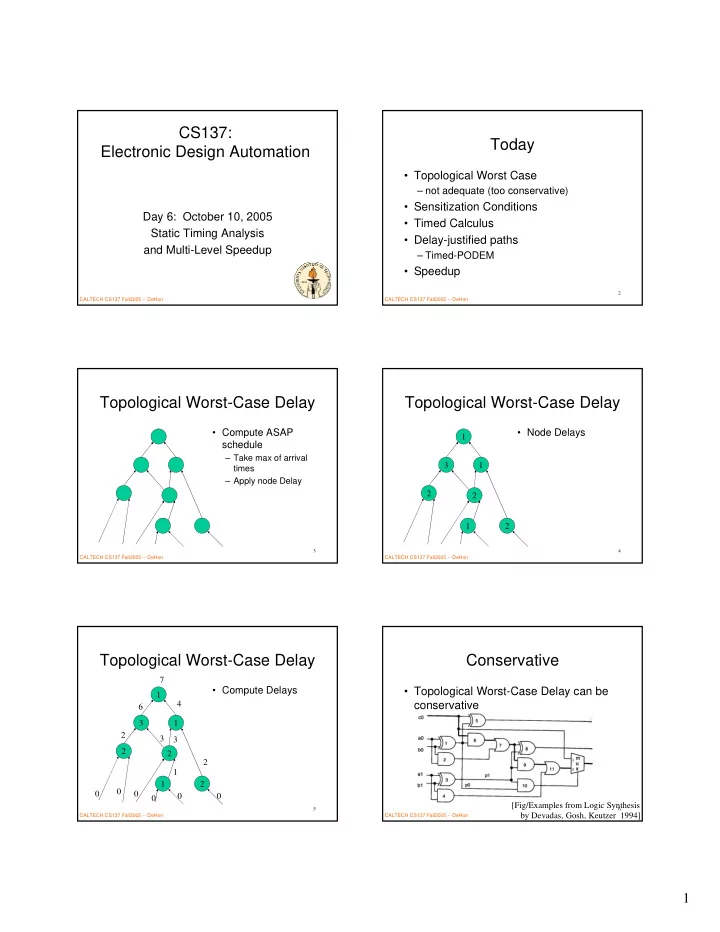
CS137: Today Electronic Design Automation Topological Worst Case not adequate (too conservative) Sensitization Conditions Day 6: October 10, 2005 Timed Calculus Static Timing Analysis Delay-justified paths and


slide-1
SLIDE 1

1

CALTECH CS137 Fall2005 -- DeHon 1

CS137: Electronic Design Automation

Day 6: October 10, 2005 Static Timing Analysis and Multi-Level Speedup

CALTECH CS137 Fall2005 -- DeHon 2

Today

  • Topological Worst Case

– not adequate (too conservative)

  • Sensitization Conditions
  • Timed Calculus
  • Delay-justified paths

– Timed-PODEM

  • Speedup

CALTECH CS137 Fall2005 -- DeHon 3

Topological Worst-Case Delay

  • Compute ASAP

schedule

– Take max of arrival times – Apply node Delay

CALTECH CS137 Fall2005 -- DeHon 4

Topological Worst-Case Delay

1 3 2 1 2 1 2

  • Node Delays

CALTECH CS137 Fall2005 -- DeHon 5

Topological Worst-Case Delay

1 3 2 1 2 1 2

  • Compute Delays

1 3 3 2 2 4 6 7

CALTECH CS137 Fall2005 -- DeHon 6

Conservative

  • Topological Worst-Case Delay can be

conservative

[Fig/Examples from Logic Synthesis by Devadas, Gosh, Keutzer 1994]

slide-2
SLIDE 2

2

CALTECH CS137 Fall2005 -- DeHon 7

Example

  • Assume each gate 1:

6 delays in longest path (5 if assume c0 latest arriving)

CALTECH CS137 Fall2005 -- DeHon 8

Example

  • Is this path possible?
  • Out from mux 0 input
  • and10 = 0
  • p0=0 or p1=0
  • p1=0 1→6→7 not matter
  • p0=0 c0 not matter
  • This path not feasible

CALTECH CS137 Fall2005 -- DeHon 9

False Paths

  • Once consider logic for nodes

– There are logical constraints on data values

  • There are paths which cannot logically
  • ccur

– Call them false paths

CALTECH CS137 Fall2005 -- DeHon 10

What can we do?

  • Need to assess what paths are real
  • Brute force

– for every pair of inputs – compute delay in outputs from in1→in2 input transition – take worst case

  • Expensive:

– 22n delay traces

CALTECH CS137 Fall2005 -- DeHon 11

Alternately

  • Look at single vector and determine

what controls delay of circuit

– I.e. look at values on path and determine path sensitized to change with input

CALTECH CS137 Fall2005 -- DeHon 12

Controlled Inputs

  • Controlled input to a gate:

– input whose value will determine gate

  • utput

– e.g.

  • 0 on a AND gate
  • 1 on a OR gate
slide-3
SLIDE 3

3

CALTECH CS137 Fall2005 -- DeHon 13

Static Sensitization

  • A path is statically sensitized

– if all the side (non-path) inputs are non- controlling – I.e. this path value flips with the input

CALTECH CS137 Fall2005 -- DeHon 14

Statically Sensitized Path

CALTECH CS137 Fall2005 -- DeHon 15

Sufficiency

  • Static Sensitization is sufficient for a

path to be a true path in circuit

CALTECH CS137 Fall2005 -- DeHon 16

…but not necessary

Paths of length 3 not statically sensitizable. But there is a true path of delay 3.

CALTECH CS137 Fall2005 -- DeHon 17

Static Co-sensitization

  • Each output with a controlled value

– has a controlling value as input on path – (and vice-versa for non-controlled)

May trace multiple edges

CALTECH CS137 Fall2005 -- DeHon 18

Necessary

  • Static Co-sensitization is a necessary

condition for a path to be true

slide-4
SLIDE 4

4

CALTECH CS137 Fall2005 -- DeHon 19

…but not sufficient

Cosensitize path of length 6. Real delay is 5.

CALTECH CS137 Fall2005 -- DeHon 20

Combining

  • Combine these ideas into a timed-

calculus for computing delays for an input vector

CALTECH CS137 Fall2005 -- DeHon 21

Computing Delays

AND Timing Calculus

CALTECH CS137 Fall2005 -- DeHon 22

Rules

  • If gate output is at a controlling value,

pick the minimum input and add gate delay

  • If gate output is at a non-controlling

value, pick the maximum input and add gate delay

CALTECH CS137 Fall2005 -- DeHon 23

Example (1)

CALTECH CS137 Fall2005 -- DeHon 24

Example (2)

slide-5
SLIDE 5

5

CALTECH CS137 Fall2005 -- DeHon 25

Now...

  • We know how to get the delay of a

single input condition

  • Could:

– find critical path – search for an input vector to sensitize – if fail, find next path – …until find longest true path

  • May be O(2n)

CALTECH CS137 Fall2005 -- DeHon 26

Better Approach

  • Ask if can justify a delay greater than T
  • Search for satisfying vector

– …or demonstration that none exists

  • Binary search to find tightest delay

CALTECH CS137 Fall2005 -- DeHon 27

Delay Computation

  • Modification of a testing routine

– used to justify an output value for a circuit

  • PODEM

– backtracking search to find a suitable input vector associated with some target output – Simple a branching search with implication pruning

  • Heuristic for smart variable ordering

CALTECH CS137 Fall2005 -- DeHon 28

Search1

  • Takes in list of nodes to satisfy
  • If all satisfied done
  • Backtrace to set next PI
  • if inconsistent PI value

– try inverting this PI call Search2

  • else

– search to set next PI – if fail

  • try inverting and Search2

CALTECH CS137 Fall2005 -- DeHon 29

Search2

  • ;; same idea, but this one not flip bit
  • ;; because already tried inverted value
  • If no conflict

– search to set next PI

  • otherwise

– pass back failure

CALTECH CS137 Fall2005 -- DeHon 30

Backtrace

  • Follow back gates w/ unknown values

– sometimes output dictate input must be

  • (AND needing 1 output; with one input already

assigned 1)

– sometimes have to guess what to follow

  • (OR with 1 output and no inputs set)
  • Uses heuristics to decide what to follow
slide-6
SLIDE 6

6

CALTECH CS137 Fall2005 -- DeHon 31

Example

Try justify g=1

CALTECH CS137 Fall2005 -- DeHon 32

Example

CALTECH CS137 Fall2005 -- DeHon 33

For Timed Justification

  • Also want to compute delay

– on incompletely specified values

  • Compute bounds on timing

– upper bound, lower bound – Again, use our timed calculus

  • expanded to unknowns

CALTECH CS137 Fall2005 -- DeHon 34

Delay Calculation

AND rules

CALTECH CS137 Fall2005 -- DeHon 35

Timed PODEM

  • Input: value to justify and delay T
  • Goal: find input vector which produces

value and exceeds delay T

  • Algorithm

– similar – implications check timing as well as logic

CALTECH CS137 Fall2005 -- DeHon 36

Example

Justify 1(3)

slide-7
SLIDE 7

7

CALTECH CS137 Fall2005 -- DeHon 37

Example

Fail to justify 1(3) Justify 0(3)

CALTECH CS137 Fall2005 -- DeHon 38

Search

  • Less than 2n

– pruning due to implications – here saw a must be 0

  • no need to search 1xx subtree

CALTECH CS137 Fall2005 -- DeHon 39

Speed Up

(sketch flavor)

CALTECH CS137 Fall2005 -- DeHon 40

Speed Up

  • Start with area optimized network
  • Know target arrival times

– Know delay from static analysis

  • Want to reduce delay of node

CALTECH CS137 Fall2005 -- DeHon 41

Basic Idea

  • Improve speed by:

– Collapsing node(s) – Refactoring collapsed subgraph to reduce height

CALTECH CS137 Fall2005 -- DeHon 42

Speed Up

  • While (delay decreasing, timing not met)

– Compute delay (slack)

  • Static timing analysis

– Generate network close to critical path – Weight nodes in network – Compute mincut of nodes on weighted network – Partial collapse and timing redecompose

  • n cut nodes
slide-8
SLIDE 8

8

CALTECH CS137 Fall2005 -- DeHon 43

Weighted Cut

  • Want to minimize area expansion
  • Want to maximize likely benefit

– Prefer nodes with varying input times – Prefer nodes with critical path on longer paths

CALTECH CS137 Fall2005 -- DeHon 44

Timing Decomposition

  • Extract area saving kernels that do not

include critical inputs to node

  • When decompose (e.g. into nand2’s)

similarly balance with critical inputs closest to output

CALTECH CS137 Fall2005 -- DeHon 45

Example

CALTECH CS137 Fall2005 -- DeHon 46

Example

CALTECH CS137 Fall2005 -- DeHon 47

Example

New factor

CALTECH CS137 Fall2005 -- DeHon 48

Admin

slide-9
SLIDE 9

9

CALTECH CS137 Fall2005 -- DeHon 49

Big Ideas

  • Topological Worst-case delays are

conservative

– Once consider logical constraints – may have false paths

  • Necessary and sufficient conditions on

true paths

  • Search for paths by delay

– or demonstrate non existence

  • Search with implications
  • Iterative improvement