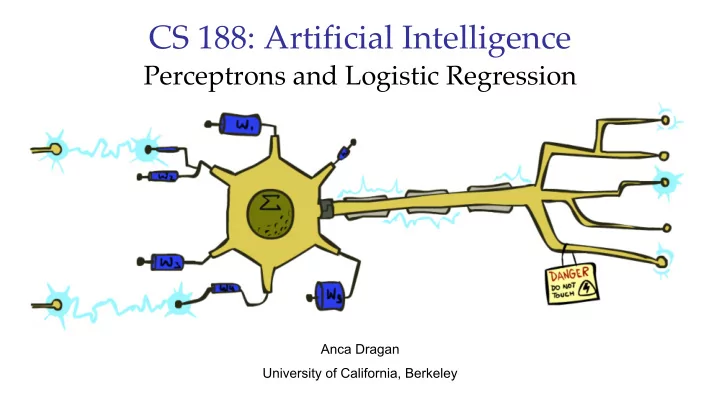
SLIDE 1 CS 188: Artificial Intelligence
Perceptrons and Logistic Regression
Anca Dragan University of California, Berkeley
SLIDE 2 Last Time
§ Classification: given inputs x, predict labels (classes) y § Naïve Bayes § Parameter estimation:
§ MLE, MAP, priors
§ Laplace smoothing § Training set, held-out set, test set
Y F1 Fn F2
SLIDE 3
Linear Classifiers
SLIDE 4 Feature Vectors
Hello, Do you want free printr cartriges? Why pay more when you can get them ABSOLUTELY FREE! Just # free : 2 YOUR_NAME : 0 MISSPELLED : 2 FROM_FRIEND : 0 ...
SPAM
+
PIXEL-7,12 : 1 PIXEL-7,13 : 0 ... NUM_LOOPS : 1 ...
“2”
SLIDE 5
Some (Simplified) Biology
§ Very loose inspiration: human neurons
SLIDE 6 Linear Classifiers
§ Inputs are feature values § Each feature has a weight § Sum is the activation § If the activation is:
§ Positive, output +1 § Negative, output -1
S
f1 f2 f3 w1 w2 w3
>0?
SLIDE 7 Weights
§ Binary case: compare features to a weight vector § Learning: figure out the weight vector from examples
# free : 2 YOUR_NAME : 0 MISSPELLED : 2 FROM_FRIEND : 0 ... # free : 4 YOUR_NAME :-1 MISSPELLED : 1 FROM_FRIEND :-3 ... # free : 0 YOUR_NAME : 1 MISSPELLED : 1 FROM_FRIEND : 1 ...
Dot product positive means the positive class
SLIDE 8
Decision Rules
SLIDE 9 Binary Decision Rule
§ In the space of feature vectors
§ Examples are points § Any weight vector is a hyperplane § One side corresponds to Y=+1 § Other corresponds to Y=-1
BIAS : -3 free : 4 money : 2 ... 1 1 2 free money
SLIDE 10 Binary Decision Rule
§ In the space of feature vectors
§ Examples are points § Any weight vector is a hyperplane § One side corresponds to Y=+1 § Other corresponds to Y=-1
BIAS : -3 free : 4 money : 2 ... 1 1 2 free money
SLIDE 11 Binary Decision Rule
§ In the space of feature vectors
§ Examples are points § Any weight vector is a hyperplane § One side corresponds to Y=+1 § Other corresponds to Y=-1
BIAS : -3 free : 4 money : 2 ... 1 1 2 free money +1 = SPAM
SLIDE 12
Weight Updates
SLIDE 13
Learning: Binary Perceptron
§ Start with weights = 0 § For each training instance: § Classify with current weights § If correct (i.e., y=y*), no change! § If wrong: adjust the weight vector
SLIDE 14 Learning: Binary Perceptron
§ Start with weights = 0 § For each training instance: § Classify with current weights § If correct (i.e., y=y*), no change! § If wrong: adjust the weight vector by adding or subtracting the feature vector. Subtract if y* is -1.
Before: w f After: wf + y*f f f f >=0
SLIDE 15
Examples: Perceptron
§ Separable Case
SLIDE 16 Multiclass Decision Rule
§ If we have multiple classes:
§ A weight vector for each class: § Score (activation) of a class y: § Prediction highest score wins
Binary = multiclass where the negative class has weight zero
SLIDE 17
Learning: Multiclass Perceptron
§ Start with all weights = 0 § Pick up training examples one by one § Predict with current weights § If correct, no change! § If wrong: lower score of wrong answer, raise score of right answer
SLIDE 18 Example: Multiclass Perceptron
BIAS : 1 win : 0 game : 0 vote : 0 the : 0 ... BIAS : 0 win : 0 game : 0 vote : 0 the : 0 ... BIAS : 0 win : 0 game : 0 vote : 0 the : 0 ...
“win the vote” “win the election” “win the game”
[1 1 0 1 1] 1 1 1 1 1
[1 1 0 0 1]
3 [1 1 1 0 1]
3 1 1
1
SLIDE 19
Properties of Perceptrons
§ Separability: true if some parameters get the training set perfectly correct § Convergence: if the training is separable, perceptron will eventually converge (binary case) § Mistake Bound: the maximum number of mistakes (binary case) related to the margin or degree of separability Separable Non-Separable
SLIDE 20 Problems with the Perceptron
§ Noise: if the data isn’t separable, weights might thrash
§ Averaging weight vectors over time can help (averaged perceptron)
§ Mediocre generalization: finds a “barely” separating solution § Overtraining: test / held-out accuracy usually rises, then falls
§ Overtraining is a kind of overfitting
SLIDE 21
Improving the Perceptron
SLIDE 22 Non-Separable Case: Deterministic Decision
Even the best linear boundary makes at least one mistake
SLIDE 23
Non-Separable Case: Probabilistic Decision
0.5 | 0.5 0.3 | 0.7 0.1 | 0.9 0.7 | 0.3 0.9 | 0.1
SLIDE 24
How to get probabilistic decisions?
§ Perceptron scoring: § If very positive à want probability going to 1 § If very negative à want probability going to 0 § Sigmoid function
z = w · f(x)
z = w · f(x) z = w · f(x)
φ(z) = 1 1 + e−z
SLIDE 25 A 1D Example
definitely blue definitely red not sure
probability increases exponentially as we move away from boundary normalizer
SLIDE 26
The Soft Max
SLIDE 27
Best w?
§ Maximum likelihood estimation: with:
max
w
ll(w) = max
w
X
i
log P(y(i)|x(i); w) P(y(i) = +1|x(i); w) = 1 1 + e−w·f(x(i)) P(y(i) = −1|x(i); w) = 1 − 1 1 + e−w·f(x(i))
= Logistic Regression
SLIDE 28
Separable Case: Deterministic Decision – Many Options
SLIDE 29
Separable Case: Probabilistic Decision – Clear Preference
0.5 | 0.5 0.3 | 0.7 0.7 | 0.3 0.5 | 0.5 0.3 | 0.7 0.7 | 0.3
SLIDE 30 Multiclass Logistic Regression
§ Recall Perceptron:
§ A weight vector for each class: § Score (activation) of a class y: § Prediction highest score wins
§ How to make the scores into probabilities?
z1, z2, z3 → ez1 ez1 + ez2 + ez3 , ez2 ez1 + ez2 + ez3 , ez3 ez1 + ez2 + ez3
softmax activations
SLIDE 31
Best w?
§ Maximum likelihood estimation: with:
max
w
ll(w) = max
w
X
i
log P(y(i)|x(i); w)
P(y(i)|x(i); w) = ewy(i)·f(x(i)) P
y ewy·f(x(i))
= Multi-Class Logistic Regression
SLIDE 32
Next Lecture
§ Optimization
§ i.e., how do we solve:
max
w
ll(w) = max
w
X
i
log P(y(i)|x(i); w)