Crushed hopes: under- employment and deskilling among skilled - - PowerPoint PPT Presentation

crushed hopes under employment and deskilling among
SMART_READER_LITE
LIVE PREVIEW

Crushed hopes: under- employment and deskilling among skilled - - PowerPoint PPT Presentation

Panel Discussion March 9th 2011 Deskilling of qualified migrant w omen: implications and solutions Blandine Mollard Project Officer Gender Coordination Unit International Organization for Migration Crushed hopes: under- employment and


slide-1
SLIDE 1

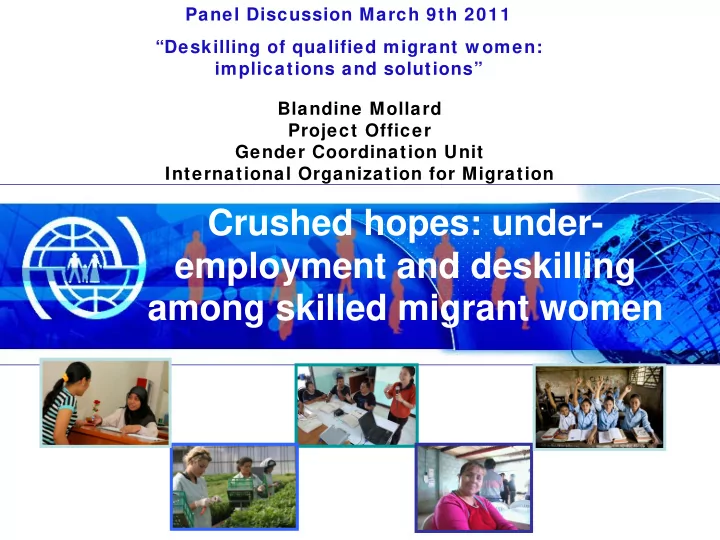
Crushed hopes: under- employment and deskilling among skilled migrant women

Blandine Mollard Project Officer Gender Coordination Unit International Organization for Migration Panel Discussion March 9th 2011 “Deskilling of qualified migrant w omen: implications and solutions”

slide-2
SLIDE 2

2

I. I. Key elements about deskilling, Key elements about deskilling, underemployment and women underemployment and women II. II. Research findings from the UK, Quebec Research findings from the UK, Quebec and Geneva and Geneva III.

  • III. Recommandations

Recommandations

Overview

slide-3
SLIDE 3

3

  • I. Key elements on underemployment,

deskilling and women

  • Deskilling and underemployment relate to

Deskilling and underemployment relate to the the situation of being overqualified for one situation of being overqualified for one’ ’s job in terms of s job in terms of education, professional experience or both education, professional experience or both, of skills not , of skills not being used being used

Concerns migrants most particularly Concerns migrants most particularly

  • Magnitude varies from one country to country

Magnitude varies from one country to country

  • Observed in all industrialised countries

Observed in all industrialised countries

slide-4
SLIDE 4
  • I. Key elements on underemployment,

deskilling and women

Existing literature shows women are disproportionatly affected: Existing literature shows women are disproportionatly affected: – – Women under Women under-

  • represented in sought after occupations (IT,

represented in sought after occupations (IT, business, engineering, business, engineering,… …) ) – – Women dominate in professions less easily transferrable Women dominate in professions less easily transferrable and more defined in the national context (education, law, and more defined in the national context (education, law, public administration, public administration,… …) ) – – With migration, harder to concile family and work balance With migration, harder to concile family and work balance – – Less likely to migrate with a job contract Less likely to migrate with a job contract

slide-5
SLIDE 5

5

Empirical studies: in the United Empirical studies: in the United Kingdom: Kingdom:

  • Migrant women engaged in care work

Migrant women engaged in care work

  • From Eastern Europe, Africa, Southern Asia and South Eastern

From Eastern Europe, Africa, Southern Asia and South Eastern Asia Asia

  • Very poor working conditions (multiple employers, low pay,

Very poor working conditions (multiple employers, low pay, unsocial working hours, lack of social security,) unsocial working hours, lack of social security,)

  • Certified health professionals (nurses, midwives, chiropractors)

Certified health professionals (nurses, midwives, chiropractors)

  • r teachers in their countries of origin
  • r teachers in their countries of origin
  • Care work seen as a stepping stone, a temporary

Care work seen as a stepping stone, a temporary solutions before receiving accreditation solutions before receiving accreditation

slide-6
SLIDE 6

6

  • Main elements

Main elements Stiff barriers for migrant women to enter regulated professions Stiff barriers for migrant women to enter regulated professions such as nursing (lack of recognition of degrees, tests, expansiv such as nursing (lack of recognition of degrees, tests, expansive e fees...) fees...) No option to advance in care work No option to advance in care work Frustration at not using their skills, skills erosion Frustration at not using their skills, skills erosion Inability to realise migration expectations (family reunificatio Inability to realise migration expectations (family reunification, n, remittances) remittances) For some, phenomenon of inverted remittances For some, phenomenon of inverted remittances

Example of how women can be drawn to low skilled positions Example of how women can be drawn to low skilled positions by unmet labour demands in the global care industry by unmet labour demands in the global care industry

Empirical studies: in the United Empirical studies: in the United Kingdom: Kingdom:

slide-7
SLIDE 7

7

  • Focused on levels of distress

Focused on levels of distress

  • 33 women age between 26 and 62

33 women age between 26 and 62

  • Varions migration trajectories

Varions migration trajectories

  • At least 5 years of university education

At least 5 years of university education

  • 16 different professions

16 different professions

  • On average, 9 years of relevant professional

On average, 9 years of relevant professional experience experience

  • Engaged in low skilled, precarious and part time jobs

Engaged in low skilled, precarious and part time jobs (mainly cleaning, childcare, elderly care, sales, (mainly cleaning, childcare, elderly care, sales,… …) )

Empirical studies: in Geneva Empirical studies: in Geneva

slide-8
SLIDE 8

8

Deskilling occurred regardless of the partners Deskilling occurred regardless of the partners’ ’ socio economic status socio economic status High levels of distress (anger, despair, sense of anonymity) cau High levels of distress (anger, despair, sense of anonymity) caused by sed by job hunting job hunting Level of distress correlated with level of underemployment and m Level of distress correlated with level of underemployment and more

  • re

acute when children under 12 acute when children under 12 Marital difficulties including separation, divorce Marital difficulties including separation, divorce Only 6 had managed to reconvert to a new profession Only 6 had managed to reconvert to a new profession

  • Main elements

Main elements

Shows the far-reaching impact of underemployment

  • n women’s lives and the serious obstacles to

reskilling and reconversion

Empirical studies: in Geneva Empirical studies: in Geneva

slide-9
SLIDE 9

83 women Europe, America, Asia, Africa Explored identity representations Focused on reactions faced to deskilling

  • Women from Asia, South and Central America tend to re-
  • rient themselves
  • Women from North Africa: rapid deskilled integration

allowing the spouse to return to further studies. Then, being a homemaker before going back to studies, depending on the future wage-earning job of the husband.

Empirical studies: in Quebec Empirical studies: in Quebec

slide-10
SLIDE 10

Main elements: Psychosocial impact linked to expectations for each group Psychosocial impact linked to expectations for each group

  • High disapointement observed among Western European

High disapointement observed among Western European Women Women

  • When deskilling is seen as a step in the

When deskilling is seen as a step in the « « migrant career migrant career » »= = protective of self protective of self-

  • esteem

esteem

Further education strategy, despite the associated costs, Further education strategy, despite the associated costs, a strategy associated with a higher employment rate for a strategy associated with a higher employment rate for migrants migrants

Empirical studies: in Quebec Empirical studies: in Quebec

slide-11
SLIDE 11

11

  • III. Recommandations
  • III. Recommandations
  • Promote gender

Promote gender-

  • sensitive migration policies

sensitive migration policies

  • Analyse

Analyse any un any un-

  • met demand for low skilled

met demand for low skilled labour labour on the

  • n the labour

labour market that could constitute a risk factor for underemployment a market that could constitute a risk factor for underemployment and nd deskilling deskilling

  • Improve systems of accreditation of foreign credentials

Improve systems of accreditation of foreign credentials

  • Improve access to information for qualified migrants upon arriva

Improve access to information for qualified migrants upon arrival l

  • Facilitate access to

Facilitate access to reskilling reskilling opportunities

  • pportunities
slide-12
SLIDE 12

Thank you

Blandine Mollard Project Officer Gender Coordination Unit International Organization for Migration Panel Discussion March 9th 2011 “Deskilling of qualified migrant w omen: implications and solutions”