Crude-Oil Blend Scheduling Optimization of a Complex - - PowerPoint PPT Presentation

crude oil blend scheduling optimization of a complex
SMART_READER_LITE
LIVE PREVIEW

Crude-Oil Blend Scheduling Optimization of a Complex - - PowerPoint PPT Presentation

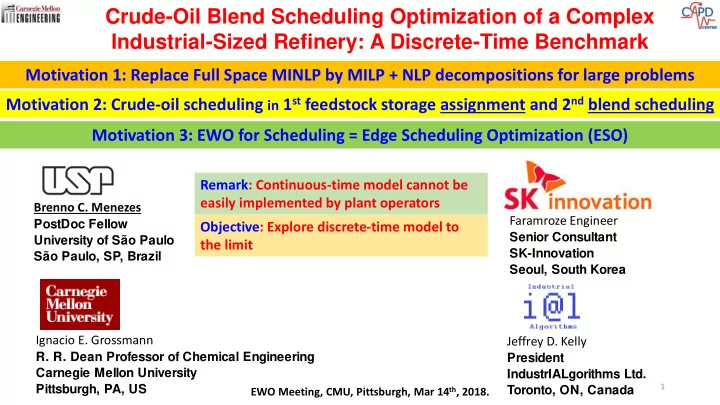
Crude-Oil Blend Scheduling Optimization of a Complex Industrial-Sized Refinery: A Discrete-Time Benchmark Motivation 1: Replace Full Space MINLP by MILP + NLP decompositions for large problems Motivation 2: Crude-oil scheduling in 1 st feedstock


slide-1
SLIDE 1

Brenno C. Menezes

PostDoc Fellow University of São Paulo São Paulo, SP, Brazil

Jeffrey D. Kelly

President IndustrIALgorithms Ltd. Toronto, ON, Canada

Crude-Oil Blend Scheduling Optimization of a Complex Industrial-Sized Refinery: A Discrete-Time Benchmark

EWO Meeting, CMU, Pittsburgh, Mar 14th, 2018.

Ignacio E. Grossmann

  • R. R. Dean Professor of Chemical Engineering

Carnegie Mellon University Pittsburgh, PA, US

Faramroze Engineer

Senior Consultant SK-Innovation Seoul, South Korea

1

Remark: Continuous-time model cannot be easily implemented by plant operators Objective: Explore discrete-time model to the limit

Motivation 1: Replace Full Space MINLP by MILP + NLP decompositions for large problems Motivation 2: Crude-oil scheduling in 1st feedstock storage assignment and 2nd blend scheduling Motivation 3: EWO for Scheduling = Edge Scheduling Optimization (ESO)

slide-2
SLIDE 2

Crude Transferring Refinery Units Fuel Deliveries Fuel Blending Crude Dieting Crude Receiving

Hydrocarbon Flow FCC DHT NHT KHT REF DC B L E N S RFCC

Fuel gas LPG Naphtha Gasoline Kerosene Diesel Diluent Fuel oil Asphalt

Crude-Oil Management Crude-to-Fuel Transformation Blend-Shop

Charging or Feed Tanks

Whole Scheduling: from Crude-Oils to Fuels

Crude-Oil Scheduling Problem

Receiving or Storage Tanks Transferring or Feedstock Tanks

VDU

1996: Lee, Pinto, Grossmann and Park (MILP), discrete-time 2004: Randy, Karimi and Srinivasan (MILP), continuous-time 2009: Mouret, Grossmann and Pestiaux: MILP+NLP continuous-time 2014: Castro and Grossmann: MINLP ; MILP+NLP, continuous-time 2015: Cerda, Pautasso and Cafaro: MILP+NLP, continuous-time

(336h: 14 days; binary ≈ 4,000; continuous ≈ 6,000; constraints ≈ 100K; CPU(s) ≈ 500)

2

Goal: solve a 1 week refinery scheduling for the 3rd biggest refinery among 635 in operatiojn

EWO Meeting, Sep 20th, 2017.

MINLP -> MILP + NLP MINLP

Relax y [0,1] as (0,1) in NLP

Current Benchmark

DICOPT (5,000 binary variables)

slide-3
SLIDE 3

Crude Transferring Refinery Units Fuel Deliveries Fuel Blending Crude Dieting Crude Receiving

Hydrocarbon Flow FCC DHT NHT KHT REF DC B L E N S RFCC

Fuel gas LPG Naphtha Gasoline Kerosene Diesel Diluent Fuel oil Asphalt

Crude-Oil Management Crude-to-Fuel Transformation Blend-Shop

Charging or Feed Tanks

Whole Scheduling: from Crude-Oils to Fuels

Crude-Oil Blend Scheduling Problem

Receiving or Storage Tanks Transferring or Feedstock Tanks

FSA

VDU

(MILP+NLP)

PDH Decomposition (logistics + quality problems) Includes logistics details

1996: Lee, Pinto, Grossmann and Park (MILP), discrete-time 2004: Randy, Karimi and Srinivasan (MILP), continuous-time 2009: Mouret, Grossmann and Pestiaux: MILP+NLP continuous-time 2014: Castro and Grossmann: MINLP ; MILP+NLP, continuous-time 2015: Cerda, Pautasso and Cafaro: MILP+NLP, continuous-time

(336h: 14 days; binary ≈ 4,000; continuous ≈ 6,000; constraints ≈ 100K; CPU(s) ≈ 500)

3

(MILP)

Goal: solve the refinery scheduling for a week (38 crude, 2 pipelines, 23 storage tanks, 11 feed tanks, 5 CDUs)

Minimize the Quality Variation Feedstocks -> Storage Tanks Reduces optimization search space for further scheduling

2nd Crude Blend Scheduling Optimization (CSBO)

Yields Rates (crude diet, fuel recipes, conversion)

(Menezes, Kelly & Grossmann, 2015)

  • 1. JD Kelly, BC Menezes, IE Grossmann, F Engineer, 2017, FOCAPO.
  • 2. JD Kelly, BC Menezes, F Engineer, IE Grossmann, 2017, FOCAPO.

MINLP -> MILP + NLP

1st Feedstock Storage Assignment (FSA) FSA CBSO

EWO Meeting, Sep 20th, 2017.

slide-4
SLIDE 4

Automated in Python/IMPL: FSA + Root + CBSO with Factors

4

Logistics (MILP) Quality Yields (for CDU) Setups Quality Yields Logistics Quality Setups Qualogistics Quality Sub-Solver (NLP) Logistics Sub-Solver (MILP) “Score”

yjit: Current assignments

1st: Feed tanks to CDU; 2nd: Storage to Feed tanks; 3rd: Feedstock Storage Assignment

xm: CDU Throughputs

(varying for the remaining amount in the feed tanks and with performance term to smooth throughput)

Multi-period NLP for near past, current and near future assignments Factors Factors (for Storage to Feed tanks) FSA root CBSO

EWO Meeting, Sep 20th, 2017.

slide-5
SLIDE 5

2016 (real crude-oil topology + simplified towers)

STEPS

2017 (simple crude-oil topology + towers in cascade) 2018 (Full crude-oil topology and Full Refinery)

EWO Meeting, Sep 20th, 2017.

slide-6
SLIDE 6

6

2017 (simple crude-oil topology + towers in cascade) Blender updated as [0,1] from the NLP

PDH converges to 3% after 4 iterations

slide-7
SLIDE 7

7

Blender recipes updated from the NLP 2017 (simple crude-oil topology + towers in cascade)

PDH converges to 3% after 3 iterations

slide-8
SLIDE 8

Reproduce an Industrial-Sized Problem using Factors

8

The logistics problem (MILP):

45,753 continuous + 28,543 binary variables 8,612 equality and 72,368 inequality constraints Non-Zeros: 628,795; Degrees-of-freedom: 63,427 CPU(s): 170 seconds (2.83 min) in 8 threads CPLEX 12.6.

The quality problem (NLP):

121,394 continuous variables 99,099 equality and 516 inequality constraint Non-Zeros: 125,462; Degrees-of-freedom: 22,295 CPU(s): 933 seconds (15.55 min) in the IMPL’ SLP engine linked to CPLEX 12.6. MILP-NLP gap: 3% after 5 PDH iterations.

Units: 5 CDUs without modes + 4 Blenders + VDU + 2 RHDS + 2 RFCC Tanks: 20 storage and 10 feed; 2 intermediate for each unit

5 days: 120-hours discretized into 1-hour time-period duration

IMPL (Industrial Modeling and Programming Language) using Intel Core i7 machine at 2.7 Hz with 16GB of RAM

EWO Meeting, Sep 20th, 2017.

slide-9
SLIDE 9

2018 (Full crude-oil topology and Full Refinery)

EWO Meeting, Sep 20th, 2017.

EWO for Scheduling as Edge Scheduling Optimization

Franzoi R.E.; Menezes B.C.; Kelly J.D.; Gut J.W., Effective Scheduling of Complex Process-shops using Online Parameter Feedback in Crude-oil Refineries, 1-5 July, PSE 2018, San Diego, 2018. (In Press) Menezes, B.C.; Kelly, J.D.; Grossmann, I.E., Logistics Optimization for Dispositions and Depooling of Oil-refinery Distillates: closing the production scheduling and distribution gap, 10-13 June, ESCAPE 2018, Graz, 2018. (In Press)

slide-10
SLIDE 10

Conclusion

10

Novelty:

  • Segregates crude management in storage assignment1 and crude blend

scheduling.2

  • Phenomenological decomposition in logistics (MILP) and quality (NLP)

problems applied in a scheduling problem updating crude-oil recipes and distillate yields. Impact for industrial applications:

  • UOPSS

modeling, pre-solving, and parallel processing, reverse polish notation, complex number for derivatives, among others, solved for the 1st time a highly complex refinery scheduling. (MILP 50K binary variables and NLP 120K continuous with 60% NLP)

  • 1. JD Kelly, BC Menezes, IE Grossmann, F Engineer, 2017, FOCAPO.
  • 2. JD Kelly, BC Menezes, F Engineer, IE Grossmann, 2017, FOCAPO.

EWO Meeting, Sep 20th, 2017.

slide-11
SLIDE 11

Thank You

11

Q?&A!

www.openIMPL.com